



publication archive: marketing
May 22, 2013
Rapid Corn Planting Progress, But Well Below the Record Pace
The USDA's weekly Crop Progress report indicated that 43 percent of the U.S. corn acreage was planted during the week ended May 19, 2013. In terms of percentage of acreage planted, that equaled the record progress for the week ended May 10, 1992. In 1992, 79.3 million acres of corn in the U.S. were planted, implying that 34.1 million acres were planted during the peak week that year. U.S. corn planting intentions for 2013 were reported at 97.3 million acres, implying that 41.8 million acres were planted last week. Conventional wisdom explains the rapid rate of planting progress this year as a function of larger and more technologically sophisticated planters.Posted by Scott Irwin and Darrel Good Permalink Tweet
May 20, 2013
Corn and Soybean Prices Continue to Retrace 2012 Drought Rally
Listen to MP3 podcastCorn and soybean prices rallied sharply beginning in July 2012 as U.S. drought conditions unfolded. It was generally expected that prices would follow the pattern experienced in other "short crop" years, with prices peaking near harvest and then returning to pre-drought levels later in the marketing year. That pattern has generally unfolded, with some differences between corn and soybeans and between old crop and new crop prices.
Posted by Darrel Good Permalink Tweet
May 13, 2013
Market Size for US Corn and Soybeans
Listen to MP3 podcastThe USDA's May 10 WASDE report contained supply and consumption projections for the 2013-14 marketing year for U.S. corn and soybeans. For the most part, the market focused on the projections of crop size, but the most important information is in the projections of marketing year consumption.
Posted by Darrel Good Permalink Tweet
May 6, 2013
A Mixed Rate of Corn Consumption, But Does It Matter?
Most of the discussion in the corn market has centered on U.S. planting progress, the likely magnitude of planted acreage, and the U.S. average yield potential. The pace of planting as revealed by the USDA's weekly Crop Progress report will continue to be monitored closely for clues about production potential.Posted by Darrel Good Permalink Tweet
May 2, 2013
Brazilian Ethanol Imports - Implications for U.S. Ethanol and Corn Demand
The current domestic ethanol market is dominated by the ongoing collision between the RFS for renewable biofuels and the E10 blend wall. Given the slow pace of market penetration of E15 and E85, the RFS likely exceeds the blend wall for ethanol in all blends in 2013. The difference between the magnitude of the RFS for renewable biofuels in 2013 (13.8 billion gallons) and the effective blend wall (estimated at 12.9 billion gallons) will be addressed with the use of blending credits accumulated from previous discretionary ethanol blending, some increase in higher blends, or possibly by discretionary blending of biomass-based biodiesel if those blending margins become positive.Posted by Scott Irwin and Darrel Good Permalink Tweet
April 29, 2013
How Large Does the Corn Crop Need to Be?
Listen to MP3 podcastBased on corn planting intentions of nearly 97.3 million acres (implied harvested acres for grain near 90.2 million) and a trend yield of 161.5 bushels, the 2013 season started with expectations of a record U.S. crop near 14.6 billion bushels. A crop of that size would be 1.5 billion bushels larger than the previous record crop of 2009 and the record large consumption during the 2009-10 and 2010-11 marketing years.
Posted by Darrel Good Permalink Tweet
April 25, 2013
How Much of the 2013 Corn Crop Will Be Planted Late?
The spring rains that have improved soil moisture conditions in many areas have been welcomed as favoring a return to more normal corn yields in 2013 following the drought of a year ago. At the same time, persistent and heavy precipitation (including snow in northern areas) that has delayed the start to corn planting raise concerns that late planting will have a negative impact on yield potential. Planting date, of course, is not the only factor and probably not the most important factor impacting corn yields. There are ample historical examples of late planted crops that yielded near or above trend value, early planted crops that yielded below trend value, and timely planted crops that yielded both above and below trend value. Still, timeliness of planting is an important consideration for yield potential at this stage of the season. Here, we address the likelihood that a larger than average percentage of the corn crop will be planted late this year.Posted by Darrel Good and Scott Irwin Permalink Tweet
April 24, 2013
Is Speculation Driving Up the Price of RINs?
The dramatic run-up in ethanol (D6) RINs prices has been discussed in several of our recent posts here at farmdoc daily. It was argued that the underlying reason for the increased value of D6 RINs lies in the impending collision of the blend wall for E10 and the rising renewable (ethanol) mandate under the U.S. Renewable Fuel Standard (RFS). This situation results in the prospect for a sharp draw down in D6 RIN stocks in 2013 and 2014 as physical blending of ethanol, due to the blend wall, falls further and further behind the mandate levels. Not everyone agrees with this assessment. Most prominently, Senator Grassley from Iowa attributed the run-up to the actions of speculators. In a March 27th interview he said he had, "just one word - speculation," when reporters asked about the price run-up. He also stated, "That's quite a rise (in prices). It doesn't seem to me that's the marketplace," and suggested that U.S. Commodity Futures Trading Commission (CFTC) should investigate.Posted by Scott Irwin and Darrel Good Permalink Tweet
April 22, 2013
Will Weak Cattle Prices Continue?
Listen to MP3 podcastI thought finished cattle prices were going to have a very bullish year with prices well into the $130s by now. Live cattle futures started the year with the same enthusiasm, but have deflated since. What went wrong?
Posted by Chris Hurt Permalink Tweet
April 17, 2013
Was 2012 Really the 'Big One' for U.S. Corn Yields?
A report from the NOAA Drought Task Force last week about the origins of the 2012 Great Plains drought has generated considerable interest and discussion. The authors of this report concluded that the drought was largely unpredictable based on conditions even a few weeks ahead of the onset of the drought and that it was unlikely to be related to global warming. It also highlighted the devastating impact of the drought conditions on corn yields, an issue we discussed in farmdoc daily posts last summer and fall (here and here). The availability of final corn yields for 2012 provides an opportunity to provide further historical perspective on the full impact of the drought on corn yields.Posted by Scott Irwin Permalink Tweet
April 15, 2013
Early Season Corn Production Concerns
Listen to MP3 podcastDecember 2013 corn futures prices have demonstrated a very erratic pattern since early February, with a trading range of about $0.70. Prices have reflected both old crop and new crop fundamentals, including expectations about producer planting intentions and the likely timeliness of planting.
Posted by Darrel Good Permalink Tweet
April 12, 2013
An Update on the 2012 RIN Carryover Controversy
The Renewable Identification Number (RIN) market has been a hot topic over the past few months as prices for Renewable Ethanol (D6) RINs soared from $0.05 to over $1.00 per gallon in early March. As noted in a recent post from Scott Irwin and Darrel Good, the rapid price increase can be linked to the impending collision of the Renewable Fuel Standard (RFS) mandates and the ethanol blend wall which, without rapid expansion of the E15 or E85 markets, will likely require the use of accumulated RIN stocks for mandate compliance in 2013 and 2014.Posted by Nick Paulson Permalink Tweet
April 10, 2013
Freeze It - A Proposal for Implementing RFS2 through 2015
We propose to freeze RFS2 mandates in 2014 and 2015 at 2013 levels argue this represents a pragmatic way forward. It is realistic in that it would not force large scale adoption of E15, E85, or biodiesel. This is particularly important since it is by no means clear whether the infrastructure investments necessary for widespread E15 or E85 adoption could actually be made in this time frame. There is also uncertainty whether sufficient biodiesel production capacity would be available. However, the proposal does provides incentive for modest growth in E15 and/or E85 penetration by keeping the mandate for renewable fuels above the current E10 blend wall. Obligated parties in the motor fuel supply chain could more easily meet their blending obligations with a combination of physical blending and use of RINs stocks. Finally, implementation of the proposal would also likely reduce the price of D6 ethanol RINs and eliminate the differential impact of those high prices on obligated parties. The key for the success of the proposal is that regulators, legislators, and industry participants use the next two years to develop a mutually agreeable biofuels policy beyond 2015.Posted by Scott Irwin and Darrel Good Permalink Tweet
April 8, 2013
Hog Profits May Still Return With Lower Feed Prices
Listen to MP3 podcastAs a new college graduate, my first job was with one of the major grain companies who took many market positions. The executives had a phrase that said a lot. "It's amazing how often we are right about the market, but for entirely wrong reasons." My previous statements that hog production could get back to profitability this spring was based on an expected spring hog price rally. The prospects for that rally, however, dimmed in February and March with the reality that pork exports were headed down. Now the prospects for a return to profitability have brightened once again, but due to an entirely different reason: much lower feed prices.
Posted by Chris Hurt Permalink Tweet
April 3, 2013
Ethanol Blending Margins, RFS2 Compliance, and the Price of Gasoline
Our post on March 27 discussed the potential implications of current high prices of D6 ethanol Renewable Identification Numbers (RINs) on the cost of compliance with the 2007 Renewable Fuels Standards (RFS2) and the price of gasoline. That post focused on the complexities of the petroleum refining and blending supply chain and how RINs prices affect various participants in that supply chain. We concluded that the buying and selling of RINs within that supply chain results in something close to a zero-sum game in terms of profitability for the industry. The result is that high RINs prices at the present time likely have a minimal impact on RFS2 compliance and the cost of motor fuel at the retail level. The focus on RINs prices alone, however, diverts attention from the larger issue impacting the on-going cost of complying with RFS2 and the price of gasoline.Posted by Scott Irwin and Darrel Good Permalink Tweet
April 1, 2013
Another Surprising Corn Stocks Estimate
Listen to MP3 podcastThe USDA's quarterly estimates of U.S. corn inventories have become a source of substantial surprises for the corn market. Dating from March 2010, 11 of the past 13 quarterly stocks estimates have deviated from expectations by enough to generate large price movements. During that period, USDA stock estimates have been both much larger and much smaller than generally expected.
Posted by Darrel Good Permalink Tweet
March 27, 2013
High Gasoline and Ethanol RINs Prices: Is There a Connection?
On March 8 we wrote about the sharp increase in the price of ethanol (D6) RINs since the first of the year. There, we indicated that the E10 blend wall would require RINs credits to be used to meet part of the RFS mandate in 2013 and beyond, increasing the value of those RINs credits. As indicated in Figure 1, the price of 2013 (current year) vintage D6 RINs remains high. The price was quoted at $0.685 per gallon on March 21, 2013, after peaking at nearly $0.90 two weeks ago.Posted by Scott Irwin and Darrel Good Permalink Tweet
March 25, 2013
2013 Corn and Soybean Acreage and Yield Prospects
Corn and soybean production prospects in the U.S. in 2013 will hinge mostly on the nature of the growing season and yield prospects. The magnitude of planted acreage, however, will provide the basis for anticipating total production. Likely acreage has been the topic of discussion all winter, with projections in a fairly wide range.Posted by Darrel Good Permalink Tweet
March 21, 2013
What's Next for the Cattle Market?
Cattle feeders have witnessed record fed cattle prices over the past few years. But they also have experienced record prices for feed and feeder cattle, resulting in record feeding losses that at times exceeded $200 per head for Corn Belt cattle feeders. This has occurred despite the fact that cattle supplies have been declining for several years. The USDA cattle inventory in January reported the lowest beef cow numbers since 1962 and the smallest calf crop since 1949.Posted by Paul E. Peterson Permalink Tweet
March 18, 2013
Mid-Year Soybean Stocks
Listen to MP3 podcastThe 2012 U.S. soybean crop was 79 million bushels smaller than the 2011 crop. Because of smaller beginning stocks, the 2012-13 marketing year supply was 121 million bushels (3.6 percent smaller) than the previous year supply. Consumption of U.S. soybeans during the first quarter of the marketing year, however, was record large and the pace of consumption remained high during much of the second quarter. The rapid pace of consumption reflected continued strong export demand for soybeans and soybean products and the drought reduced South American harvest in 2012.
Posted by Darrel Good Permalink Tweet
March 11, 2013
Anticipating the USDA's March 1 Corn Stocks Estimate
Listen to MP3 podcastOn March 28, the USDA will release an estimate of U.S. corn stocks as of March 1, 2013. That estimate is based on a survey of all commercial storage facilities and a large sample of farmers. The estimate will be used to gauge the pace of domestic feed and residual use of corn during the second quarter of the 2012-13 marketing year. In addition the magnitude of stocks on March 1 will reveal the supply of corn available for consumption during the last half of the marketing year and will serve as the basis for judging the pace of consumption as it unfolds over the next several months.
Posted by Darrel Good Permalink Tweet
March 8, 2013
Exploding Ethanol RINs Prices: What's the Story?
The objective of this post is to provide a brief explanation of the underlying cause of the recent very sharp increase in the price of ethanol (D6) RIN credits and to identify the factors that might influence future price direction. As described in an earlier post by Nick Paulson, "RINs are the basis of the accounting system created by the Environmental Protection Agency (EPA) for use in enforcing the fuel mandates outlined under the RFS2."Posted by Scott Irwin and Darrel Good Permalink Tweet
March 7, 2013
Relationship between Crop Returns and Acreage Decisions
Relative corn and soybean prices over the past few crop years have encouraged expansion of corn acreage and the use of more corn intensive rotations throughout much of the Midwest. In general, and in central and northern Illinois in particular, increased corn acreage has come at the expense of fewer acres being planted to soybeans and, to a lesser extent, wheat.Posted by Nick Paulson Permalink Tweet
March 4, 2013
Spring Pork Price Recovery Threatened
Listen to MP3 podcastHog prices have dropped sharply in the past month, falling from about $67 per live hundredweight in early February to $58 recently. Futures prices have followed suit, with April lean hog futures dropping about $7.50 since the beginning of February. These declining prices raise concerns over the spring price recovery and whether that recovery will be strong enough to push hog prices up to breakeven levels as had been expected.
Posted by Chris Hurt Permalink Tweet
February 28, 2013
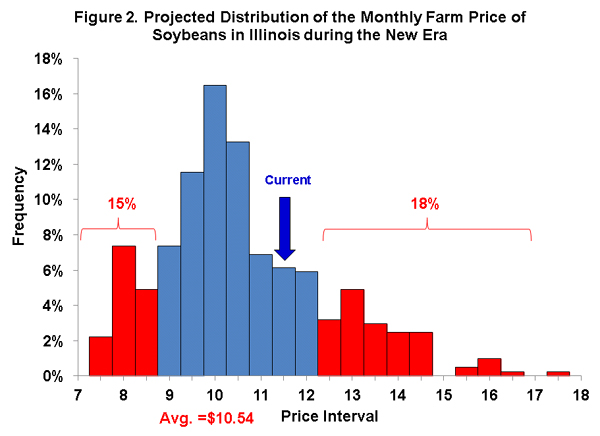
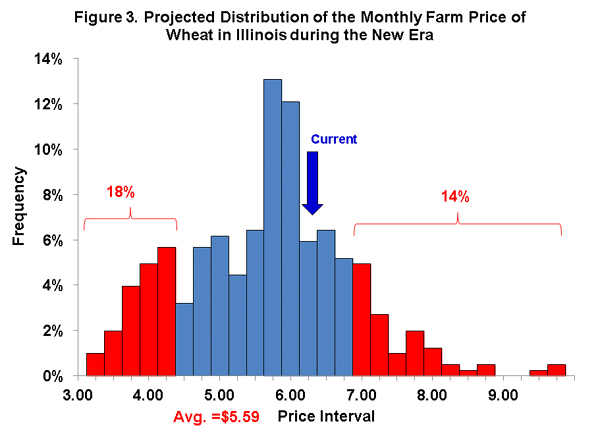
New Era Crop Price Distributions and Marketing the 2012 and 2013 Crops
In yesterday's post, we evaluated the average farm price and distribution of monthly farm prices of corn, soybeans, and wheat in Illinois since December 2006 relative to much earlier projections for the new era of prices that began in late 2006. Today we will use the actual Illinois monthly average prices of corn, soybeans, and wheat for December 2006 through December 2012 to evaluate whether the original projections of average prices and price distributions in the new era need any modifications. We will also use the new era projections to evaluate the current level of prices in these markets and draw implications for marketing 2012 and 2013 crops. But first it is useful to briefly review yesterday's post.Posted by Scott Irwin and Darrel Good Permalink Tweet
February 27, 2013
The New Era of Crop Prices --- A Five-Year Review
In a 2008 report and a 2009 article we addressed whether the trend towards higher crop prices that started in the Fall of 2006 was here to stay. Our analysis was motivated by the need of farmers, landowners, and others in the agricultural industry to have some reasonable way of assessing long-term price prospects. From a farmer's standpoint, the question basically came down to this, "What is a good price for corn, soybeans and wheat?" We argued that corn, soybean, and wheat prices moved to a new, higher nominal price level beginning in about December 2006. We suggested that the new price level would persist for an extended period of time and we projected the likely average Illinois monthly price and range in monthly prices for those commodities in the first five years of new era.Posted by Scott Irwin and Darrel Good Permalink Tweet
February 25, 2013
A Review of the USDA's 2013-14 Projections for Corn and Soybeans
Listen to MP3 podcastThe USDA's Interagency Commodity Estimates Committees prepared projections for the 2013-14 U.S. marketing year for corn and soybeans (as well as other crops) presented at the USDA's 2013 Agricultural Outlook Forum on February 22.
Posted by Darrel Good Permalink Tweet
February 18, 2013
Soybean Price Prospects - Near Term and Long Term
Listen to MP3 podcastSoybean prices reached record high levels in late August and early September 2012. Those high prices were generated by a combination of a drought-reduced harvest in South America earlier in the year, drought conditions in much of the U.S. production region, and on-going strong Chinese demand for soybeans. Prices declined by about $2.00 per bushel in September and October as the U.S. crop turned out to be larger than expected.
Posted by Darrel Good Permalink Tweet
February 13, 2013
The Ethanol Blend Wall, Biodiesel Production Capacity, and the RFS...Something Has to Give
We have had a number of posts in in the last year addressing issues associated with U.S. biofuels policy. In particular, we noted that the new era of higher crop prices that began in late 2006 could be extended well into the future as a result of the Renewable Fuels Standard (RFS) for advanced biofuels which in all likelihood could only be met with a rapid expansion in biodiesel production. That analysis is revisited here based on additional information, including the mandated RFS volumes of biofuels for 2013 recently released by the U.S. Environmental Protection Agency (EPA). Our focus is on the increasing difficulty of meeting the RFS for both renewable biofuel (domestically produced ethanol) and advanced biofuels in the next 12 to 18 months. This issue is quickly coming to the forefront as the total mandate for biofuels continues to increase sharply--from 16.55 billion gallons this year to 20.5 billion gallons in 2015. Most importantly, the mandates could exceed the capacity to produce and/or blend biofuels by a substantial amount as soon as mid-2014.Posted by Scott Irwin and Darrel Good Permalink Tweet
February 11, 2013
Evaluating Corn and Soybean Consumption Projections
Listen to MP3 podcastOn February 8, the USDA released new projections for marketing year consumption of U.S. corn and soybeans. Prices will now be at least partially influenced by how closely the rate of consumption tracks these projections.
Posted by Darrel Good Permalink Tweet
February 4, 2013
Where Have All the Beef Cows Gone?
Listen to MP3 podcastCattle numbers are down again, to their lowest level since 1952, according to USDA's recent inventory count. Beef cow numbers are at their lowest level since 1962 as the devastating impacts of the 2012 drought continues the longer-term decline. Beef cow numbers were down three percent in 2012 and 11 percent since 2007. The drivers have been high feed and forage prices, persistent drought in the Southern Plains, and of course the widespread Midwestern drought of 2012.
Posted by Chris Hurt Permalink Tweet
January 31, 2013
Expanding the Ethanol Blend Wall - a Role for E85?
We began a discussion of the potential domestic blend wall for ethanol in a post in May of last year. The issue remains important for the biofuels industry, regulators, and policy makers. Domestic ethanol consumption is almost entirely in the form of low level blends with gasoline capped at 10 percent (E10), although small amounts have been consumed in "flex fuel" vehicles as an 85 percent blend (E85) and very small quantities are being consumed as a 15 percent blend (E15). With blending dominated by E10, the blend wall is reached when the ethanol inclusion rate reaches 10 percent of domestic motor gasoline consumption. The blend wall can be problematic since the federal Renewable Fuels Standards (RFS) require increasing quantities of renewable (ethanol) biofuels consumption for the next three years. Those requirements exceed the expected E10 blend wall.Posted by Scott Irwin and Darrel Good Permalink Tweet
January 28, 2013
Update on Corn Consumption
Listen to MP3 podcastMarch 2013 corn futures are currently trading about $0.25 above the closing price on January 10 and about $0.10 below the high reached on January 16. The spot market basis also remains very strong in most markets. The USDA's Grain Stocks report released on January 11 confirmed that feed and residual use of corn from June through November 2012 had been large, implying that consumption had not been sufficiently rationed following the small crop of 2012.
Posted by Darrel Good Permalink Tweet
January 22, 2013
Early Focus on the Prospective Size of the 2013 U.S. Corn Crop
Listen to MP3 podcastThe drought reduced U.S. corn crop of 2012 suggested that corn prices might behave in a pattern generally described as "short crops have long tails." The phrase depicts the expectation of rapidly rising prices that peak near harvest time, decline in an unspecified pattern over the next several months, and return to pre-drought levels as early as the following marketing year. The decline in prices is expected as a result of a slowdown in consumption and a return to normal production.
Posted by Darrel Good Permalink Tweet
January 16, 2013
Domestic Biodiesel versus Brazilian Ethanol Revisited
In a post on January 10, 2013 we examined the relative profitability of meeting the RFS for advanced biofuels with domestically produced biodiesel and imported Brazilian ethanol. We concluded that even with the $1.00 per gallon tax credit for biodiesel, price relationships still favored Brazilian ethanol. We received a number of comments from readers in both the public and private sectors pointing out some omissions in the analysis as well as suggestions for alternative analysis. Here we incorporate those comments into an updated analysis of the relative economics of biodiesel and Brazilian ethanol based on prices as of January 10, 2013.Posted by Scott Irwin and Darrel Good Permalink Tweet
January 14, 2013
USDA Reports Provide Some Price Direction
Listen to MP3 podcastOn January 11, the USDA released a series of reports that provide important fundamental information for the crop markets. The information included the final estimate of the size of the 2012 U.S. corn and soybean crops, estimates of December 1 crop inventories, a winter wheat seedings estimate, and updated U.S. and world supply and consumption forecasts for the current marketing year.Listen
Posted by Darrel Good Permalink Tweet
January 10, 2013
Does the Biodiesel Tax Credit Change the Advanced Biofuels Landscape?
In an earlier post we highlighted the importance of the advanced biofuels Renewable Fuels Standard (RFS) for the current and future demand for biodiesel and biodiesel feed stocks. The RFS for 2013 is expected to require a minimum blending of 1.28 billion gallons of biodiesel and 2.75 billion gallons of all advanced biofuels. The difference between the minimum biodiesel requirement and the minimum total requirement is referred to as undifferentiated biofuel. That requirement can be met by Brazilian ethanol, biodiesel, or cellulosic ethanol. Since cellulosic ethanol is not available in any substantial quantities, the requirement will be met by either Brazilian ethanol or domestic biodiesel. In a separate post we illustrated that imported Brazilian ethanol was a cheaper alternative for meeting the undifferentiated advanced RFS than the domestic production of biodiesel. Those economic conditions implied that Brazilian ethanol imports would be maximized (estimated at 830 million gallons) in 2013 and would limit domestic biodiesel production to the minimum RFS requirement of 1.28 billion gallons. In addition, the impending ethanol blend wall near 13.3 billion gallons implies that Brazilian ethanol imports would limit the production of U.S ethanol to 13.17 billion gallons (assuming exports of 700 million gallons) in 2013.Posted by Scott Irwin and Darrel Good Permalink Tweet
January 7, 2013
Pork Profits on the Horizon
Listen to MP3 podcastPork producers have begun the chant "four more months" as they can now see the light of profits as they are set to emerge from a tunnel of losses. That tunnel of darkness stretched from the spring of 2012 through the winter of 2013, with average estimated losses of $18 per head, primarily due to high feed prices.
Posted by Chris Hurt Permalink Tweet
December 28, 2012
IFES 2012: The Impact of Biofuels Mandates on Grain and Oilseed
Listen to MP3 podcastMinimum volumes of biofuel usage were first mandated for the U.S. in the 2005 Energy Policy Act and then revised in the Energy Independence and Security Act of 2007. The current legislation sets annual minimum volumes through 2022 in four categories of biofuels: cellulosic, biomass-based diesel, undifferentiated advanced, and renewable. There is a hierarchy among these different categories based on their life-cycle contribution to reducing "green house" gas (GHG) emissions. Most people are surprised to learn that there is not an explicit mandate for corn-based ethanol. Instead, corn-based ethanol has been the cheapest alternative to date for fulfilling the renewable component of the mandates.
Posted by Scott Irwin Permalink Tweet
December 27, 2012
IFES 2012: Crop and Livestock Price Prospects for 2013
Listen to MP3 podcastThe crop price environment will likely remain very volatile in 2013, reflecting production uncertainty and unsettled economic issues. However, a transition to lower prices is anticipated as production rebounds. The extent of the price decline will depend heavily on the outcome of the 2013 crops.
Posted by Darrel Good Permalink Tweet
December 19, 2012
Do Recent Precipitation Deficits Tell Us Anything about Next Summer's Precipitation?
Drought conditions that impacted corn and soybean production in many areas of the U.S. in 2012 generally began in June. By the end of the growing season, large precipitation deficits developed in some areas. Some of those areas remain very dry, while more normal levels of precipitation have been received in other areas since August. That diverse pattern is illustrated below, which shows cumulative precipitation deficits for four major corn producing states for the period June through November 2012. Average statewide precipitation for this six-month period in Illinois, Indiana, Iowa, and Nebraska is compared to the average precipitation for the same six-month period since 1895. All four states received less than the average amount of precipitation since June, but the deficits are smaller in Illinois and Indiana, larger in Iowa, and much larger in Nebraska.Posted by Scott Irwin and Darrel Good Permalink Tweet
December 17, 2012
Difficult to Anticipate December 1 Corn Stocks Estimate
Listen to MP3 podcastThe USDA's estimate of December 1, 2012 inventories of corn, to be released on January 11, 2013, will be one of the more important factors influencing the price of old crop corn in the first quarter of the new year. The estimate of soybean stocks may be somewhat less important because more is known about the level of consumption during the first quarter of the 2012-13 marketing year.
Posted by Darrel Good Permalink Tweet
December 10, 2012
Will Corn and Soybean Prices Return to Pre-Drought Levels?
Listen to MP3 podcastMarch 2013 corn futures dropped below $5.50 in early May 2012 and were drifting lower when U.S. drought conditions turned prices higher starting in mid-June. The price of that contract peaked in early August, just short of the $8.50 mark. March 2013 soybean futures dropped below $11.50 in December 2011before South American drought conditions and then U.S. drought conditions sent that contract above $17.25 by mid-September 2012. conditions sent that contract above $17.25 by mid-September 2012.
Posted by Darrel Good Permalink Tweet
December 7, 2012
What's Driving the Surge in Ethanol Imports?
With ethanol production margins under pressure in recent months there has been an understandable search for explanations. One widely-discussed factor is the recent surge in "cheap" imports of ethanol to the U.S. from Brazil. As Figure 1 documents, the volume of ethanol imports to the U.S. definitely has risen notably in the in the last few months. Total imports during January-May 2012 totaled only 43 million gallons, but increased over five-fold to 235 million gallons over June-September. It is important to keep in mind that ethanol imports have actually been much larger in the past. The U.S. imported a total of 1.7 billion gallons of ethanol in 2006-2008, mainly due to an immediate need to replace MTBE as an oxygenate in our motor fuel gasoline supply.Posted by Scott Irwin and Darrel Good Permalink Tweet
December 3, 2012
Continued Support for Corn Prices
Listen to MP3 podcastCorn prices peaked in August, moved sharply lower in September, and have been in a sideways pattern over the past two months. Within that sideways pattern, prices have moved higher over the past two weeks, with March 2013 futures trading within $0.10 of the post-September high. The recent rally has been fueled by some supply concerns and more optimism about near-term demand.
Posted by Darrel Good Permalink Tweet
November 26, 2012
Focus on Soybean Oil
Listen to MP3 podcastThe sharp increase in soybean prices that began in June 2012 and peaked in early September 2012 was carried more by soybean meal prices than by soybean oil prices. From the June low to the September peak, January 2013 soybean futures increased by 43 percent, January soybean meal futures increased by 51 percent, and January soybean oil futures gained 20 percent. Soybean oil futures are now back to the level of early June, while soybean futures are 13 percent above the early June level and soybean meal futures are 21 percent higher.
Posted by Darrel Good Permalink Tweet
November 21, 2012
How Many Acres of Corn are Needed in 2013?
The corn market will continue to be influenced by an array of factors over the next several months. One of the important price factors in the new year will be the prospective size of the 2013 U.S. crop. Prospective crop size begins with the magnitude of planted acres. Rather than forecast the likely magnitude of those plantings, we pose the question of how many acres are needed?Posted by Darrel Good and Scott Irwin Permalink Tweet
November 19, 2012
Pork Producers Did Not Panic
Listen to MP3 podcastHere is some good advice: If you are in a crisis, DO NOT PANIC! Pork producers were facing a drought driven crisis late last summer. December corn futures had risen as high as $8.49 per bushel, December soybean meal futures had reached $540 per ton. Markets anticipated a fairly rapid period of sow liquidation which depressed the December lean hog futures price to $70 per hundredweight. The bleak outlook called for losses of as much as $50 to $60 per head in the final quarter of this year. A panic response might have been to cover substantial amounts of feed needs at record high prices, to forward price lean hog futures before the outlook worsened, or just sell out altogether.
Posted by Chris Hurt Permalink Tweet
November 12, 2012
Corn and Soybean Prices Following Short-Crop Pattern
Listen to MP3 podcastThe USDA's November forecasts of the size of the 2012 U.S. corn and soybean crops were larger than expected, particularly for soybeans. As a result, the general downtrend in soybean prices since mid-September has accelerated, with January futures now at the lowest level since June 29. Corn prices have moved into the lower half of the trading range that has been in place since mid-September and December futures are at the lowest level since September 28. So far, prices seem to be following the classic pattern associated with small crops -peaking early in the marketing year and then declining as the year progresses.
Posted by Darrel Good Permalink Tweet
November 9, 2012
U.S Corn and Soybean Production Forecasts Are Larger Than Expected
Today, the USDA released new forecasts of U.S. and world crop production as well as updated forecasts of 2012-13 marketing year consumption. Following is a brief summary of the new forecasts and implications for corn, soybean, and wheat prices.Posted by Darrel Good Permalink Tweet
November 5, 2012
Which Way for Soybean Prices?
Listen to MP3 podcastSoybean prices reached a peak on September 4, with November 2012 futures trading to $17.89 per bushel. The price of that contract declined to about $15.50 by the end of September and has been in a range of $14.86 to $15.74 since then. The price is currently in the lower half of that range.
Posted by Darrel Good Permalink Tweet
November 2, 2012
The Biofuels Era - A Changing of the Guard?
The increase in corn used for ethanol has been a major driver of crop prices in the New Era that began in the Fall of 2006. In the face of one of the worst droughts of the last century this summer, there have been numerous calls to limit the policy incentives to use corn for ethanol production in the upcoming year. The U.S. Environmental Protection Agency (EPA) is currently considering formal requests for this potential relief. While ethanol has garnered nearly all of the headlines in recent years, its role as the leading driver of crop prices may be nearing an end.Posted by Darrel Good and Scott Irwin Permalink Tweet
October 29, 2012
Monitoring Corn Consumption
The price of corn, like the price of other commodities, is influenced by a wide array of factors that reflect a combination of current and expected supply and consumption. The market continually judges whether the price of corn is adequate to ration the available supply. While expectations about demand over the course of the marketing year influence that judgment, the on-going pace of consumption reveals the adjustments that are being made to accommodate the available supply. A pace of consumption that cannot be supported implies the need for higher prices, while a slower pace than required implies the need for lower prices.Posted by Darrel Good Permalink Tweet
October 22, 2012
Cattle Prices Will Continue to Rise
The impacts of the 2012 drought continue to play out in a beef industry discouraged by high feed prices and large cattle feeding losses. In the latest Cattle On Feed report, the USDA confirmed that placements into feed lots dropped sharply in September following substantial declines in July and August. As a result, on-feed numbers are now down nearly three percent as the beef industry is doing its part to reduce corn and other feed usage.Posted by Chris Hurt Permalink Tweet
October 15, 2012
Beyond the October Production Forecasts for Corn and Soybeans
Listen to MP3 podcastAt 10.706 billion bushels, the USDA's October forecast of the U.S. corn crop was about 100 million bushels larger than the average trade guess and about equal to the September forecast. The October soybean forecast, at 2.86 billion bushels was about 90 million bushels larger than the average trade guess and 126 million larger than the September forecast. Prices of both commodities increased immediately after the forecasts were released.
Posted by Darrel Good Permalink Tweet
October 11, 2012
Kazakhstan, Russia, Ukraine (KRU) and World Grain Markets
A major change in world grain markets over the last quarter century is the increasing role of Kazakhstan, the Russian Federation, and Ukraine (KRU). This change is examined in this article.Posted by Carl Zulauf Permalink Tweet
October 8, 2012
Corn and Soybean Prices Searching for Support
Listen to MP3 podcastDecember 2012 corn futures declined by $1.44 (17 percent) from the high on August 10 to the recent low on September 28. That contract has managed a recovery of about $0.40 so far this month. November 2012 soybean futures declined by $2.85 (16 percent) from the high on September 4 to the low on October 3 and have rebounded about $0.45 since then.
Posted by Darrel Good Permalink Tweet
October 3, 2012
How Bad Was the 2012 Corn and Soybean Growing Season?
Prior to 2012, the most adverse growing season weather conditions for U.S. corn and soybeans in recent history occurred in 1988. Now that the 2012 season is over, it is instructive to compare the two growing seasons and the impact on the U.S. average yields of the two crops.Posted by Scott Irwin and Darrel Good Permalink Tweet
October 1, 2012
Large Losses Still Loom for Pork Industry
Pork producers are expected to continue to suffer very large losses in the next six months after already operating in the red for the last six months. These large losses have been brought on by the extreme feed prices due to the drought. There is little producers can do to change the overall situation for the industry since the pigs that will represent these large losses are already on-feed. The pigs that are here today represent producers' plans earlier this year when they were hopeful for $5 corn prices.Posted by Chris Hurt Permalink Tweet
September 28, 2012
Grain Stocks Estimates Provide Surprises, but Less Information than Usual for Corn
Today, the USDA released the September 1 Grain Stocks and Small Grains reports. The Grain Stocks report contained estimates of the magnitude of old crop corn and soybean inventories at the end of the 2011-12 marketing year and the inventory of wheat at the end of the first quarter of the 2102-13 marketing year. The Small Grains report contained the final estimate of the size of the 2012 U.S. wheat crop. Following is a brief summary of the information contained in the reports.Posted by Darrel Good Permalink Tweet
September 26, 2012
The Impending Collision of Biofuels Mandates with Market Reality
In the face of a small corn crop and high prices, there has been a great deal of debate about a partial temporary waiver of the Renewable Fuels Standards (RFS) mandate for ethanol in 2013. While the headlines have focused on the short-term implications of waiving the ethanol mandate in 2013, a potentially much larger issue looms on the horizon. Beyond 2013, there are real questions about the feasibility of meeting the ever-increasing requirements of the RFS, and this concern goes beyond the well-known difficulties with meeting the mandate for cellulosic biofuels. The purpose of this post is to show why the RFS is likely to collide with market realities in the near future.Posted by Darrel Good and Scott Irwin Permalink Tweet
September 24, 2012
Soybean Prices Tumble, but There are Some Positive Developments
Listen to MP3 podcastNovember 2012 soybean futures reached a high of $17.89 on September 4, but have declined sharply since then. The USDA's September 12 Crop Production report containing a smaller yield and production forecast provided some brief support, but that contract has traded under $16 and is currently about $1.90 below the high. Basis levels have also weakened over the past three weeks. The average cash bid in central Illinois, for example, was $0.03 over November futures on September 4 and $0.13 under on September 21.
Posted by Darrel Good Permalink Tweet
September 17, 2012
Early Corn Harvest and September 1 Stocks
Listen to MP3 podcastA larger percentage of the U.S. corn grain acreage was harvested in August this year than is typically the case. The availability of large new crop corn supplies during the last month of the previous marketing year makes it more difficult to anticipate the magnitude of old crop stocks on September 1.
Posted by Darrel Good Permalink Tweet
September 14, 2012
What Price of Crude Oil Makes Ethanol Production Profitable?
There has been a great deal of interest this summer in the ethanol market, RFS mandates, and corn use for ethanol production. This reflects the impact of the historic drought of 2012 in the Midwest and concerns about how reduced corn supplies will be allocated across consumption categories. The focus of this post moves from the short-term to the long-term. In particular, we are interested in analyzing the basic economic question of how high do crude oil prices have to be in order for ethanol production in the U.S. to be profitable. Sometimes this simple but important issue is lost in the blizzard of daily market data and analysis. The answer also helps provide a frame of reference for thinking about the longer-term outlook for the market demand for ethanol.Posted by Scott Irwin Permalink Tweet
September 12, 2012
USDA September Crop Production and WASDE Reports
Today, the USDA's National Agricultural Statistics Service released the September Crop Production Report that contained new survey-based forecasts of the size of the U.S. corn and soybean crops. The World Agricultural Outlook Board released the monthly WASDE report that contains new estimates and forecasts of U.S. and world supply and consumption of corn, soybeans, and wheat. Following is a brief summary and analysis of the reports.Posted by Darrel Good Permalink Tweet
September 10, 2012
Renewed Focus on U.S. Crop Exports
Listen to MP3 podcastCrop markets continue to be heavily influenced by the prospective size of the U.S. corn and soybean crops, with the USDA's September 12 Crop Production report to provide an important update on prospective crop sizes. With prospects for very small crops, the potential strength of export demand for wheat, corn, and soybeans is of increasing importance as crop problems have also been experienced in other parts of the world.
Posted by Darrel Good Permalink Tweet
September 4, 2012
Questions About Corn Acreage
Listen to MP3 podcastThe pace of consumption of U.S. corn has been slowing, as evidenced by small weekly exports and export sales, smaller weekly estimates of ethanol production, declining cattle feedlot placements, and increased slaughter of dairy cows and the hog breeding herd. The extent of rationing required in the current marketing year that has just begun, however, is still not clear since the size of the 2012 crop is not yet known.
Posted by Darrel Good Permalink Tweet
August 29, 2012
Consumer Spending and Beef Demand
Demand can be measured by the quantities that consumers are willing to buy over a range of different prices. This list of quantities and corresponding prices can be plotted to map out the familiar downward-sloping demand curve, with smaller quantities demanded at higher prices and larger quantities demanded at lower prices. Although "demand" is often used interchangeably - and incorrectly - with the quantity sold, an accurate picture of demand also requires some measure of the prices paid for each of the quantities sold.Posted by Paul E. Peterson Permalink Tweet
August 27, 2012
Pork Industry Faces Record Losses
Listen to MP3 podcastA tsunami of red ink is about to wash across the pork industry which is facing losses unseen even in the fall of 1998 when hog prices at times approached zero value. The stressors include: more hogs than expected, rapid sow liquidation now underway, and record feed prices. Losses in the final quarter of this year could be $60 per head, exceeding the previous record quarterly losses of $45 per head in the fall of 1998.
Posted by Chris Hurt Permalink Tweet
August 15, 2012
Rationing the 2012 Corn Crop Revisited
A month ago, we presented alternative supply, consumption, and price projections for the 2012-13 marketing year in the context of addressing the question of whether or not prices were high enough to ration a much smaller crop. We concluded at that time that prices were likely still not high enough if the national average yield was below 135 bushels. Now that corn prices have moved higher and the USDA has released the first survey-based forecast of 2012 corn yield and production, we revisit the question of rationing.Posted by Darrel Good and Scott Irwin Permalink Tweet
August 13, 2012
Corn and Soybean Forecasts, What's Next?
Listen to MP3 podcastThe USDA's August Crop Production report confirmed prospects for small U.S. corn and soybean crops and the need for consumption of both crops to decline sharply in the year ahead. Prices will now begin to reflect expectations for any changes in the production forecasts and confirmation that the necessary rationing is occurring. Indications of the pace of consumption will be provided by weekly reports of exports, ethanol production, and broiler placements and monthly reports of the domestic soybean crush, cattle feedlot inventories, and dairy cow numbers. New production forecasts will be released in September, October, and November and the final estimate will be released in January.
Posted by Darrel Good Permalink Tweet
August 10, 2012
USDA August Crop Production and WASDE Reports
Today, the USDA's National Agricultural Statistics Service released the August Crop Production Report that contained the first survey-based forecasts of the size of spring planted crops. The World Agricultural Outlook Board released the monthly WASDE report that incorporates these production forecasts into the 2012-13 marketing year supply and demand forecasts. Following is a brief summary of report high lights for corn, soybean, and wheat.Posted by Darrel Good Permalink Tweet
August 6, 2012
Drought and the Cattle Industry
Listen to MP3 podcastThe beef industry has already experienced a number of difficult years characterized by falling cow numbers and declining per capita beef supplies. There was hope in the first-half of this year that this downward production phase was coming to an end, but the drought of 2012 has erased those hopes. So, where is the cattle industry today, and what do we know about the impacts of this year's drought?
Posted by Chris Hurt Permalink Tweet
August 2, 2012
Ethanol - Does the RFS Matter?
As we noted in a post last week, drought conditions this summer have become as bad as 1988 and perhaps worse, potentially only rivaled in the last century by 1936. As corn yield expectations have declined issues related to rationing usage in 2012-13 have taken center stage. The full extent of any needed rationing will not be known for a while, but the USDA's August 10 Crop Production report will provide some guidance. Assuming that substantial rationing will be required, the issue becomes one of which consumption sector will make the majority of the adjustment. The primary consumption sectors are exports, feed, and ethanol and by-products. It is generally believed that export demand is relatively price inelastic so that high prices might result in only small declines in exports. The Renewable Fuels Standards (RFS) require minimum levels of blending of renewable biofuels so that ethanol use of corn would presumably remain large even with a small crop and high prices. The bulk of the adjustment to a smaller corn supply, then, might be left to the livestock industry as has typically been the case in previous small crop years.Posted by Scott Irwin and Darrel Good Permalink Tweet
July 30, 2012
Anticipating the Size of the 2012 Corn and Soybean Crops
Listen to MP3 podcastThe National Agricultural Statistics Service (NASS) of the USDA will release the first yield and production forecasts for the 2012 U.S. corn and soybean crops on August 10. The first forecasts of the season are always highly anticipated, but none more than this year as widespread drought conditions have resulted in a wide range of yield and production expectations.
Posted by Darrel Good Permalink Tweet
July 23, 2012
Are Soybean Prices High Enough?
Listen to MP3 podcastMuch of the recent attention in commodity markets, at least in the popular press, has focused on the U.S. corn crop and the potential impact of drought conditions on production and prices. The focus has been warranted since corn is the largest U.S. crop; corn is used in a wide variety of food, feed, and industrial products; and corn yields are most susceptible to drought conditions.
Posted by Darrel Good Permalink Tweet
July 19, 2012
Current Expectations of Future Corn Prices, and Ghosts of Prices Past
It is generally regarded that futures markets provide the best aggregated beliefs about future prices by market participants, given all currently available information; and thus that current prices are also the best estimate of future prices. Changes in futures prices thus reflect changes in information, or resolution of uncertainty prior to expiration. Even if price levels do not change, market participants generally become more certain about the production and demand as time progresses, and the uncertainty around the prices usually declines with time as well. The prices of options on futures reflect the degree of uncertainty about the futures prices and provide a means to recover additional probabilistic information about price uncertainty, or the probability of prices moving to various other levels, either higher or lower than the current futures price.Posted by Bruce Sherrick Permalink Tweet
July 16, 2012
Expected Price Pattern for Corn and Soybeans
Listen to MP3 podcastWidespread drought conditions continue to reduce the 2012 U.S. corn and soybean yield potential. Yields are now expected to be well below trend value so that this year's production will qualify as "short crops".
Posted by Darrel Good Permalink Tweet
July 13, 2012
Rationing the 2012 Corn Crop - Are We There Yet?
The 2012 corn crop will be much smaller than anticipated earlier in the year when producers planted near-record acreage in a very timely fashion. Prospects then were for an above-trend average U.S. yield and a record large crop in excess of 14.5 billion bushels. A crop of that size would have allowed for an increase in consumption and some build-up in inventories and resulted in much lower prices than experienced over the past year. In May, for example, the USDA saw prospects for U.S. corn stocks to grow from 850 million bushels at the end of the current marketing year to 1.88 billion by the end of the 2012-13 marketing year. The average farm price was expected to decline from $6.15 this year to $4.20 to $5.00 next year.Posted by Darrel Good and Scott Irwin Permalink Tweet
July 11, 2012
USDA Jolts the Markets
The USDA's World Agricultural Outlook Board (WAOB) released the monthly WASDE report this morning. Several changes were made in supply and consumption projections for corn and soybeans. By far the most important changes were the drops in yield projections. Following is a brief summary and implications of the report.Posted by Scott Irwin and Darrel Good Permalink Tweet
July 9, 2012
Pork Industry Faces Financial Disaster?
Listen to MP3 podcastDrought and the impact on feed prices may be on the verge of creating a financial disaster for the pork industry and other livestock species. The crop stress which began in Indiana and Illinois is now spreading further to the west. Most of the media attention has been focused on crop producers who face large yield losses; however the animal industries may ultimately fare even worse.
Posted by Chris Hurt Permalink Tweet
July 2, 2012
Considerable Uncertainty About Both Corn Supply and Demand
Listen to MP3 podcastJuly 2012 corn futures are currently trading about $1.00 below the peak reached in August 2011, but $1.40 above the low reached a month ago. December 2012 futures are trading $1.50 above the low of June 15, 2012 and within $0.15 of the high reached on August 31, 2011.
Posted by Darrel Good Permalink Tweet
June 29, 2012
USDA Grain Stocks and Acreage Reports - No Big Surprises
Today, the USDA released the quarterly Grain Stocks report that contains estimates of June 1 inventories of corn, soybeans, and wheat, as well as the annual Acreage report containing estimates of planted and harvested acreage of these and other crops. Following is a summary of these estimates and the general implications for near-term price prospects.Posted by Darrel Good Permalink Tweet
June 26, 2012
Where Should We Be Now With Corn Yield Expectations?
Based on an analysis of the recent trend in the U.S. average corn yield and a near record early planted crop, the USDA's May and June WASDE reports indicated prospects for a record U.S. average corn yield of 166 bushels in 2012. With much of the Corn Belt crop now entering the critical stage of the growing season, this seems to be an appropriate time to re-assess yield prospects.Posted by Scott Irwin and Darrel Good Permalink Tweet
June 25, 2012
Soybean Fundamentals Remain Strong
Listen to MP3 podcastSoybean prices began moving higher in July 2010, starting from about $9.50. July 2012 soybean futures reached a high of about $14.70 in late August 2011, declined to a low near $11.25 in mid-December 2011, and reached a high of $15.12 in early May 2012. Prices have been very choppy the past two months, but the July futures contract is now trading within about $.30 of the early May high. November 2012 futures prices have been lower than July futures, but have followed a similar pattern and are now trading at a contract high near $14.30.
Posted by Darrel Good Permalink Tweet
June 20, 2012
Thinking Out of the Box about Crop and Livestock Marketing
Crop and livestock producers have long identified price risk as one of the highest risk management priorities of the farm business. One of the major challenges of marketing is the extreme variability in prices, not only across years, but within years. A second challenge in making pricing decisions is that future prices cannot be anticipated with a high degree of accuracy. Producers have a long time period in which to price their production. Livestock futures contracts are available 18 months into the future while crop contracts are available four years into the future. The factors that determine prices cannot be accurately forecast that far into the future. Even limiting the pricing window to a few months before livestock reach market weight or a few months before crops are harvested through the storage period, price-determining factors can and often do change dramatically, making the decision about when and how much to price extremely difficult.Posted by Scott Irwin and Darrel Good Permalink Tweet
June 18, 2012
Anticipating the Estimates of June 1 Stocks of Corn and Soybeans
Listen to MP3 podcastThe USDA will release the estimates of June 1 corn and soybean inventories on June 29. The level of those stocks will reveal the rate of consumption during the third quarter of the 2011-12 marketing year and the available supply for consumption during the fourth quarter.
Posted by Darrel Good Permalink Tweet
June 12, 2012
Smaller Year-Ending Soybean Stocks Expected
The USDA's World Agricultural Outlook Board (WAOB) released the monthly WASDE report this morning. Several changes were made in supply and consumption projections for soybeans, corn, and wheat. The most significant changes were for soybeans, but none of the changes were very surprising. Following is a brief summary and implications of the report.Posted by Darrel Good Permalink Tweet
June 11, 2012
Update on Export Progress
Listen to MP3 podcastMuch of the attention in the crop markets is rightly focused on the potential size of the northern hemisphere crops. Still, the on-going pace of consumption is an important measure of demand strength and the likely level of year ending stocks. Here we focus on the U.S. export sector for wheat, corn, and soybeans.
Posted by Darrel Good Permalink Tweet
June 6, 2012
Recent Observations on the Tolerance of Corn Yield to Drought Conditions
The tolerance of U.S. corn yields to hot and dry, or drought, conditions is a topic of perennial interest. There has been a great deal of discussion in recent years whether current corn varieties have greater drought tolerance than in the past. We have discussed this issue in a previous post and publication. Here, we highlight three recent observations that provide further pieces of this puzzle.Posted by Scott Irwin and Darrel Good Permalink Tweet
June 4, 2012
Soybean Price Roller Coaster
November 2012 soybean futures reached a high of $14 in September 2011, declined to about $11.20 in December 2011, rebounded to almost $14 in early April and again in early May 2012, and traded to a low of $12.45 in the current trading session. The wide price swings reflect ever -changing supply and demand expectations.
Posted by Darrel Good Permalink Tweet
June 1, 2012
Beef Supplies and Cattle Industry Expansion Plans
With the cookout season in full swing, it's a good time to take a close look at beef supplies and cattle numbers. Steaks, roasts and other retail cuts come almost exclusively from steers and heifers. Beef from steers and heifers - often called "fed beef" - accounts for about 85% of total beef production. The remaining 15% consists of cuts from cows and bulls (used primarily in further-processed products) and calves (for veal and other specialty items).Posted by Paul E. Peterson Permalink Tweet
May 29, 2012
The Season for Determining Corn Yields is Underway
Listen to MP3 podcastThe 2012 U.S. average corn yield will be one of the dominant factors in determining the level of corn prices over the next year. Expectations about that yield have started at a pretty high level, but the critical period for yield determination is really just beginning.
Posted by Darrel Good Permalink Tweet
May 24, 2012
Is the Long Ethanol Boom Coming to a Close?
U.S. ethanol production has increased rapidly since 2006, reaching about 13.95 billion gallons in 2011. The increase was driven by a combination of high crude oil prices, federal Renewable Fuel Standards (RFS) for domestic renewable fuel consumption, a generous tax credit for ethanol blenders, and large net exports in 2010 and 2011. The expansion in domestic ethanol production has been one of the main drivers of the corn market since 2006, as corn is the primary feedstock for ethanol production in the U.S. The USDA estimates that corn processed for ethanol production totaled 5.021 billion bushels in the 2010-11 marketing year and projects use at 5 billion bushels for the current marketing year. Accounting for co-product production, net corn consumption for ethanol production in 2011-12 will be near 3.35 billion bushels, or about 26 percent of total expected consumption.Posted by Scott Irwin and Darrel Good Permalink Tweet
May 23, 2012
Rationing Old Crop Corn and Ethanol Shutdown Prices
The tightness of the old crop corn supply and demand balance is a subject of considerable debate as we head into the final quarter of the 2011/12 marketing year. The final degree of tightness will be a function of several variables, including the accuracy of previous USDA stock estimates, the availability and price of feed wheat this summer, the amount of "early" harvested corn available in August, and the consumption pace of end-users. This latter variable is mainly a function of livestock numbers both in the U.S. and overseas and ethanol production here in the U.S. Since livestock feeders have a limited capacity to adjust usage over a few months, ethanol producers would likely bear the brunt of any additional rationing if it is necessary.Posted by Scott Irwin Permalink Tweet
May 21, 2012
Pork Producers Ask, What Happened?
listen to MP3 podcastThere is an old saying that, "Life is what actually happens when you're planning on something else!" That adage is playing out for pork producers this spring. The spring hog price rally has not occurred and feed costs have now pushed to record high levels. This combination is resulting in a disappointing period of financial losses this spring and summer that was not anticipated earlier this year.
Posted by Chris Hurt Permalink Tweet
May 16, 2012
What is a Reasonable Starting Point for Estimating the U.S. Corn Yield in 2012?
The magnitude of the U.S. average corn yield in 2012 will be one of the most important factors in determining the average price during the 2012-13 marketing year due to the relatively low level of carry-out from the current marketing year. Early in the season, yield expectations generally start with an analysis of the trend in historic yields and an extension of the trend into the current year. As the planting and growing season progress, yield expectations are modified by the timeliness of planting, weather developments, and USDA crop condition ratings. The USDA provides survey based yield estimates beginning in August. See this publication for a detailed discussion of the procedures used by the USDA to produce the survey estimates.Posted by Scott Irwin and Darrel Good Permalink Tweet
May 14, 2012
Corn Market Direction Unfolding, Magnitude Still Uncertain
Listen to MP3 podcastThe USDA's projections of U.S. and world corn and feed grain supply and demand conditions presented in the May WASDE report set the benchmark by which the corn market will judge unfolding events. Those events are continually unfolding, with some of the more important ones to be revealed this summer.
Posted by Darrel Good Permalink Tweet
May 11, 2012
How Many Futures Contracts Can One Market Support?
On April 12, the InterContinental Exchange (ICE) announced that it will be offering futures and options contracts for corn, wheat, soybeans, soybean meal and soybean oil beginning Monday, May 14. All five contracts will be settled daily to the corresponding Chicago Board of Trade (CBOT) prices, and final settlement will rely on cash settlement rather than physical delivery. Trading hours will be from 8 PM Sunday to 6 PM Friday, which is substantially longer than the CBOT's current 6:00 PM to 7:15 AM and 9:30 AM to 1:15 PM trading day.Posted by Paul E. Peterson Permalink Tweet
May 10, 2012
As Usual, USDA Reports Contain Some Surprises
Today, the USDA released the May WASDE report and the May Crop Production report. The WASDE report, which included the first forecasts for the 2012-13 marketing year, contained some very bearish projections for corn, but the soybean and wheat forecasts have mixed implications. Following is a brief summary of the new forecasts.Posted by Darrel Good Permalink Tweet
May 7, 2012
Corn Prices in Three Parts
Listen to MP3 podcastCorn prices have recently moved in three distinct patterns. These include the patterns for new crop futures, old crop futures, and old crop cash prices.
Posted by Darrel Good Permalink Tweet
April 30, 2012
Is The Cattle Market Too Cautious?
Listen to MP3 podcastThe beef industry was stung by two negative events in the past two months that have left market traders uncertain about their longer term impacts. For now, market participants are taking a cautious approach until consumers more clearly define if they will reduce beef consumption.
Posted by Chris Hurt Permalink Tweet
April 25, 2012
Speculation and Gasoline Prices: Is There a Link?
The role of speculation in energy markets has flared up again. Earlier this month, Joseph P. Kennedy II, former U.S. Congressman from Massachusetts, made the following statements,But there are factors contributing to the high price of oil that we can do something about. Chief among them is the effect of "pure" speculators -- investors who buy and sell oil futures but never take physical possession of actual barrels of oil. These middlemen add little value and lots of cost as they bid up the price of oil in pursuit of financial gain. They should be banned from the world's commodity exchanges, which could drive down the price of oil by as much as 40 percent and the price of gasoline by as much as $1 a gallon.Just last week, President Obama stated,
Rising gas prices means a rough ride for a lot of families. We can't afford a situation where speculators artificially manipulate markets by buying up oil, creating the perception of a shortage and driving prices higher, only to flip the oil for a quick profit.As part of his crackdown on speculators in energy markets, the President proposed increasing penalties for market manipulation and increasing oversight of U.S. energy markets.
Posted by Scott Irwin and Dwight Sanders Permalink Tweet
April 23, 2012
Expectations for the 2012-13 Corn Marketing Year
Listen to the MP3 podcastDecember 2012 corn futures reached a high of $6.735 on August, 31, 2011, declined to a low of $5.23 on March 30, 2012, and are currently trading near $5.40. The steady decline in prices over the past few months reflects, in part, expectations for a large 2012 U.S. corn crop and some re-building of inventories during the year ahead.
Posted by Darrel Good Permalink Tweet
April 18, 2012
2012 Corn Crop To Be The Earliest Ever Planted?
Unusually warm weather in March and early April provided the opportunity to start planting the 2012 corn crop earlier than normal. While there is little doubt that some corn has been planted much earlier than usual, determining whether the crop in total is being planted at a record pace is not as straightforward as it may seem at first glance. The problems include: i) corn planting is generally spread over a relatively long time period, ii) the timing of planting differs substantially by region of the country, and iii) there are several ways to characterize how early or late the crop is planted. One consistent measure is the date at which planting in those states in the heart of the Corn Belt reaches 50 percent completed, as reported in the USDA's weekly Crop Progress report.Posted by Scott Irwin and Darrel Good Permalink Tweet
April 16, 2012
Has the 2011 Corn Crop Been Rationed?
Listen to MP3 podcastCorn prices declined substantially over the past week. May and December 2012 futures have declined by $.26 and $.22, respectively, following the release of the USDA's WASDE report on April 10.
Posted by Darrel Good Permalink Tweet
April 11, 2012
A Look at the Profitability of Ethanol Plants
The boom in ethanol production is a well-known and much-discussed phenomenon. Less understood is the profitability of all the ethanol plants built during the last decade. It is important to track the profitability of ethanol plants not only to assess investment performance in the industry but to also analyze short-term implications for the production of ethanol and use of corn as a feedstock.Posted by Scott Irwin Permalink Tweet
April 9, 2012
Pork Profit Outlook Gets Trimmed
Listen to MP3 podcastThe nation's pork producers are largely holding back on expansion even though the industry returned to profitability in the spring of 2011. However, higher feed prices in the past few months as a result of crop damage in South America has increased costs and reduced the profit outlook for 2012.
Posted by Chris Hurt Permalink Tweet
April 2, 2012
Winter Precipitation and Corn Yield
Due to the very warm temperatures in the winter of 2011-12, we recently examined the relationship between average winter temperatures and average temperatures the following summer and the relationship between average winter temperatures and corn yield. We showed that the correlation between average winter temperature and both average summer temperature and average state yield is small for Illinois and Iowa. Here we extend the analysis to the relationship between total state average precipitation during December, January, and February and the total precipitation in the following July and August. In addition, we examine the relationship between the total winter precipitation and the trend-adjusted corn yield the following year. Once again, the analysis is conducted for Illinois and Iowa (the two largest corn producing states) over the period 1960 through 2011.Posted by Scott Irwin and Darrel Good Permalink Tweet
March 30, 2012
USDA Reports a Jumble of Surprises
The much anticipated USDA Prospective Plantings and Grain Stocks reports were released this morning and contained an interesting mix of surprises. For a review of the USDA methodology for the Prospective Plantings report, see this Marketing and Outlook Brief.Posted by Scott Irwin Permalink Tweet
March 26, 2012
March USDA Reports and Beyond
Listen to MP3 podcastCorn and soybean prices continue to be influenced by a wide range of fundamental factors. Currently, those factors include prospects for the rate of economic growth and commodity demand in China, prospects for the size of the current South American crop, and prospects for the 2012 growing season in the Northern Hemisphere.
Posted by Darrel Good Permalink Tweet
March 23, 2012
How Much Impact Will Early U.S. Corn Planting Have on Potential Yield?
Conditions that have allowed early field work and some very early planting of corn in the Corn Belt have raised the issue of potential impact on the 2012 U.S. average corn yield if the crop is generally planted earlier than normal. That question is addressed here by first briefly summarizing some of the research that has been conducted on the impact of planting date on corn yields.Posted by Scott Irwin and Darrel Good Permalink Tweet
March 19, 2012
Corn Yield Prospects
Listen to MP3 podcastWith 2011-12 marketing year-ending stocks of U.S. corn expected to be near pipeline levels, the size of the 2012 crop has substantial price implications. Acreage intentions will be revealed in the USDA's March 30 Prospective Plantings report, but much of the current discussion centers on prospects for the U.S. average corn yield.
Posted by Darrel Good Permalink Tweet
March 12, 2012
Continued Focus on Corn Consumption and Stocks
Listen to MP3 podcastMay 2012 corn futures have traded in a range of about $1.00 per bushel since last fall. Since late January, the trading range has been about $.40 per bushel and the current price is near the top of that range. The narrowing of the trading range for old-crop corn prices may point to a breakout from the long standing sideways trend. The central question for the direction of old-crop prices is whether consumption has slowed enough to ensure a minimum level of year ending stocks.
Posted by Darrel Good Permalink Tweet
March 8, 2012
Do Warm Winters Tell Us Anything about Summer Temperatures and Corn Yields?
The mild temperatures experienced in the winter of 2011-12 have some wondering if there is any relationship between average winter temperatures and average temperatures the following summer. Implicit in that question is whether are not there are any implications for crop yields following a mild winter. Here we examine the relationship between state average temperature during December, January, and February and the average temperature in the following July and August. In addition, we examine the relationship between the average winter temperature and the trend-adjusted corn yield the following year. The analysis is conducted for Illinois and Iowa (the two largest corn producing states) over the period 1960 through 2011.Posted by Scott Irwin and Darrel Good Permalink Tweet
March 5, 2012
Anticipating the March 1 Corn Stocks Estimate
Listen to MP3 podcastIt is widely anticipated that the 2012-13 corn marketing year will be a transition from the current environment of tight stocks and high prices to one of a large crop, increasing stocks, and lower prices. The futures market reflects that expectation as the March 2013 futures price is currently trading $0.80 to $0.85 below the March 2012 price.
Posted by Darrel Good Permalink Tweet
February 27, 2012
Will Consumers Come Back to Pork? Yes!
Listen to MP3 podcastPer capita pork consumption in the U.S. has declined sharply in the past several years due primarily to strong pork export growth. Per capita pork consumption in the U.S. averaged 50.1 pounds in 2006 and 2007 when $2 per bushel corn was still the rule. That dropped to a low of 45.8 pounds by 2011, a nine percent decrease.
Posted by Chris Hurt Permalink Tweet
February 24, 2012
More about the Historic Pattern of U.S Winter Wheat Yields
In yesterday's post we examined the history of average U.S. winter wheat yields in search of any patterns that might be helpful in anticipating the average yield for 2012. We expand that analysis here in recognition that, unlike corn and soybeans, winter wheat consists of several classes of wheat. The USDA reports winter wheat production in four classes--hard red, soft red, hard white, and soft white. An estimate of the percentage distribution of production by class in each state and an estimate of state average yield of all classes are made, but an estimate of U.S. average yield by class is not provided. Here we select representative states to illustrate the historical yield pattern of hard red winter (HRW) and soft red winter (SRW) wheat. Kansas is selected for HRW wheat since it is the largest producer of that class of wheat and 98 percent of the production in the state is HRW. The selection of a representative state for SRW wheat is more difficult because that class of wheat is produced in relatively small quantities in a large number of states in the eastern U.S. Here we use Ohio as a representative state since that state is among the largest producers and 100 percent of the wheat there is SRW.Posted by Scott Irwin and Darrel Good Permalink Tweet
February 23, 2012
The Historic Pattern of U.S Winter Wheat Yields, Any Implications for 2012?
The U.S. average winter wheat yield was below trend value in 2011. Market sentiment favors a return to trend yield in 2012. Here we examine the pattern of yields from 1960 through 2011 to identify any patterns that might be helpful in forming expectations for 2012. See our earlier posts for similar observations for corn and soybean yields in 2012.Posted by Scott Irwin and Darrel Good Permalink Tweet
February 20, 2012
Corn and Soybean Export Progress
Listen to MP3 podcastIn December 2011, the USDA judged total corn production prospects in Argentina and Brazil at 3.54 billion bushels. That forecast was reduced by 120 million bushels in January and by an additional 160 million bushels earlier this month. All of the reduction has been for the Argentine crop. Similarly, combined soybean production in those two countries was forecast at 4.67 billion bushels in December, but was reduced by 90 million bushels in January and an additional 165 million bushels earlier this month.
Posted by Darrrel Good Permalink Tweet
February 15, 2012
The Truly Amazing Continuing Story of Natural Gas Prices
In a post last November, the dramatic decline in the price of natural gas relative to the price of crude oil was highlighted. The dramatic break in the relationship was attributed to rising production associated with a new technique known as hydraulic fracturing, or fracking for short, which is the use of liquids forced into deep rock formations to �crack open� previously unreachable deposits of natural gas.Posted by Scott Irwin Permalink Tweet
February 13, 2012
Soybean Export and Acreage Prospects Support Prices
Listen to MP3 podcastAmong the major crops, the corn market has received the lion's share of attention over the past two months. The attention has been the result of the surprising USDA December 1 stocks estimate, adverse weather conditions in South America, the demise of the ethanol blenders' tax credit, and prospects for small year-ending stocks. The soybean market, however, has become the focus of more attention in recent weeks.
Posted by Darrel Good Permalink Tweet
February 8, 2012
The Historic Pattern of U.S Soybean Yields, Any Implications for 2012?
Like the U.S. average corn yield, the U.S. average soybean yield was below trend value in 2011. Market sentiment favors a return to trend yield for soybeans in 2012. Here we examine the pattern of yields from 1960 through 2011 to identify any patterns that might be helpful in forming expectations for 2012. See our earlier post for similar observations about corn yield in 2012.Posted by Scott Irwin and Darrel Good Permalink Tweet
February 6, 2012
Corn Market Remains Unsettled
Listen to MP3 podcastThe 2011-12 corn marketing year is approaching the half-way point. At this time of year, prospects for marketing year consumption and ending stocks are often fairly clear and the market begins to focus more on new crop prospects.
Posted by Darrel Good Permalink Tweet
February 2, 2012
The Historic Pattern of U.S Corn Yields, Any Implications for 2012?
The U.S. average corn yield was below trend value in both 2010 and 2011. Market sentiment seems to be that such a pattern reduces the odds of a below-trend average yield in 2012. That sentiment raises the interesting issue of what, if anything can be learned from the historical pattern of U.S. average corn yields that would be useful in anticipating yields in any particular year? Here we examine the pattern of yields from 1960 through 2011.Posted by Scott Irwin and Darrel Good Permalink Tweet
January 30, 2012
Cattle Producers Show Surprise Interest in Expansion
Listen to MP3 podcastWhile beef supplies will be very short for several more years, the USDA's Cattle report indicated that the very early stages of beef cattle expansion has begun as beef heifer retention has increased a modest one percent. However, the big picture is that beef cow numbers dropped 3 percent last year and this will mean a smaller calf crop in 2012 that will keep cattle slaughter small for 2013 and 2014. If producers follow through with more heifer retention in 2012 and 2013, slaughter supplies will decline over the next two years and increase finished cattle prices even more.
Posted by Chris Hurt Permalink Tweet
January 27, 2012
Corn Basis Revisited
The extremely strong corn basis is currently receiving a lot of attention. We first made note of the strong basis pattern in our post on October 20, 2011. We suggested at the time that the strong cash prices relative to futures prices implied that futures prices may have been under-valued relative to demand strength. We concluded with the statement that "Historically, divergences like this one have not tended to last long. It will be interesting to see exactly how this one is resolved. Stay tuned"Posted by Darrel Good and Scott Irwin Permalink Tweet
January 23, 2012
Corn Price Swings to Continue?
Listen to MP3 podcastSince early October, corn prices have bounced in a wide trading range. March 2012 futures have traded between about $5.75 and $6.75 while December 2012 futures have been between about $5.35 and $6.20.
Posted by Darrel Good Permalink Tweet
January 17, 2012
Understanding the Surprise in the USDA Corn Stocks Estimate
Listen to MP3 podcastThe corn market was surprised by the USDA's final 2011 corn production estimate and the estimate of December 1, 2011 corn stocks. The March 2012 futures price declined by $0.52 per bushel in the two sessions following the release of the reports.
Posted by Darrel Good Permalink Tweet
January 9, 2012
Focus on South American Weather, USDA Reports
Listen to MP3 podcastCorn and soybean prices declined sharply in mid-November and remained at the lower level through mid-December. From mid-December through early January, the cash price of corn in central Illinois increased by $0.78 while the cash price of soybeans increased by $1.21 per bushel.
Posted by Darrel Good Permalink Tweet
December 20, 2011
2011 IFES: USDA - NASS Revealed: Procedures in Setting Crop, Livestock and Economic Estimates
Listen to MP3 podcastOverview
The USDA's National Agricultural Statistics Service (NASS) conducts hundreds of surveys every year and prepares reports covering virtually every aspect of U.S. agriculture. Production and supplies of food and fiber, prices paid and received by farmers, farm labor and wages, farm finances, chemical use, and changes in the demographics of U.S. producers are only a few examples of information in NASS reports.
Posted by Brad Schwab and Mark Schleusener Permalink Tweet
December 16, 2011
Seasonality and the Ethanol Blending Margin
In yesterday's post the relationship between gasoline and ethanol prices was explored. The importance of tracking the difference between gasoline and ethanol prices as an indicator of the "blending margin" between gasoline and ethanol was highlighted. A positive difference means market blending economics favor ethanol and vice versa. In recent years it has been profitable to blend ethanol in gasoline about 70% of the time (without consideration of the blenders' tax credit).Posted by Scott Irwin Permalink Tweet
December 15, 2011
Trends in Gasoline and Ethanol Prices
In recent posts, we began exploring basic pricing relationships in the energy markets. The first post examined crude oil and gasoline prices. The second post looked at the relationship between crude oil and natural gas prices. Now we push on closer to agriculture and look at the crucial relationship between gasoline and ethanol prices.Posted by Scott Irwin and Darrel Good Permalink Tweet
December 14, 2011
Biotechnology and Variation in Average U.S. Yields
In a previous article, we compared the trend in U.S. average yield per harvested acre for the 1940-1995 and 1996-2011 periods. The year 1996 was the first year that biotech varieties of crops were commercially adopted in the U.S. The analysis included 14 crops, 3 biotech crops (corn, cotton, and soybeans) and 11 crops for which adoption of biotech varieties is limited. This article specifically examines the deviation of average U.S. yield from its trend-line yield. The objective is to provide information concerning the commonly-expressed argument that biotechnology has reduced yield variability.Posted by Carl Zulauf and Evan Hertzog Permalink Tweet
December 12, 2011
Continued Weakness in Crop Prices
Listen to MP3 podcastCrop prices are heading to year-end on a weak note. Corn prices are near the level that existed in the first week of January and well below the late summer highs. Soybean prices are well below the level at the start of the year and at the lowest level since early October 2010. Prices of soft red winter wheat are at the lowest level since July 2010.
Posted by Darrel Good Permalink Tweet
December 5, 2011
Anticipating Crop Prices in 2012
Listen to MP3 podcastCrop prices during 2011 were influenced by a wide range of factors that resulted in extremely large trading ranges. The price patterns, however, were very different for corn, soybeans, and wheat. As the year ends, thoughts turn to likely price levels in 2012.
Posted by Darrel Good Permalink Tweet
November 28, 2011
Corn and Soybean Demand and Acreage Prospects for 2012
Listen to MP3 podcast Corn and soybean prices have declined sharply since the release of the USDA's November Crop Production report that contained smaller forecasts of the size of the 2011 harvest for both crops. In addition, the historically strong corn basis has begun to weaken in many markets.Posted by Darrel Good Permalink Tweet
November 21, 2011
Hogs: 2012 the Best Year in High-Priced Feed Era
Listen to MP3 podcastThe pork industry is expected to have a profitable year in 2012! In fact, the level of profitability could be the most favorable during the high priced feed era. Profits in 2012 are currently forecast to be near $17 per head, which would be the highest since 2006. That was the last year of the low feed price era when corn prices received by farmers averaged about $2.30 per bushel for the calendar year and estimated hog profits were $27 per head.
Posted by Chris Hurt Permalink Tweet
November 18, 2011
Marketing Corn, Soybeans, and Wheat in the New Era
In posts on March 29, April 5, April 12, and April 19 we examined crop and livestock price behavior in the new era that began to emerge in fall 2006. We argued that unfolding evidence suggested that corn, soybean, and wheat prices were indeed likely establishing a higher (nominal) average than previously experienced. Not surprisingly, the range of prices we forecast for this new era was also very wide. The purpose of this post is to take a more detailed look at the distribution of corn, soybean, and wheat prices we expect in this new era.Posted by Scott Irwin and Darrel Good Permalink Tweet
November 14, 2011
Corn and Soybean Prices Continue to Struggle
Corn prices have traded in a sideways pattern since mid-October, but are currently in the lower end of the recent range. Soybean prices have trended lower over the past month, with January futures now back near the early October lows.Posted by Darrel Good Permalink Tweet
November 10, 2011
Tracking Crop Exports
The USDA expects that exports of U.S. corn, soybeans, and wheat will be adversely impacted by the increased supply of these crops in the rest of the world. Corn production outside the US in the 2011-12 marketing year is projected to be 6.6 percent larger than production of a year ago. Argentina, Brazil, China, and the Ukraine are all expected to have larger crops than those of last year. Of the larger producers, only Mexico is expected to have a smaller crop. Foreign wheat production is expected to be up 6.8 percent, led by a 39 percent increase in production in the countries that make up the former Soviet Union as that area recovers from the drought of 2010. Foreign soybean production is expected to increase by 1.4 percent.Posted by Darrel good Permalink Tweet
November 9, 2011
Numerous Changes in Crop Production and Consumption Forecasts
The USDA's November Crop Production and WASDE reports released this morning contained a number of changes in production and consumption forecasts for corn, soybeans, and wheat for the current marketing year. Following is a brief summary of those changes.Posted by Darrel Good Permalink Tweet
November 7, 2011
Soybean Export Progress
Listen to MP3 podcastSince the first of October, November 2011 soybean futures have traded in a range of $1.20, with a high of $12.72. The price of that contract is currently about in the middle of the recent trading range and $2.50 below the contract high reached on August 31.
Posted by Darrel Good Permalink Tweet
November 2, 2011
Trends in Crude Oil and Natural Gas Prices
In a recent post, we began exploring basic pricing relationships in the energy markets. The first post examined crude oil and gasoline prices. In this post, we will take a look at the relationship between crude oil and natural gas prices.Posted by Scott Irwin and Darrel Good Permalink Tweet
October 31, 2011
Crop Prices Treading Water
Listen to MP3 podcastFollowing wide swings in September and early October, the prices of corn, soybeans, and wheat have traded in relatively narrow ranges in the last half of October. Narrow trading ranges reflect the lack of new information and, in some cases, conflicting demand indicators.
Posted by Darrel Good Permalink Tweet
October 24, 2011
Cattle Can Eat Corn Too
Listen to MP3 podcastCattle feeders are going to use more corn than previously expected according to USDA's latest Cattle on Feed report that showed five percent more cattle in the nation's feedlots. The real surprise was the higher number of placements in September that has resulted in over one-half million more cattle being fed than a year ago. Feed grains used by cattle in feedlots from the 2011 crop will now likely be more than five percent higher than was fed from the 2010 crop.
Posted by Chris Hurt Permalink Tweet
October 20, 2011
Corn Prices, Basis, and Spreads
December 2011 corn futures increased by $2.00 between July 1, 2011 and August 29, 2011. That contract closed at $7.70 on August 29. Basis levels also strengthened during that period. The average cash bid for harvest delivery at country elevators in south-central Illinois, for example, strengthened to $0.28 under December futures on August 29, compared to about $0.40 under earlier in the spring and summer. In addition, the spread from December 2011 to July 2012 futures narrowed from $0.32 on July 1 to about $0.18 on August 29. Much of the price increase and reduced carry in the market was fueled by prospects of very small stocks of corn at the end of the 2010-11 marketing year and deteriorating prospects for the 2011 harvest. The market was discouraging storage of the new crop and signaling corn consumers to slow the pace of consumption in a classic "short crop" price pattern. Such a pattern is typically characterized by high prices and lack of carry early in the marketing year followed by declining prices and increasing spreads as the year progresses, resulting in the saying that "short crops have long tails".Posted by Darrel Good and Scott Irwin Permalink Tweet
October 17, 2011
Corn and Soybean Consumption
Listen to MP3 podcastWith the USDA's October Crop Production report, corn and soybean supply forecasts for the 2011-12 marketing year are likely close to the final estimates. Prices will be primarily influenced by the current rate of consumption and expectations about consumption during the remainder of the marketing year. The actual rate of consumption will be revealed sporadically, and in some cases, slowly. Expectations about future consumption will likely vary widely.
Posted by Darrel Good Permalink Tweet
October 10, 2011
Revisiting Recent Corn Stocks Estimates
Listen to MP3 podcastWhile the USDA's estimate of the September 1, 2011 inventory of old crop corn is old news, there are ongoing questions surrounding the quarterly stocks estimates. For corn, quarterly stocks estimates have not been well anticipated since June 2010.
Posted by Darrel Good and Scott Irwin Permalink Tweet
October 6, 2011
Trends in Crude Oil and Gasoline Prices
Much has been written in recent years about the linkages between the agricultural and energy markets. Energy prices have always had an impact on agricultural prices indirectly through their effect on input costs. What's new is their direct impact on output prices forged via biofuel production. In particular, corn prices are now inextricably linked with crude oil and gasoline prices. With that background in mind, this is the first of a series of posts that will explore basic pricing relationships in the energy markets and between energy and agricultural markets.Posted by Scott Irwin and Darrel Good Permalink Tweet
October 3, 2011
Pork Outlook Brightens
Listen to MP3 podcastFinally, pork producers have some positive news that has increased optimism for greater profitability in the coming year. That good news came from USDA in two forms. The first was the September Hogs and Pigs report which indicated little change in the size of the breeding herd. The second was the feed price lowering impacts of higher than expected corn inventories revealed in the September Grain Stocks report. The combination of stronger hog prices and lower feed prices has put the pork outlook back into solid black for the coming year.
Posted by Chris Hurt Permalink Tweet
September 30, 2011
Corn and Wheat Stocks Exceed Expectations
The pattern of surprises in USDA quarterly Grain Stocks reports that began in June 2010 continued today. The September Grain Stocks report estimated September 1, 2011 inventories of old crop corn at 1.128 billion bushels. Stocks were 580 million bushels smaller than those of a year earlier, but 166 million larger than the reported average pre-report expectation and 208 million larger than forecast in the USDA WASDE report released earlier this month. The stocks estimate implies that feed and residual use of corn during the last quarter of the marketing year was extremely small and that feed and residual use for the year totaled only about 4.8 billion bushels, about 200 million bushels less than USDA had forecast.Posted by Darrel Good Permalink Tweet
September 29, 2011
U.S. Corn Exports--The Rest of the Story
Exports of unprocessed (whole) corn from the U.S. vary substantially from year to year, ranging from 1.588 billion bushels to 2.437 billion bushels over the past 10 years, but generally have been trending lower since 2007-08. Annual exports from all other origins are also variable, but have been increasing since 2008-09. For the 2011-12 marketing year, the USDA projects U.S. corn exports at a 9-year low of 1.65 billion bushels and exports from all other origins at a record large 2.02 billion bushels. If the forecasts are correct, this will be the first year since the early 1970s that U.S. exports were smaller than those from all other origins.Posted by Scott Irwin and Darrel Good Permalink Tweet
September 26, 2011
Soybean Production and Consumption Uncertainty
Listen to MP3 podcastSoybean prices, along with the prices of many commodities, have come under considerable pressure in the month of September. November 2011 futures reached a high of $14.65 on August 31 and traded to a low of $12.26 in the September 26 overnight session before settling at $12.50.
Posted by Darrel Good Permalink Tweet
September 19, 2011
Will the Corn Production Forecast Change?
Listen to MP3 podcastCorn prices have declined sharply so far in September. After reaching a high of $7.79 on August 29, December 2011 corn futures traded to $6.76 early in the trading session on September 19. The lower prices have occurred even as USDA lowered the 2011 production forecast by more than 400 million bushels, suggesting that consumption during the 2011-12 marketing year will be restricted and that year ending stocks will be minimal.
Posted by Darrel Good Permalink Tweet
September 12, 2011
Smaller Corn Crop Confirmed
Listen to MP3 podcastThe USDA's September 12, 2011 Crop Production report confirmed expectations of a smaller U.S. corn crop than forecast in August. The September soybean production forecast, however, is larger than the August forecast and the forecast size of the foreign wheat, coarse grain, and soybean crops also exceed the August forecasts.
Posted by Darrel Good Permalink Tweet
September 9, 2011
2011 U.S. Corn and Soybean Yield Expectations
In posts on July 19 and August 4 we reviewed the Illinois and U.S. average corn and soybean yields in previous years when July temperature was well above average in Illinois, as was the case in 2011. Those analog years included 1977, 1980, 1983, 1999, and 2002.Posted by Scott Irwin and Darrel Good Permalink Tweet
September 6, 2011
Economics of Corn and Soybean Storage
Listen to MP3 podcastWith smaller grain and oilseed supplies than those of a year ago and increased storage capacity, there should be fewer crop storage issues than in recent years. The decision by producers to store corn and soybeans, however, should be based on expected returns rather than on capacity to store.
Posted by Darrel Good Permalink Tweet
September 1, 2011
USDA Corn and Soybean Yield Forecast Errors Across Report Release Months
In an earlier post we examined the accuracy of the USDA's August forecast of the U.S. average corn and soybean yield since 1970 to determine if there had been a change in accuracy over time. Here we examine the magnitude of the yield forecasting errors for corn and soybeans over the forecast cycle from August through November. The same time period as used in the previous analysis, 1970 through 2010, is used here. The analysis of forecast errors should be helpful in evaluating forecasts in the current forecast cycle.Posted by Scott Irwin and Darrel Good Permalink Tweet
August 29, 2011
Early Price Peak for Corn and Soybeans?
Listen to MP3 podcastThe 2011-12 corn and soybean marketing years will be characterized by the need to reduce consumption of both crops. The magnitude of those needed reductions are not yet known and the prices needed to make those cuts will depend on the strength of underlying demand.
Posted by Darrel Good Permalink Tweet
August 25, 2011
Soybean Crush Up in July
In the August WASDE report, the USDA lowered the projection of the 2010-11 marketing year soybean crush by 5 million bushels, to a total of 1.645 billion bushels. That projection is 107 million bushels smaller than the crush during the previous marketing year. To reach the projected level, crush during July and August, the last 2 months of the marketing year, needed to total 251.6 million bushels, compared to 257.5 million bushels in the same two months last year.Posted by Darrel Good Permalink Tweet
August 19, 2011
Have the Accuracy of USDA's August Corn and Soybean Production Forecasts Changed?
USDA crop forecasts and estimates continue to be criticized by a wide range of users of the information. Part of the criticism appears to stem from a lack of understanding of the methodology used in producing the forecasts and estimates. In an earlier publication, we provided some detail of the USDA crop production forecasting methodology. Part of the criticism appears to stem from perceived inaccuracies in the forecasts and estimates. The large over-estimate of the 2010 U.S. average corn yield in August 2010, for example, suggested to some that the accuracy of August yield and production forecasts may have diminished over time.Posted by Scott Irwin and Darrel Good Permalink Tweet
August 15, 2011
No Room to Increase Corn Consumption
Listen to MP3 podcastThe USDA projects that 13.245 billion bushels of U.S. corn will be consumed during the marketing year that ends on August 31, 2011. That forecast is 60 million bushels below the July forecast, but is 179 million bushels above the record consumption in the previous year.
Posted by Darrel Good Permalink Tweet
August 11, 2011
USDA's August Crop Forecasts
Today the USDA released the first survey based forecast of the size of the 2011 U.S. corn and soybean crops. In addition, forecasts of consumption and ending stocks for the 2010-11 and 2011-12 marketing years for corn, soybeans, and wheat were updated. Following is a summary of those reports.Posted by Darrel Good Permalink Tweet
August 8, 2011
Corn and Soybean Production Prospects
Listen to MP3 podcastThe 2011-12 corn and soybean marketing year officially begins on September 1. As pointed out last week, the 2010-11 marketing year is ending with a slowdown in the consumption of both corn and soybeans, suggesting that year ending stocks could be larger than projected in the USDA's July WASDE report. Those stocks will not be known until September 30 and the estimates in the September Grain Stocks report often deviate from expected levels. The USDA will release updated forecasts of 2010-11 marketing year consumption and ending stocks on August 11.
Posted by Darrel Good Permalink Tweet
August 4, 2011
Hot Summer Weather and 2011 Corn and Soybean Yields
In the post on July 19 we examined trend-adjusted corn yields in Illinois in the 5 previous years since 1975 when the average July temperature and precipitation most resembled that of 2011 (average temperature above 77 degrees and below-average precipitation). The state average corn yields varied considerably in those 5 years, reflecting highly diverse weather conditions in August, but averaged well below trend. Barring extremely favorable weather conditions in August 2011, the analysis pointed to a state average corn yield in 2011 in the low- to mid-150 bushel range, 13 to 15 bushels below trend value.Posted by Scott Irwin and Darrel Good Permalink Tweet
August 1, 2011
Corn and Soybean Consumption Coming Up Short
Listen to MP3 podcastMuch of the corn and soybean market attention is appropriately focused on the prospective size of the 2011 U.S. crops and speculation about the USDA's August 11 Crop Production report. The size of these crops will obviously largely determine the magnitude of supplies available for consumption during the 2011-12 marketing year. The magnitude of old crop stocks on September 1 will also contribute to next year's supply. As the 2010-11 marketing year enters the final month, there are indications that both soybean and corn consumption will fall short of the most recent USDA projections.
Posted by Darrel Good Permalink Tweet
July 28, 2011
June Soybean Crush Smaller Than Expected
Today's Census Bureau report estimated the domestic crush of soybeans during June 2011 at 124.3 million bushels. That estimate is 4.8 million bushels less than the crush during June 2010 and 3.8 million bushels less than the crush during May 2011 (Figure 1). The crush was the smallest for the month since 2004 and was about 800,000 bushels less than expected based on the National Oilseed Processors Association estimate of crush by its members released earlier in the month. Crush during the first 10 months of the 2010-11 marketing year totaled 1.394 billion bushels, 100 million less than the crush during the same period last year. For the year, USDA projects that the crush will total 1.65 billion bushels, 101.5 million bushels less than crushed during the 2009-10 marketing year. To reach that projection, crush during the final two months of the marketing year will need to total 256 million bushels, only 1.5 million less than during the final two months last year. It now appears that the domestic crush during the current marketing year will fall short of the USDA projection.Posted by Darrel Good Permalink Tweet
July 25, 2011
Beef Shortage Means Hold On To The Cows
Listen to MP3 podcastThe quantity of beef available to consumers in the U.S. has declined a startling amount in recent years and that trend is going to continue. The declining supplies are related to continuing liquidation of the cow herd in the past few years due to high feed prices, a weak U.S. dollar that is spurring beef exports, and of course drought in the southwest and southeast. Declining supplies will support prices across the cattle complex at new record highs in 2011 and again in 2012. Unfortunately, even higher retail beef prices can be expected for consumers.
Posted by Chris Hurt Permalink Tweet
July 19, 2011
Hot July Weather and Corn Yields
The onset of high temperatures in much of the Corn Belt this week has raised the issue of the impact of high summer temperatures on corn yields. See this recent article for an overview of the effects of high temperature on corn plant physiology and yield potential.Posted by Scott Irwin and Darrel Good Permalink Tweet
July 18, 2011
How Much Risk to the Corn Crop?
Listen to MP3 podcastA number of factors combine each year to determine the U.S. average corn yield. Among those factors, temperature and precipitation during July are the most important. Crop yield models have long confirmed the large yield impact of July weather. The most favorable weather conditions in July in the heart of the corn belt consist of temperatures that are modestly below average and precipitation that is about 25 percent above average. These are the kind of conditions that were experienced in 2009 and contributed to the record high U.S. average yield that year. Historically, such conditions over large areas have been rare.
Posted by Darrel Good Permalink Tweet
July 12, 2011
USDA Report Highlights
Today, the USDA's World Agricultural Outlook Board (WAOB) released the monthly report of World Agricultural Supply and Demand Estimates (WASDE) and the National Agricultural Statistics Service (NASS) released new wheat production forecasts. The WASDE report incorporated the information in the Grain Stocks and Acreage reports released on June 30. Following are some of the highlights of today's reports.Posted by Darrel Good Permalink Tweet
July 11, 2011
Corn Market Waiting on August Production Report
Listen to MP3 podcastCorn prices have made a modest recovery following the sharp declines stemming from the USDA reports released on June 30. The recovery has reflected a combination of continued strong corn demand and a few concerns about yield potential.
Posted by Darrel Good Permalink Tweet
July 7, 2011
Some "Random" Thoughts About Corn Prices
This season has witnessed fairly high prices and volatile corn price movements, driven at different times and degrees by a late and wet planting season, slow planting progress, acreage expectation slippages and offsetting later gains, surprises in stocks reports, the recent (and upcoming) WASDE releases, and uncertainty surrounding implications of removal of the ethanol blend credit but retention of the RFS mandate -- and ever important future weather uncertainties. With the possible exception of the summer of 2008, the importance of understanding and managing future price risk likewise seems to be at an all time high, and the importance of forming accurate expectations about future random prices equally important.Posted by Bruce Sherrick Permalink Tweet
July 5, 2011
Sorting Out the June 1 Corn Stocks Estimate
Listen to MP3 podcastIt is an understatement to say that last week's USDA estimate of June 1, 2011 corn stocks was a surprise to the market. At 3.67 billion bushels, the estimate was about 370 million bushels larger than the reported average trade guess.
Posted by Darrel Good Permalink Tweet
July 1, 2011
Where Did the Corn Acres Come From?
The U.S. Department of Agriculture released its Acreage Report on June 30th and estimated planted corn acres for 2011 at 92 million acres. The 92 million acres is a 4 million acre increase - or a 4.5 percent increase - over 2010 acres of 88 million acres. A complete list of acre changes by state is shown in Table 1. In general, states in the western corn-belt have large increase in acres. Somewhat surprisingly, most states in the eastern corn-belt have not lost acres.Posted by Gary Schnitkey Permalink Tweet
June 30, 2011
USDA Reports Sink The Corn Market
A year ago, the USDA's June Grain Stocks and Acreage reports provided bullish surprises for the corn market and triggered a year long rally in prices. The same two reports released today provided a lot of bearish information. June 1 stocks of corn were estimated at 3.67 billion bushels. While that estimate is 640 million bushels smaller than stocks of a year ago, it is about 350 million bushels larger than expected. The stocks estimate implies feed and residual use of corn during the third quarter of the marketing year of about 750 million bushels, a figure that is too low to be believed. In retrospect, the estimate of March 1 stocks of corn was smaller than expected, implying a high rate of feed and residual use of corn during the second quarter of the marketing year. Still, total use from September 2010 through May 2011 appears small in relation to the number of livestock being fed. Like last year, the estimate of September 1 stocks will likely reconcile these inconsistencies.Posted by Darrel Good Permalink Tweet
June 27, 2011
Pork Outlook Looks Up as Corn Prices Go Down
Listen to MP3 podcastPork producers are maintaining the size of the breeding herd in the face of a very uncertain financial outlook. This cautious position would be expected given the wide swings in both hog and feed prices evident this spring. In addition, little change should be expected in the hog herd until the feed supply situation is better known this fall.
Posted by Chris Hurt Permalink Tweet
June 20, 2011
USDA Stocks and Acreage Reports
Listen to MP3 podcastA large number of factors have contributed to the higher prices of corn and other commodities over the past year. The beginning of the price increase can be traced to the USDA's forecast of 2010 corn planted acreage and the estimate of June 1 corn stocks released on June 30, 2010.
Posted by Darrel Good Permalink Tweet
June 14, 2011
Interpreting Recent Data on Corn Planting Progress
The USDA's weekly Crop Progress report released on June 13th indicated that corn planting progress had caught up to the normal level of 99 percent by June 12. Some caution is warranted in interpreting the planting progress numbers. First, planting progress always catches up to the average pace since planting is eventually completed. Planting progress this year caught up to the average pace very late in the season, underscoring the fact that a much larger than average percent of the crop was planted after the optimum date for maximizing yield potential. Yield potential is reduced in a non-linear fashion with lateness of planting, with yield penalties increasing for later planting dates. Figure 1 depicts that relationship for Illinois based on estimates from research here at the University of Illinois by Emerson Nafziger. Yield penalties become very large for corn planted after mid-May. The yield penalty for corn planted in early June, around 25%, is especially striking.Posted by Scott Irwin and Darrel Good Permalink Tweet
June 13, 2011
Attention Shifting from Acreage to Corn and Soybean Yields
Listen to MP3 podcastIn the monthly report of World Agricultural Supply and Demand Estimates (WASDE), the USDA's World Agricultural Outlook Board (WAOB) reduced the forecast of U.S. planted and harvested acreage of corn and rice,. Forecasts for the other major crops were not changed from the forecasts in the March Prospective Plantings report.
Posted by Darrel Good Permalink Tweet
June 9, 2011
USDA Report Highlights
Today, the USDA's World Agricultural Outlook Board (WAOB) released the monthly report of World Agricultural Supply and Demand Estimates (WASDE) and the National Agricultural Statistics Service (NASS) released new winter wheat production forecasts. Following are some of the highlights of those reports.Posted by Darrel Good Permalink Tweet
June 6, 2011
Can Corn and Soybean Crops Overcome Late Planting?
Listen to MP3 podcastFor much of the Corn Belt, optimum planting dates for both corn and soybeans are generally identified as occurring in late April or early May. Agronomic research has clearly documented the negative yield impacts of planting corn and soybeans "late". The yield response of late planting is estimated to be nonlinear. That is, yield losses generally accelerate as planting dates get later.
Posted by Darrel Good Permalink Tweet
June 1, 2011
Is Speculation Driving Commodity Prices?
The role of speculation in the ongoing boom in commodity prices is hotly debated. President Obama recently waded into the debate, stating that, "It is true that a lot of what's driving oil prices up right now is not the lack of supply. There's enough supply. There's enough oil out there for world demand... The problem is ... speculators and people make various bets, and they say, you know what, we think that maybe there's a 20 percent chance that something might happen in the Middle East that might disrupt oil supply, so we're going to bet that oil is going to go up real high. And that spikes up prices significantly."Posted by Scott Irwin and Dwight Sanders Permalink Tweet
May 31, 2011
Crop Markets Reflect Both New and Missing Information
Listen to MP3 podcastPrices of corn, soybeans, and wheat continue to move erratically, reflecting both new information and the lack of some information. The markets are supplied with a steady flow of data on consumption in some markets, particularly the export markets and the ethanol market. Less frequent information is available about consumption in other markets, particularly the domestic feed market.
Posted by Darrel Good Permalink Tweet
May 26, 2011
April Domestic Soybean Crush Smallest Since 2004
Two weeks ago, the USDA lowered the projection of 2010-11 marketing year exports of U.S. soybeans by 30 million bushels, to a total of 1.55 billion bushels. The reduction resulted in a projection of marketing year ending stocks of 170 million bushels, or 5.1 percent of projected consumption. That is a more comfortable level of stocks than the previous projection of 4.2 percent of consumption.Posted by Darrel Good Permalink Tweet
May 23, 2011
Corn Market Continues to Focus on Production Prospects
Listen to MP3 podcastTwo weeks ago, corn prices were declining rapidly and we pondered the likelihood of a recovery similar to those of September 2010, November 2010, and March 2011. The answer came quickly. By May 23, July 2011 futures traded within $.14 of the contract high and December 2011 futures traded within $.07 of the contract high on May 19.
Posted by Darrel Good Permalink Tweet
May 17, 2011
Monitoring Corn and Soybean Exports
The May 11 USDA WASDE report lowered the forecast of 2010-11 marketing year exports of U.S. corn and soybeans. Corn exports are now forecast at 1.9 billion bushels, 87 million less than exported in the previous year and 50 million less than forecast in April. Soybean exports are still expected to be record large at 1.55 billion bushels, but the forecast is 30 million bushels below the April forecast. In addition, the first forecast of 2011-12 marketing year corn exports is at a 9 year low of 1.8 billion bushels. Soybean exports are expected to remain large at 1.54 billion bushels.Posted by Darrel Good Permalink Tweet
May 16, 2011
A Rebound in World Grain Production Expected
Listen to MP3 podcastThe USDA's report of World Agricultural Supply and Demand Estimates (WASDE) released on May 11 refocused the market's attention on world crop production and the implications for re-building U.S. and world stocks. The report reflects prospects for some modest increase in world feed grain stocks and prospects for maintaining world wheat and soybean stocks. However, substantial uncertainty remains.
Posted by Darrel Good Permalink Tweet
May 10, 2011
Do High Prices Destroy Demand?
During the period of rapidly increasing commodity prices since the summer of 2010, there has been occasional reference to "demand destruction" resulting from higher prices. That terminology is misleading and conceptually incorrect. What commentators are generally referring to, of course, is that high and increasing prices would be expected to result in less consumption of the commodity than would have occurred at lower prices. That relationship, however, does not constitute demand destruction. That is, a change in consumption in reaction to a change in price does not represent a change in demand.Posted by Scott Irwin and Darrel Good Permalink Tweet
May 9, 2011
Can Corn Prices Rebound Again?
Listen to MP3 podcastThe corn market has been the "poster child" for the sharp increase in agricultural commodity prices that began last summer and extended into the spring of 2011. Higher corn prices were driven by a combination of shortfalls in crop production, including the U.S. corn crop, and strong demand.
Posted by Darrel Good Permalink Tweet
May 5, 2011
Soybean Oil Use for Biodiesel Begins to Recover
The consumption of soybean oil in domestic biodiesel (methyl esters) totaled 2.021 billion pounds during the 2008-09 marketing year (October 2008-September 2009). Consumption during the 2009-10 marketing year declined to 1.681 billion pounds. The decline reflected the failure to extend the $1.00 per gallon biodiesel blenders' tax credit for calendar year 2010. As indicated in the red columns in figure 1, consumption of soybean oil in methyl esters declined to very low levels in November and December of 2010. The Census Bureau has provided estimates of the consumption of all soybean oil in methyl esters since October 2006. Monthly consumption peaked at 376.2 million pounds in August 2007 and accounted for 20 percent of total consumption of U.S. soybean oil. Consumption in December 2010 was only 53.7 million pounds, accounting for 3.4 percent of total soybean oil consumption that month.Posted by Darrel Good Permalink Tweet
May 2, 2011
Corn and Soybean Prices Continue an Erratic Pattern
Listen to MP3 podcastAs expected, corn and soybean prices continue to move erratically in a very wide range. Just in the past week, both May 2011 corn and soybean futures had a $.56 trading range. As the markets make the transition from old crop to new crop dominance, a lot of factors are influencing price expectations.
Posted by Darrel Good Permalink Tweet
April 28, 2011
Slow Soybean Crush Rate in March
The soybean market is increasingly looking to prospects for the 2011 U.S. crop for price direction. Still, the projection for small year-ending stocks of soybeans means that the on-going rate of consumption will have some price influence. The Census Bureau's estimate of the size of the domestic crush during March was released today. That report revealed a continuation of the slow pace of the domestic crush.Posted by Darrel Good Permalink Tweet
April 25, 2011
Cattle Prices Move Past Seasonal Highs
Listent to MP3 pocastCattle prices have had a remarkable run to the upside, with finished steers reaching the low $120s per hundredweight in early April. Now there are signs that those lofty prices will not be maintained into the spring and summer.
Posted by Chris Hurt Permalink Tweet
Late Corn Planting and Planting Speed
The recent and on-going widespread precipitation in the Corn Belt raises two related issues. One issue is the potential impact on the U.S. average corn yield if a substantial portion of the crop is planted "late". The second is the speed at which the crop can be planted when weather conditions improve. As for the impact of late planting on corn yields, agronomic research clearly demonstrates that late planted corn generally yields less than corn planted in a timely fashion. For a brief, but informative discussion of this research see Nafziger 2008. While there continues to be mixed evidence about the optimum planting time for corn and the magnitude and pattern of yield decline as planting gets later and later (Nafziger 2011) there is clear evidence that the rate of yield decline increases as planting delays increase. Current market commentary centers on May 15 as dividing timely from late planting.Posted by Scott Irwin and Darrel Good Permalink Tweet
April 19, 2011
A New Era in Real Agricultural Prices?
In posts on March 29, April 5, and April 12 we examined crop and livestock price behavior in the new era that began to emerge in Fall 2006. Each of these posts was based on the behavior of nominal prices, so that the effects of changes in the general price level over time were not considered. Focusing on nominal prices made sense in the previous posts because farmers make marketing decisions using nominal prices. From a broader economic perspective, it is actually real, or inflation-adjusted, prices that matter. A simple example will help to explain why. If someone has $100 of income and purchases a basket of goods for an average price of $10, they can purchase 10 'baskets' of the goods. Now let the person's income and all prices double, so they have $200 of income and the average price of the basket of goods is $20. Is the person better off? Of course not-- since they can still only purchase 10 baskets of the goods.Posted by Scott Irwin and Darrel Good Permalink Tweet
April 18, 2011
Corn and Soybean Prices to Reflect Substantial Uncertainty
Listen to MP3 podcast Old crop corn prices declined sharply in the first half of March as it appeared that high prices had sufficiently slowed the rate of consumption. However, a continued high rate of ethanol production, a resurgence of export sales, and larger livestock inventories provided evidence that consumption had not slowed.Posted by Darrel Good Permalink Tweet
April 12, 2011
Livestock/Corn Price Ratios in the New Era
In posts on March 29 and April 5 we examined the changes in average nominal (not adjusted for inflation) price levels for crops and livestock in the most recent era compared to the previous era. Here, we examine the ratio of livestock prices ($ per hundredweight) to corn prices ($ per bushel) in the most recent era of higher crop prices compared to ratios in the previous era. Since feed costs account for a high percentage of livestock production costs, these ratios have long been used as indicators of livestock production profitability. One should of course remember that these ratios are imperfect reflections of profitability since feed and other production efficiencies can change over time.Posted by Scott Irwin and Darrel Good Permalink Tweet
April 11, 2011
Questions Still Remain About Corn and Soybean Demand
Listen to MP3 podcastThe USDA's monthly update of prospective supply and demand for U.S. corn and soybeans released on April 8 contained some changes from the March report, but re-affirmed the tightness of supply.
Posted by Darrel Good Permalink Tweet
April 5, 2011
A New Era in Livestock Prices?
Our post on March 29 provided updated evidence that nominal crop prices entered a new era beginning about January 2007. The increases in price levels that have occurred in this new era are generally consistent with the increases that occurred in the previous era that extended from January 1973 through September 2006. We have not previously examined livestock prices to determine if a shift in those prices has also occurred recently. Here we examine the average monthly farm prices of hogs; steers and heifers; and milk in Illinois in the accompanying three figures to identify the timing and magnitude of any previous or recent shift in nominal price levels.Posted by Scott Irwin and Darrel Good Permalink Tweet
April 4, 2011
Focus Remains on Corn Demand
Listen to MP3 podcastThe USDA's March 1 Grain Stocks report revealed a surprisingly small inventory of corn. The smaller than expected inventory implies that consumption during the second quarter of the 2010-11 marketing year was larger than expected. It appears that consumption is progressing at a rate that cannot be sustained by available supplies.
Posted by Darrel Good Permalink Tweet
March 31, 2011
USDA Reports Have Some Surprises
The much anticipated USDA Prospective Plantings and Grain Stocks reports were released this morning and contained a few important surprises. For a review of the USDA methodology for the Prospective Plantings report, see our recent Marketing and Outlook Brief.Posted by Darrel Good Permalink Tweet
March 29, 2011
A New Era in Crop Prices?
In a 2008 report and a 2009 article we addressed the following basic question: Are higher crop prices here to stay? We argued that unfolding evidence suggested that corn, soybean, and wheat prices were indeed likely establishing a higher (nominal) average than previously experienced. Some disagree with this conclusion. We revisit the evidence here to see if the data continues to support our original conclusion.Posted by Scott Irwin and Darrel Good Permalink Tweet
March 28, 2011
Hog Price Peak Coming Soon?
Listen to MP3 podcastThe highest hog prices on record will soon be arriving. These may be the highest hog prices for the next several years as well, especially if corn and soybean shortages can be reduced somewhat this summer with favorable growing conditions. On the other hand, if 2011 turns out to be a short crop production year, then the previous statement will be invalid as surging feed prices will force added liquidation of the hog herd this fall. But, you already knew how much was riding on upcoming crops.
Posted by Chris Hurt Permalink Tweet
March 24, 2011
Domestic Soybean Crush Remains Slow
The USDA projects that soybean stocks at the end of the current marketing year will total only 140 million bushels, or about 4.2% of projected consumption. With expectations for such small inventories, soybean prices have been and will continue to be sensitive to the pace of consumption. The USDA provides weekly soybean export and export sales data. For the domestic crush, however, monthly data are provided by the Census Bureau, typically in the fourth week of the following month. Estimates for February were released today.Posted by Darrel Good Permalink Tweet
March 23, 2011
USDA Corn and Soybean Acreage Estimates and Yield Forecasts: Dispelling Myths and Misunderstandings
Listen to MP3 podcastThe U.S. is the world's largest producer and exporter of corn and soybeans. As a result, the size of the crops in the U.S. has a substantial impact on the price of corn and soybeans. During the planting and growing season, market participants form expectations about the potential size of these crops from a variety of private and public sources of information. The National Agricultural Statistics Service (NASS) of the U.S. Department of Agriculture (USDA) is the primary provider of public information relative to potential crop size. These reports are among the biggest market movers year-in and year-out.
Posted by Darrel Good and Scott Irwin Permalink Tweet
March 21, 2011
Update on Corn Consumption
Listen to MP3 podcastThe corn market, along with most other commodity and financial markets, was negatively impacted by the uncertainty created by the natural disaster in Japan and on-going conflicts in North Africa and the Middle East. The Japanese situation is especially important for corn since Japan is the largest importer of U.S. corn.
Posted by Darrel Good Permalink Tweet
March 14, 2011
Corn and Soybean Prices - Mission Accomplished?
Listen to MP3 podcastIn our newsletter of January 18, it was suggested that corn and soybean prices had the dual objectives of allocating old crop supplies so as to maintain pipeline supplies at the end of the year and directing spring planting decisions. Specifically, prices needed to ensure an increase in corn acreage and to maintain soybean acreage at the 2010 level.
Posted by Darrel Good Permalink Tweet
March 2, 2011
Alternative 2011 Corn Production, Consumption, and Price Scenarios
Listen to MP3 At 12.477 billion bushels, the 2010 U.S. corn crop was nearly a billion bushels smaller than early season forecasts. The shortfall reflected a below-trend average yield of 152.8 bushels, 11.9 bushels below the record average yield of 2009.Posted by Scott Irwin and Darrel Good Permalink Tweet
February 28, 2011
Pork Industry Walking Tight Rope
Listen to MP3The pork industry in 2011 will be walking a tight rope between high hog prices and high feed prices. Consumers will be paying record high prices for pork. Producers will be receiving record high prices for their hogs, but also paying record high prices for feed. The outlook is in balance right now as hog prices are expected to be high enough to cover feed prices. However, the consequence of losing that balance could have extreme financial consequences on producers if consumers balk at high pork prices or weather threatens 2011 crops.
Posted by Chris Hurt Permalink Tweet
February 14, 2011
Mixed News for Corn and Soybean Exports
Listen to MP3The USDA's weekly Export Sales report and weekly reports of export inspections provide timely information about export demand for U.S. agricultural commodities. The U.S. Census Bureau, however, is the official source of export estimates. The monthly Census Bureau reports are not as timely as USDA reports, but provide an opportunity to reassess export progress during the marketing year.
Posted by Darrel Good Permalink Tweet