








Fats in the MAHA Era: Consumer Perceptions of Common Cooking Fats
Introduction
Last summer, the Make America Healthy Again (MAHA) movement brought some attention to fat sources (Heckel, 2025; Godoy, 2025). The movement has criticized the use of seed oils in cooking and food processing, including oils from soybean, canola, and corn; Secretary of Health and Human Services, Robert F. Kennedy Jr. has been a prominent critic, even going so far as to say that consumers were being “poisoned” by the products (Todd, 2025). Secretary Kennedy and other MAHA voices have also encouraged the use of animal fats (e.g., butter, beef tallow) (Todd, 2025), public health experts, however, have pushed back on much of this campaign (see e.g., Mozaffarian, 2025; Roeder, 2025; Williams, 2025; Brognano, 2025).
On the policy side, the largest shift we’ve seen around sources of fat is the recent update to the Dietary Guidelines (DGAs). The DGAs, which serve as the national recommendations for healthy food choices and affect some federal food programs (e.g., WIC), continued to encourage the use of olive oil, but came out more supportive of animal fats than previous versions. At the state level, one state has passed a law requiring restaurants in the state that utilize seed oils to include a notice saying, “Some menu items may contain or be prepared using seed oils.” (Louisiana SB-14, 2025). On the consumer side, a recent evaluation from the Center for Food Demand Analysis and Sustainability found 20% of respondents said they were trying to avoid seed oils in cooking, up from 18% the prior year (Balagtas and Bryant, 2025).
These changes have not gone unnoticed among the food industry. In the first year of MAHA, two food manufacturers (PepsiCo and Real Good Foods) and three restaurants (BOA Steakhouse, Steak ‘n Shake, and Sweetgreen) announced they will be removing seed oils from products and menus, respectively (Muth and Ellison, 2026). In 2026, a variety of food products have announced new or complementary versions of products utilizing MAHA-accepted sources of fat (e.g., Inklebarger, 2026).
In this post, we report results from the Gardner Food and Agricultural Policy Survey to assess consumer perceptions of seven potential fat sources (olive oil, vegetable oil/soybean oil, canola oil, corn oil, avocado oil, butter/ghee, and beef tallow). Specifically, we assess respondents’ awareness, use, and perceptions of healthfulness of each source. We also assess perceptions of the recent DGA recommendation on cooking fats and analyze how perceptions of fat sources and the recommendation differ across perceptions of MAHA.
We find the while the majority of respondents were aware of all seven fat sources, actual experience with the products was more varied. Respondents reported the highest rates of use of olive oil, butter/ghee, and vegetable oil/soybean oil. Beef tallow had the largest gap between awareness and use, with over 70% of respondents saying they were aware of the source but only 10% having purchased it. In terms of perceived healthfulness, respondents thought of both avocado oil and olive oil as being healthy at the highest rates, and over half thought vegetable/soybean oil, canola oil, and corn oil were healthy. Interestingly, with the exception of animal fat sources, we find that respondents with differing perceptions of MAHA were in general agreement about the healthfulness of fat sources. Finally, we highlight that most respondents agreed that following the DGA recommendation on fat sources was important for their health, and those who were supportive of MAHA agreed more strongly.
Data
Each quarter, the Gardner Food and Agricultural Policy Survey (GFAPS) is conducted online with approximately 1,000 US adult consumers. Qualtrics Panels recruits participants each wave using quotas to match the US population in terms of age, income, gender, and region. In this post, we share results from Wave 13 (conducted in May 2025) and Wave 16 (conducted in February 2026).
In Wave 13, respondents were asked to indicate their views on seven fat sources used in cooking – olive oil, vegetable oil/soybean oil, canola oil, corn oil, avocado oil, butter/ghee, and beef tallow. These seven were selected to include both the most commonly sold fat sources and fat sources central to recent MAHA discussions. For example, an analysis of cooking oil purchases from 2018 to 2022 found that soy, canola, olive, and corn were the four most commonly sold products, accounting for over 90% of total consumer sales (Son and Lusk, 2023). Other sources of oils, including peanut, coconut, grapeseed, sesame, and other were much less frequently sold. Recent MAHA discussions of fat sources are often critical of soy, canola, corn and supportive of olive oil, avocado oil, butter, and beef tallow.
For each of the seven sources, respondents were asked to indicate how healthy or unhealthy they thought the source was (very unhealthy, somewhat unhealthy, somewhat healthy, or very healthy). If they had never heard of a particular fat source, they were asked to select “N/A”. From this question, we discuss two measures. First, the proportion of respondents who were aware of the fat source (i.e., did not select N/A) and second, among those who were aware of the source, the proportion who thought the source was healthy (either somewhat or very). Respondents were also asked what sources of fat they have had purchased in the last year from the list of seven described above, other, and none. Respondents were able to select multiple sources. In both questions, the order of fat sources was randomized to prevent ordering effects. We evaluate differences in perceptions across support for MAHA (positive versus negative or unaware).
In Wave 16, following the release of the new DGAs, we asked respondents about their perceptions of each of the recommendations (see farmdoc daily, March 5, 2026). We also asked about one supportive DGA recommendation focused on sources of fats, which says: “When cooking with or adding fats to meals, prioritize oils with essential fatty acids, such as olive oil. Other options can include butter or beef tallow.” Respondents were asked to what extent they agreed or disagreed that following the recommendation was important for the health of their household. We explore these results below. Here, too, we evaluate differences in perceptions across support for MAHA.
Results
We find that the majority of respondents were aware of all seven fat sources (see Table 1). Respondents were most aware of olive oil (95% aware of source) and least aware of beef tallow (73% aware of source). While respondents were widely aware of each source, actual experience with the products was more limited. The products most commonly purchased by respondents were olive oil (65%), butter/ghee (65%), and vegetable oil/soybean oil (43%). Fewer reported purchasing canola oil (33%), avocado oil (28%), and corn oil (18%). Beef tallow purchases were reported least often (10%). This is in line with a recent assessment of cooking oil expenditures, which shows the highest expenditures from olive oil and soybean oil (Son and Lusk, 2023). Outside of home use, the public also consumes cooking fats via processed products and in restaurants. Here, too, some consumers say fat sources utilized affects their choices (e.g., Balagtas and Bryant, 2025).
Table 1. Proportion of respondents who reported being aware and proportion that reported having purchased each fat source in the last 12 months
| Aware of Source | Purchased Source | |
| Olive Oil | 95% | 65% |
| Vegetable Oil/Soybean Oil | 92% | 43% |
| Canola Oil | 91% | 33% |
| Corn Oil | 89% | 18% |
| Avocado Oil | 90% | 28% |
| Butter/Ghee | 91% | 65% |
| Beef Tallow | 73% | 10% |
Note: Results from Wave 13 of GFAPS.
Overall, we find that respondents thought of both avocado oil and olive oil as being healthy (either very or somewhat) at the highest rates, with 88% and 87% of those aware of the source reporting it was healthy, respectively. Interestingly, perceptions of healthfulness for most sources did not differ much across perceptions of MAHA (see Figure 1). The largest differences come in perceptions of both beef tallow and butter, with a higher share of those who perceive MAHA as being positive reporting both were healthy sources.
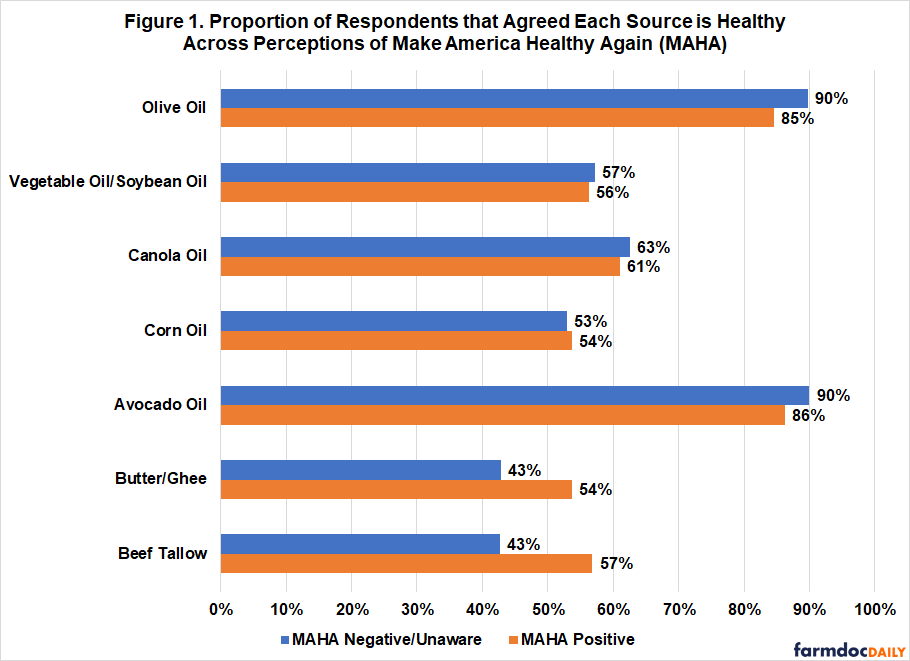
Finally, we explore perceptions of the new DGA recommendation about sources of fats used in cooking, “When cooking with or adding fats to meals, prioritize oils with essential fatty acids, such as olive oil. Other options can include butter or beef tallow.” Overall, 43.6% of respondents strongly agreed and 43.1% somewhat agreed that following this recommendation was important for the health of their household. Only 9.6% of respondents said they somewhat disagreed and 3.7% of respondents strongly disagreed that following this recommendation was important to the health of their household.
Responses to the DGA recommendation differed across perceptions of MAHA (see Table 2). In particular, we find that those who thought of MAHA as positive were much more likely to strongly agree that following the recommendation was important to their household’s health.
Table 2. Proportion of respondents who agreed that following the DGA recommendation “When cooking with or adding fats to meals, prioritize oils with essential fatty acids, such as olive oil. Other options can include butter or beef tallow.” was important to the health of their household.
| MAHA Negative or Unaware | MAHA Positive | |
| Strongly Agree | 34% | 53% |
| Somewhat Agree | 46% | 40% |
| Somewhat Disagree | 14% | 5% |
| Strongly Disagree | 6% | 2% |
Note: Results from Wave 16 of GFAPS.
Conclusions
In this post, we review results from the Gardner Food and Agricultural Policy Survey, evaluating public perceptions of seven fat sources – some of which have found themselves in the crosshairs of MAHA (Todd, 2025). We also assess public perceptions for the DGA recommendation on fat sources and provide insights on how perceptions vary across support for MAHA.
First, we find that respondents were widely aware of all seven sources, but actual purchasing experience was more varied. Respondents reported the highest rates of purchasing for olive oil, butter/ghee, and vegetable/soybean oil. The largest gap between awareness and purchasing occurred in beef tallow – with over 70% aware but only 10% having purchased.
Second, we find that respondents thought of avocado oil and olive oil as being healthy at the highest rates. While there has been much debate around MAHA and seed oils, we do not find differences in the perceptions of seed oil healthfulness across respondents’ support for MAHA, with over half of supporters and non-supporters saying vegetable/soybean, canola, and corn oil were healthy. On the other hand, we find that perceptions of healthfulness of animal fat sources did differ considerably across support for MAHA – with MAHA supporters reporting butter/ghee and beef tallow to be healthy at significantly higher rates.
Finally, we find that most respondents agreed that following the new DGA recommendation on fat sources (“When cooking with or adding fats to meals, prioritize oils with essential fatty acids, such as olive oil. Other options can include butter or beef tallow.”) was important for their household’s health. Those who were supportive of MAHA agreed more strongly.
While interesting in its own right, the MAHA focus on fat sources is also of interest to farmers and the agricultural sector. Changes in public perceptions and demand for cooking fats can affect demand for agricultural products, too, although the relationship is complex. For example, while crushed soybeans are used in vegetable oil (which could be affected by changes in demand surrounding seed oils), they are also utilized in animal feed, a necessary input for the production of animals (which could be affected by changes in demand for animal fat sources). Additionally, as the crushing process co-creates both oil and meal – utilized in a variety of categories, from renewable energy to poultry – signals would be intertwined (Arkansas Farm Bureau, 2025). Ultimately, much depends on how and if changes in public perceptions change consumer buying and demand, as well as how stakeholders across the food system respond.
References
Balagtas, J. and Bryant, E. “Consumer Food Insights – April 2025.” Center for Food Demand Analysis and Sustainability [CFDAS]. 4(2). (2025). Accessed via: https://ag.purdue.edu/cfdas/publication/consumer-food-insights-volume-4-issue-4-april-2025/
Brognano, E. “Seed Oils Aren’t the Problem—How We Consume Them Is.” Tufts Now. (2025). Accessed via: https://now.tufts.edu/2025/07/14/seed-oils-arent-problem-how-we-consume-them
Dietary Guidelines for Americans: 2025-2030. U.S. Department of Agriculture and U.S. Department of Health & Human Services (2025). Accessed via: https://cdn.realfood.gov/DGA_508.pdf
Godoy, M. “Are seed oils actually bad for your health? Here's the science behind the controversy.” NPR. (2025). Accessed via: https://www.npr.org/2025/07/07/nx-s1-5453769/nutrition-canola-rfk-seed-oils-soybean
Heckel, W.S. “The big fuss about banning seed oils.” Farm Progress. (2025). Accessed via: https://www.farmprogress.com/farm-policy/the-big-fuss-about-banning-seed-oils
Inklebarger, T. “Seed oils are out, avocado oil is in – and snack brands are leading the switch.” Food Navigator. (2026). Accessed via: https://www.foodnavigator-usa.com/Article/2026/03/18/avocado-oil-replaces-seed-oils-in-snack-reformulations/
Kalaitzandonakes, M., B. Ellison, M. Muth and J. Coppess. "Flipping the Pyramid: Public Perceptions of New Dietary Guidelines." farmdoc daily (16):37, Department of Agricultural and Consumer Economics, University of Illinois at Urbana-Champaign, March 5, 2026.
Louisiana SB-14. Louisiana Senate. (2025). Accessed via: https://legis.la.gov/legis/ViewDocument.aspx?d=1421347&utm_source=Agri-Pulse+Daybreak&utm_campaign=8711d93ffc-EMAIL_CAMPAIGN_2025_06_05_02_35&utm_medium=email&utm_term=0_-8711d93ffc-50926681
Mozaffarian, D. “The 2025-2030 Dietary Guidelines for Americans.” JAMA. (2025). Accessed via: https://jamanetwork.com/journals/jama/fullarticle/2844092#250813918
Muth, M. and Ellison, and B. “Food Industry Responses to the Make America Healthy Again Initiative.” Healthy Eating Research. Accessed via: https://healthyeatingresearch.org/wp-content/uploads/2026/03/HER_Industry-Response-to-MAHA_Report.pdf
Roeder, A. “Are seed oils healthful or harmful?” Harvard T.H. Chan School of Public Health. (2025). Accessed via: https://hsph.harvard.edu/news/are-seed-oils-healthful-or-harmful/
Son, M. and Lusk, J. “An Analysis of U.S. Cooking Oil Demand.” Purdue University, Department of Agricultural Economics. (2023). Accessed via: https://ag.purdue.edu/cfdas/wp-content/uploads/2023/07/An-Analysis-of-U.S.-Cooking-Oil-Demand_USB-approval_6-29-update.pdf
“The Critical Role of Seed Oils in U.S. Agriculture.” Arkansas Farm Bureau - Ag Insider. (2025). Accessed via: https://www.arfb.com/uploads/pages/4_the_critical_role_of_seed_oils_in_u.s.agriculture_april_2025_v4.pdf
Todd, S. “What MAHA’s crusade against seed oils reveals about flaws in America’s food system.” Stat. (2025). Accessed via: https://www.statnews.com/2025/02/12/are-seed-oils-bad-for-you-examining-science-behind-claims-maha-movement-rfk/
William, S. “Five things to know about seed oils and your health.” Stanford Medicine. (2025). Accessed via: https://med.stanford.edu/news/insights/2025/03/5-things-to-know-about-the-effects-of-seed-oils-on-health.html
Disclaimer: We request all readers, electronic media and others follow our citation guidelines when re-posting articles from farmdoc daily. Guidelines are available here. The farmdoc daily website falls under University of Illinois copyright and intellectual property rights. For a detailed statement, please see the University of Illinois Copyright Information and Policies here.