








The High Cost of Honey Bee Colony Losses: Rebuilding Inventories and Managing Health
Despite persistent honey bee colony health issues and widespread attention on colony losses in the U.S., colony inventories have remained relatively stable. Using USDA data, this article shows U.S. beekeepers have consistently replaced and renovated colonies so that rebuilding activity often met or exceeded reported losses. Beekeepers support colony health by purchasing inputs such as pest and disease treatments and supplemental feed. These costs highlight the economic burden associated with maintaining colony health and sustaining honey bee populations for honey production and pollination services of U.S. specialty crops. Recent evidence of historically high losses suggests that this system may be under increasing strain.
Honey bee producers are not the only livestock producers who have struggled to maintain and grow herd inventories. For instance, U.S. cattle numbers remain at historic lows (see farmdoc daily, February 2, 2026). The case of U.S. honey bee inventories outlined here shows how persistent stressors create numerous costs for producers working to maintain herd inventory. These high costs necessary just to keep ‘running in place’ makes the industry both vulnerable to changes in demand and highlights the importance of investment in research to address underlying causes of herd losses and improve livestock production economics.
U.S. Honey Bee Colony Inventories
For the past two decades, honey bee colony health issues and losses have been widely reported, often leading to the perception that honey bee populations are in steady decline. Recent survey evidence suggests these challenges may be intensifying, with beekeepers reporting historically high colony losses in recent years. U.S. beekeepers report losing an average of approximately 41% of honey bee colonies per year since 2008 with higher losses reported in recent years.
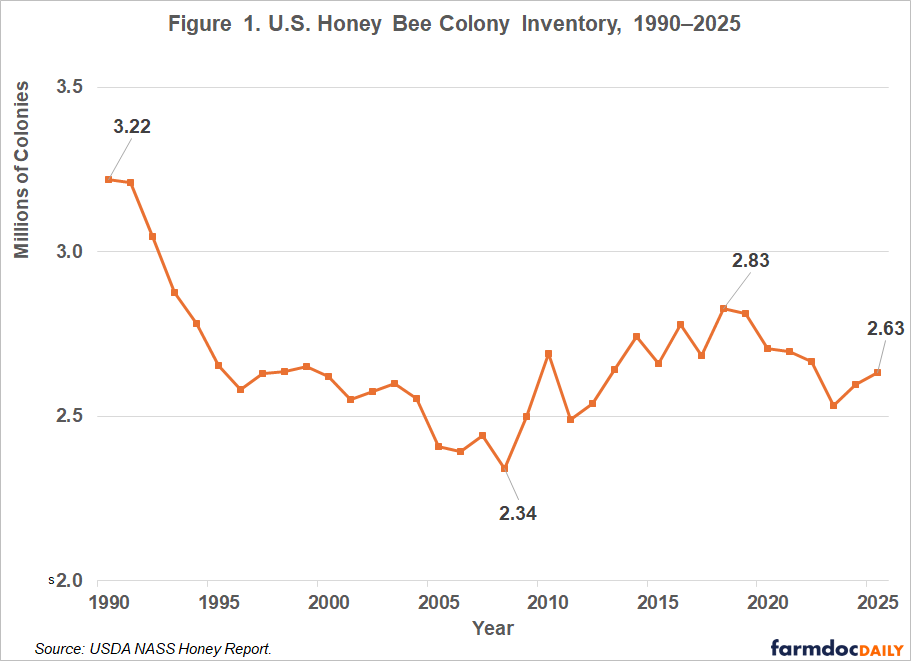
Despite growing losses, total colony inventories have remained relatively stable since 2008 and even increased in some subperiods. As shown in Figure 1, the number of honey bee colonies in the U.S. declined through the 1990s and early 2000s. Inventory hit its lowest point in 2008 at 2.34 million colonies. Since 2008, honey bee numbers grew to 2.83 million colonies in 2018 and have since stabilized around 2.6 million colonies.
Seemingly conflicting trends in inventories and losses are reconciled by the adaptive management and rebuilding strategies used by beekeepers to sustain colony inventories. Beekeepers in the U.S. rebuild colony populations to offset losses, either replacing lost colonies through purchases of nucleus colonies and package bees from other beekeepers or splitting large colonies. Each of these processes requires substantial expenditure on labor, feed, equipment, and other purchased inputs. Rebuilding is supported in part by the strong demand for pollination services in U.S. crop agriculture. Many specialty crops, including almonds, apples, and sunflowers, depend on managed honey bee pollination for production. Colonies are transported across the country each year to meet seasonal pollination demand. In particular, the California almond bloom requires the majority of managed colonies in the U.S. during the early spring (see farmdoc daily, February 17, 2025) .
Colony Stressors
Many stressors contribute to colony losses, including diseases, pesticides, and environmental factors. The relative importance of these stressors has been argued extensively. However, one stressor consistently stands out as the most significant: the Varroa mite, a parasitic pest that weakens and can ultimately kill colonies, contributing to both colony losses and ongoing management costs. Figure 2 displays the percentage of U.S. honey bee colonies impacted by various stressors each quarter from 2020 through 2024. It shows Varroa mites consistently affect a larger percentage of colonies than any other reported stressor throughout this period.
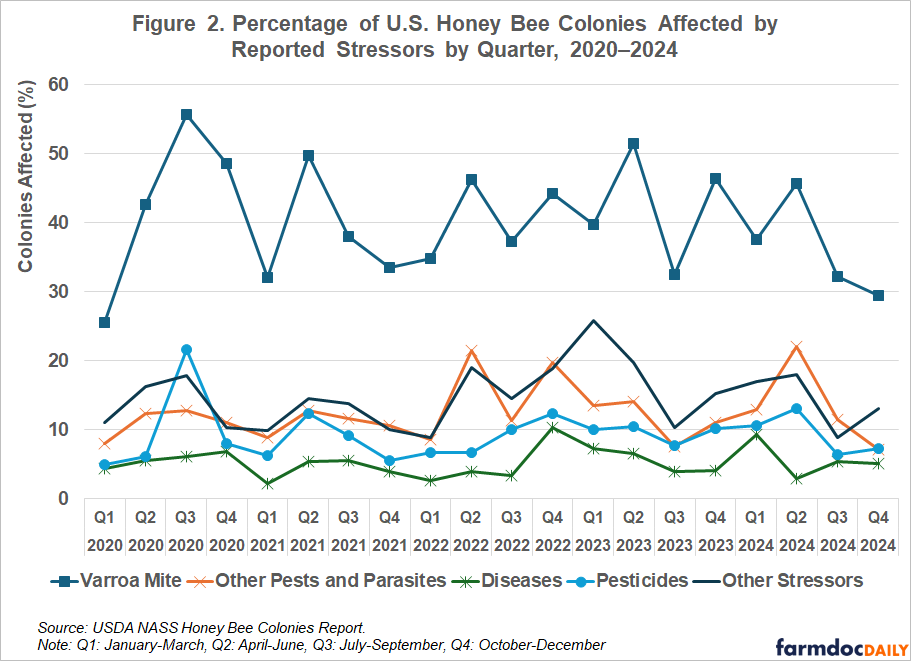
Honey bee stressors are seasonal. Table 1 displays the average percentage of colonies affected by stressors each quarter over 2020-2024 to examine seasonality in stressor timing. Pressure from Varroa, other pests and parasites, and other stressors is consistently highest in the second quarter, when colony populations and brood production expand during the spring and early summer months. On average, nearly half of colonies (47%) were affected by Varroa mites during April–June. Pesticide-related impacts peak in the third quarter and are also high in the second quarter, when the crop growing season is in full swing across most of the U.S. and pesticide use is prevalent. Disease pressure remains relatively stable throughout the year with a slight increase in the fourth quarter. Overall, Figure 2 and Table 1 highlight the persistent and seasonally recurring role of colony stressors in honey bee colony health, with emphasis on Varroa mites as the largest stressor.
Table 1. Quarterly Average Percentage of U.S. Honey Bee Colonies Affected by Reported Stressors, 2020–2024
| Quarter Affected | ||||
| Honey Bee Stressor | Jan-Mar | Apr-Jun | Jul-Sep | Oct-Dec |
| Varroa Mite | 34 | 47 | 39 | 41 |
| Other Pests and Parasites | 10 | 17 | 11 | 12 |
| Diseases | 5 | 5 | 5 | 6 |
| Pesticides | 8 | 10 | 11 | 9 |
| Other Stressors | 15 | 18 | 13 | 14 |
Source: USDA NASS Honey Bee Colonies Report.
Costs of Maintaining Honey Bee Colony Health and Populations
Beekeepers use a combination of management strategies to keep colonies healthy and mitigate losses. Beekeepers use chemical, mechanical, and cultural controls to reduce pests and diseases in colonies. Beekeepers also must provide pollen and nectar supplements during times of the year when natural forage is lacking, or to boost new colonies made from splits or package bees.
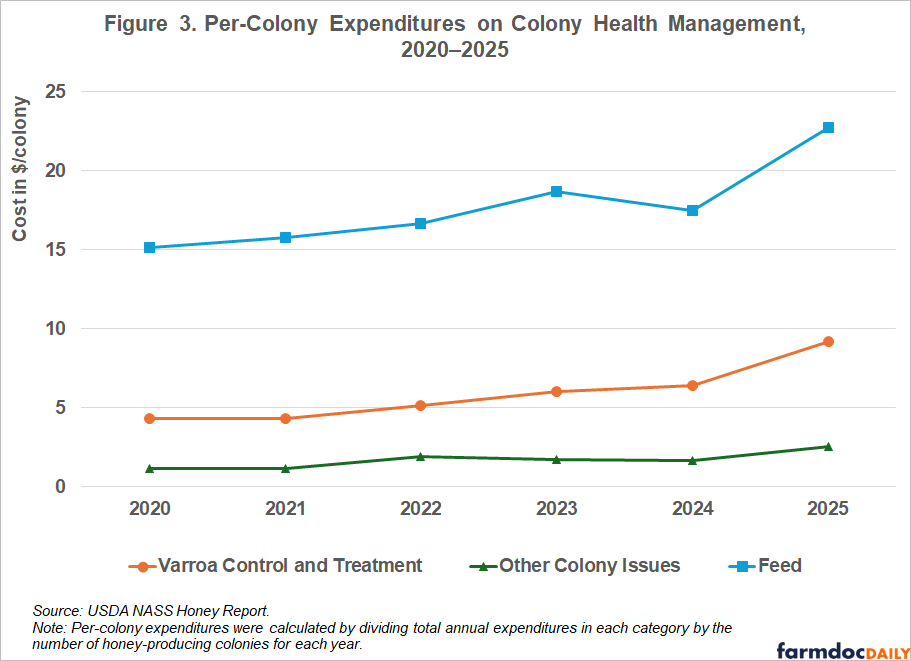
Figure 3 displays per-colony costs of some key beekeeper expenditures related to colony health. Each has increased over the past five years, underscoring the ongoing economic burden associated with maintaining colony health. The per-colony cost of feed is consistently the highest at over $20 per colony in 2025. The relatively high cost of feed reflects the limited availability of natural forage in many regions and periods of the year, particularly during overwintering and prior to pollination events, requiring beekeepers to supplement colonies with sugar syrup and protein patties to sustain colony strength. The costs of Varroa control and treatment and other colony health issues are comparatively lower in 2025 at $9.22 and $2.56 per colony, respectively. However, these costs have more than doubled since 2020, reflecting the increasing pest and disease pressure beekeepers are facing.
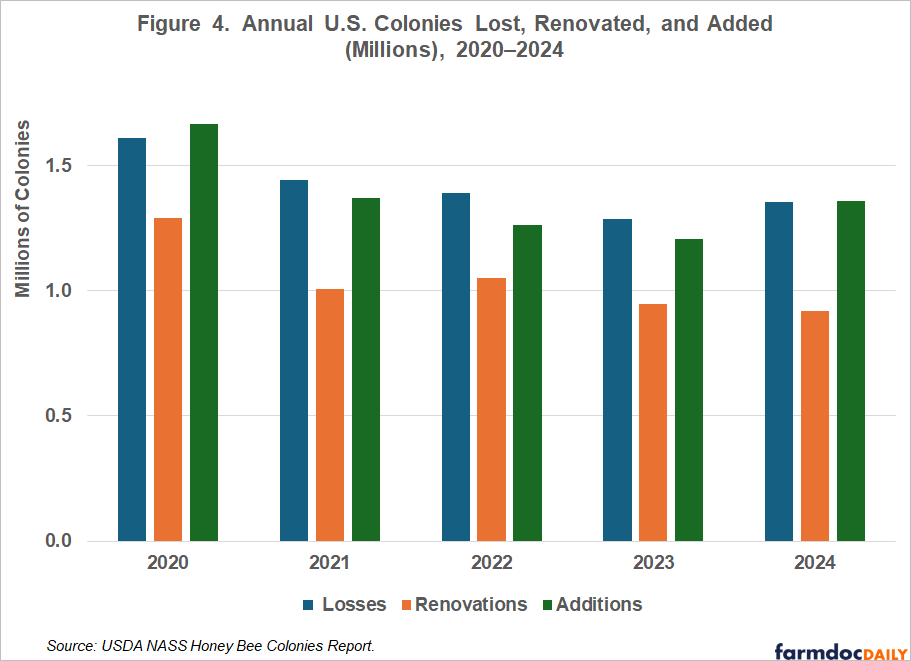
Even with active management and treatment for pests and diseases, colony losses still occur, requiring beekeepers to continually rebuild their operations each year. While colony losses are costly alone potentially resulting in lost revenues, the cost of renovating and adding colonies also requires significant expenditure. Figure 4 compares the number of colonies lost annually with the number of colonies added through splits or purchases and the number renovated through requeening or the addition of nucleus colonies or package bees. The figure shows that beekeepers are not only replacing lost colonies through additions, but also investing heavily in maintaining and strengthening surviving colonies through renovations. This combined annual rebuilding activity consistently surpasses reported colony losses and helps maintain the relatively stable colony inventories shown in Figure 1.
Quantifying the total cost of maintaining and rebuilding colony populations is difficult because USDA does not collect comprehensive data on all costs of production for U.S. beekeeping operations. Major expenses such as fuel and labor, for example, are not detailed in the USDA Honey or Honey Bee Colonies reports. However, making some assumptions can provide a rough estimate of these costs. In 2024, USDA Farm Service Agency set a fair market value of a honey bee colony at $129 for the purposes of the Emergency Assistance for Livestock, Honeybees and Farm Raised Fish Program (ELAP). Applying this fair market value to the 2024 losses depicted in Figure 4 suggests beekeepers lost about $175 million in colony stock, or roughly 29% of the $602 million in honey, pollination and other revenues earned in 2024. Under the assumption that beekeepers spent approximately 25% of the fair market value renovating colonies ($33/colony) and 75% of the fair market value replacing colonies ($97/colony), we estimate a total cost of renovating and adding colonies of $161 million in 2024. This is 27% of total revenue, similar to our rough estimate of the value of colony losses. These significant costs to maintain and rebuild honey bee populations reduce the profitability of beekeeping operations, making long-term economic sustainability challenging.
Summary
For the past two decades, honey bee colonies have faced many stressors. Recent survey evidence suggests that these challenges may be intensifying. Commercial beekeepers reported exceptionally high colony losses between 2024 and 2025, highlighting the increasing difficulty and cost of maintaining colony populations. This article demonstrates that maintaining the U.S. honey bee population requires continuous biological and economic investment through rebuilding efforts, pest management, supplemental feeding, and ongoing colony replacement. Stable colony numbers do not reflect the absence of colony health issues and losses, but rather the substantial and ongoing management effort required by beekeepers each year. These high and growing costs to keep ‘running in place’ motivate investment in improved production practices, better stressor mitigation technologies, and other tools to improve livestock production economics in U.S. agriculture.
References
Bond, J. K., Hitaj, C., Smith, D., Hunt, K., Perez, A., and Ferreira, J. 2021. Honey Bees on the Move: From Pollination to Honey Production and Back, ERR-290, U.S. Department of Agriculture, Economic Research Service. https://www.ers.usda.gov/publications/pub-details?pubid=101475
Franken, J. "Extending the Cattle Cycle with Still Lower Inventories." farmdoc daily (16):15, Department of Agricultural and Consumer Economics, University of Illinois at Urbana-Champaign, February 2, 2026.
Giacobino, Agostina, Nathalie Steinhauer, Samantha Brunner, Natasha Garcia-Andersen, Dan Aurell, Selina Bruckner, Stephanie Rogers, and Geoffrey Williams. 2025. “Preliminary Results from the 2024–2025 US Beekeeping Survey: Honey Bee Colony Loss and Management.” Auburn University, Oregon State University, and Apiary Inspectors of America. Accessed May 6, 2026. US Beekeeping Survey 2024–2025 Results
Goodrich, B. and A. Altschuler. "Where Have All the Honey Bees Gone? To California Almond Orchards." farmdoc daily (15):30, Department of Agricultural and Consumer Economics, University of Illinois at Urbana-Champaign, February 17, 2025.
U.S. Department of Agriculture, Farm Service Agency. (2024). ELAP: Honeybee assistance [Fact sheet]. https://www.fsa.usda.gov/sites/default/files/2024-12/FSA_ELAP_HoneybeeFact%20Sheet_24.pdf
U.S. Department of Agriculture, National Agricultural Statistics Service (USDA NASS). Honey Report. Available at: https://esmis.nal.usda.gov/publication/honey
U.S. Department of Agriculture, National Agricultural Statistics Service (USDA NASS). Honey Bee Colonies Report. Available at: https://esmis.nal.usda.gov/publication/honey-bee-colonies
Disclaimer: We request all readers, electronic media and others follow our citation guidelines when re-posting articles from farmdoc daily. Guidelines are available here. The farmdoc daily website falls under University of Illinois copyright and intellectual property rights. For a detailed statement, please see the University of Illinois Copyright Information and Policies here.