








Costs and Returns for Illinois Beef Producers in 2025
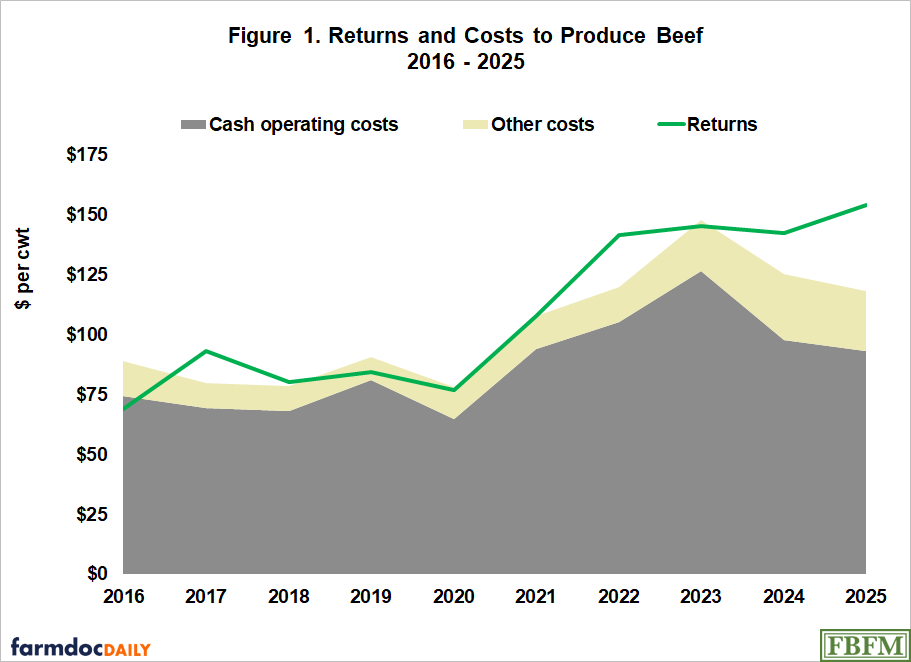
Total economic returns in 2025 for Illinois beef feeding enterprises exceeded total costs by $35.98 per 100 pounds of beef produced in preliminary findings for farms enrolled in Illinois Farm Business Farm Management (FBFM). The 2025 returns were higher than the 2024 total returns above feed costs of $17.30 per 100 pounds produced. Total returns have exceeded total economic costs in five out of the last ten years. The 2025 level of return above all costs was $30.01 per 100 pounds beef produced above the average return above all costs for the 2016 through 2025 period. Figure 1 illustrates average returns, cash operating costs and total costs for this same period.
Higher Total Returns
Higher prices received contributed to the higher total returns for these enterprises. Total returns per 100 pounds produced increased from $142.46 in 2024 to $154.09 in 2025. Total returns for 2025 were the highest on record. The average price received per 100 pounds of beef sold of $210.18 was 17 percent higher than 2024. This price was the highest price received since this study began and the first time over $200 per 100 pounds of beef sold. The average price paid for feeder cattle replacements in 2025 of $361.07 was 27 percent higher than 2024. This was the highest price paid for feeder cattle replacements. The price paid for feeder cattle in 2014, 2015, 2023 and 2024 were the only years where the price paid averaged over $200.00 per hundredweight with 2025 being over $300 per hundredweight. The purchase cost of feeder cattle is subtracted from finished cattle sales in determining total returns per 100 pounds produced.
Feed Costs Continue to Decrease
Lower costs added to higher gross receipts which led to higher returns above all costs as compared to 2024. Feed costs decreased 4 percent in 2025 as compared to 2024. Feed costs were $66.52 per 100 pounds produced in 2025 compared to $69.50 in 2024. Non-feed costs decreased from $55.64 per 100 pounds produced in 2024 to $51.59 in 2025. Other Interest costs of $13.43 per 100 pounds produced made up the largest portion of the non-feed costs. Feed and non-feed costs were $118.11 per 100 pounds produced in 2025. Total costs in 2025 were $7.05 per 100 pounds produced below 2024 and $14.64 above the last ten-year average of $103.48. Excluding the cost of feeder cattle, feed costs were 56 percent of the total cost to produce beef in 2025, compared to 62 percent for the four-year average.
Summary and Projections for 2026
Returns to cattle feeders increased in 2025 compared to 2024 and were above the last four-year average. The increase in price received was the main factor in the increased returns. Lower costs helped to increase the higher returns. Forecasts for 2026 using the United States Department of Agriculture’s Livestock, Dairy and Poultry Outlook: April 2026 as a guide shows that beef production is estimated to decrease by about 1% and thus market cattle prices are expected to increase by about 8%. Returns for 2026 will increase due to higher cattle prices. Feed costs will be like 2025 with projected grain and forage prices. However, non-feed costs are expected to increase. With these factors combined, returns to all costs for 2026 will be similar to 2025.
The author would like to acknowledge that data used in this study comes from Illinois Farm Business Farm Management (FBFM) Association. Without their cooperation, information as comprehensive and accurate as this would not be available for educational purposes. FBFM, which consists of 4,900 plus farmers and 80 plus professional field staff, is a not-for-profit organization available to all farm operators in Illinois. FBFM field staff provide on-farm counsel with recordkeeping, farm financial management, business entity planning and income tax management. For more information, please contact the State FBFM Office located at the University of Illinois Department of Agricultural and Consumer Economics at 217-333-8346 or visit the FBFM website at www.fbfm.org.
More Information
A more thorough report can be found at the University of Illinois farmdoc website: https://farmdoc.illinois.edu/handbook/cost-to-produce-beef-in-illinois
References
USDA. “Livestock, Dairy, and Poultry Outlook: April 2026.” https://ers.usda.gov/sites/default/files/_laserfiche/outlooks/114065/LDP-M-382.pdf?v=49381
Disclaimer: We request all readers, electronic media and others follow our citation guidelines when re-posting articles from farmdoc daily. Guidelines are available here. The farmdoc daily website falls under University of Illinois copyright and intellectual property rights. For a detailed statement, please see the University of Illinois Copyright Information and Policies here.