








A US Manufacturing Safety Net and Tariffs
Tariffs have now been a topic of US debate for nearly 10 years. The debate has many compartments, but assistance for US manufacturing has been a consistent theme. This article proposes that parallels exist between the creation of a US farm safety net and the current debate, suggesting tariffs could be emerging as the cornerstone of a US manufacturing safety net.
Policy Parallel
An often unstated, but key factor that allowed formation of a safety net for US farm commodities was farming’s small and declining share of the US economy. Cash receipts from all US farm commodities was 11% of US GDP (Gross Domestic Product) in the 1920s when calls began for a US farm safety net and 9% when the first version of the US farm safety net, the Agricultural Adjustment Act of 1933, was authorized (see Figure 1). In short, a US farm safety net was economically feasible.
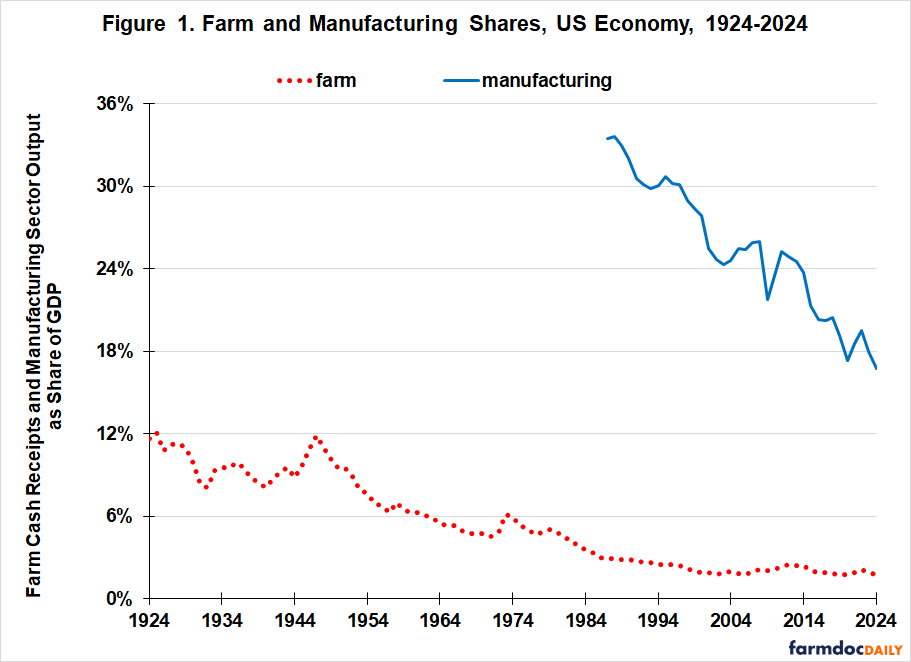
In 2024, US manufacturing output was 17% of US GDP and declining sharply, not much different from farming’s role in the US economy when farm safety net discussions began. In short, a US manufacturing safety net is economically feasible.
Economic feasibility is not sufficient for a policy response to occur. The Great Depression that started in 1929 provided the political will for a US farm safety net. President Trump’s now decade old political message and core support suggests political will now exists for a US manufacturing safety net.
Policy Response: Tariffs Make Sense
Farming is obviously not manufacturing. US farm products number relatively few, are mostly similar within product type, and are often exported. US manufactured products are numerous, often differ within product type, and are often imported. The farm safety net design does not fit manufacturing. However, a tariff-centered US manufacturing safety net can fit. It raises domestic prices and thus aids US manufacturers, particularly those who make products the US imports. As importantly, it is easy to implement. Imports pass through international customs at US points of entry.
Discussion
Tariffs come with nontrivial negatives that need to be carefully considered. They are inflationary. Consumers are worse off. Production efficiency is lower. The poor are hurt.
But Americans can willingly decide to accept negative economic impacts to provide a manufacturing safety net, just as they willingly accept higher food prices and nontrivial government spending to provide a farm safety net.
A tariff-centered manufacturing safety net would impose tariffs only on manufacturing imports. In 2025, 71% of total US imports of goods and services were manufactured commodities.
A tariff-centered safety net would be a more uniform, systemic approach to assistance for US manufacturers than the current set of tax breaks, grants, loans, and other government aid to US manufacturers. These programs need systematic review and rebasing given the presence of tariffs.
A key question is, “What should be the tariff rate on manufacturing imports?’
One perspective on the potential Congressional policy marketplace answer to this question is the American consumer’s willingness to “pay for American.” An AI search of this and related questions as well as examination of the articles listed suggest these take aways: (1) some will willingly pay nothing, (2) the poor are especially unwilling to pay, (3) average willingness to pay differs notably across studies and products, (4) consumers’ willingness to pay often exceeds what they will actually pay, and (5) 10-20% appears to be the upper bound in many situations. When combined, they suggest a smaller than larger tariff rate.
The preceding point also suggests the likelihood of tariff assistance for the poor, a parallel to food assistance. A potential source of funds for tariff assistance would be the systemic review and rebasing of current non-tariff assistance provided to US manufacturers.
Data Sources
Federal Reserve Bank of St. Louis. May 2026. Federal Reserve Economic Data. https://fred.stlouisfed.org
US Department of Agriculture, Economic Research Service. February 2026. Farm Income and Wealth Statistics. https://www.ers.usda.gov/data-products/farm-income-and-wealth-statistics/
Disclaimer: We request all readers, electronic media and others follow our citation guidelines when re-posting articles from farmdoc daily. Guidelines are available here. The farmdoc daily website falls under University of Illinois copyright and intellectual property rights. For a detailed statement, please see the University of Illinois Copyright Information and Policies here.