








The Characteristics of Higher Profit Farms in Illinois, 2006 – 2025 Average
Data from the Illinois Farm Business Farm Management (FBFM) Association for 2006 through 2025 was used to analyze selected differences between the highest profit grain farms (high one-third) and the lower profit grain farms (low one-third). The farms were sorted into thirds based on production per dollar of non-feed costs (accrual gross farm returns divided by total non-feed costs). The analysis was done using the 2006 through 2025 twenty-year average. Farms in the higher profit group were larger, had higher corn yields, cash rented a larger percentage of their acres, and had higher crop returns and lower costs, especially crop and power and equipment costs. Management returns, an economic profit measurement, were significantly greater for the higher profit farms.
Farms are grouped by region in the state – north, central, and south (roughly using Interstate 80 in the north and Interstate 70 in the south). The central region is also divided into a group of higher productive soils and a group with less productive soils. All farms were at least 500 tillable acres in size with the larger average number of acres per farm in northern and southern Illinois. These farms also had none or very limited livestock enterprises.
Farm Size
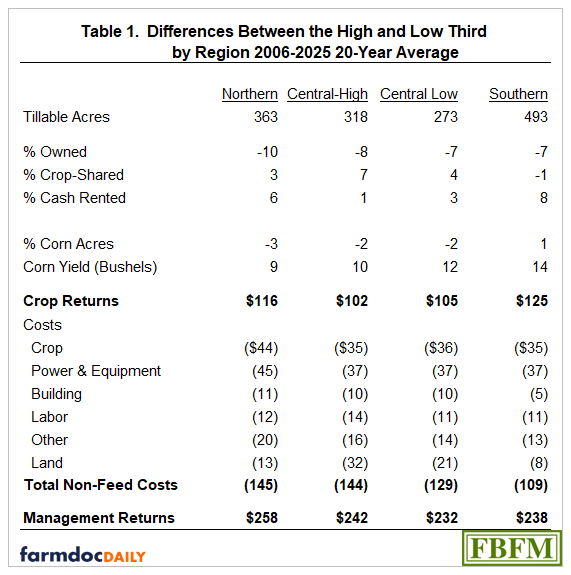
Farm size seems to be a contributing factor to the profitability as the higher profit farms were larger, generally from 275 to 500 more acres (Table 1) depending on the period and the region in the state. The larger farms can spread their labor and machinery costs over more acres contributing to lower costs per acre and higher profitability. When looking at the twenty-year average the largest difference in tillable acres is in southern Illinois with 493 more acres for higher profit farms, while the smallest difference was for the central Illinois farms with the lower soil rating with 273 more acres.
Corn Yield & Rotation
The higher profit farms generally had higher corn yields. For the most recent twenty-year period, the higher profit farms had higher corn yields ranging from 9 bushels per acre more in northern Illinois to 14 bushels per acre more in southern Illinois. The higher corn yields were a main factor for crop returns being $102 per acre in central Illinois with higher rated soils to $125 per acre higher in southern Illinois for the higher profit farms for the ten-year average from 2006 to 2025.
For the 2006 through 2025 average, higher profit farms had a lower percent of their tillable acres planted to corn, except in southern Illinois where higher profit farms had one percent more of their tillable acres planted to corn.
Expenses
All economic non-feed expense categories were analyzed in the study which include crop, power and equipment, building, labor, other and land. Crop costs include fertilizer, seed and pesticides. The main power and equipment costs are fuel, repairs, machine hire and lease expense and economic machinery depreciation. Drying, storage, building repairs and economic building depreciation compose the building costs. Labor costs are actual employee costs as well as an economic charge for unpaid operator and family labor. The main other costs are insurance, economic interest charge on non-land assets and miscellaneous expenses. Finally, land costs include cash rent, real estate taxes, economic interest charge on owned acres and an estimation for costs association with farming non-revenue acres (landlord share) in a crop-share arrangement.
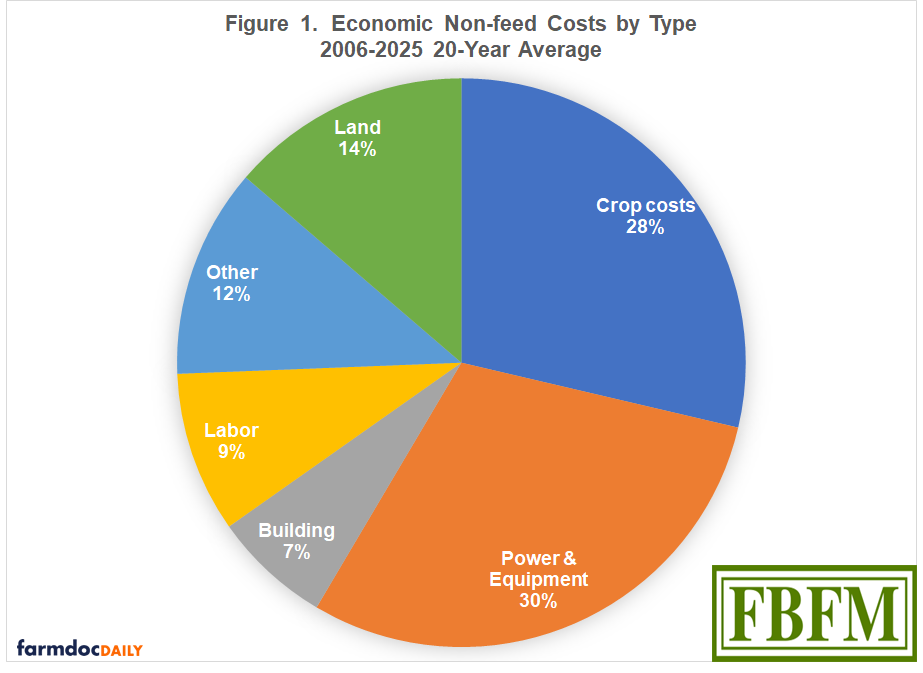
Crop costs on average made up about 28% (Figure 1) of the total non-feed costs for the 2006 to 2025 twenty-year average. This cost was $35 to $44 per acre less for the different regions for the 2006 through 2025 average for higher profit farms. The largest share (30%) of expenses was power and equipment costs. They ranged from $37 to $45 per acre less for the twenty-year average comparison. The next largest expense category was land costs at 14 percent. Of these three main costs, land costs varied the most among regions, going from $8 per acre less in southern Illinois to $32 per acre less in central Illinois with the higher soil ratings. Total non-feed costs for the most recent twenty-year average ranged from $109 less in southern Illinois to $145 per acre less in northern Illinois.
Management Returns
Economic management returns are calculated by subtracting interest on equity capital and unpaid labor charges from accrual net farm income. Higher crop returns, combined with lower economic costs per acre, produced significantly higher management returns for the more profitable farms. For the 2006 through 2025 average, management returns were $232 to $258 per acre higher for higher profit farms.
Summary
Many factors contribute to some farms being more profitable than other farms. A few of these factors, such as weather, farm operators cannot control. However, many factors, such as crop and machinery costs, operators can control. As in past studies of this type, not one single factor is the main contributor to the difference in profitability, but many factors are put together. Over the last twenty years we have had two periods of record high incomes, but overall, the main characteristic of a higher profit producer is lower costs. Careful analysis of your farm business records on at least an accrual adjusted basis over time can help individual farmers look at their own trends to help find ways to work toward higher profitability.
The author would like to acknowledge that data used in this study comes from the Illinois Farm Business Farm Management (FBFM) Association. Without Illinois FBFM, information as comprehensive and accurate as this would not be available for educational purposes. FBFM, which consists of 4,900+ farms and 80+ professional field staff, is a not-for-profit organization available to all farm operators in Illinois. FBFM field staff provide independent, on-farm counsel along with recordkeeping, farm financial management, business entity planning and income tax management. For more information, please contact our office located on the campus of the University of Illinois at 217-333-8346 or visit the FBFM website at www.fbfm.org.
Disclaimer: We request all readers, electronic media and others follow our citation guidelines when re-posting articles from farmdoc daily. Guidelines are available here. The farmdoc daily website falls under University of Illinois copyright and intellectual property rights. For a detailed statement, please see the University of Illinois Copyright Information and Policies here.