








Rural Americans are Concerned About the Impact of Data Centers
Artificial Intelligence (AI) has the potential to reshape our economy and workforce. Data centers serve as the physical infrastructure for AI, but they come with notable costs and unknowns. These unknowns have generated consumer concerns around issues such as land use—especially farmland—and their impact on infrastructure needs, energy consumption, and water use. Given the growing prevalence of data centers, the Gardner Food and Agricultural Policy Survey recently assessed US consumers’ concerns about the impact of data centers and AI. This article discusses the results and presents potential implications for rural economic development and community leaders.
Data Centers Power the Digital and AI Ecosystem
Data centers physically house the servers, data, and infrastructure that support the internet, cloud computing, and artificial intelligence. These facilities require reliable access to large amounts of electricity as they use a lot of power, and significant amounts of water to support the liquid-cooling systems needed to prevent overheating (Lawson, Offutt, Ortiz, and Zhu, 2026). Relevant to rural areas, modern data centers built to support AI require 500-800 acres of land (Cvengros and Skae, 2024), and in some instances, these data centers will require more land. Given this growing need for developable land, many rural data centers are built on farmland.
Data center development can potentially contribute to local economic development. They are capital-intensive developments that, in some instances, can generate significant property tax revenue for some local jurisdictions. That said, specific tax incentives available to data‑center owners and operators will determine the overall magnitude of the tax benefits. Not all data centers are the same, and the employment benefits of data centers vary, but the jobs impacts are often overstated (Pipa and Aley, 2026). Outside of the construction phase, the local employment impacts related to data center operation, maintenance, and security are more modest. Data centers have also been shown to raise house prices. This can benefit property owners, but these increases can also increase costs for renters and prospective homeowners (Alvarez et al., 2026).
Many unknowns remain about the full impacts associated with data center growth and expansion. According to the UVA Weldon Cooper Center for Public Service, by 2030 the energy requirements for data centers are projected to more than double in Illinois and triple in Indiana, Michigan, Minnesota and Wisconsin (Ferreira, Shobe, Rephann, and Scheffel, 2026). In addition to the greater demands on energy generation and transmission, these developments will also impact water usage, wastewater discharge, and land use. Additionally, communities must also consider how these developments will affect air quality, noise pollution, and the economic trade-offs associated with data center development (Walker and Goldsmith, 2026).
Given these uncertainties, public views of data centers are mixed and may vary depending on where people live. In 2024, there were 115 data centers operating in Illinois—mostly located in the Greater Chicago area—and an additional 67 were expected to open by 2030 (Ferreira, Shobe, Rephann, and Scheffel, 2026). These data centers directly employed almost 10,000 people and generated $131M in state tax revenue and $127M for localities across the state (2024 dollars). However, the Pew Research Center reports that nationwide, 87% of existing data centers are in urban areas, but 67% of planned facilities are slated for rural communities. Moreover, 39% of planned data centers are in counties that currently have none (Seets and Radde, 2026). As these developments become more rural, data centers will increasingly affect farmland, as well as rural electricity and water systems.
Survey Findings Highlight Key Areas of Concern Surrounding Data Center Development
While surveys show that many Americans are concerned about data centers—and often oppose having one built nearby (Jones, 2026; Gramlich et al., 2026)—much less is known about how these views differ between rural and urban residents. To better understand these differences, the quarterly Gardner Food and Agricultural Policy Survey (GFAPS) asked survey respondents to identify their concerns about data centers and AI (We conflate AI with modern data centers in this post). This survey (GFAPS Wave 16) was conducted online in February 2026 and reached approximately 1,000 US adults who were representative of the country by region, income, age, and gender.[1]
Specifically, respondents were asked, “On a scale from 1 to 7, where 1=not at all worried and 7=extremely worried, how worried are you that Artificial Intelligence (sometimes called AI) will result in the following outcomes?”
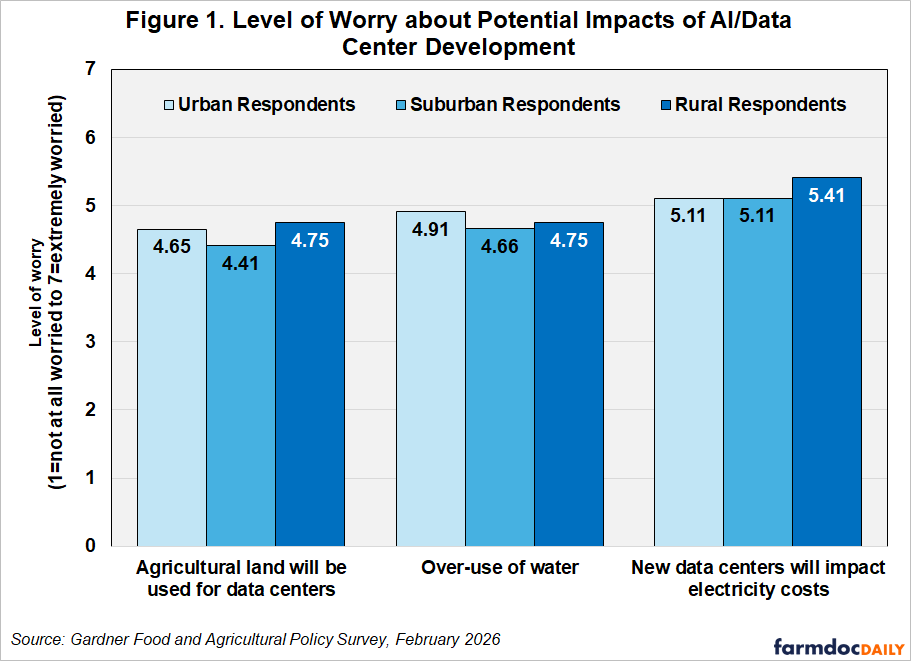
Three outcomes were presented to survey respondents. “New data centers will impact electricity costs,” had an average worry level of 5.17 out of 7. “Overuse of water” had an average worry level of 4.77 out of 7. Finally, “Agricultural land will be used for data centers” had an average worry level of 4.56 out of 7. All three levels of worry were above the midpoint (4). These are not the only potential concerns associated with either AI or modern data centers, but they are the issues that most consistently appear in news stories focused on rural and/or agricultural issues.
Rural Residents Are More Concerned About the Potential Impacts of AI/Data Centers than Urban and Suburban Residents
The survey results were organized according to the nature of the respondent’s community, be it urban, suburban, or rural (Q: “What best describes the community you live in?”), and our results revealed significant differences between urban and rural residents. Rural residents are more concerned about the potential impacts of data centers than urban and suburban residents. Figure 1 shows that, more than any other issue, the impact of data centers on electricity costs is most concerning to the average respondent. However, rural respondents were the most concerned about rising electricity costs, with an average worry level of 5.41 out of 7. Rural respondents were also more concerned about the impacts on agricultural land use and electricity costs than urban or suburban respondents. We did not find significant differences in levels of worry about water use, suggesting urban, suburban, and rural respondents had similar levels of concern about this impact.
More than Half of Rural Respondents Are ‘Very Worried’ About Data Centers Impacting Electricity Costs
Rural residents were more likely to be ‘very worried’ about the impacts of AI/data centers across the board (Figure 2). Respondents who rated their level of worry a 6 or 7 on the 1-7 scale were considered ‘Very Worried.’ Fewer suburban residents were very worried about the use of farmland than either urban or rural respondents. By contrast, urban respondents were more likely to be very worried about water usage (44.5%) than rural or suburban respondents.
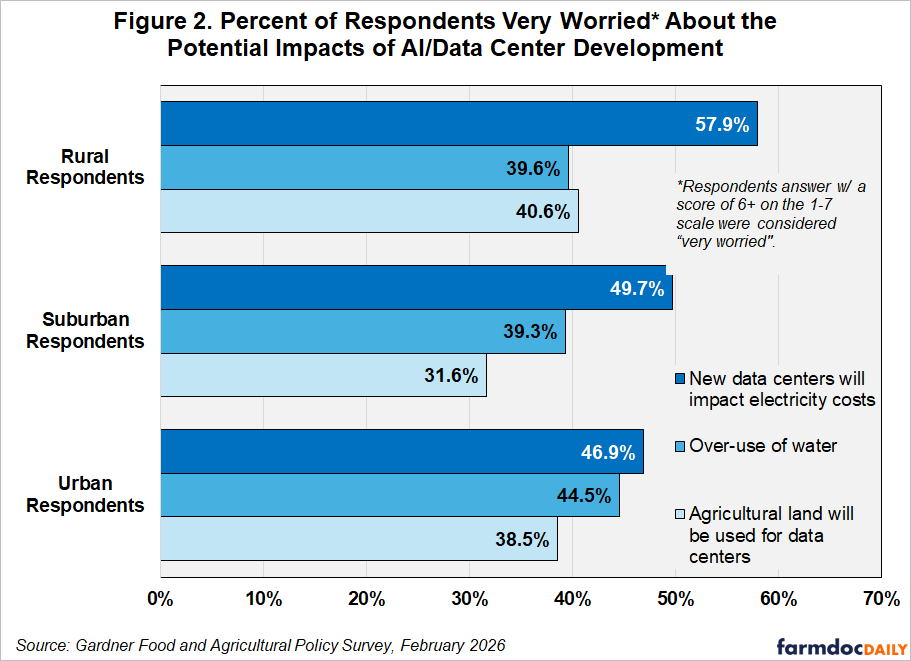
The gap between urban, suburban and rural responses was most pronounced in electricity costs. Of these three issues, the rising cost of electricity was the issue most likely to affect people’s personal finances. Rural residents were 11 percentage points more worried than urban residents and 8 percentage points more worried than suburban residents. How data center electricity costs affect consumers varies by state. In regulated states like Virginia, utilities can build generation and grid infrastructure for data centers and recover those costs across all or specific ratepayers with regulatory approval. In partially deregulated states like Illinois, generation is market-based, so data centers can influence wholesale energy and capacity prices. In some instances, the increased generation costs required for a new or expanding data center may be borne by that customer. However, individual consumers may also bear costs through regulated transmission and distribution upgrades needed to serve large new loads.
Implications for Rural Communities
The survey results show that many rural residents recognize the impacts associated with data center development, but they also suggest that their greatest concerns focus on the impacts that most directly affect their personal finances—particularly rising energy costs. While these individual-level concerns were significant, community leaders must take a broader perspective. In addition to the consumer impacts, they must also balance broader implications, including planning for future energy demand and infrastructure capacity, managing public finance and tax implications, evaluating opportunity costs relative to alternative land uses, and addressing land-use planning and zoning issues, among others.
Larger communities are more likely to have the capacity and resources to make these decisions, but many smaller and rural communities do not. In these instances, there is often an asymmetric relationship between rural communities and the companies, investors, and experts working to advance these projects. Large companies that operate AI-scale data centers can bring specialized lawyers, engineers, and financial analysts to structure these projects and site-location decisions. By contrast, many rural communities have limited decision-making capacity due to budget and staffing constraints, and they often rely on volunteer mayors or part-time elected officials. Often, they are simply not equipped to make these informed decisions or to effectively negotiate with companies that own data centers (Marohn, 2026).
Smaller communities do not want to miss out on these economic development opportunities, as some communities have benefited from the contributions these developments have made to their local tax base. However, they also do not want to have to live with decisions that could negatively impact their future. At the very least, local leaders must better understand these potential issues so that they can make more informed decisions about siting data centers in their community and ask the right questions. To aid their communities, Penn State Extension (2026) produced a guide to common questions that communities must ask about potential data center developments. These questions cover a wide range of issues, including power generation and usage, water usage, zoning and land use, workforce, and tax implications. In addition to asking the right questions, communities should also do their due diligence on individual developers by trying to understand what has happened in other communities—in terms of jobs, tax revenue, energy and water use, and infrastructure—where a prospective company built a similar data center.
Note
[1] Qualtrics Panels recruits participants each wave using quotas to match the US population in terms of age, income, gender, and region. Online surveys are limited by sample bias. For example, our sample over-represents those with a bachelor’s degree (43.7% vs. 35.7% nationally, per the most recent US Census) and characteristics such as education, which may affect our estimates.
References
Cvengros, Andy, and Peter Skae. 2024. “How to Assess a Property’s Data Center Potential.” JLL, November 5. https://www.jll.com/en-us/insights/how-to-assess-a-propertys-data-center-potential
Alvarez, Fernando E., David Argente, Joyce Chow, and Diana Van Patten. 2026. Data Centers and Local Economies in the Age of AI: A Shift–Share Approach. NBER Working Paper 35194. Cambridge, MA: National Bureau of Economic Research. https://doi.org/10.3386/w35194
Ferreira, João, William Shobe, Terry Rephann, and Matthew Scheffel. 2026. Economic, Fiscal and Energy-Related Impacts of Data Centers in the Great Lakes Region. Charlottesville, VA: Weldon Cooper Center for Public Service, University of Virginia. January 13. https://www.coopercenter.org/research/GLDC
Gramlich, J., B. Kennedy, C. McClain, and G. Stocking. 2026. “How Americans View Data Centers’ Impact in Key Areas, from the Environment to Jobs.” Pew Research Center, March 12. https://www.pewresearch.org/short-reads/2026/03/12/how-americans-view-data-centers-impact-in-key-areas-from-the-environment-to-jobs/
Jones, Jeffrey M. 2026. “Americans Oppose AI Data Centers in Their Area.” Gallup News, May 13. https://news.gallup.com/poll/709772/americans-oppose-data-centers-area.aspx
Lawson, A., M. Offutt, N. Ortiz, and L. Zhu. 2026. Data Centers and Their Energy Consumption: Frequently Asked Questions. CRS Report R48646. Washington, DC: Congressional Research Service. May 12. https://www.congress.gov/crs-product/R48646
Marohn, Charles. 2026. “When the Decision Is Too Big for the City.” Strong Towns, May 11. https://www.strongtowns.org/journal/2026-5-11-when-the-decision-is-too-big-for-the-city
Penn State Extension. 2026. “Data Centers: A Guide to Common Questions.” Penn State Extension, April 2. https://extension.psu.edu/data-centers-a-guide-to-common-questions
Pipa, Anthony F., and Adam Aley. 2026. “The Local Implications of Data Centers for Rural Communities in the US.” Brookings Institution, March 2. https://www.brookings.edu/articles/local-implications-data-centers-rural-communities-us/
Seets, Skyler, and Kaitlyn Radde. 2026. “Most New Data Centers in the U.S. Are Coming to Rural Areas.” Pew Research Center, April 13. https://www.pewresearch.org/short-reads/2026/04/13/most-new-data-centers-in-the-us-are-coming-to-rural-areas/
Walker, Carla D., and Ian Goldsmith. 2026. “From Energy Use to Air Quality, the Many Ways Data Centers Affect US Communities.” World Resources Institute, February 17. https://www.wri.org/insights/us-data-center-growth-impacts
Disclaimer: We request all readers, electronic media and others follow our citation guidelines when re-posting articles from farmdoc daily. Guidelines are available here. The farmdoc daily website falls under University of Illinois copyright and intellectual property rights. For a detailed statement, please see the University of Illinois Copyright Information and Policies here.