








Smaller Loans Drive Decline in Non-Real Estate Farm Lending at Commercial Banks in Q3 2026
Non-real estate farm loan volume at commercial banks fell 25.0% year-over-year in the third quarter of 2026. A sharp contraction in average loan sizes drove the decline, even as the total number of loan originations increased. Average maturities shortened across categories, most notably for farm machinery and equipment financing, while interest rates on these loans eased modestly from 2025 levels yet remained well above what they were in 2020.
Today’s article uses the Federal Reserve’s National Survey of Terms of Lending to Farmers to examine third-quarter non-real estate farm lending at commercial banks, focusing specifically on operating and farm machinery loans (see Federal Reserve Bank of Kansas City).[1]
More Loans, Smaller Loan Sizes
Farm lending activity at commercial banks contracted in the third quarter as smaller loans offset an increase in the number of originations. Across all non-real estate farm loans, the total number of loans increased 11.1% from a year earlier, but a 32.5% decline in average loan size pushed the total volume down by 25.0% (Figure 1).
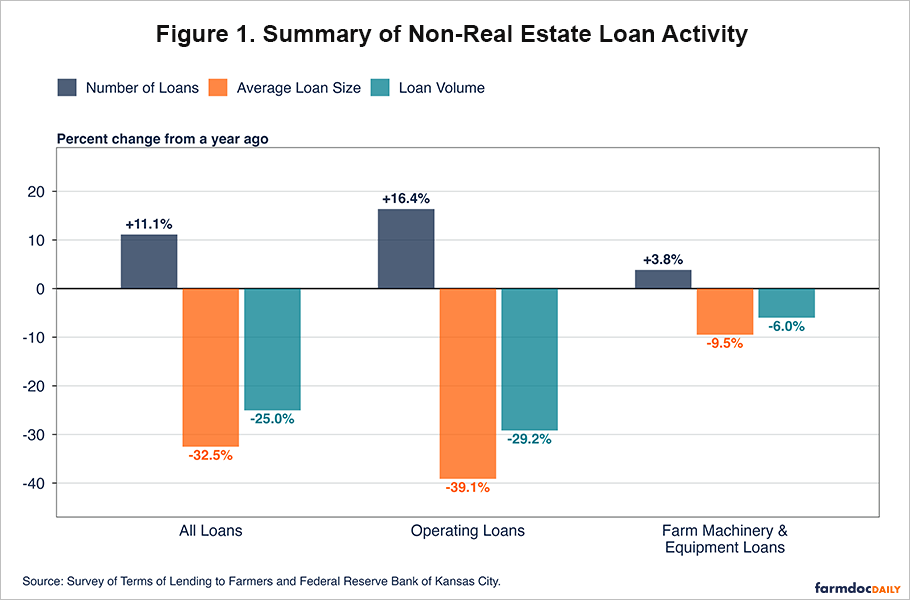
The decline in total volume in the third quarter was primarily driven by operating loan activity. Although the total number of operating loans increased 16.4%, average loan size fell by 39.1%, resulting in a 29.2% decline in operating loan volume for the period. Farm machinery and equipment lending followed a similar pattern but on a smaller scale, as a 3.8% increase in loan originations was outweighed by a 9.5% decline in average loan size, lowering total volume by 6.0%.
Average Loan Sizes Fell Year-over-Year
Figure 2 places the decline in average loan sizes alongside the 11-year third-quarter average. Across all non-real estate farm loans, the average loan size decreased 32.5% from approximately $120,500 in the third quarter of 2025 to $81,300 in 2026. This was about 4.2% below the 2015–2025 third-quarter average of $84,900.
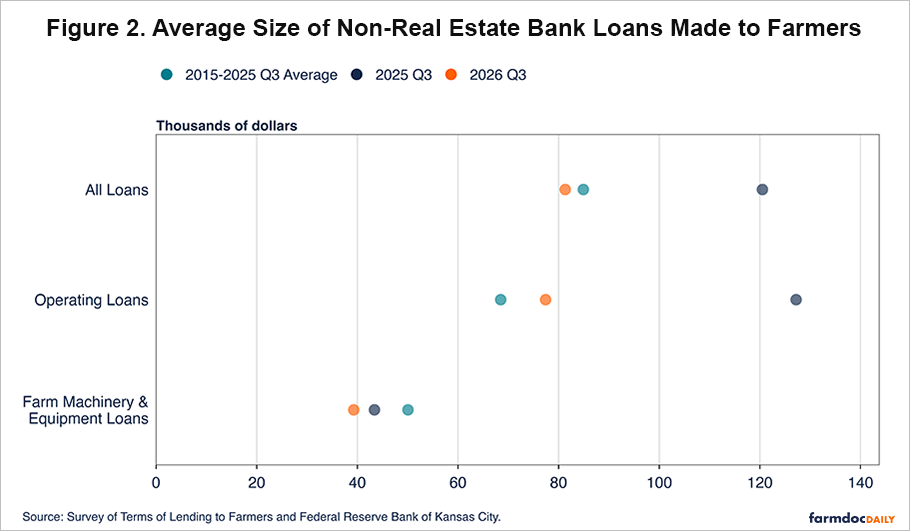
The size of operating farm loans in the third quarter averaged approximately $77,400, down 39.1% from $127,200 a year earlier. Despite the sharp decline, the average operating loan was 13.0% larger than the 2015-2025 average of $68,500.
Farm machinery and equipment loans followed a similar downward trend year-over-year, though average sizes remained well below the 11-year average. Equipment loans averaged approximately $39,300, down 9.5% from $43,400 in the third quarter of 2025 and 21.5% below the 11-year average of $50,100.
Operating Loans Accounted for Most of the Decline in Loan Volume
Total non-real estate farm loan volume decreased 25.0% from $75.33 billion in the third quarter of 2025 to $56.47 billion in 2026, as shown in Figure 3. This was 30.0% below the 11-year third-quarter average of $80.71 billion.
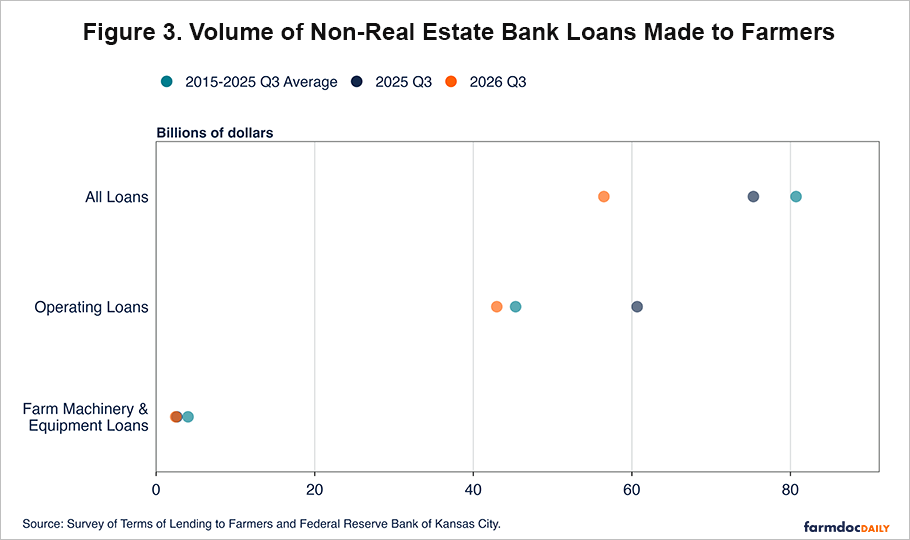
Operating loan volume fell from $60.67 billion to $42.96 billion. This decrease accounted for a substantial share of the $18.86 billion reduction in total non-real estate loan volume. Nevertheless, operating lending was only 5.2% below its 11-year average of $45.34 billion.
Meanwhile, farm machinery and equipment loan volume decreased from $2.61 billion to $2.46 billion. Its annual decline was comparatively modest; however, the latest estimate was 38.9% below its 2015–2025 Q3 average of $4.02 billion.
Average Maturities Shortened in the Third Quarter
Average loan maturities shortened in the third quarter of 2026 compared with a year earlier, as shown in Figure 4.
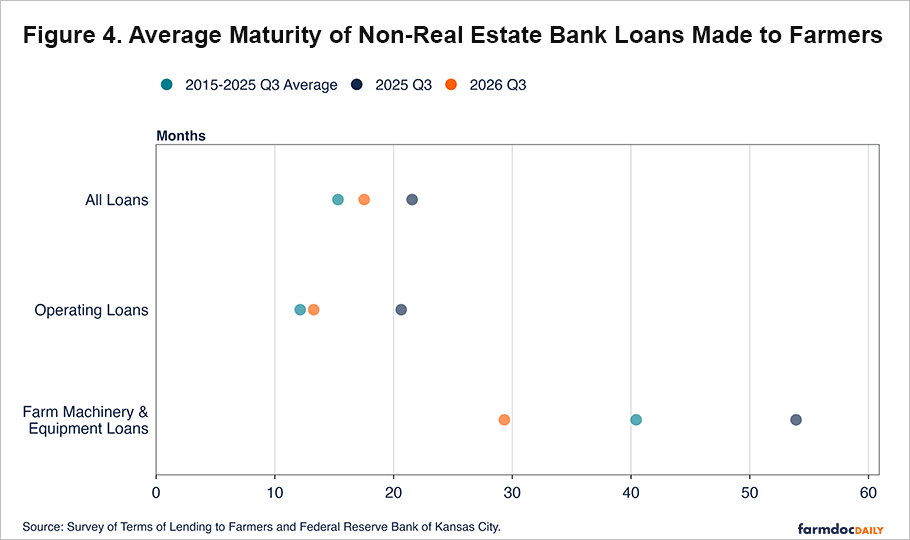
For all non-real estate farm loans, average maturity decreased from 21.6 months in the third quarter of 2025 to 17.5 months in 2026. Despite the drop, overall maturity remained slightly above the 2015–2025 Q3 average of 15.3 months.
Operating loan maturities fell from 20.6 months to 13.3 months, returning near their 2015–2025 Q3 average of 12.1 months. Farm machinery and equipment loans registered the sharpest reduction, with average maturity falling by more than two years—from 53.9 months to 29.3 months—placing equipment maturities well below their 11-year average of 40.4 months.
Furthermore, farm machinery and equipment loans stood out across the measures discussed in this article, as average loan size, total volume, and average maturity were all below their respective 11-year averages.
Interest Rates Declined but Remained above Their 2020 Levels
Average effective interest rates declined from a year earlier across the reported loan categories (Figure 5).
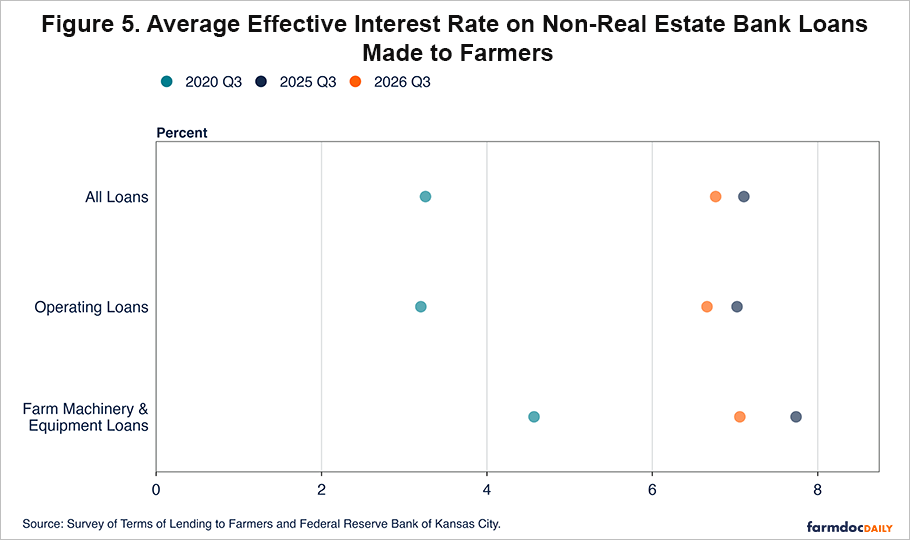
The average interest rate on all non-real estate farm loans fell 34 basis points from 7.11% in the third quarter of 2025 to 6.77% in 2026. Operating loan rates dropped 36 basis points to 6.66%, while average rates on machinery and equipment loans decreased 68 basis points to 7.06%.
Comparing recent interest rates with those in 2020 illustrates how borrowing costs have shifted over a longer period. Third-quarter 2020 interest rates averaged 3.26% for all non-real estate loans, 3.20% for operating loans, and 4.57% for farm machinery loans. This translates to their corresponding rates in 2026 being 351, 346, and 249 basis points higher, respectively.
Although effective average interest rates eased over the past year, borrowing costs remained well above the levels farmers faced at the start of the decade.
Concluding Thoughts
Non-real estate farm loans at commercial banks were smaller and had shorter average maturities in the third quarter of 2026 than a year earlier. Although banks made more loans, the decline in average loan size reduced total dollar volume, with operating loans accounting for most of the annual decline.
Comparing these figures with 2015–2025 third-quarter averages provides essential context. Despite sharp declines from 2025, the average operating loan size remained above its 2015–2025 third-quarter average, while operating loan volume was only modestly below its 11-year average. Farm machinery and equipment loans were smaller, had shorter average maturities, and accounted for less dollar volume than their respective 11-year averages. Lastly, interest rates eased from a year earlier but remained substantially above 2020 levels in the third quarter.
Notes
[1] The data is from the Federal Reserve System’s Survey of Terms of Bank Lending to Farmers (FR 2028B), reported by the Federal Reserve Bank of Kansas City. Figures represent estimates for insured commercial banks based on a stratified, voluntary sample during a representative survey week (the first full business week of August for third-quarter observations). Loan counts and dollar volumes reflect the estimated pace of new loan originations expressed at an annual rate, rather than total outstanding loan balances.
Disclaimer: We request all readers, electronic media and others follow our citation guidelines when re-posting articles from farmdoc daily. Guidelines are available here. The farmdoc daily website falls under University of Illinois copyright and intellectual property rights. For a detailed statement, please see the University of Illinois Copyright Information and Policies here.