








Contingency Planning with Cash Flow Shortages
A contingency plan is a course of action designed to help a business determine how to respond to possible future events. Contingency plans are often referred to as “Plan B”. One of the most common contingency plans used by a business, particularly a small business, relates to how to respond to the departure or absence of key personnel. Contingency plans relating to how to respond to changes in projected cash flow are also important. Given the recent increase in input prices for fertilizer and fuel and wide variability in expected prices, it would be prudent for a farm to examine the sensitivity of their cash flow and repayment capacity to changes in crop prices. This article illustrates the use of continency plans for a case farm in southwest Indiana.
Sources and Uses of Funds
In addition to providing a mechanism for reporting how a farm’s performance during an accounting period influenced and was influenced by major funding activities, a sources and uses of funds statement is useful when developing contingency plans. Specifically, this statement can be used to examine whether the farm has enough cash flow from the farm to repay debt and purchase assets. An example of a sources and uses of funds statement using historical data is illustrated and described by Langemeier (2019).
The five primary categories of a sources and uses of funds statement are beginning cash balances, cash flows from operating activities, cash flows from investing activities, cash flows from financing activities, and ending cash balances. Cash flows from operating activities are computed by subtracting cash farm expenses, owner withdrawals (e.g., family living withdrawals), and income and self-employment taxes from cash farm receipts. Cash flows from investing activities are computed by subtracting capital asset purchases from capital asset sales. If a farm is planning on purchasing assets, cash flows from investing activities will be negative. In other words, cash flows from operating activities or from financing activities will need to be used to help pay for the assets. Cash flows from financing activities are computed by subtracting principal payments from loans received during the year. If principal payments are higher than loan receipts, cash flows from financing activities are negative. Conversely, if principal payments are smaller than loan receipts, cash flows are positive.
Financial metrics and sources and uses of funds for a case farm in southwest Indiana will be examined below using a pro-forma spreadsheet that is available on the Center for Commercial Agriculture web site. To use the pro-forma spreadsheet the following information is needed: current assets, current liabilities, crop acres, crop income (bushels in storage, crop prices, and crop yields), other income (e.g., beef income), crop and livestock expenses per acre or head, assets sales and purchases, and nonfarm income and expenses (e.g., family living expenses). When conducting a pro-forma analysis, it is common to use more than one scenario. In this article, we will use three crop price scenarios for fall sales and ending inventories. The price scenarios were developed using historical basis and futures prices. For futures prices, the 25th percentile, the 50th percentile, and the 75th percentile for corn and soybeans were obtained in late May from the iFarm Price Distribution Tool. Cash prices were then computed by adding historical basis to futures prices. The 50th percentile scenario is used as the base case. The 25th percentile represents a low-price scenario while the 75th percentile represents a high-price scenario.
Case Farm Example
Let’s use the cash flow definitions above to look at an example. The case farm is in southwest Indiana and has crop acres and a small beef cowherd. Gross revenue and net farm income in 2025 were $722,322 and $53,221, respectively. The operating profit margin in 2025 for the case farm was 6.9 percent. The farm has solid liquidity and solvency positions. The capital debt repayment margin was $35,789 in 2025 indicating that the farm had enough cash to cover owner withdrawals and principal on term debt. However, the replacement margin was negative, indicating that the farm did have enough cash to cover both principal on term debt and to fully replace the portion of machinery and buildings that depreciated in 2025. The farm did not purchase machinery or buildings in 2025. Looking ahead to 2026, the farm is primarily interested in whether there will be enough cash to cover owner withdrawals and principal on term debt. If the capital debt repayment margin is positive, the farm may consider purchasing machinery and equipment.
There are at least four different sources of cash that could be used to purchase machinery and buildings in 2026. Having said that, it is likely that a combination of these sources will be utilized. First, the farm could draw down cash balances. This would reduce liquidity, which may not be prudent. Second, the farm could use cash flows from operating activities, assuming that this number is positive. Third, the farm could sell other assets to help make the purchase. Fourth, the farm could borrow money to help pay for the assets. Where do contingency plans come in? If cash flow becomes relatively tight as the year progresses, cash flow from operating activities may be relatively small. In this instance, the farm will likely not purchase additional machinery or buildings in 2026.
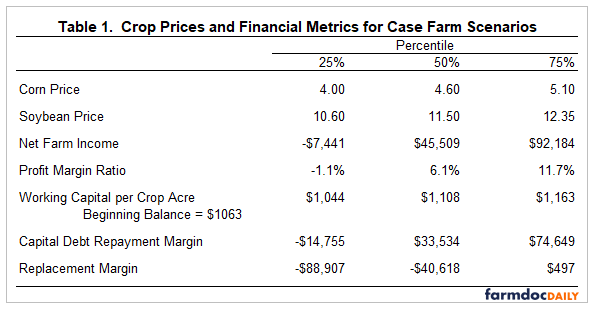
Table 1 presents crop prices and financial metrics for each crop price scenario. The only difference between the scenarios are the expected crop prices for fall sales and ending inventories. Net farm income and the profit margin ratio were negative for the low-price scenario (25th percentile). Similarly, the capital debt repayment margin was negative for this scenario. The negative capital debt repayment margin indicates that this farm does not have enough cash flow from operating and financing activities to fully cover principal and interest payments on noncurrent debt. Net farm income, the operating profit margin ratio, and the capital debt repayment margin were positive for the base case and high-price scenario (75th percentile). Moreover, the replacement margin was positive for the high-price scenario, indicating that the farm could replace the portion of machinery and buildings that wore out during the year. Working capital per crop acre declined $19 for the 25th percentile and increased $45 and $100 for the 50th and 75th percentiles, respectively. Given the relatively higher net farm income for the high-price scenario, the farm would be in position to purchase machinery and/or buildings in 2026. Cash used for replacement (i.e., 1.15 x depreciation expense) for this farm is approximately $73,850. If the farm does not purchase any machinery in 2026, it will not be able to replace the value of machinery that was depreciated during the year. Long-term, it will need to do so.
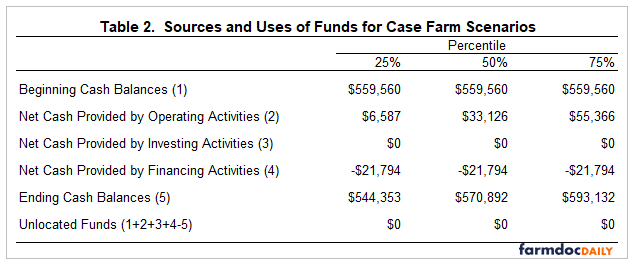
The primary categories for projected sources and uses of funds are illustrated in Table 2. The net cash provided by investing activities excludes potential asset sales and purchases. The net cash provided by financing activities was negative reflecting the payment of term debt during the year. Net cash from operating activities ranged from $6,587 for the low-price scenario to $55,366 for the high-price scenario. Note that depreciation, because it is a non-cash expense, is not subtracted from cash farm receipts when computing net cash provided by operating activities. Depreciation is projected to be approximately $64,220 in 2026. Thus, to at least some extent, this farm would be living off of depreciation under each of the price scenarios. The ending cash balance was lower than the beginning cash balance for the low-price scenario. For the high-price scenario, the ending cash balance was approximately $44,000 higher than the beginning cash balance.
Summary and Conclusions
This article briefly discussed the use of contingency planning to project cash flow and repayment capacity. As cash flows from the farm operation become tighter, it is necessary to find other funds to help pay for asset purchases or delay asset purchases, and to repay debt. A case farm was used to illustrate how contingency plans could be used. Unless crop price prospects improve it would be difficult for the case farm to purchase assets, such as machinery and equipment, later this year. Working capital will be drawn down to meet term debt obligations under one of the three crop price scenarios examined, even if the farm does not purchase machinery and equipment in 2026. Given the potential volatility of crop prices this summer, it would be prudent to periodically update cash flow projections.
References
Langemeier, M. “Sources and Uses of Funds Statement.” Center for Commercial Agriculture, Purdue University, August 23, 2019.
Disclaimer: We request all readers, electronic media and others follow our citation guidelines when re-posting articles from farmdoc daily. Guidelines are available here. The farmdoc daily website falls under University of Illinois copyright and intellectual property rights. For a detailed statement, please see the University of Illinois Copyright Information and Policies here.