








Non-GMO Soybeans Profitability: Experience from PCM
About 10% of the soybean fields in Precision Conservation Management (PCM) raise varieties that do not contain Genetically Modified Organisms (GMOs). From 2020 to 2025, yields from non-GMO fields averaged the same as from GMO fields. Non-GMO fields typically have about $15 per acre in higher costs than GMO fields. With $1 to $2 per bushel premiums for non-GMO soybeans, non-GMO fields will be more profitable than GMO fields, ignoring additional cleaning, segregation, and storage costs associated with non-GMO soybeans. Premiums would likely decline if more farmers begin raising non-GMO soybeans.
Background
We summarize data from Precision Conservation Management (PCM), a farmer service program led by the Illinois Corn Growers Association, in partnership with over 30 entities, including other commodity associations, conservation groups, private foundations, supply chain providers, the Soil and Water Conservation Districts, and the Natural Resources Conservation Service (NRCS). PCM was started in 2015 to address the goals of the Illinois Nutrient Loss Reduction Strategy. PCM’s mission is to help farmers make financially responsible decisions about adopting on-farm conservation practices. PCM regional specialists work one-on-one with over 500 farmers in Illinois, Kentucky, and Nebraska (see PCM website).
We summarize soybean fields enrolled in PCM located in central Illinois for the last six crop years from 2020 to 2025. We divide the fields that grow soybeans into two groups: those using genetically modified seed varieties (GMOs) and those that don’t, hereafter referred to as non-GMO.
We further divide those fields into high- and low-Soil Productivity Rating (SPR) categories. SPRs are calculated for the fields using data from Bulletin 811, Optimum Crop Productivity Ratings for Illinois Soils. Fields in the high-productivity category have SPRs above 130 and generally have higher average yields. Low productivity fields have SPRs below 130. Comparison across SPRs will help determine whether profitability varies with soil productivity.
On average, there are slightly over 1,358 fields per year in the analysis, with a slight upward trend over time. More of the fields are in the High SPR range: a 926 average for High SPR and a 432 average for Low SPR. On average, 10% of the fields are non-GMO each year, roughly matching the split of acres between GMO and non-GMO indicated by the U.S. Department of Agriculture.

The following sections summarize average yields, revenues, production practices, and cost differences associated with the GMO and non-GMO systems.
Yields from GMO and non-GMO Fields
For high SPR fields, yields averaged 72.2 bushels per acre for the years from 2020 to 2025 (see Table 1). Non-GMO fields averaged 2.1 bushels per acre more at 74.3 bushels per acre. In each year from 2020 to 2025, non-GMO fields had a higher average yield than GMO fields.
For low SPR fields, non-GMO fields averaged 65.0 bushels per acre, .6 bushels more than the 64.4 bushels per acre (see Table 1). For low SPR fields, GMO fields had higher yields than non-GMO fields in two years: 2020 (2.2 bushels per acre more) and 2024 (3.4 bushels per acre more).
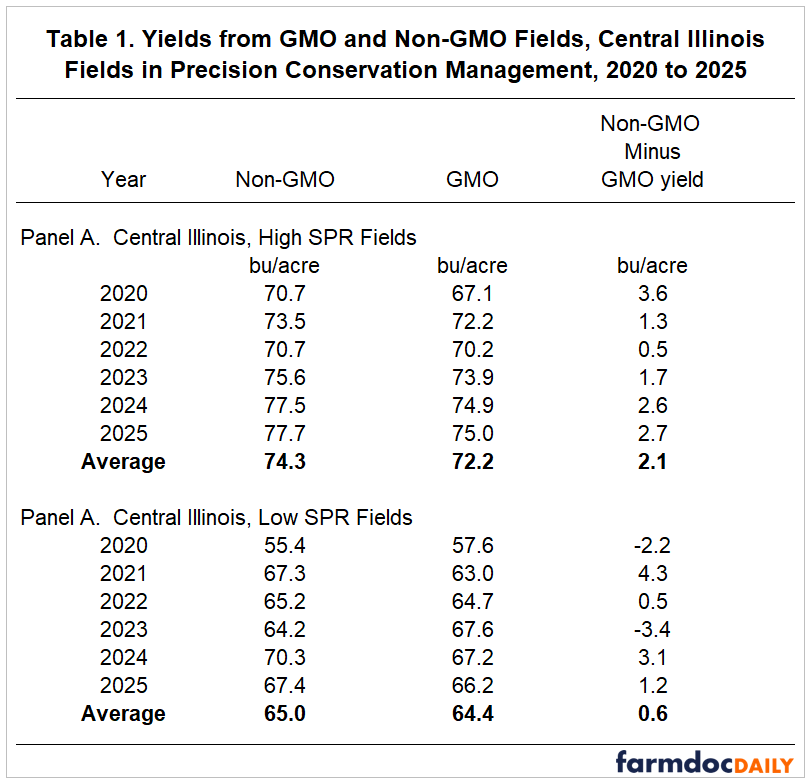
Substantial variability in yields across fields, resulting in a simple statistical test of means from GMO and non-GMO fields finding no difference in yields between GMO and non-GMO fields.
Premiums and Revenue
Premiums often exist for non-GMO production. Those premiums will vary from year to year, with premiums historically in the range of $1 to $2 per bushel above the Chicago Board of Trade price in Illinois (see the slide download and farmdoc webinar entitled “Premium Crop Market Opportunities”). Given a $.30 basis, that range translates to $1.30 to $2.30 per bushel.
Given no yield drag, revenue from non-GMO fields will be higher. At a 73 bushels per acre yield — the average for high SPR fields — revenue will be $95 per acre higher at a $1.30 per bushel premium and $168 per acre higher at a $2.30 per bushel premium. At a 65 bushels per acre average yield — the average for low SPR fields — revenue will be $85 per acre higher for a $1.30 per bushel premium and $150 per acre higher at a $2.30 per bushel premium.
Production Practices
There are differences in production practices across fields with and without GMOS:
Seed: Seed variety choices affect costs, and non-GMO varieties are typically lower cost than GMO varieties. However, some non-GMO varieties can have similar or even higher prices than do some GMO varieties. Overall, seed cost savings would be considered typical for non-GMOs.
Tillage: More tillage is generally used on non-GMO fields, resulting in higher costs. In 2025,
- 60% of the GMO fields used no-till compared to 27% for non-GMO fields.
- 23% of the fields used one-pass systems in both the GMO and non-GMO systems. One-pass systems have a single tillage pass, such as a vertical tillage operation.
- 15% of the GMO fields used a two-pass system compared to 48% for non-GMO fields.
Chemical: Non-GMO systems use different pesticides than do GMO systems, which can result in higher chemical costs. Glyphosate and Glufosinate cannot be used in non-GMO systems once the crop has sprouted. Overall, non-GMO fields use more active ingredients (AIs) in their pesticide programs. Non-GMO fields had an average of 8.9 AIs for all herbicides, insecticides, and fungicides. That 8.9 AI average for non-GMO fields was .8 higher than for GMO fields.
Costs
Overall, those differences in production practices result in higher non-land costs for non-GMO systems than for GMO systems. Non-land costs include direct costs (fertilizer, seed, pesticides, drying, storage), power costs (equipment-related costs), and overhead (see Illinois Crop Budgets for categories). Those non-land costs also include financial costs of moving grain to its first storage. Land costs are not included in the total.
Non-land costs are typically are about $15 higher for non-GMO systems, with some variation across tillage practices.
- Non-land costs for no-till systems averaged $376 per acre from 2020 to 2026 for non-GMO systems, $14 higher per acre than $362 per acre for GMO systems
- Non-land costs for one-pass systems averaged $376 per acre for non-GMO systems, $15 higher per acre than $361 per acre for GMO systems.
Profitability and Commentary
Non-GMO fields in central Illinois within PCM do not have lower yields than GMO fields. Given a $1.30 to $2.30 per bushel premium, non-GMO fields will be more profitable despite the additional $15 per acre in costs. The $85 to $168 in additional revenue from non-GMO premiums will cover those costs and provide an additional profit margin.
Those additional costs are also associated with additional burdens. Non-GMO production will require grain segregation, which will necessitate cleaning the combine, grain-hauling, and grain-handling equipment. Non-GMO production will require changes in production practices, including, and prominently, the chemical program. Often, non-GMO production will require on-farm grain storage. If a farmer lacks suitable grain storage, non-GMO production may not be a viable option. Moreover, the delivery of non-GMO grain may require coordination with the purchaser and a longer hauling distance than GMO soybeans.
Also, premiums for non-GMO grain could be significantly reduced if more farmers grow non-GMO varieties. As the supply of farmers willing to supply non-GMO grains increases, the premiums necessary to fulfill non-GMO demands will decline, assuming no change in demand patterns.
Disclaimer: We request all readers, electronic media and others follow our citation guidelines when re-posting articles from farmdoc daily. Guidelines are available here. The farmdoc daily website falls under University of Illinois copyright and intellectual property rights. For a detailed statement, please see the University of Illinois Copyright Information and Policies here.