








Rethinking Phosphorus and Potassium, Part 1: Soil Testing 101
History of Soil Fertility: the Pre-Testing Period
The University of Illinois has long been a pioneer in the science of soil fertility, with foundational research to support nutrient management recommendations dating back to the late 1800s. Arguably, the Morrow Plots – celebrating their 150th anniversary this year – serve as a milestone of how far the science of soil fertility has come. Designed to study the impact of crop rotations on yields and soil properties, the Morrow Plots sought to address challenges farmers were facing at the time: virgin prairie was running out, corn yields were starting to sag to 25-40 bu/ac in the latter 1880s from the 60-80 and even 100 bu/ac reported in the 1820s after breaking the prairie (Woods, 1822). Many Europeans (Hopkins, 1910) and even the USDA (King, 1911) were sounding the alarm on how long agriculture could continue in the Midwest. Farmers utilized few fertility inputs beyond manure, which combined with residue harvest, resulted in a net export of nutrients from Illinois croplands: more nutrients removed with harvest than returned. The result was steadily declining fertility of Illinois soils.
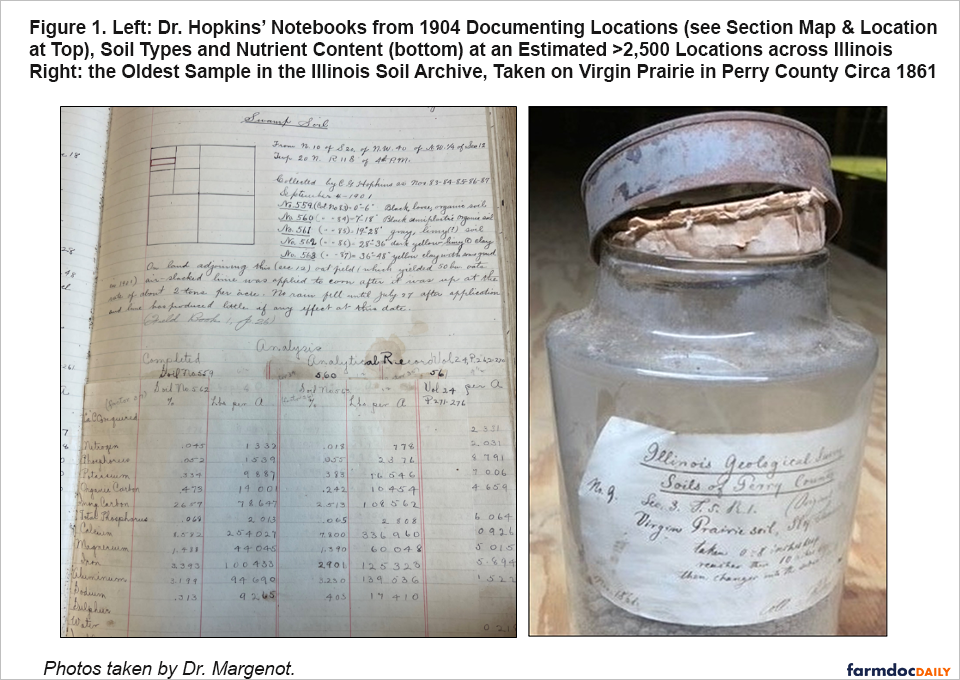
Shortly before the turn of the 20th century, a South Dakota farmboy named Cyril Hopkins arrived on campus for his doctoral work on corn breeding. Likely intrigued by the “composition of the corn kernel” that was his dissertation project, Dr. Hopkins remained on campus as Professor of Agronomy (1900-1919) to develop a system of “permanent agriculture” adoptable by Illinois farmers. Hopkins was considered by many a heretic for believing that soil must be replenished with nutrients by applying manure and phosphate rock. To support a systems approach for site-specific management, Hopkins set out to quantify the total “plant food” stored in Illinois soils, specifically the stocks (lb/ac to 3’ depth) of nutrients such as phosphorus (P), and potassium (K). Many of the original soil samples and notebooks (Figure 1) from this era and through the 20th century are held in the newly curated Illinois Soil Archive and are being analyzed for insights on changes in soils over the past >120 years (NREC Award: 2021-4-360731-469).
Moving From Total to Available: the Challenge of the 20th Century
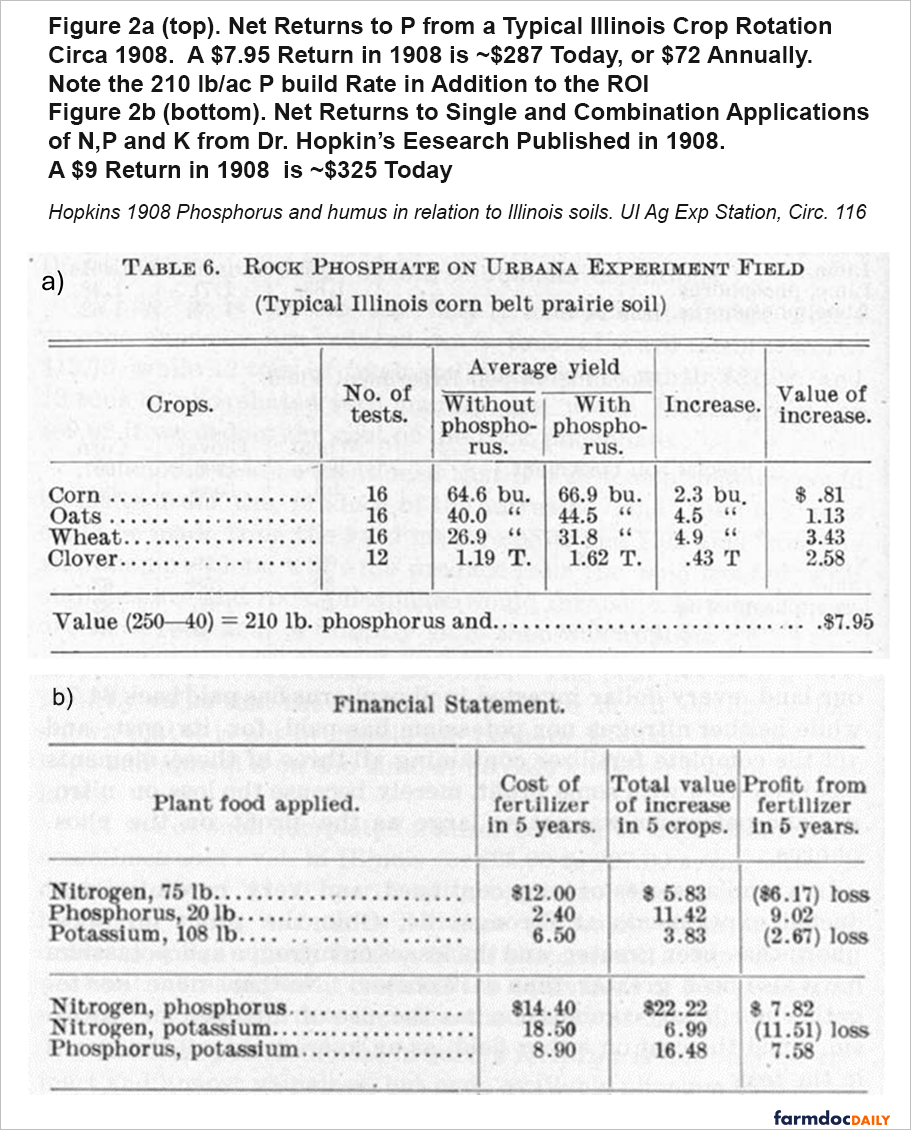
As any agronomist knows, the total amount of a nutrient in the soil is different from the crop available portion, which is generally smaller and varies by soil properties. Arguably, we have not yet found a way to measure “crop available” nutrients to this day. Instead, we have settled for “operational” measures that “get the job done”. In the absence of modern tools, Hopkins addressed this by understanding how to replace “plant food” removed with crop harvest – and the economics of this approach. His research showed that commercial N and K sources rarely achieved a positive return ($/ac) – but P often paid (Figure. 2). Since N could be more economically provided by rotations with legumes, Hopkins developed the “Illinois System of Permanent Soil Fertility” that featured (1) legume forage crops for N, (2) liming to enable maximum N fixation by the legumes, and (3) phosphate rock for P. Hopkins would never live to see the beginnings of soil testing for fertility management: he died in 1919 from malaria while studying soils in Greece and is buried at Mount Hope Cemetery.
A few decades later, Professor Bray and his then-student Kurtz developed what is believed to be the first successful soil nutrient test in the world: the Bray test, also known as Bray-1, “P1” or Bray-Kurtz. Patented in 1943, Bray and Kurtz developed a simple chemical extraction that targeted forms of soil P hypothesized to be crop-available. Much of the initial work was descriptive: identifying Bray-1 values associated with higher vs lower crop yields, and with and without P inputs. By the late 20th century, calibrations that related Bray-1 values (and other soil test extractants) to crop yield response probability were developed.
Soil Testing in the 21st Century: Will What Got Us Here, Take Us There?
Our modern soil test recommendations for P and K have built upon the foundation laid in the second half of the 20th century following the seminal work by Bray and Kurtz. Today, most commercial labs now utilize the Mehlich-3 test as a “universal” extractant for utility across acidic to circumneutral soils, relatively rapidity, and utility in assessing crop yield response to P and K extracted. In fact, if you see a Bray-1 result today it was most likely converted from Mehlich-3 to Bray-1, not actually analyzed by “wet chemistry”. While soil testing results are often reported as lbs/acre (ppm multiplied by 2 with 6” sampling depth & assumed bulk density of 1.33 g/cm3), they are not a direct measure of the pounds of available nutrients in the soil. Here, it is vital to understand that these tests were not designed to measure the pool of crop “available” nutrient in the soil but are operational tests for predicting the likelihood of a crop yield (or net return) response to nutrient additions. In other words, soil tests are meant and most useful to guide application decisions. To do this, soil test thresholds known as critical soil test values (CSTVs) are used. In the current iteration of the Illinois Agronomy Handbook, these values are beneath the leftmost blue/green vertical line (Chapter 8, figures 8.5 & 8.8). While the definitions and methods for calibration vary, soil tests do a reasonably good job of identifying this likelihood.
The metric of relative yield is key to standardizing yield responses to fertilizer at a given soil test value in different soil types and growing conditions. Relative yield (RY) is the ratio of yield without the nutrient (e.g., no P) relative to yield with the nutrient added (e.g., P fertilization). RY is then correlated to the soil test value of the two plots before fertilization of the +nutrient plot. Across many such paired plots encompassing a range of soil test values, the relationship of RY and soil test values can be identified. When well-calibrated, the probability of a yield response from fertilization is higher in fields below the CSTV.
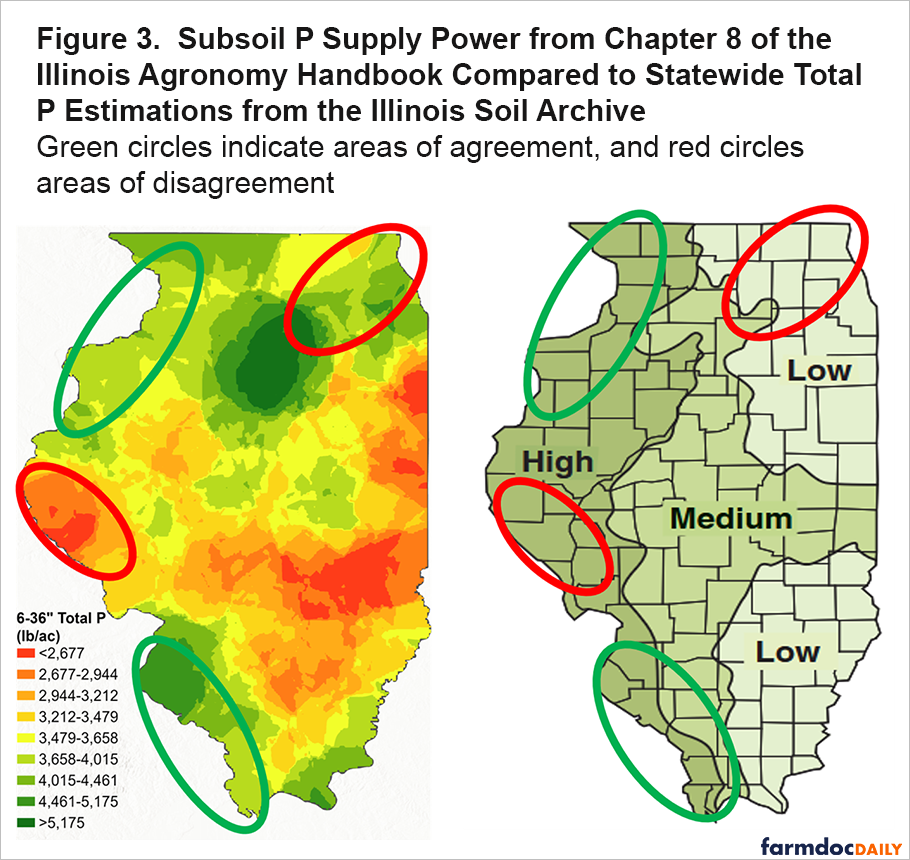
Unique to Illinois, and a nod to Hopkins work on mapping “plant food” across the state, the Illinois Agronomy Handbook CSTV values are also tiered by estimated subsoil P supply power statewide. This concept postulates that soils with higher subsoil supply power of P can provide more P to the crop, and thus surface concentrations of soil test P can be lower for yield maximization (i.e., lower CSTV value) than those with lower subsoil supply power. Historic estimations of P supply power were based on glaciation and loess deposits; however, we can now directly measure statewide total P stocks thanks to the historic Illinois Soil Archive (Figure 1). As highlighted below (Figure 3), analysis of soils to 36” depth across the state indicate that statewide total P reserves do not necessarily match the Handbook map. Analogously, for K, CEC maps are used in a similar tiered system, assuming soils with higher CEC may require more K to ensure crop response. Recent evidence on the importance of mineralogy from North Dakota and Minnesota, indicates potential in future analyses for refining soil test K interpretation (Franzen, 2023; Kaiser & Rosen, 2018).
Future Considerations
While soil testing strategies and recommendations have improved since the early 1900s, agricultural needs of the 21st century may require more. One foundation of early P and K fertility recommendations in Illinois diminished in recent decades is considering the economic return to P and K. This concept is already present in the MRTN calculator: why not too, for P and K? In other words, rather than soil testing for yield response, we should consider net $/ac return in an MRTP and MRTK. Doing so is a return, but with new tools, to the concepts laid forth by Hopkins in the 1910s. This approach stands to improve profitability during periods of high input and low crop prices. It should be noted that skipping a maintenance application on fields with adequate fertility in lean margin years may provide an economic boost to the farm and is perfectly acceptable in the short-term.
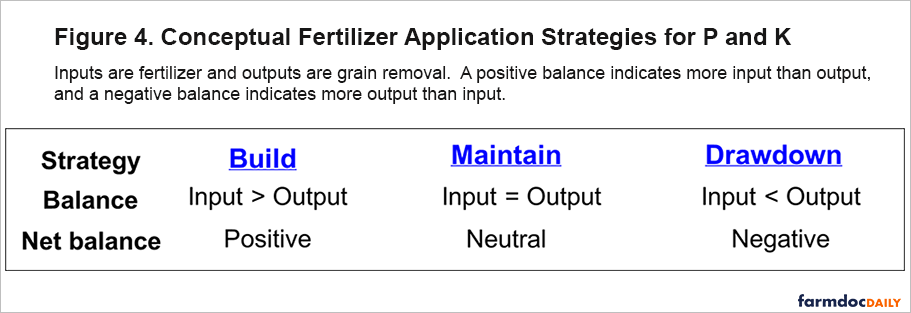
How to address nutrient removal rates with harvest brings up an arguably overlooked point for increasing profitability of P and K on farm. Accurate estimations of inputs (fertilizer) and outputs (grain removal) are essential for any fertilization strategy (Figure 4). This will be the focus of the next part of this series, motivated by a simple question: how do we know that we have the correct crop removal rate?
Summary
Soil tests are operational tools meant to predict the likelihood or probability of a crop response to a P or K application. Soil tests do not represent a literal amount (lb/ac) of crop-available nutrients, and mask complexity in how the actual available pool is replenished by soil chemical and biological processes. That’s ok; operational tools are useful. Soil testing unleashed a step up in precision for P and K management in the second half of the 20th century and stands to be further refined. However, to increase precision – and profitability – of P and K management, evidence is growing that soil testing may not be able to take us where we want. For this, we will next explore an overlooked opportunity for making more accurate and precise decisions on P and K based on testing of grain, not soils.
References
University of Illinois at Urbana-Champaign. Cooperative Extension Service. Illinois Agronomy Handbook (Vol. 1394). University of Illinois at Urbana-Champaign, College of Agriculture, Cooperative Extension Service, 2009.
Hopkins, Cyril G. Phosphorus and Humus in Relation to Illinois Soils. Circular No. 116. University of Illinois Agricultural Experiment Station, 1908.
Franzen, D. W. North Dakota Fertilizer Recommendation Tables and Equations. SF882. North Dakota State University Extension, 2023. https://www.ndsu.edu/agriculture/extension/publications/north-dakota-fertilizer-recommendation-tables-and-equations
Hopkins, Cyril G. European Practice and American Theory Concerning Soil Fertility. Circular No. 142. University of Illinois Agricultural Experiment Station, 1910. https://hdl.handle.net/2142/33073
Kaiser, Daniel E., and Carl J. Rosen. Potassium for Crop Production. University of Minnesota Extension, 2018. https://extension.umn.edu/phosphorus-and-potassium/potassium-crop-production
King, Franklin H. Farmers of Forty Centuries: Organic Farming in China, Korea, and Japan. Dover Publications, 1911.
Woods, John. Two Years' Residence in the Settlement on the English Prairie, in the Illinois Country, United States: With an Account of Its Animal and Vegetable Productions, Agriculture, &c. &c., a Description of the Principal Towns, Villages, &c. &c., with the Habits and Customs of the Back-Woodsmen. London: Printed for Longman, Hurst, Reessa, Orme, and Brown, 1822. https://catalog.hathitrust.org/Record/008652360
Disclaimer: We request all readers, electronic media and others follow our citation guidelines when re-posting articles from farmdoc daily. Guidelines are available here. The farmdoc daily website falls under University of Illinois copyright and intellectual property rights. For a detailed statement, please see the University of Illinois Copyright Information and Policies here.