








How Farmer Sentiment Compares in the United States and Argentina
Despite facing similar pressures on farm finances, such as high input costs and low commodity prices, farmers in the United States and Argentina see the years ahead quite differently. This is one of the key findings from the first direct comparison of two established producer sentiment surveys: the Purdue University–CME Group Ag Economy Barometer in the United States and the Austral Ag Barometer in Argentina. In this article, we bring together data from the two barometers to compare producer perspectives in these major agricultural producers and exporters. Using a common set of questions asked during the May-June 2026 period, we examine views on the crop and livestock sectors, farmland values, and the factors affecting farm financial conditions.
Data and Methods
This study uses data from two established producer sentiment surveys: the Purdue University–CME Group Ag Economy Barometer in the United States and the Austral Ag Barometer in Argentina. The U.S. barometer is a nationwide survey of U.S. agricultural producers conducted monthly since October 2015. It is based on interviews with at least 400 producers and tracks perceptions of current economic conditions, expectations for the future, and issues such as farm finances, investment expectations, farmland values, and U.S. policy and trade issues. The Austral Ag Barometer, developed by the Universidad Austral in Rosario, measures agricultural producer confidence in Argentina. Conducted every two months since 2018, the survey also includes approximately 400 producers and examines perceptions of current and future economic conditions, investment expectations, and other issues affecting Argentine agriculture.
Five common questions were included in both barometers for the May–June 2026 comparison. Because the Purdue–CME Ag Barometer is conducted monthly, responses from its May and June surveys were averaged to align with the May–June survey of the Austral Ag Barometer. For three questions – the five-year outlook for crop producers, the five-year outlook for livestock producers, and 12-month farmland price expectations – respondents selected a single response category, allowing direct comparison of response shares between the two surveys. For the questions on factors influencing farmland values and factors limiting improvements in farm financial conditions, the Austral Ag Barometer allowed respondents to select multiple factors, whereas the Purdue–CME Barometer asked respondents to identify the single most important factor. Accordingly, results for these two questions should be interpreted as comparisons of the relative importance of factors within each country rather than as directly equivalent response shares across surveys.
Producers’ Outlook for Crop and Livestock Sectors
Producer expectations for the agricultural sector differed between the United States and Argentina, with Argentine producers expressing a much more favorable medium-term outlook for crop production than their U.S. counterparts (see Figure 1). Among U.S. respondents, 57% said they expected widespread bad times for crop producers over the next five years, while only 28% expected good times. In Argentina, the outlook was considerably more positive: 53% of respondents expected good times for crop producers, while just 4% anticipated bad times. Argentine respondents were also more likely to report a neutral outlook, at 43%, compared with 16% of U.S. respondents.
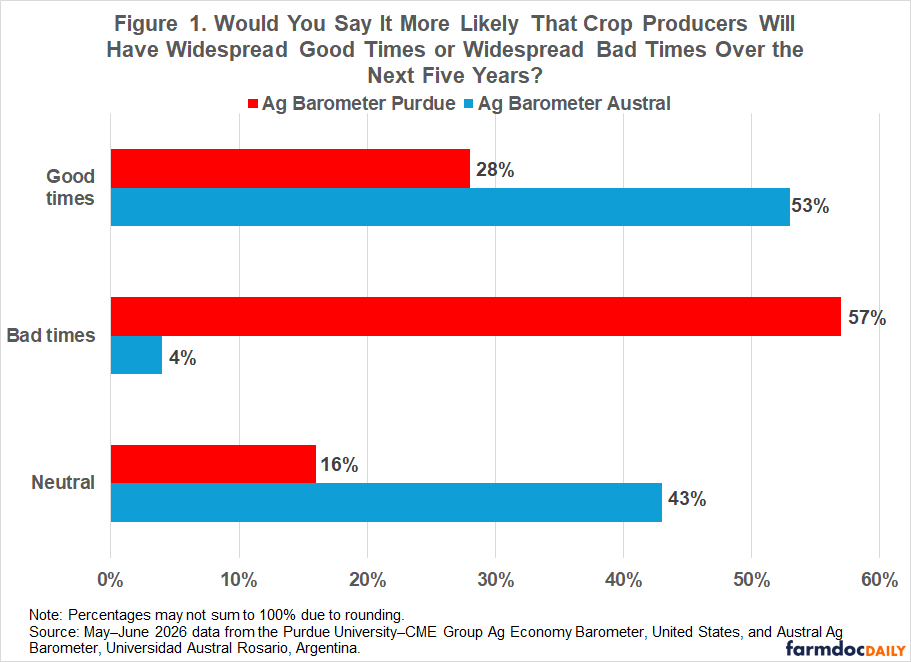
The more pessimistic outlook among U.S. crop producers is consistent with tighter expected margins. Crop producers entered 2026 facing weak commodity prices, elevated production costs, and strong global competition, conditions that continued to put pressure on expected crop margins. In Argentina, the optimism does not necessarily imply that current profitability is high. Instead, it may partly reflect perceptions of a more favorable institutional environment for investment. The reduction in export taxes, greater market openness, and improved access to dollar-denominated credit have strengthened expectations about future returns, even while commodity prices remain relatively weak.
Expectations for the livestock sector were more positive in both countries (see Figure 2). In the United States, 68% of respondents expected widespread good times for livestock producers over the next five years, compared with 16% who expected bad times. Optimism was even stronger in Argentina, where 80% expected good times and only 1% anticipated bad times. The share of respondents reporting a neutral outlook was similar across the two surveys, at 17% in the United States and 19% in Argentina.
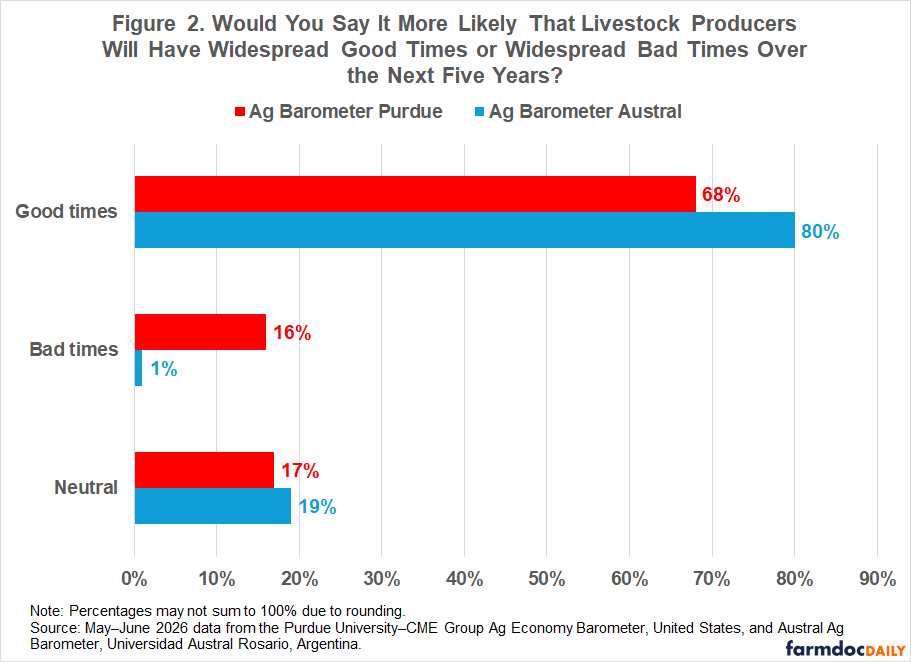
For livestock, the broadly optimistic expectations in both countries likely reflect favorable market conditions for the cow/calf sector, including strong prices and relatively tight supplies. In Argentina, optimism may also have been reinforced by recent reductions in beef export taxes and the easing of restrictions on livestock exports. Beyond strong cattle prices, Argentine producers also anticipate a rebuilding phase of the national herd. Improved export conditions and the availability of relatively low-cost dollar financing have encouraged investment in breeding females, reinforcing long-term optimism in the livestock sector.
Farmland Price Expectations and Drivers
Argentine producers were more likely to anticipate farmland price appreciation for the year ahead, whereas U.S. producers were more inclined to expect stability. In the United States, 57% of respondents expected farmland prices to remain about the same over the next 12 months, while 35% expected higher prices and 8% anticipated lower prices (see Figure 3). In Argentina, 50% of respondents expected farmland prices to increase, compared with 46% who expected prices to remain about the same and only 4% who anticipated a decline.
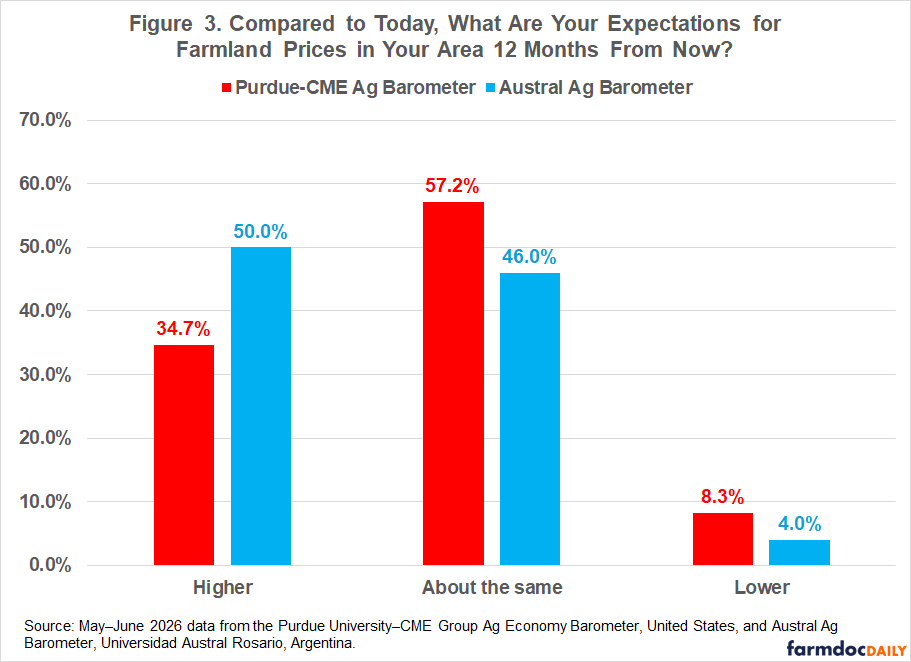
The more optimistic farmland price expectations among Argentine producers may reflect improving expectations for farm income and broader economic conditions. In the United States, farmland values are already high, while higher interest rates and production costs may limit further price increases. In Argentina, inflation, exchange-rate changes, and recent reductions in agricultural export taxes may support expectations for higher farm income and farmland values. An additional factor is the relative valuation of Argentine farmland. Many producers perceive that agricultural land remains undervalued after years of policy instability. If institutional conditions continue to improve, farmland appreciation could be viewed as a recovery of value rather than the beginning of a speculative cycle.
The factors perceived as most influential on farmland values also differed between the United States and Argentina. Among U.S. respondents, alternative investments ranked first, followed by interest rates and net farm income. In Argentina, net farm income ranked as the most influential factor, followed by agricultural policy, alternative investments, and liquidity (see Table 1).
Table 1. Factors Influencing Farmland Values, by Rank
| Rank | Purdue–CME Ag Economy Barometer | Austral Ag Barometer |
| 1 | Alternative investments (31%) | Net farm income (49%) |
| 2 | Interest rates (19.2%) | Agricultural policy (44%) |
| 3 | Net farm income (19.1%) | Alternative investments (34%) |
| 4 | Inflation (17%) | Liquidity (30%) |
| 5 | Agricultural policy (8%) | Interest rates (15%) |
Note: U.S. respondents selected the single most important factor, while Argentine respondents could select multiple factors. Therefore, percentages for the Austral Ag Barometer may sum to more than 100%. Only the five highest-ranked factors are shown; therefore, the U.S. percentages displayed in the table do not sum to 100%.
Source: May–June 2026 data from the Purdue University–CME Group Ag Economy Barometer, United States, and Austral Ag Barometer, Universidad Austral, Argentina.
The economic conditions facing farmers in each country help explain these contrasting results. In the United States, farmland values appear to be influenced more by broader financial factors, such as interest rates and alternative investments. In Argentina, producers placed greater emphasis on farm income, agricultural policy, and liquidity, indicating a stronger connection between farmland values, farm profitability, and the policy environment.
Factors Limiting Improvements in Financial Conditions
While producers differed in their outlooks and farmland price expectations, they reported relatively similar concerns about the factors limiting improvements in their farms’ financial conditions. High input costs ranked first in both countries (see Table 2). Fertilizer costs were an important source of this pressure in May and June, with global fertilizer markets affected by higher energy costs and supply disruptions associated with the conflict in the Middle East (Colussi and Langemeier, 2026). In the United States, high input costs were followed by weather risk and low output prices, while in Argentina, low output prices and weather risk ranked next.
Table 2. Factors Limiting Improvement in Farm Financial Conditions, by Rank
| Rank | Purdue–CME Ag Economy Barometer | Austral Ag Barometer |
| 1 | High input costs (44%) | High input costs (58%) |
| 2 | Weather risk (17%) | Low output prices (48%) |
| 3 | Low output prices (15%) | Weather risk (40%) |
| 4 | Labor and equipment concerns (9%) | Policy uncertainty (34%) |
| 5 | Debt or financial pressure (6%) | Debt or financial pressure (22%) |
Note: U.S. respondents selected the single most important factor, while Argentine respondents could select multiple factors. Therefore, percentages for the Austral Ag Barometer may sum to more than 100%. Only the five highest-ranked factors are shown; therefore, the U.S. percentages displayed in the table do not sum to 100%.
Source: May–June 2026 data from the Purdue University–CME Group Ag Economy Barometer, United States, and Austral Ag Barometer, Universidad Austral, Argentina.
One difference between the two countries was the importance of policy uncertainty. While it was not among the leading concerns of U.S. producers, it ranked among the main factors limiting financial improvement in Argentina. Argentine producers also operate under persistent institutional risk. Policy changes – including export taxes, exchange-rate regulations, and market interventions – not only affect current profitability but also alter long-term investment decisions. Consequently, institutional risk can amplify the effects of price, financial, and weather risks rather than acting as an isolated source of uncertainty.
Final Considerations
The comparison of the two ag economy barometers shows that farmers in the United States and Argentina entered mid-2026 with different views of the years ahead, particularly for crop production and farmland values. Argentine producers expressed a more favorable outlook for the crop sector and were more likely to expect farmland prices to increase, while livestock expectations were positive in both countries. At the same time, producers shared several concerns about farm finances, especially high input costs, low commodity prices, and weather risk.
The comparison also suggests that producer sentiment is influenced not only by market conditions but also by the institutional environment in which farmers operate. While producers in both countries face similar global economic pressures, differences in policy incentives, financial conditions, and institutional stability can help shape expectations about farmland values and the future of agriculture. Future comparisons of the two barometers could help track how these differences and similarities change over time.
References
Colussi, J. and Langemeier, M. “Middle East Conflict Revives Concerns Over Fertilizer Dependence in the U.S. and Brazil.” Purdue University–CME Group Ag Economy Barometer, April 20, 2026. Available at https://ag.purdue.edu/commercialag/home/resource/2026/04/middle-east-conflict-revives-concerns-over-fertilizer-dependence-in-the-u-s-and-brazil/
Langemeier, M. and Colussi, J. “High Input-Cost Concerns Continue to Weigh on Farmer Sentiment.” Purdue University–CME Group Ag Economy Barometer, July 7, 2026. Available at https://ag.purdue.edu/commercialag/ageconomybarometer/high-input-cost-concerns-continue-to-weigh-on-farmer-sentiment/
Langemeier, M. and Colussi, J. “Farmer Sentiment Slips Again as High Input Costs Remain Top Concern.” Purdue University–CME Group Ag Economy Barometer, June 2, 2026. Available at https://ag.purdue.edu/commercialag/ageconomybarometer/farmer-sentiment-slips-again-as-high-input-costs-remain-top-concern/
Disclaimer: We request all readers, electronic media and others follow our citation guidelines when re-posting articles from farmdoc daily. Guidelines are available here. The farmdoc daily website falls under University of Illinois copyright and intellectual property rights. For a detailed statement, please see the University of Illinois Copyright Information and Policies here.