








Changing Public Perceptions of AI and Data Center Development: Results from the Gardner Food and Agricultural Policy Survey
The social, economic, and environmental impacts of data centers and artificial intelligence (AI) are increasingly important issues facing communities across the country. Although most existing data centers are in urban areas, about two-thirds of new planned facilities are slated for rural communities, where larger sites can accommodate their growing need for developable land (Melotte, 2026). However, many rural communities have no experience hosting this emerging infrastructure (Seets and Radde, 2026). The pace of these developments, the increased media attention, and public opinion has begun to affect how states and communities respond.
Some states view data centers as economic development opportunities and have created incentives to attract investment (National Conference of State Legislatures, 2026), but others are starting to take a more cautious approach. For instance, Illinois—which has the 5th most data centers in the country (Data Center Map, 2026)—has paused the approval of state incentives for new data centers (Office of the Governor of Illinois, 2026). New York State has gone even further by enacting a temporary, statewide moratorium on large-scale data centers (New York State Executive Chamber, 2026). Pennsylvania is also looking to slow the development of large-scale data centers (Gelles and Thacker, 2026), and Texas is reconsidering the state’s approach to these projects (Goldmacher, 2026).
In February 2026, the Gardner Food and Agricultural Policy Survey (GFAPS) asked respondents to indicate their level of concern about the impact of AI/Data Center development on electricity costs, water usage, and the use of agricultural land—three issues that most commonly arise in news stories that focus on how these development impact rural and agricultural areas. These survey results—summarized in a June farmdoc daily article (White et al., 2026)—showed that rural residents were more concerned about AI/data center development than urban or suburban residents, and rising electricity costs emerged as the primary concern across all community types.
As AI and data center development accelerates, public perceptions continue to evolve. In this post, we analyze results from the latest wave of the GFAPS—conducted in August 2026—to examine how attitudes have changed over the past six months. We also assess respondents’ optimism about the potential benefits of a new local data center (e.g., increased tax revenue, new job creation, etc.). Combined, these findings highlight the shifting nature of public opinion toward AI and data center development.
About the Data
We use data from two waves of the GFAPS, wave 16 (conducted in February 2026) and wave 18 (conducted in August 2026). The survey is conducted quarterly online. Each wave, Qualtrics recruits 1,000 U.S. adults using quotas to match the U.S. population in terms of region, income, age, and gender. In this post, we review results from two questions. First, in both waves, respondents were asked, “On a scale from 1 to 7, where 1=not at all worried and 7=extremely worried, how worried are you that Artificial Intelligence (sometimes called AI) will result in the following outcomes?” Respondents were asked about three potential outcomes (1) agricultural land will be used for data centers, (2) over-use of water, and (3) new data centers will impact electricity costs. The order of these was randomized.
Additionally, in wave 18, we asked about potential benefits. Respondents were asked, “On a scale from 1 to 7 where 1=not at all optimistic and 7=extremely optimistic, how optimistic are you that if a new data center were built in your area, it would result in the following outcomes?” Here, respondents were asked about four potential impacts (1) Increased local tax revenue (e.g., property tax revenue), (2) Jobs created by the data center, (3) Increased business opportunities for local companies and suppliers, and (4) Infrastructure improvements (e.g., roads, utilities, broadband). Here, again, the order of items was randomized. Finally, we compare responses across community type, where respondents indicated whether their community was best described as urban, suburban, or rural.
Over the past half year, concerns about the potential impacts of AI/Data Centers have intensified.
Figure 1 shows that concerns about the potential impacts of AI/Data Center development increased between February 2026 and August 2026. For all three issues, the average concern level now exceeded five, whereas in February this was only true for concerns about electricity costs. With an average score of 5.52 (out of 7) rising electricity costs remained the issue worrying respondents, followed by the over-use of water (5.32 out of 7) and agricultural land being used to build new data centers (5.22 out of 7).
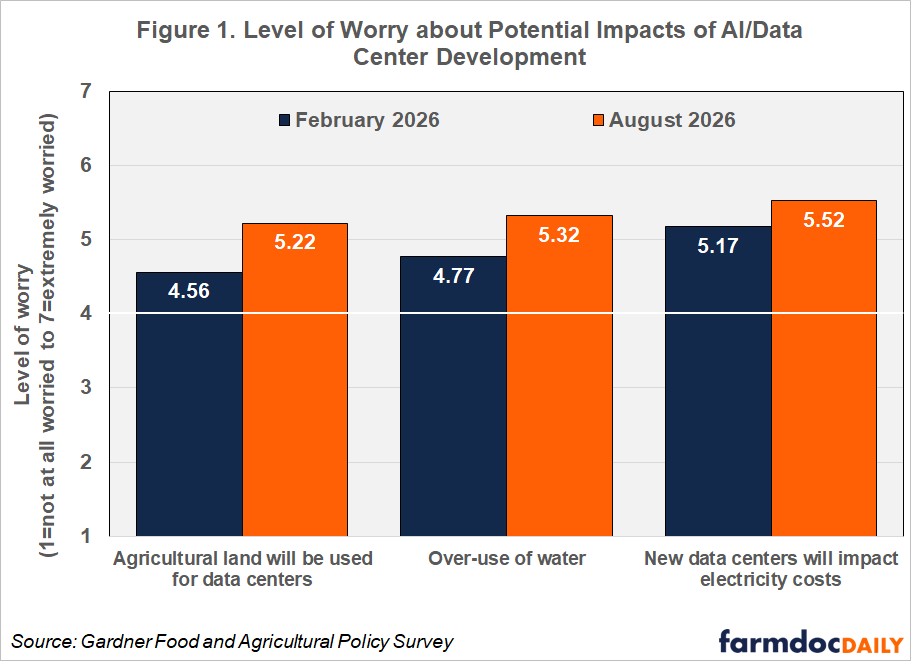
As with previous survey waves, we compared responses across community types (i.e., urban, suburban, and rural). Concern increased in every community type over the past six months, with rural residents consistently reporting the highest levels of concern. Across all three groups, the potential impact of new data centers on electricity costs remained the top issue, and rural residents expressed the greatest concern, averaging 5.83 on a 7-point scale.
Concern not only increased over time and across different community types, but the August survey results demonstrate that these concerns have also intensified. Figures 2A and 2B compare the share of respondents who reported being “very worried” about the impacts of AI and data centers (defined as selecting a 6 or 7 on the 1-to-7 concern scale), in February and August 2026. In February, only one issue exceeded the 50% threshold—concern among rural residents about the impacts of data centers. By August, however, more than half of all respondents in every community type identified as “very worried” about every issue examined, thereby highlighting the growing intensity of public concern.
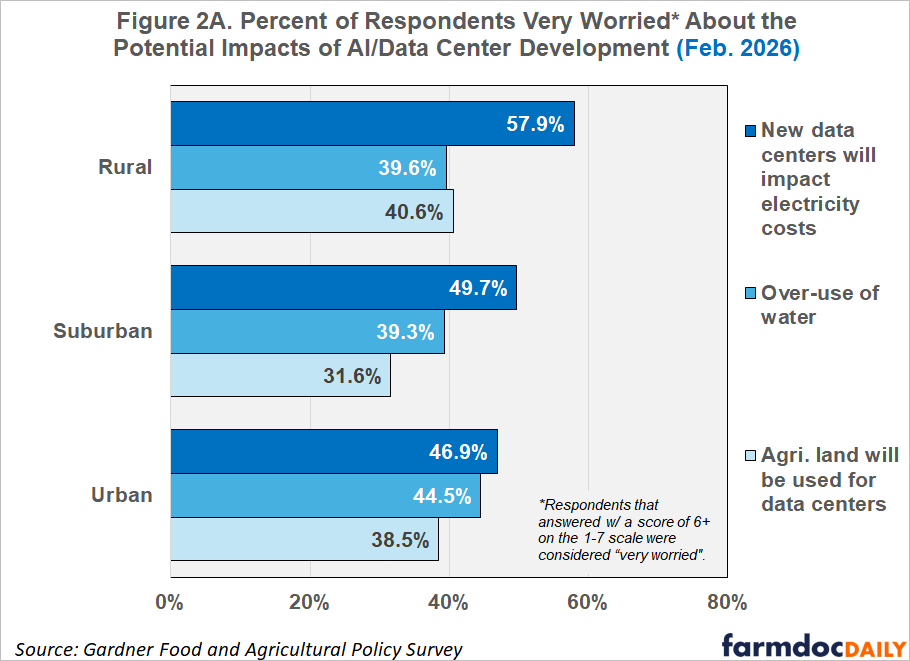
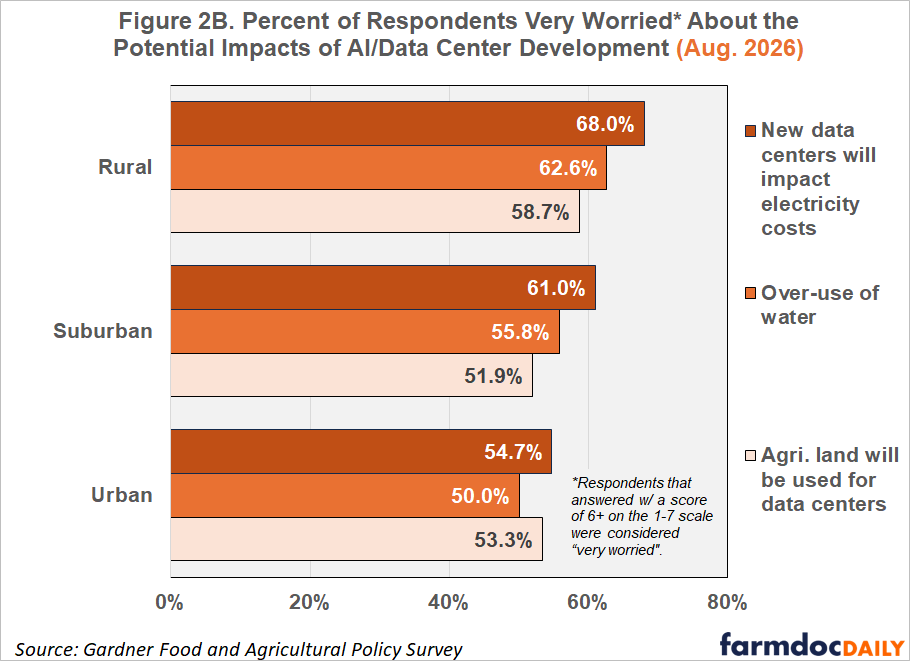
In some instances, concern rose sharply, especially among rural residents. Between February and August, the share of rural residents who were “very worried” about water overuse and the conversion of agricultural land to data center development increased by 23 and 18 percentage points, respectively. These relatively large, significant increases mirror other surveys documenting the growing numbers of Americans opposing data centers being built in their communities (e.g., Meyer, 2026; Jones, 2026; McClain and Park, 2026).
These findings further align with other evidence that highlights the growing demand for land suitable for data center development. For example, recent results from the Illinois Society of Professional Farm Managers and Rural Appraisers (ISPFMRA) mid-year survey showed that during the first half of 2026, 26% of the farm managers surveyed reported being approached by developers or brokers looking to buy or lease managed farmland to develop a data center (Tsay et al., 2026). Public concerns also increased substantially in suburban areas, where the share of respondents that were “very worried” about the conversion of agricultural land rose by 20 percentage points and concern about water overuse increased by nearly 17 percentage points.
The intensity of public concern outweighs the optimism about the potential benefits of AI/Data Center development.
Despite the concerns described above, many communities continue to pursue AI and data center development because they expect significant economic benefits. The main perceived benefits include increased tax revenue, job creation, infrastructure improvements, and opportunities for additional business investment (Boyce and Whitacre, 2026; Poole, 2026). The actual benefits arising from these development projects varies depending on the scale of the investment and the terms of any tax incentive or community benefit agreements. In many instances, the employment impacts are often overstated outside of the jobs created during the construction phase (Pipa and Aley, 2026).
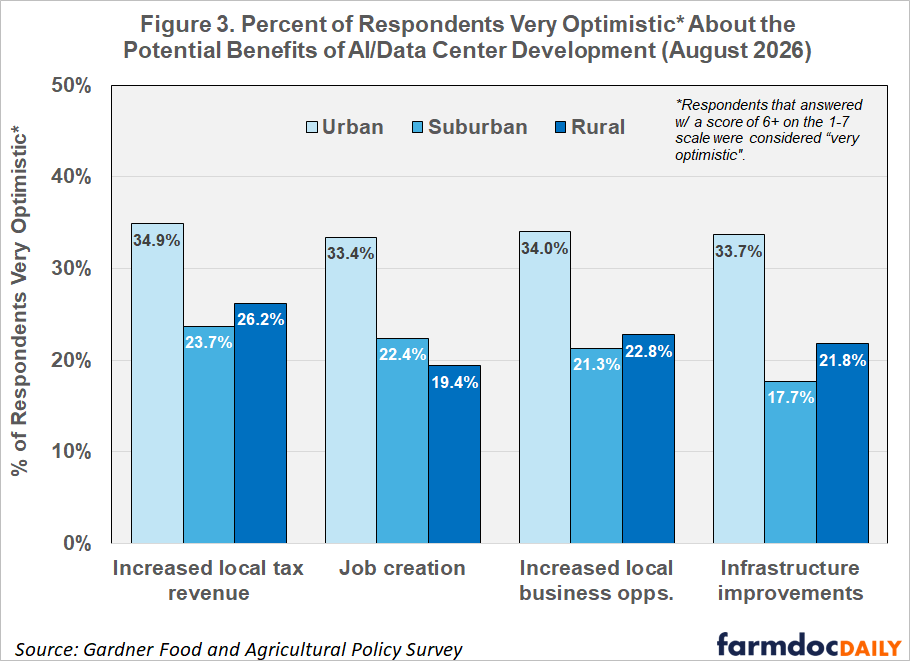
Given that public perceptions can influence the pace of these developments, the GFAPS sought to gauge public opinion about these perceived benefits. Overall, only one-quarter of respondents were ‘very optimistic’ about the benefits. By contrast, as noted above, half were very worried about the challenges arising from AI/Data Center development. Figure 3 shows that relative to public concerns, optimism about the potential benefits arising from AI/Data Center development appears more tepid across all community types. Urban residents expressed the greatest optimism, with roughly one-third being ‘very optimistic’ about potential benefits. This, however, was greater than the levels of optimism reported among suburban and rural residents. Across all community types, respondents viewed increased local tax revenue as the most likely benefit of data center development. Overall, however, optimism about the potential benefits of AI/Data Center development remain far behind concerns about the challenges.
Tracking public perceptions of data center development will continue
Public opinion surrounding data centers will remain important. AI will shape the future economy, and the data centers and infrastructure that supports AI will impact the communities where they are located. The survey results discussed above show that conversations about data center development have intensified in public discussions, thereby drawing greater attention to both the economic opportunities and community impacts associated with these projects. Data center development is also one of the few issues that draws concern across the political spectrum. As a result, GFAPS will continue to monitor these trends as public perceptions continue to evolve.
References
Boyce, M., & Whitacre, B. (2026, June). The economics of data centers: Considerations for communities (Fact Sheet AGEC-924). Oklahoma State University Extension. https://extension.okstate.edu/fact-sheets/the-economics-of-data-centers-considerations-for-communities
DataCenterMap. n.d. “USA Data Centers.” Accessed August 31, 2026. https://www.datacentermap.com/usa/.
Gelles, D., & Thacker, K. (2026, August 31). Pennsylvania's A.I. gold rush meets second thoughts. The New York Times. https://www.nytimes.com/2026/08/31/climate/pennsylvanias-ai-gold-rush-meets-second-thoughts.html
Goldmacher, S. (2026, August 23). The Data Center Backlash Bursts into the Midterms. The New York Times. https://www.nytimes.com/2026/08/23/us/politics/data-centers-midterm-elections.html
Jones, J. M. (2026, May 13). Americans oppose AI data centers in their area. Gallup. https://news.gallup.com/poll/709772/americans-oppose-data-centers-area.aspx
McClain, C., & Park, E. (2026, August 18). Young adults in the U.S. are increasingly wary of AI, concerned it will take jobs. Pew Research Center. https://www.pewresearch.org/short-reads/2026/08/18/young-adults-in-the-us-are-increasingly-wary-of-ai-concerned-it-will-take-jobs/
Melotte, S. A. (2026, September 2). The largest data centers planned in rural counties. The Daily Yonder. https://dailyyonder.com/the-largest-data-centers-planned-in-rural-counties/2026/09/02/
Meyer, R. (2026, August 19). Exclusive: 75% of Americans now oppose local data center development. Heatmap News. https://heatmap.news/daily/data-center-opposition-poll-collapse
National Conference of State Legislatures. (2026, April 1). Subsidizing servers: How states are competing to attract data centers. https://www.ncsl.org/fiscal/subsidizing-servers-how-states-are-competing-to-attract-data-centers
New York State Executive Chamber. (2026, July 14). Executive Order No. 62: Establishing a temporary moratorium on data centers in New York while the state develops higher standards for data center development and benefits blueprint to support localities. https://www.governor.ny.gov/executive-order/no-62-establishing-temporary-moratorium-data-centers-new-york-while-state-develops
Office of the Governor of Illinois. (2026, June 5). Gov. Pritzker pauses new data center tax incentives. https://gov-pritzker-newsroom.prezly.com/gov-pritzker-pauses-new-data-center-tax-incentives
Pipa, Anthony F., and Adam Aley. 2026. “The Local Implications of Data Centers for Rural Communities in the US.” Brookings Institution, March 2. https://www.brookings.edu/articles/local-implications-data-centers-rural-communities-us/
Poole, K. (2026). The Digital Backbone: Data Centers, Community Tradeoffs, and Regional Competitiveness. Center for Regional Economic Competitiveness. https://www.crec.net/2026/08/the-digital-backbone-data-centers-community-tradeoffs-and-regional-competitiveness/
Seets, Skyler, and Kaitlyn Radde. 2026. “Most New Data Centers in the U.S. Are Coming to Rural Areas.” Pew Research Center, April 13. https://www.pewresearch.org/short-reads/2026/04/13/most-new-data-centers-in-the-us-are-coming-to-rural-areas/
Tsay, J-H, Worrell, L., Schnitkey, G., and Gleason, T. (2026, August 27). Rents and Prices Outlook: Results from a Mid-Year Survey Conducted by the Illinois Society of Professional Farm Managers and Rural Appraisers [Webinar]. farmdoc daily. Available at: https://www.youtube.com/watch?v=lNcVXkeu8oM
White, M., S. Low, M. Kalaitzandonakes, J. Coppess and B. Ellison. "Rural Americans are Concerned About the Impact of Data Centers." farmdoc daily (16):111, Department of Agricultural and Consumer Economics, University of Illinois at Urbana-Champaign, June 25, 2026. https://farmdocdaily.illinois.edu/2026/06/rural-americans-are-concerned-about-the-impact-of-data-centers.html
Disclaimer: We request all readers, electronic media and others follow our citation guidelines when re-posting articles from farmdoc daily. Guidelines are available here. The farmdoc daily website falls under University of Illinois copyright and intellectual property rights. For a detailed statement, please see the University of Illinois Copyright Information and Policies here.