








US-Mexico Cattle Trade and Beef Markets
Mexico exported feeder cattle to the US until New World Screwworm (NWS) caused officials to stop this flow in 2025. Given the partial reopening in effect now, there is uncertainty about the level of live trade going forward.
We estimate the impacts on the US and Mexico going from baseline projections where live trade returns to pre-entry levels to an alternative case with less live trade. As expected, the shortfall in US supplies leads to higher feeder cattle, fed cattle, and beef prices, although US producer response moderates these impacts over time. The animals do not vanish but instead lead to greater beef production in Mexico. The beef trade impacts are more net imports into the US and more net exports from Mexico. Overall, the sector loses some efficiency as we see less total production at a higher price.
Live Animal Trade: Recovery or Flat?
The expansion of New World Screwworm (NWS) in Mexico led the USDA to close the border to cattle imports in May 2025 in an effort to curb its potential spread in the US. The US-Mexico border partially reopened in August 2026 and additional ports of entry opened in September 2026. This article compares what could happen to the US and Mexico beef markets under two different paths for live animal trade over the 2027-2031 period. The comparison illustrates how a potential future border closure could affect prices and production in the two countries.
Data and Methods
The FAPRI-MU baseline released in August 2026 assumed that live animal imports from Mexico would recover to historical levels over several years when it was published (available here). The blue line in Figure 1 shows the gradual recovery of feeder cattle imports to over 1.2 million head per year across all border crossing locations. This volume is similar to historical levels but is subject to variation due to market conditions in the projection period.
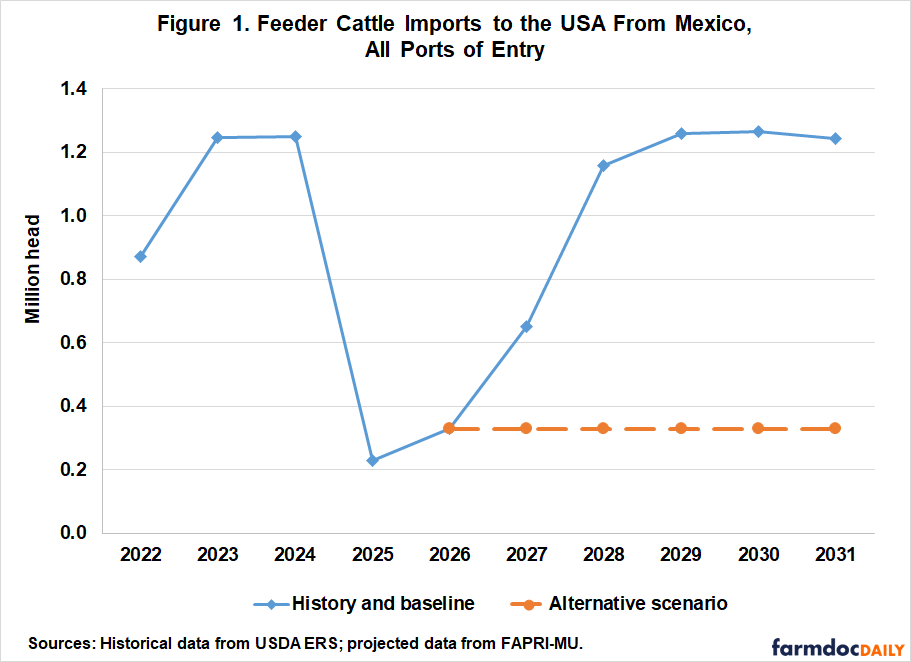
One alternative scenario assumes that feeder cattle imports from Mexico stay flat at their current level or approximately 330 thousand head per year. This could be due to a variety of political or market decisions. Given this assumption, that would cut the number of feeder cattle imports in half for 2027 and reduce the import flow by almost 75% for 2028-2031. We use the FAPRI-MU models of agricultural and related markets to estimate the impacts. The results below focus on US and Mexico beef market conditions, but the model also captures this impact on other markets, such as other livestock products, crop, and renewable fuels. The results below consider the changes from the baseline paths caused by the alternative feeder cattle import scenario and do not reflect year-over-year changes.
Results: Prices Move about a Bit, Production Shifts, and Producers Respond over Time
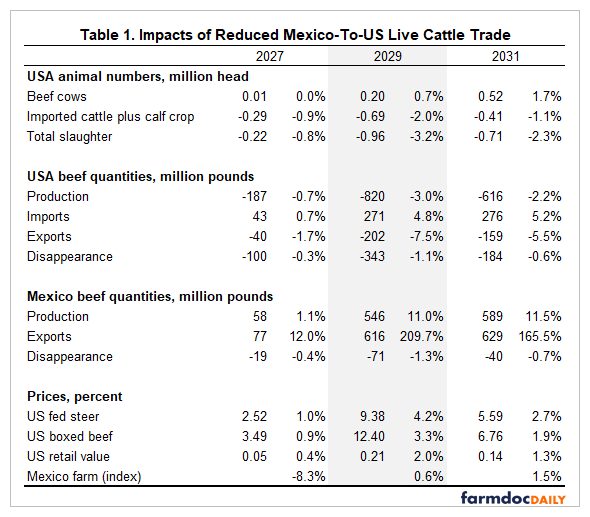
The immediate impact of fewer live cattle imports into the US from Mexico is lower US beef production and more beef production in Mexico compared to the baseline (see Table 1 below). The reduction in imported cattle in 2027 results in the US having a smaller supply of animals domestically. Fewer animals reduce the number of animals harvested and thus reduces US beef production, although some part of this loss could be recovered with greater weights. Lower domestic supply continues to put upward pressure on US beef and both feeder and fed cattle prices. The price pressure along the beef supply chain strengthens from 2027 to 2029 for two reasons. First, the change in live imports is smaller in 2027 (about 332 thousand head lower) than in 2029 (930 thousand head) and subsequent years, as shown in Figure 1. So, we expect a smaller price impact from a smaller market shock. Second, there is some time between when cattle flow into the supply chain and when those animals are eventually harvested.
Higher prices in the US are assumed to induce greater beef cow numbers as producers respond to higher prices by retaining more heifers thus growing the domestic cow herd which continues rising through 2031. More beef cows eventually lead to more calves, while the reduction in feeder cattle imports plus the domestic calf crop does mitigate the domestic beef supply shortage over time. There are similar moderations to the negative impacts on cattle harvest and production. The price increase in 2029 (+4.2% fed steer) is greater than in 2031 (+2.7%) as the domestic supply response starts to offset lost imports over time. US beef domestic demand responds to the higher prices as compared to the baseline through lower domestic disappearance.
In this scenario, Mexico would export fewer cattle compared to the baseline. The greater number of animals available for domestic slaughter have implications for Mexico’s market and trade.
We assume that the transition in Mexico to more domestic slaughter and production is costly. We temporarily widen the gap between the price Mexican feeder cattle producers receive and the price Mexican feedlots pay as the feeding and processing industries are strained by the extra throughput. Given these assumptions, we estimate a lower internal producer price in Mexico as the market manages the un-exported animals. However, eventually animal and meat prices in Mexico move more like US prices.
Mexico beef production is higher in the scenario compared to the baseline. The initial impact on total beef production is relatively small compared to later years for a couple reasons. First, compared to our baseline, the alternative has a smaller decrease in live trade in 2027 as compared to later years (Figure 1). Second, the animals have to be fed in Mexico, resulting in the beef being produced there, but that takes time. However, the beef production increase rises to over half a billion pounds (11.0-11.5%).
Beef consumption falls in Mexico. Consumers see higher meat prices in this scenario. At first, the price they pay rises despite the falling producer price because of the assumed inefficiencies caused by the surge in live animals for domestic processing. Over time, however, the domestic meat price tends to move higher with the US price. Mexico beef consumption is lower because of these price effects.
Beef trade impacts follow the production and price effects. Lower US beef production and a higher beef price lead to more US beef imports and less US beef exports as compared to the baseline. In contrast, Mexico’s rising beef production supports more exports. Suspending feeder cattle imports shifts where beef is produced, leading to greater Mexico net exports and US net imports. In terms of global efficiency, it is worth noting that total beef production for these two countries is lower even through 2031, suggesting that the ban of Mexican feeder cattle into the US unwinds sectoral gains won by firms in both countries pursuing the least-cost strategies of producing beef. Consumers might judge that the cost of reduced efficiency is a price worth paying to contain NWS and its potential negative impacts on the US beef supply. However, those effects, if any, are beyond what we study here.
Implications for US Producers
US producer impacts depend on where they are at in the supply chain. A key point is that US cow-calf producers do not just see less competition if there are fewer live animal imports, but instead they experience a shift in where the competition takes place. The eventual effect is that some part of the lost imported cattle is replaced with domestically produced cattle, but there is also a sustained, albeit partial, shift in beef production from the US to Mexico. Animals that the US no longer imports are grown elsewhere which eventually reduces the US’s competitiveness in final beef product markets.
For completeness, we highlight just a few points of uncertainty in our estimates. First, we do not know what future feeder cattle imports will be. Will the initial, partial opening of the border give the industry a path to recover to past levels of trade, as we assumed in our last outlook? How well will NWS be contained in Mexico and the Southern US. Second, the expansion of beef production and trade in Mexico raises questions about costs and regulatory settings. Will Mexico’s expansion be costly and widen margins between buyer and seller prices at least temporarily? Will Mexico’s beef production compete directly with US beef exports in the same markets or indirectly?
Disclaimer: We request all readers, electronic media and others follow our citation guidelines when re-posting articles from farmdoc daily. Guidelines are available here. The farmdoc daily website falls under University of Illinois copyright and intellectual property rights. For a detailed statement, please see the University of Illinois Copyright Information and Policies here.