








Illinois Yields in 2026 Below Trend
Many Illinois farmers report that 2026 yields fell short of expectations. The November yield forecasts from the National Agricultural Statistics Service (NASS), U.S. Department of Agriculture, also point to below-trend yields. Illinois corn yield is projected at 200 bushels per acre, 17 bushels below trend. Soybean yield is projected at 64 bushels per acre, about 3 bushels below trend. Projected yields suggest most farms will have below trend yields in 2026. Yield performance varies across the Midwest, with Iowa, Minnesota, and Ohio projected to have above-trend yields for both crops.
2026 Corn Yields
Figure 1 shows Illinois corn yields from 1970 through 2026, with the November NASS forecast used for 2026. The orange line shows actual yields and the 2026 projection, while the black line shows trend yields. The blue bars show differences between actual and trend yields, with negative values indicating below-trend yields.
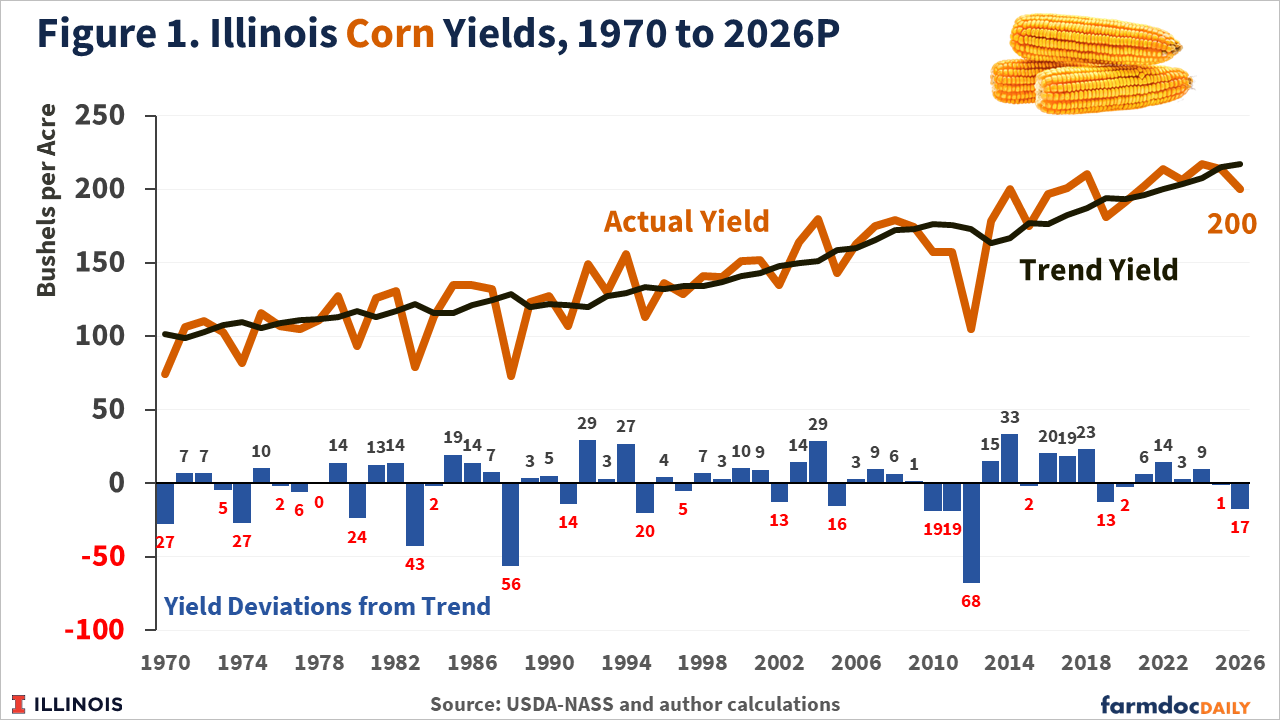
The November forecast of 200 bushels per acre is 8 bushels below the October forecast of 208 bushels per acre. It is also 14 bushels below the 2025 yield of 214 bushels per acre. NASS will release its final yield estimate in January 2027, and that estimate could differ from the November forecast.
Trend yields provide a measure of expected yield for a particular year. Conceptually, if the same year could be repeated many times under varying growing conditions, the average yield would be the trend yield. We estimate each year’s trend by statistically fitting a straight line to yields from the previous 20 years and projecting that line into the year being evaluated. The trend changes each year as the previous 20 years change. Over time, trend yields generally have increased.
The estimated Illinois corn trend yield for 2026 is 217 bushels per acre. The projected 200-bushel yield is about 8% below trend and would represent the largest shortfall since the 2012 drought. In 2012, Illinois corn yield was about 68 bushels below trend, 0r 39% below trend. The projected 2026 shortfall is much smaller than in 2012 but is large relative to those experienced since that drought.
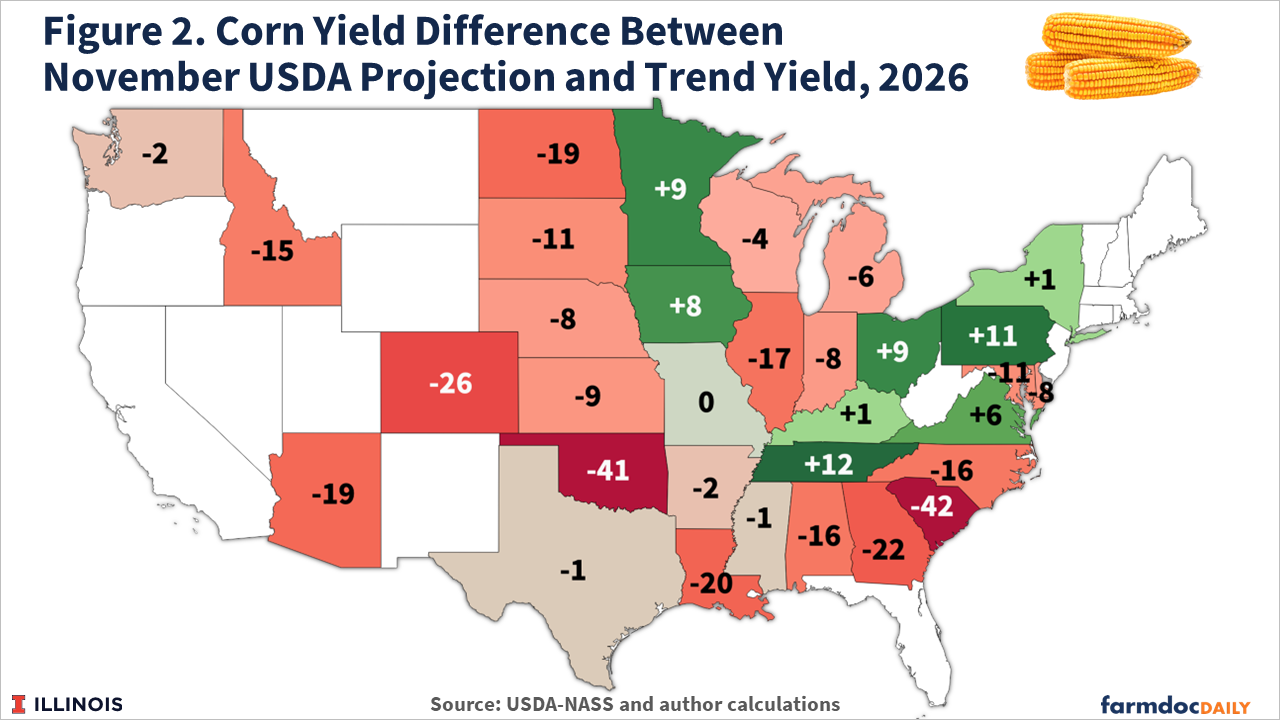
Illinois yield performance differs from that in several other major corn-producing states (see Figure 2). Corn yields are projected below trend in Illinois, Indiana, Wisconsin, and Michigan. The shortfalls are 17 bushels per acre in Illinois, 8 in Indiana, 4 in Wisconsin, and 6 in Michigan. North Dakota, South Dakota, and Nebraska also have below-trend projections. On the other hand, Iowa is projected 8 bushels above trend, while Minnesota and Ohio are each projected 9 bushels above trend.
2026 Soybean Yields
Illinois soybean yield is projected at 64 bushels per acre in 2026 (see Figure 3), up 1.5 bushels from the 2025 yield of 62.5 bushels per acre. Even with that increase, the projected yield remains below the estimated 2026 trend yield of 66.9 bushels per acre, or approximately 67 bushels.
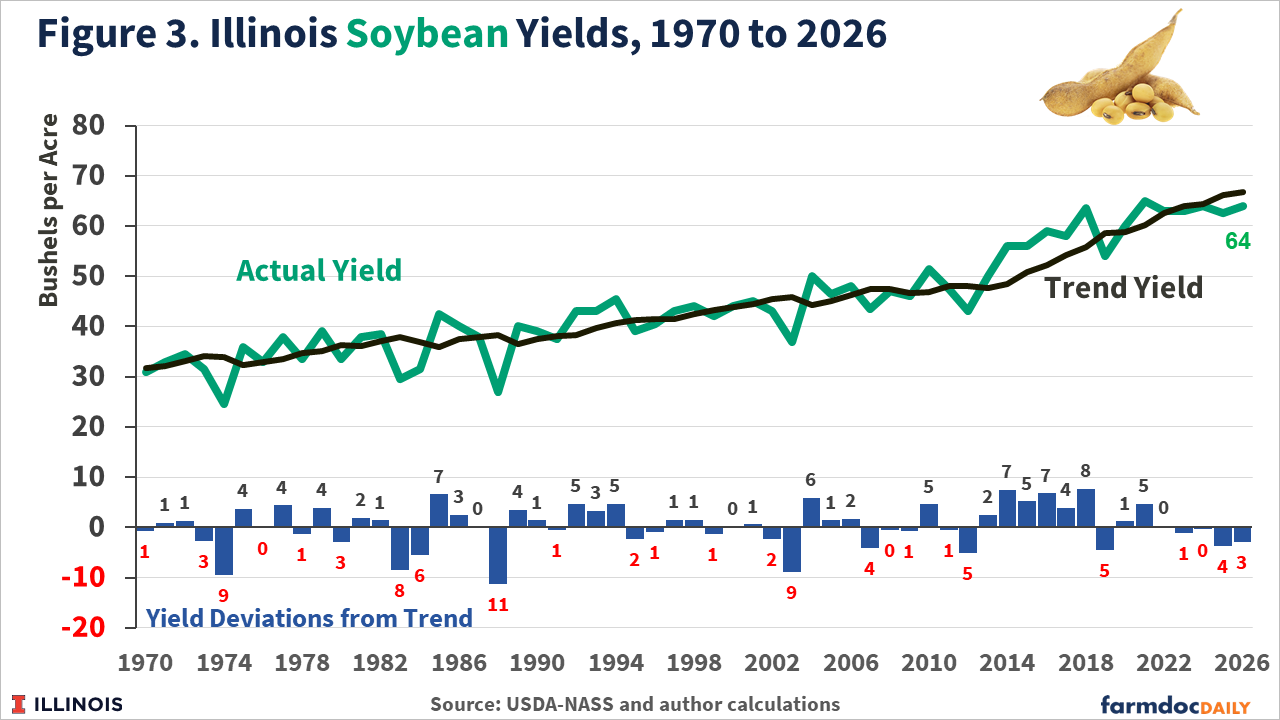
The projected shortfall is 2.9 bushels per acre, about 4% below trend. Soybean yields therefore show an improvement over 2025, when yield was 3.6 bushels below trend. Still, the higher yield in 2026 does not return Illinois to trend.
Soybean yields across states show some similarities to corn, along with several differences (see Figure 4). Iowa, Minnesota, and Ohio have above-trend projections for both crops. Soybean yields are projected 3.2 bushels per acre above trend in Iowa, 3.3 bushels above in Minnesota, and 5.2 bushels above in Ohio. Illinois, Wisconsin, North Dakota, and South Dakota are projected below trend for both crops.
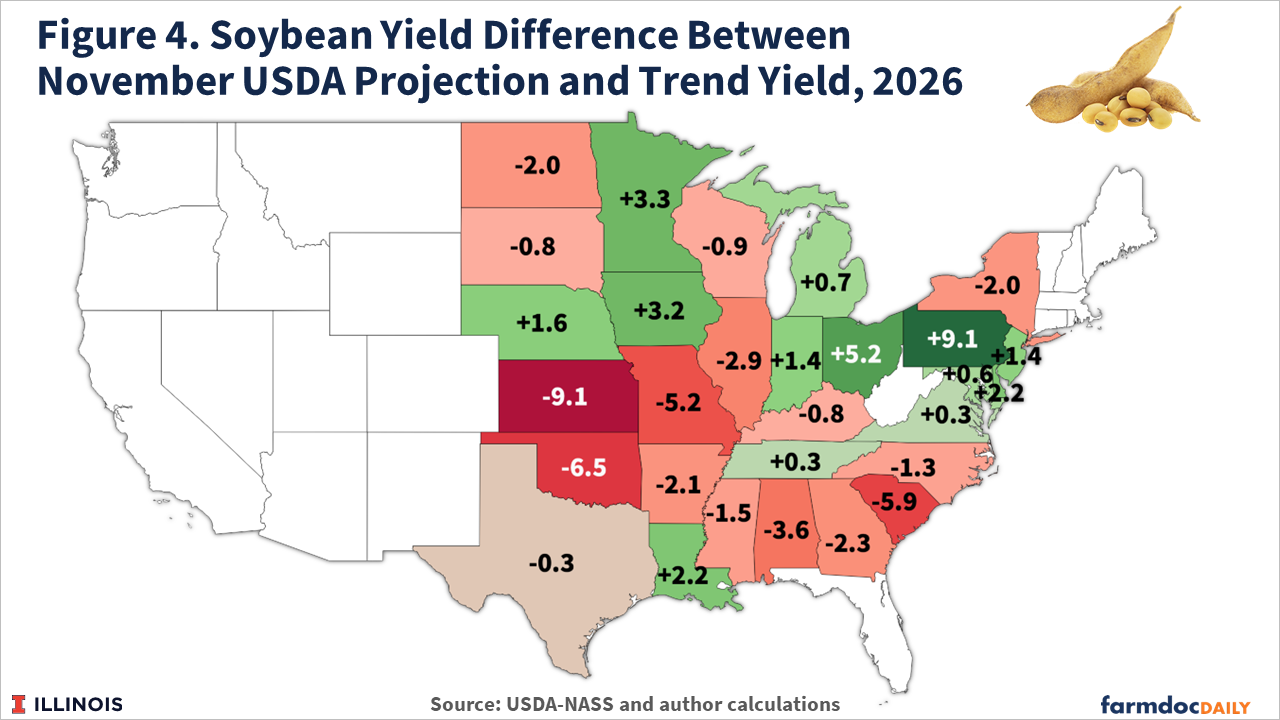
Indiana, Michigan, and Nebraska have above-trend soybean projections even though their corn projections are below trend. Soybean yields are projected 1.4 bushels above trend in Indiana, 0.7 bushels above in Michigan, and 1.6 bushels above in Nebraska. Thus, yield performance across the Midwest depends on both the state and the crop being considered.
Implications
The November forecasts suggest that Illinois will have below-trend yields for both corn and soybeans in 2026. The corn shortfall is particularly notable, with the largest negative deviation from trend since 2012. Soybean yield is higher than in 2025 but remains below trend.
At a given price, below-trend yields reduce crop revenue relative to what would have been received at trend yields. The effect on an individual farm’s income will depend on its own yields, prices received, production costs, and any crop insurance or other payments. State yields alone do not determine farm income, but the projected shortfalls point to less crop revenue than would be generated with trend yields at the same prices.
Considerable variation also exists within Illinois. Reports from southern Illinois indicate an exceptional year, while reports from northern and central Illinois suggest lower yields. These reports point to differences in farm income across the state that will not be captured by the statewide averages.
Across the Midwest, Iowa, Minnesota, and Ohio are projected to have above-trend yields for both crops, providing more support for crop revenue in those states than in Illinois, all else equal. Other states have mixed results. The January 2027 NASS estimates will provide a further assessment of 2026 yield performance and could change the comparisons presented here.
Disclaimer: We request all readers, electronic media and others follow our citation guidelines when re-posting articles from farmdoc daily. Guidelines are available here. The farmdoc daily website falls under University of Illinois copyright and intellectual property rights. For a detailed statement, please see the University of Illinois Copyright Information and Policies here.