








From Infrastructure Investment to Expanded Market Access: China’s Belt and Road Initiative in Africa and the Implications for U.S. Trade Policy
China’s economic relationship with Africa has expanded greatly since the launch of the Belt and Road Initiative in 2013. After becoming Africa’s largest trading partner in 2009, China’s total trade with Africa rose from $198.5 billion in 2012 to $295.6 billion in 2024 (see China-Africa Economic and Trade Cooperation Report, August 2013; Communiqué, Ministry of Foreign Affairs, People’s Republic of China, June 2025). By comparison, total U.S. trade with Africa amounted to $104.9 billion in 2024 (see Office of the U.S. Trade Representative, Africa).
In 2025, total trade between China and Africa rose by 17.7% to $348.05 billion, primarily driven by a 25.8% increase in exports from China, while imports from Africa rose by 5.4% (see China Global South Project). However, this trade expansion coincided with a major shift in U.S. foreign policy. On January 20, 2025, President Trump issued an executive order requiring U.S. foreign assistance to be reevaluated and realigned with his administration’s priorities, and on January 27, 2025, the Office of Management and Budget directed agencies to pause and review a broad set of financial-assistance programs (see Reevaluating and Realigning United States Foreign Aid; see OMB Memorandum M-25-13). By March 2025, roughly 83 percent of programs funded by the U.S. Agency for International Development (USAID) had been canceled, sharply reducing the institutional footprint of U.S. development engagement abroad, including in Africa (see Reuters, March 10, 2025).
In today’s farmdoc daily article, we examine how China’s Belt and Road Initiative has expanded Beijing’s economic presence in Africa through infrastructure and related investments. However, the U.S. has an initiative of its own, known as the African Growth and Opportunity Act (AGOA), which provides eligible sub-Saharan African countries with duty-free access to the U.S. market for more than 1,800 products. Although President Trump signed legislation on February 3, 2026, reauthorizing AGOA (with retroactive effect to September 30, 2025), the program is scheduled to expire at the end of this year, leaving its longer-term future uncertain (see Statement from Ambassador Jamieson Greer).
“If you build it, [they] will come”
Much of the financing associated with China’s overseas engagement is loan-based and heavily concentrated in infrastructure development. According to AidData, Chinese official financing across twenty low- and middle-income countries totaled about $320 billion between 2000 and 2022, with 94% provided as loans and only 6% as grants. Additionally, more than two-thirds of that financing was directed toward infrastructure projects. By improving roads, railways, ports, power systems, and irrigation, these investments can generate tangible economic benefits for both China and recipient countries through lower transport frictions, reduced trade costs, expanded market access, and deeper diplomatic and economic ties (see AidData, October 2025).
China’s agricultural engagement in Africa has also extended beyond large infrastructure projects to include smaller-scale efforts in technology transfer and skills development. One example is the FAO–China South-South Cooperation project in Uganda. The second phase of the project aimed to raise production and productivity, build farmer and staff capacity, and strengthen already-established trade and investment linkages. According to the FAO, the project trained more than 3,000 farmers and 80 extension staff, established seven agricultural technology demonstration hubs, facilitated $220 million in Chinese investment for the Kehong China-Uganda Agricultural Industrial Park, and supported joint ventures in hybrid rice, foxtail millet, and sweet-potato processing (see FAO South–South Cooperation Gateway).
More recently, China has paired infrastructure finance and technical cooperation with expanded market access. For example, China reported that it had signed 22 agricultural export protocols with 18 African countries at the Beijing Summit of the Forum on China-Africa Cooperation (FOCAC) in 2024 (see Communiqué, Ministry of Foreign Affairs, People’s Republic of China, June 2025). Additionally, effective December 1, 2024, Beijing granted zero-tariff treatment for 100% of tariff lines to all least-developed countries with diplomatic relations with China, including 33 African countries (see The State Council, September 2024).[1] This policy will now be extended to all 53 African countries with diplomatic relations with China beginning May 1, 2026 (see Reuters, February 2026).
AGOA’s impact across Africa
AGOA is only one part of a broader set of trade arrangements between the United States and many African countries. For eligible African exporters, however, its importance lies in the duty-free access it provides to the U.S. market. Moreover, that value is not fully captured by aggregate trade totals. For example, U.S. goods trade with Africa totaled $72 billion in 2024. Imports for goods from Africa were $39.6 billion, of which $8.0 billion entered under AGOA, indicating that the program accounts for only a modest share of overall U.S.–Africa trade (see Office of the U.S. Trade Representative; IF10149). Even so, AGOA’s design still offers opportunities to strengthen economic ties between Africa and the United States over time, especially as China broadens its tariff-free access across the continent.
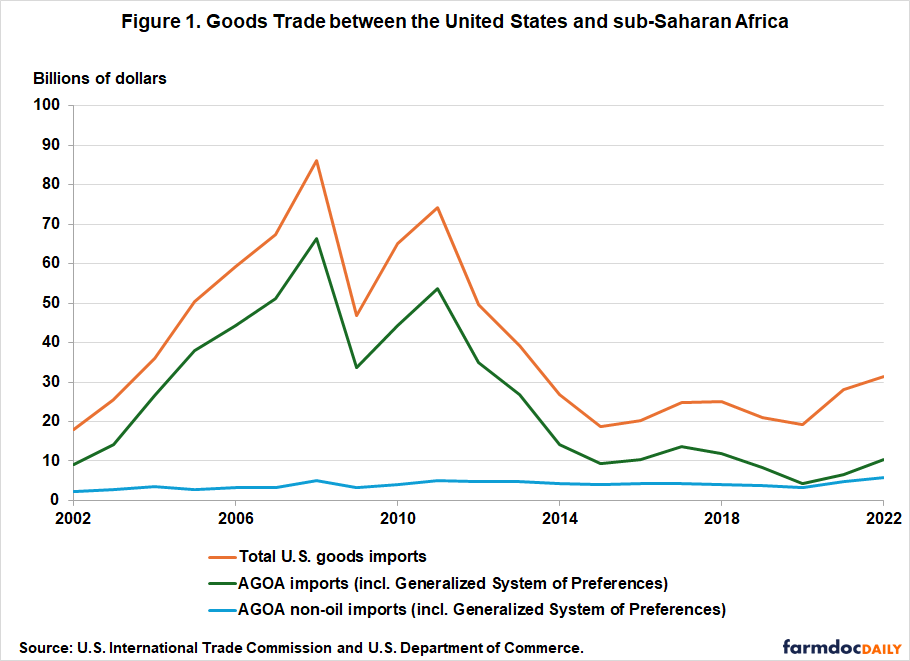
For South Africa, AGOA is particularly important for for a subset of agricultural producers. The United States accounts for only about 4 percent of South Africa’s total agricultural exports, but that share is concentrated in higher-value products such as citrus, grapes, wine, fruit juices, and nuts (see Wandile Sihlobo, February 2026; Agricultural Economic Fact Sheet, South Africa, May 2023). Beyond South Africa, AGOA has also supported agricultural exports from countries such as Côte d’Ivoire, Ghana, Kenya, and Senegal. Outside of agriculture, Kenya and Lesotho highlight the program’s importance for manufacturing and employment. According to KEPSA, Kenya’s apparel exports to the United States totaled about $470 million in 2024 and directly supported 66,800 jobs through AGOA (see KEPSA, September 2025). Lesotho exported $237.3 million in apparel, while its manufacturing sector supported about 30,991 workers that year (see Lesotho Country Commercial Guide).
Conclusion
China’s Belt and Road Initiative has evolved from a strategy centered on infrastructure and economic development into one that increasingly combines investment with broader access to the Chinese market. The clearest recent example is the extension of zero-tariff treatment from 33 least-developed African countries to all 53 African countries with diplomatic ties to China beginning May 1, 2026. The United States, by contrast, is at an inflection point in its trade policy with Africa. AGOA has been reauthorized only through the end of 2026, and the Trump administration has indicated that any successor arrangement would place greater emphasis on expanding market access for U.S. businesses, farmers, and ranchers, potentially with more reciprocal terms. At the same time, the broader U.S. development footprint in Africa has contracted sharply following the cancellation of more than 80 percent of USAID-funded programs in early 2025.
For U.S. agricultural trade, the longer-run stakes are worth keeping in mind. Africa’s population, and incomes are expected to rise substantially over the coming decades, and rising incomes tend to shift food demand toward higher-value products, including grains, protein, and processed foods, in which U.S. agriculture is competitive. Whether the United States retains a meaningful economic presence on the continent will depend in part on the policy choices it makes now, while China is actively working to deepen its own.
Note
[1] Eswatini (formerly Swaziland) is excluded because it maintains formal diplomatic relations with Taiwan.
References
AidData. October 2025. New In-Depth Profiles on China's Grants and Loans to 20 Countries. AidData at William & Mary. Williamsburg, VA. https://www.aiddata.org/blog/new-in-depth-profiles-on-chinas-grants-and-loans-to-20-countries
China Global South Project. Top 20 African Exporters to China. https://chinaglobalsouth.com/infographic/top-20-african-exporters-to-china/
China-Africa Economic and Trade Cooperation Report. August 2013. Embassy of the People's Republic of China in South Africa. https://za.china-embassy.gov.cn/eng/jbwzlm/zfgxss/gk/201412/t20141230_7682360.htm
Ministry of Foreign Affairs, People's Republic of China. June 2025. Communiqué, List of the Outcomes of the Implementation of the Follow-up Actions of the Beijing Summit of the Forum on China-Africa Cooperation. https://www.mfa.gov.cn/eng/zy/gb/202506/t20250611_11646041.html
Congressional Research Service. IF10149: African Growth and Opportunity Act (AGOA). https://www.congress.gov/crs-product/IF10149
FAO South–South and Triangular Cooperation Gateway. Technical Assistance under the South-South Cooperation with the People's Republic of China in Support of Agricultural Sector Strategy Plan in the Republic of Uganda – Phase 2. Food and Agriculture Organization of the United Nations. Rome. https://www.fao.org/sstc-gateway/node/510
KEPSA (Kenya Private Sector Alliance). September 25, 2025. KEPSA calls for AGOA’s renewal; if not, a two-year transition window to allow for a trade deal between Kenya and the U.S.. https://www.tralac.org/documents/resources/external-relations/us-agoa/6121-kepsa-calls-for-agoa-s-renewal-25-september-2025/file.html
U.S. Department of Commerce, International Trade Administration. Lesotho Country Commercial Guide — Manufacturing. https://www.trade.gov/country-commercial-guides/lesotho-manufacturing
Office of Management and Budget. January 27, 2025. OMB Memorandum M-25-13: Temporary Pause of Agency Grant, Loan, and Other Financial Assistance Programs. Washington, DC. https://www.whitehouse.gov/wp-content/uploads/2025/03/M-25-13-Temporary-Pause-to-Review-Agency-Grant-Loan-and-Other-Financial-Assistance-Programs.pdf
Office of the U.S. Trade Representative. Africa: Trade Summary. https://ustr.gov/countries-regions/africa
Reuters. March 10, 2025. Trump Administration Scraps Over 80% of USAID Programs, top diplomat Rubio says. https://www.reuters.com/world/us/trump-administration-scraps-over-80-usaid-programs-top-diplomat-rubio-says-2025-03-10/
Reuters. February 14, 2026. China to Implement Zero Tariffs on Imports from 53 African Countries. https://www.reuters.com/world/asia-pacific/china-implement-zero-tariffs-imports-53-african-countries-2026-02-14/
Sihlobo, W. February 2026. The Value of Pushing for AGOA Renewal in South Africa’s agriculture. AgriView (Substack). https://wandile.substack.com/p/the-value-of-pushing-for-agoa-renewal
Office of the U.S. Trade Representative. Statement from Ambassador Jamieson Greer on the Reauthorization of the African Growth and Opportunity Act. February 3, 2026. Washington, DC. https://ustr.gov/about/policy-offices/press-office/press-releases/2026/february/statement-ambassador-jamieson-greer-reauthorization-african-growth-and-opportunity-act
The State Council, People's Republic of China. September 2024. Xi proposes partnership actions to jointly advance modernization with Africa. https://english.www.gov.cn/news/202409/05/content_WS66d966fcc6d0868f4e8eaa09.html
The White House. January 20, 2025. Reevaluating and Realigning United States Foreign Aid. Executive Order 14169. The White House. Washington, DC. https://www.whitehouse.gov/presidential-actions/2025/01/reevaluating-and-realigning-united-states-foreign-aid/
USDA Foreign Agricultural Service. May 2023. Agricultural Economic Fact Sheet: South Africa. Washington, DC. https://apps.fas.usda.gov/newgainapi/api/Report/DownloadReportByFileName?fileName=Agricultural%20Economic%20Fact%20Sheet_Pretoria_South%20Africa%20-%20Republic%20of_SF2023-0012.pdf
Disclaimer: We request all readers, electronic media and others follow our citation guidelines when re-posting articles from farmdoc daily. Guidelines are available here. The farmdoc daily website falls under University of Illinois copyright and intellectual property rights. For a detailed statement, please see the University of Illinois Copyright Information and Policies here.