








Margin Coverage Option (MCO) 2026 Input Harvest Prices
The Margin Coverage Option (MCO) is an endorsement product introduced last fall and offered to producers for their 2026 crop year (see farmdoc daily September 16, 2025). MCO covers operating margin at a county level. The margin is a function of county yields and crop and input futures prices. Projected prices for 2026 were set last fall both for crop and inputs. Harvest prices for inputs were finalized at the end of April and are substantially above projected prices. That results in a cost shock to margins, increasing the likelihood of payments. Harvest crop prices and yields remain uncertain. Higher prices, excellent yields, or both could potentially offset the higher costs in the final margin calculation.
Recap of MCO
MCO is an area-based product that pays when county margins fall below a threshold. Thus, it provides coverage if crop revenues decrease, input prices increase, or a combination of both.
It is an endorsement to traditional farm policies (Yield Protection (YP), Revenue Protection (RP), Revenue Protection with Harvest Price Exclusion (RP-HPE) and Area Production History (APH)). Its coverage level is 95% or 90% down to 86% of county margin. Given the coverage band overlap, it cannot be purchased with ECO. Since SCO coverage band for crop year 2026 started at 86%, it could be used with SCO.
For corn and soybeans, the MCO projected price discovery period for crop and inputs is in the fall, from August 15th to September 15th. Based on projected input and crop prices, expected and trigger margins are calculated.
Harvest (final) input prices are determined as the average of futures prices in April.
Harvest crop prices are determined during the October discovery period used for most spring-planted crop insurance policies. They are the average of October for the November and December futures contracts for soybeans and corn, respectively. Actual county yields for 2026 crop year will be released in June of 2027.
Based on harvest input and crop prices and actual yields, final margins are calculated, and if lower than trigger margins, triggers a payment.
Therefore, MCO now depends on actual county yields and crop futures prices to trigger a payment or not. Full details on how indemnities are calculated are available at https://www.margincoverageoption.com/ and were presented in farmdoc daily September 16, 2025.
2026 Projected vs. Harvest Input Prices
Harvest input prices were determined as the average of futures prices in April and are shown in Table 1. Except for natural gas, all harvest inputs prices are higher than projected. Potash is an index based on urea, DAP, natural gas, and diesel, and has also increased relative to projected prices. Urea and diesel prices are significantly higher (65.3% and 79.8%, respectively).
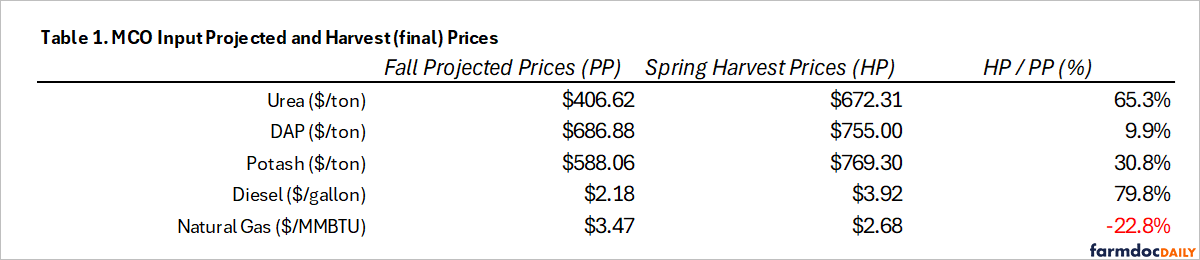
The overall increase relative to fall prices is substantial. Urea, diesel and potash had larger increases compared to the average of the past five years, which were driven by relative cost increases in 2021 and 2022 (see farmdoc daily September 23, 2025). Except for natural gas, all prices are higher than the last ten years average.
MCO total costs
Input quantities are based on counties’ Expected Yields set by RMA. They do not vary with final yields and, thus, they are set for the 2026 crop year. The increase in input prices results in a higher cost, which in turn reduces the calculated county margin and increases the likelihood of a payment.
The cost increase is not the same for corn and soybeans, as their input’s weights used in the cost calculation are different. Using weights based on expected yields for McLean County, IL, the total increase for non-irrigated corn and soybean is 42% and 33% respectively (see Table 2). Note that Urea is not considered for soybeans, and natural gas is only considered in irrigated practices. Fertilizer prices were converted to $/lb for the total cost calculation by dividing each by 2000.
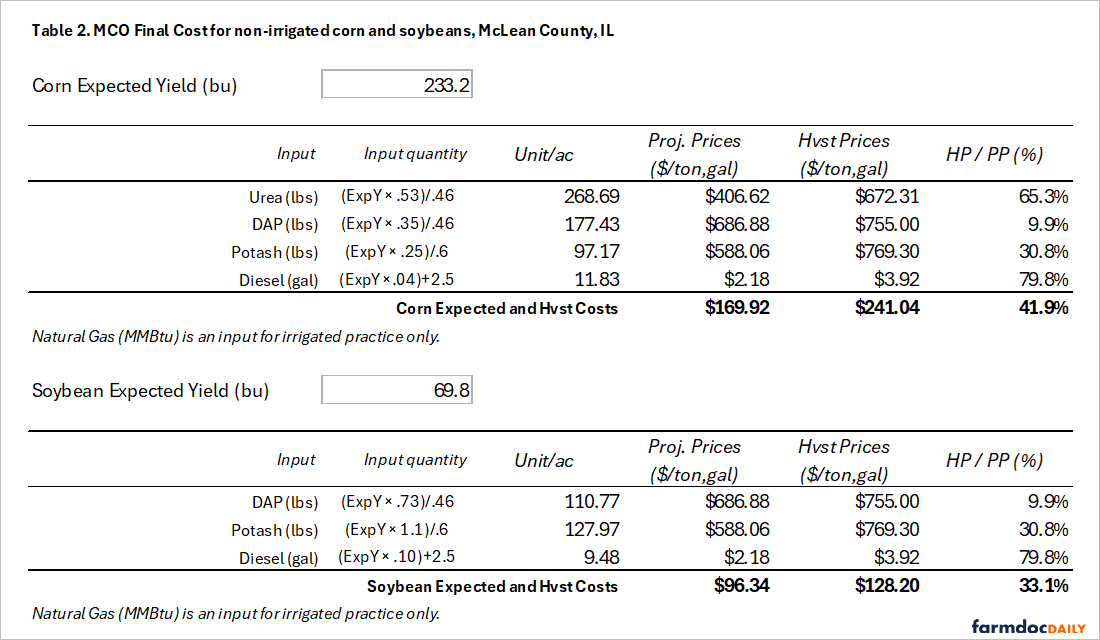
In dollar terms, this corresponds to an increase of $71.12 per acre for corn and $31.86 per acre for soybeans. Relative to expected revenue, the increase is 6.2% for corn and 3.9% for soybeans, and relative to expected margin, it is 7.3% for corn and 4.4% for soybeans.
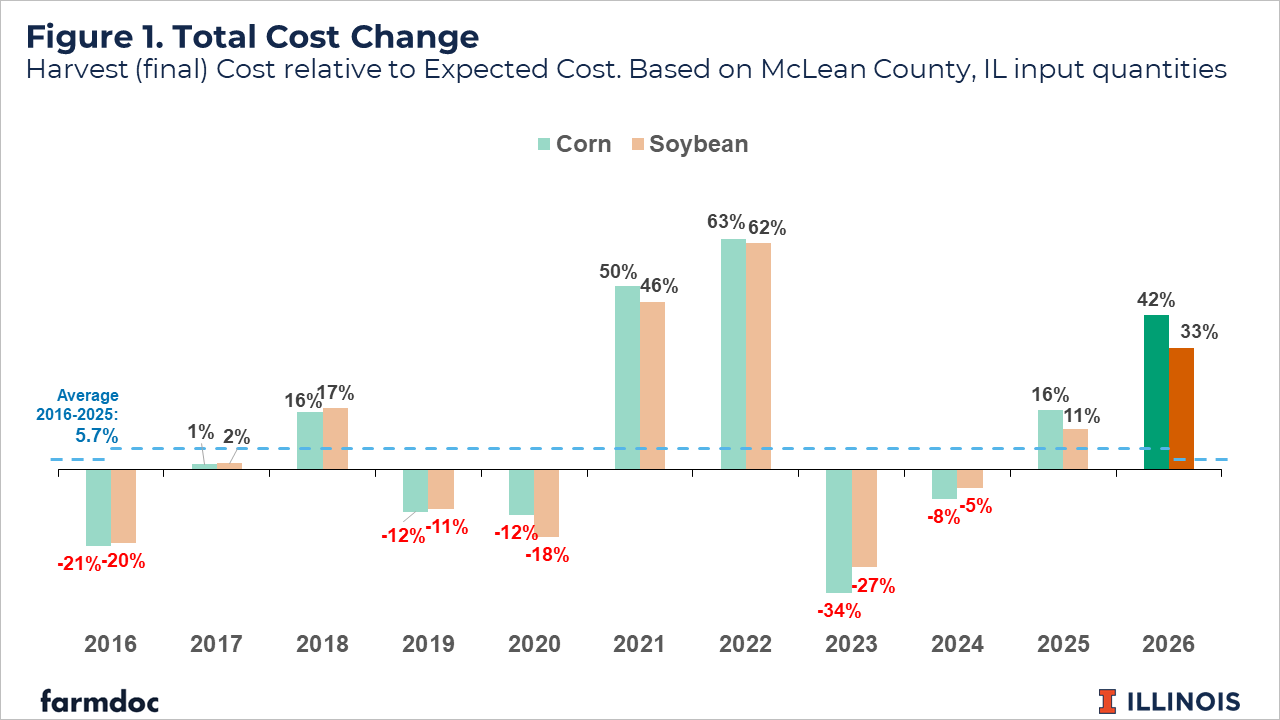
Historically, these are high levels of total cost change, though they are lower than 2021 and 2022 levels, as shown in Figure 1. In general, the relative cost change is going to be similar for counties with different expected yields.
MCO Payment Scenarios
While final costs are now known, MCO payments will still depend on final crop prices (determined in October, the same as for COMBO products) and actual county yields (released in June of the following year). For MCO, crop projected prices were set in the fall, and are $4.56 for corn and $10.73 for soybeans (see farmdoc daily, September 16, 2025).
MCO will pay if final margins are below the trigger margin. The trigger margin when MCO is paired with RP, will change depending on crop harvest prices as RP offers the guarantee increase if the harvest price is greater than the projected price.
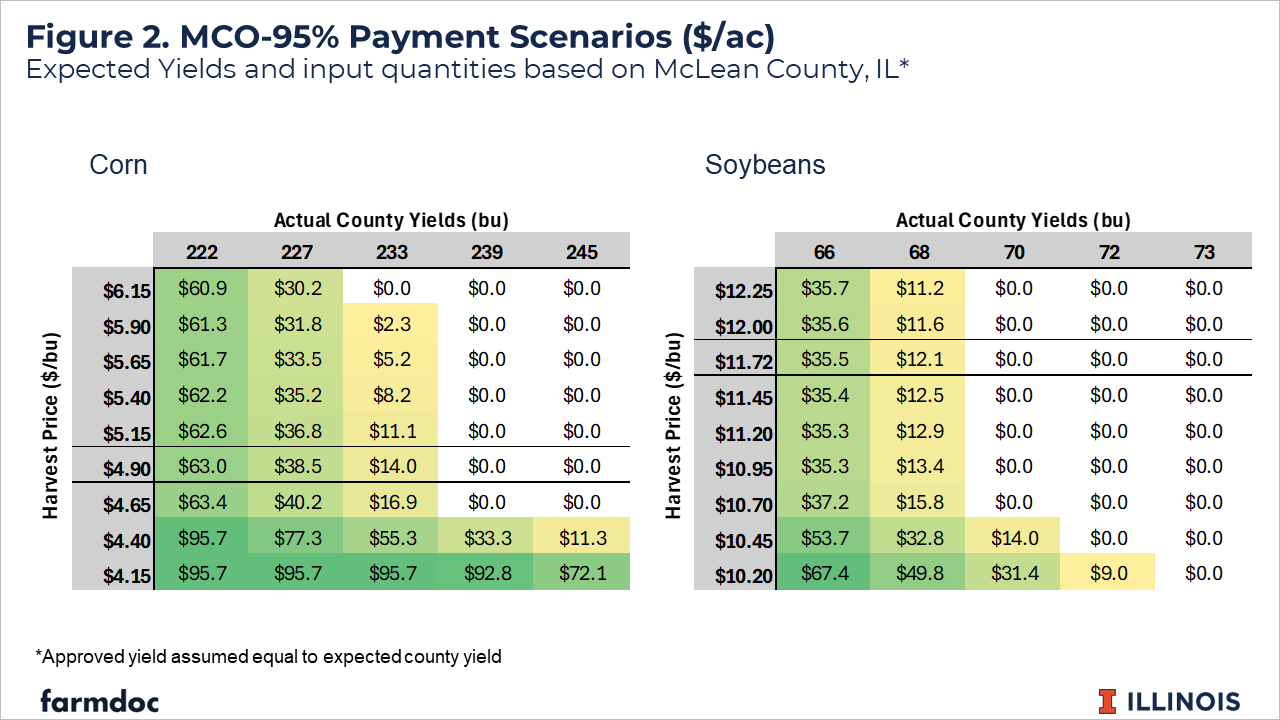
For McLean County, IL, at current market conditions (December corn futures at $4.90/bu and November soybean futures at $11.72/bu) final margins would have to decrease $57.13/ac and $37.65/ac for corn and soybeans to trigger MCO-95%, respectively. Costs have increased $71.12/ac for corn and $31.86/ac for soybeans. That puts MCO-95% for corn in the money at current futures price levels and trend yields. Soybeans would need to have yields slightly below trend or prices would need to decline slightly from current futures levels to trigger a payment. Figure 2 shows other combinations of prices and yields that can also trigger payments for McLean County, IL.
Discussion
MCO is a product that covers county-based margin shortfalls. Harvest, or final, prices for inputs were determined in April, which for 2026 happened amid the Middle East conflict (see farmdoc daily, April 24, 2026).
MCO costs are an index based primarily on fertilizer and energy prices, which have been center to many geopolitical disputes in recent years and, in particular, over the past 2 months. Because final input prices are now known and are substantially above fall projected prices, part of the margin shock has already occurred.
Even though costs have increased, they do not necessarily match farmers costs. This can be thought as ‘cost basis risk’, which is similar to the yield basis risk on the revenue side (see farmdoc daily, February 19, 2026). Farmers do not necessarily buy all fertilizer and diesel in the spring, and quantities utilized likely differ from the indexed quantities. Furthermore, traded contracts might not reflect actual prices paid due to basis and low trade volume in some cases. Therefore, MCO’s cost index can vary from the costs facing any individual farm.
Although MCO partially covers the cost increase, historical analysis back to 2016 shows that MCO’s cost component would not have contributed to significantly to payments had MCO been available over the past 10 years (see farmdoc daily September 23, 2025). Exceptions were other geopolitical disruptions, such as the Russia-Ukraine conflict in 2021 and 2022. At current market conditions, the cost component could be the driving factor in triggering MCO payments for 2026.
Although costs are contributing to payments, what remains uncertain is whether harvest crop prices and actual county yields will offset or reinforce this cost shock. Thus, it is still soon to predict if MCO will make payments. Grain prices can react by October and offset portion of the margin decrease. Actual yields can also interact with prices, and in some cases completely offset margin shortfalls and result in no payment. Considerations on RMA’s Expected Yields are also relevant, particularly in Illinois (see farmdoc daily January 27, 2026).
Higher input prices may also affect interest and use of MCO for the 2027 crop year. If the conflict persists into the 2027 input-price discovery period (August 15 to September 15), MCO projected costs could be set at elevated levels. Depending on if or how quickly input prices fall toward pre-conflict levels (see farmdoc daily April 29, 2026), MCO may become less attractive because coverage would be based on temporarily high projected costs.
MCO cannot be used with ECO. Both have the same subsidy levels but crop projected price discovery periods are different. MCO focus on margins while ECO on revenues. Relative premiums also determine their relative attractiveness. As we progress through the crop season, a future article will compare payment rules for ECO and MCO, highlighting which cases ECO will outperform MCO and vice-versa.
References
Arita, S., M. Wang, J. Kim, R. Chakravorty and S. Steinbach. "Strait of Hormuz Disruption Scenarios and Fertilizer Purchasing Risks for U.S. Crop Producers." farmdoc daily (16):75, Department of Agricultural and Consumer Economics, University of Illinois at Urbana-Champaign, April 29, 2026.
Mashange, G. "The Strait of Hormuz: Why Global Trade Dependency Turns a Localized Conflict into a Global Crisis." farmdoc daily (16):52, Department of Agricultural and Consumer Economics, University of Illinois at Urbana-Champaign, March 27, 2026.
Mashange, G. and G. Gardner. "Middle East Ceasefire Fails to Ease U.S. Fertilizer Price Pressure on Farmers." farmdoc daily (16):72, Department of Agricultural and Consumer Economics, University of Illinois at Urbana-Champaign, April 24, 2026.
Monaco, H., G. Schnitkey, N. Paulson and C. Zulauf. "A New Area-Based Crop Insurance Product: MCO (Margin Coverage Option)." farmdoc daily (15):169, Department of Agricultural and Consumer Economics, University of Illinois at Urbana-Champaign, September 16, 2025.
Monaco, H., G. Schnitkey, N. Paulson and C. Zulauf. "Margin Coverage Option (MCO) Historical Analysis." farmdoc daily (15):174, Department of Agricultural and Consumer Economics, University of Illinois at Urbana-Champaign, September 23, 2025.
Monaco, H., G. Schnitkey, N. Paulson, B. Sherrick and C. Zulauf. "Revisiting the Basis Risk when evaluating SCO and ECO." farmdoc daily (16):27, Department of Agricultural and Consumer Economics, University of Illinois at Urbana-Champaign, February 19, 2026.
Schnitkey, G., H. Monaco, N. Paulson, C. Zulauf and B. Sherrick. "Expected Yields for SCO and ECO in Illinois." farmdoc daily (16):12, Department of Agricultural and Consumer Economics, University of Illinois at Urbana-Champaign, January 27, 2026.
Disclaimer: We request all readers, electronic media and others follow our citation guidelines when re-posting articles from farmdoc daily. Guidelines are available here. The farmdoc daily website falls under University of Illinois copyright and intellectual property rights. For a detailed statement, please see the University of Illinois Copyright Information and Policies here.