








Grocery Bills and the 2026 Midterm Elections
Introduction
U.S. midterm elections, the elections that occur halfway through a president’s four-year-term, are on the horizon. This November, Americans will be asked to cast ballots across the country and weigh in on all 435 seats in the U.S. House of Representatives, one-third of the 100 seats in the U.S. Senate, and many other state-specific (e.g., governor, state representatives) positions and measures. In this post, we discuss the role of affordability, and in particular the role of food prices, in the midterm election using results from the most recent wave of the Gardner Food and Agricultural Policy Survey.
Results show that both cost of living and, more broadly, the economy ranked as top issues in the midterm election across political parties. For food and agricultural policy more specifically, respondents indicated that food affordability and food safety were top priorities. Importantly, over 40% of respondents from each party said a candidate’s stance on food affordability would strongly affect their vote. Finally, we discuss which political parties, if any, respondents expect to be able to affect food prices.
Data
The Gardner Food and Agricultural Policy Survey (GFAPS) aims to assess public perceptions of ongoing issues relevant to food and agricultural policy. As consumers, taxpayers, and more, the public plays a unique role in this space. Each quarter, Qualtrics Panels recruits approximately 1,000 adults online aiming to match the U.S. population in terms of gender, age, income, and region. Here, we share results from the most recent wave, conducted in May 2026, where respondents were asked about their plans for the midterm election and what types of issues were most important to them.
Respondents were first provided the definition of a midterm election, then respondents were asked their likelihood of voting in the midterm elections (very likely, somewhat likely, somewhat unlikely, or very unlikely), the extent to which nine major issue areas would affect their vote, and their priority amongst the issue areas. These nine issue areas were: the economy, cost of living/inflation, immigration, abortion/reproductive issues, violence/crime, environment, international relations, candidate’s values, and candidate’s fitness for office. These issue areas were previously assessed in the Gardner Food and Agricultural Policy Survey immediately following the Presidential Election (see farmdoc daily, December 5, 2024). In the most recent wave, respondents were asked, “If you were to vote in the midterm elections, please indicate to what extent you expect each issue to affect your vote, from 0 (would not affect my vote at all) to 10 (would strongly affect my vote).” These policy areas are not intended to be comprehensive, and instead, are meant to measure perceptions of some relevant issues. The order of the nine issue areas was randomized to prevent ordering effects.
Additionally, in this wave, respondents were asked about the expected impact of several additional areas relevant to food and agricultural policy on their vote. Specifically, respondents were asked, “If you were to vote in the midterm elections, please indicate to what extent you expect a candidate’s stance on each issue to affect your vote, from 0 (would not affect my vote at all) to 10 (would strongly affect my vote).” Here, we asked about ten topics: farm labor issues, food affordability, food assistance programs (e.g., SNAP, WIC), food safety and inspection, payments to farmers, pesticides, protection of natural resources and the environment, rural economic development, school meal programs, and ultra-processed foods. Here, too, the list of topics is not comprehensive, as other food and agricultural policy issues not explored here may be relevant to voters, and the order of the topics was randomized to prevent any ordering effects.
As there has been increasing political pressure around food prices, we also asked respondents “Which political party, if any, do you think can help to lower food prices in grocery stores?” Respondents were able to select Republicans, Democrats, it will require support from both Republicans and Democrats, or I do not think any party can lower prices in grocery stores. The GFAPS first assessed this issue in August 2024, during the Presidential election campaign (farmdoc daily, August 26, 2024).
Online surveys are limited by sample bias, as some people are more or less likely to participate in online surveys and these attributes can be related to their perceptions of issues such as the election. For example, our sample tends to overrepresent those with a bachelor’s degree (41.9% vs. 35.8% of those over 18, according to the U.S. Census). Additionally, online surveys are limited by hypothetical bias, which occurs when respondents overstate or understate actual behaviors. For example, respondents tend to overstate their likelihood to participate in elections compared to actual voting behaviors.
To reflect the political nature of the midterm elections, we breakdown results by respondents’ stated political party affiliation. In our sample, approximately 47% reported they were Republicans, 32% reported they were Democrats, and 21% reported they were Independent/Other. Of Republican respondents, 59% said they were very likely to vote in the midterm elections and 35% said they were somewhat likely to vote in the midterm elections. Of Democratic respondents, 71% said they were very likely to vote and 22% said they were somewhat likely to vote. Of Independent/Others, 46% said they were very likely to vote and 25% said they were somewhat likely to vote.
Results
Public Priorities in the Midterm Election
Following the Presidential Election in November 2024, the Gardner Food and Agricultural Policy Survey assessed how respondents said nine major issue areas – from the economy to immigration – affected their vote (farmdoc daily, December 5, 2024). These results underscored the importance of inflationary pressures on the election, showing that both respondents who cast their vote for President Donald Trump and those who did not vote were motivated significantly by concerns around the economy and cost of living/inflation. President Trump, too, has attributed his 2024 presidential win in part to grocery prices (Welker, 2024).
Now, with an eye on the midterm elections, respondents again highlight the importance of these two issues (see Table 1). We find that, on average, the economy and cost of living/inflation were the top issues expected to affect midterm votes for Republicans (7.9 and 7.7 out of 10 respectively), Democrats (8.4 and 8.5 out of 10 respectively), and Independents/Others (7.8 and 7.7 out of 10 respectively). It is worthwhile to note that the importance of these two issues does not change if we exclude those who say they are less likely to vote, suggesting both intended voters and wary voters consider cost of living/inflation and the economy to be important issues.
Table 1. Average responses to the question, “If you were to vote in the midterm elections, please indicate to what extent you expect each issue to affect your vote, from 0 (would not affect my vote at all) to 10 (would strongly affect my vote).” across respondents’ stated political party affiliation
| Issue Area | Republican Respondents | Democratic Respondents | Independent/Other Respondents |
| The Economy | 7.9 | 8.4 | 7.8 |
| Cost of Living/Inflation | 7.7 | 8.5 | 7.7 |
| Immigration | 7.4 | 6.5 | 5.9 |
| Abortion/Reproductive Issues | 6.2 | 6.9 | 5.5 |
| Violence/Crime | 7.4 | 7.1 | 6.7 |
| Environment | 6.4 | 7.3 | 6.3 |
| International Relations | 7.0 | 7.2 | 6.1 |
| Candidate’s Values | 7.3 | 7.7 | 6.7 |
| Candidate’s Fitness for Office | 7.2 | 7.7 | 6.7 |
Similarly, when respondents were asked which of the nine issue areas was most important to them in the midterm election, we find that all three political groups stressed cost of living. Specifically, 32.8% of Republicans, 44.7% of Democrats, and 48.3% of Independent/Others selected Cost of Living/Inflation as the most important issue in the midterm election vote.
Table 2. Share of respondents that indicated each issue was the most important to them in the midterm election, across respondents’ stated political party affiliation
| Issue Area | Republican Respondents | Democratic Respondents | Independent/Other Respondents |
| The Economy | 24.6% | 19.2% | 22.2% |
| Cost of Living/Inflation | 32.8% | 44.7% | 48.3% |
| Immigration | 10.9% | 2.8% | 4.4% |
| Abortion/Reproductive Issues | 3.4% | 2.2% | 3.0% |
| Violence/Crime | 9.0% | 6.6% | 3.4% |
| Environment | 4.5% | 4.4% | 4.4% |
| International Relations | 4.7% | 3.5% | 4.9% |
| Candidate’s Values | 6.4% | 8.5% | 3.9% |
| Candidate’s Fitness for Office | 3.6% | 8.2% | 5.4% |
It is perhaps informative to compare these results to the issue areas that motivated voters in the presidential elections (see farmdoc daily, December 5, 2024). In 2024, results from the Gardner Food and Agricultural Policy Survey showed that 33.0% of respondents who voted for President Trump and 44.4% of respondents who did not vote cited cost of living/inflation as the most important issue. Far fewer of those who voted for Kamala Harris (22.6%) or a third party (20.0%) cited this as their most important issue. Similarly, in 2024, we found that 27.8% of respondents who voted for Trump, 15.5% of respondents who voted for Harris, 25.0% of respondents who voted for a third party, and 14.4% of respondents who did not vote said the economy was the most important issue. Results suggest that cost of living, in particular, has become a more central issue to the midterm election for Democratic and Independent/Other voters. This may be explained in part by previous research, which has shown that political ideology influences expectations for the economy (perceptions are more favorable when one’s preferred political party is in office) (e.g., Bachman, 2019).
Food & Agriculture and the Midterm Election
We also asked respondents to think about how candidates’ stances on several food and agricultural policy issues would affect their midterm vote (see Table 3). We find that, on average, all three political groups said that candidates’ stances on both food affordability and food safety and inspection would more strongly affect their vote.
Table 3. Average response to the question, “If you were to vote in the midterm elections, please indicate to what extent you expect a candidate’s stance on each issue to affect your vote, from 0 (would not affect my vote at all) to 10 (would strongly affect my vote).” across respondents’ stated political party affiliation
| Food or Agricultural Policy Area | Republican Respondents | Democratic Respondents | Independent/Other Respondents |
| Farm Labor Issues | 6.5 | 6.7 | 6.1 |
| Food Affordability | 7.6 | 8.3 | 7.5 |
| Food Assistance Programs (e.g., SNAP, WIC) | 6.4 | 7.4 | 6.3 |
| Food Safety and Inspection | 7.3 | 7.5 | 7.0 |
| Payments to Farmers | 6.7 | 6.7 | 6.0 |
| Pesticides | 6.8 | 6.8 | 6.1 |
| Protection of Natural Resources and the Environment | 6.8 | 7.4 | 6.8 |
| Rural Economic Development | 6.6 | 6.6 | 5.9 |
| School Meal Programs | 6.2 | 6.9 | 5.8 |
| Ultra-Processed Foods | 6.7 | 6.6 | 6.1 |
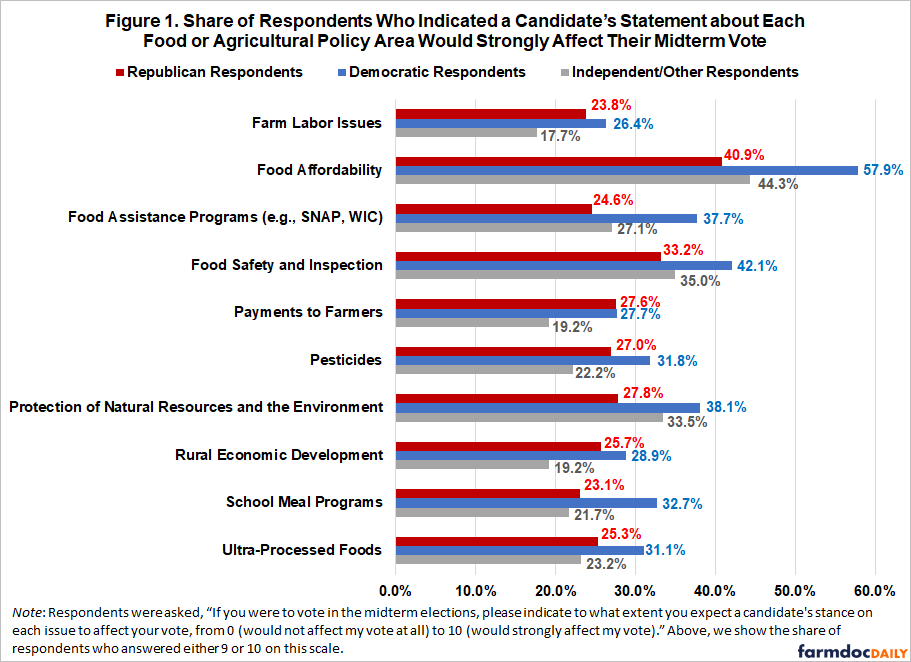
To assess the share of respondents whose perception of a candidate may be seriously affected by their stance on a particular food or agricultural policy issue, Figure 1 shows the percent that indicated stances on each food or agricultural issue would strongly affect their vote (rated 9 or 10 out of 10). Here, we find that over 40% of respondents in each political party said candidates’ statements about food affordability would strongly affect their vote. This was highest for Democratic respondents, where 57.9% said candidates’ statements about food affordability would strongly affect their vote. Additionally, Democratic respondents indicated that most food issues listed would be likely to strongly affect their votes at higher rates than both Republicans and Independents/Others. Strong interest in candidates’ statements on payments to farmers, farm labor, and rural economic development were more equal amongst Democratic and Republican respondents. Again, it is important to note that the importance both food affordability and food safety and inspection does not significantly differ if we exclude those who say they are less likely to vote, suggesting both voters and non-voters consider these important issues.
Can Politicians Lower Food Prices?
As the issue of food prices is a priority for so many, it is worth assessing whether respondents think political parties can do much to affect them. The GFAPS first assessed this issue in August 2024, during the Presidential election campaign when candidates from both sides of the aisle made promises to increase food affordability (farmdoc daily, August 26, 2024).
Table 3 below shows the proportion of respondents from the current wave (May 2026) who thought Republicans, Democrats, and bipartisan efforts can help lower food prices in grocery stores as well as the share of respondents who indicated they did not think any party could contribute to lower food prices.
Overall, we find that most respondents thought politicians could lower food prices, with only 4.1% of Republican respondents, 5.3% of Democratic respondents, and 21.2% of Independent/Other respondents saying no political party could help lower food prices. Additionally, we find respondents from the two major political parties generally thought their own party could do the job, with 71.5% of Republican respondents and 68.9% of Democratic respondents saying their political party could help lower food prices. Independent/Other respondents were more pessimistic about the impact of politicians on the issue overall; 51.7% said bipartisan efforts, 15.3% said Democrats, and 11.8% said Republicans could help lower food prices. Compared to previous estimates (farmdoc daily, August 26, 2024), Republican respondents indicated bipartisan support would be required at slightly higher rates, Democratic respondents indicated their own party would be effective at slightly higher rates, and Independent/Other respondents selected both Democrats and bipartisan support at slightly higher rates.
Table 3. Response to “Which political party, if any, do you think can help to lower food prices in grocery stores?” across participants’ stated political party affiliation
| Republican Respondents | Democratic Respondents | Independent/Other Respondents | |
| Republicans | 71.5% | 1.6% | 11.8% |
| Democrats | 2.8% | 68.9% | 15.3% |
| It will require support from both Republicans and Democrats | 21.6% | 24.2% | 51.7% |
| I don’t think any party can lower food prices in grocery stores | 4.1% | 5.3% | 21.2% |
Conclusions
In this post, we share results from the Gardner Food and Agricultural Policy Survey, showing that issues surrounding affordability, and in particular food prices, may play an important role in the upcoming midterm elections. Results underscore that both cost of living and the economy more broadly are top issues for respondents and that the majority of respondents believe politicians can help reduce food prices. Perhaps most importantly, we find that 40.9% of Republican respondents, 57.9% of Democratic respondents, and 44.3% of Independent/Other respondents said candidates’ statements about food affordability would strongly affect their vote. As November inches closer, we expect grocery bills to become central to the midterm election discussions.
References
Bachmann, O., Gründler, K., Potrafke, N. et al. Partisan bias in inflation expectations. Public Choice 186, 513–536 (2021). https://doi.org/10.1007/s11127-019-00741-0.
Kalaitzandonakes, M., J. Coppess and B. Ellison. "Lowering Food Prices: Do Consumers Think Politicians Are Able to Reduce Costs?" farmdoc daily (14):156, Department of Agricultural and Consumer Economics, University of Illinois at Urbana-Champaign, August 26, 2024.
Kalaitzandonakes, M., B. Ellison and J. Coppess. "The Importance of Food Prices in 2024 Election: Results from the Gardner Food & Agricultural Policy Survey." farmdoc daily (14):220, Department of Agricultural and Consumer Economics, University of Illinois at Urbana-Champaign, December 5, 2024.
Welker, K. “Read the full transcript: President-elect Donald Trump interviewed by "Meet the Press" moderator Kristen Welker.” NBC News. December 8, 2024. Accessed via: https://www.nbcnews.com/politics/donald-trump/trump-interview-meet-press-kristen-welker-election-president-rcna182857
Disclaimer: We request all readers, electronic media and others follow our citation guidelines when re-posting articles from farmdoc daily. Guidelines are available here. The farmdoc daily website falls under University of Illinois copyright and intellectual property rights. For a detailed statement, please see the University of Illinois Copyright Information and Policies here.