








2026 Area Add-On Insurance Purchases by US Farmers
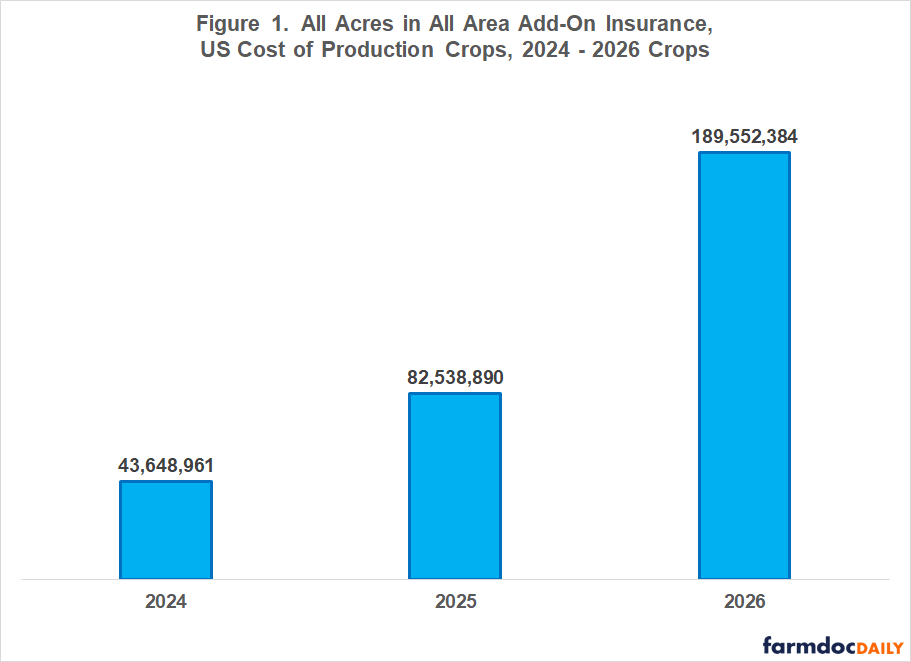
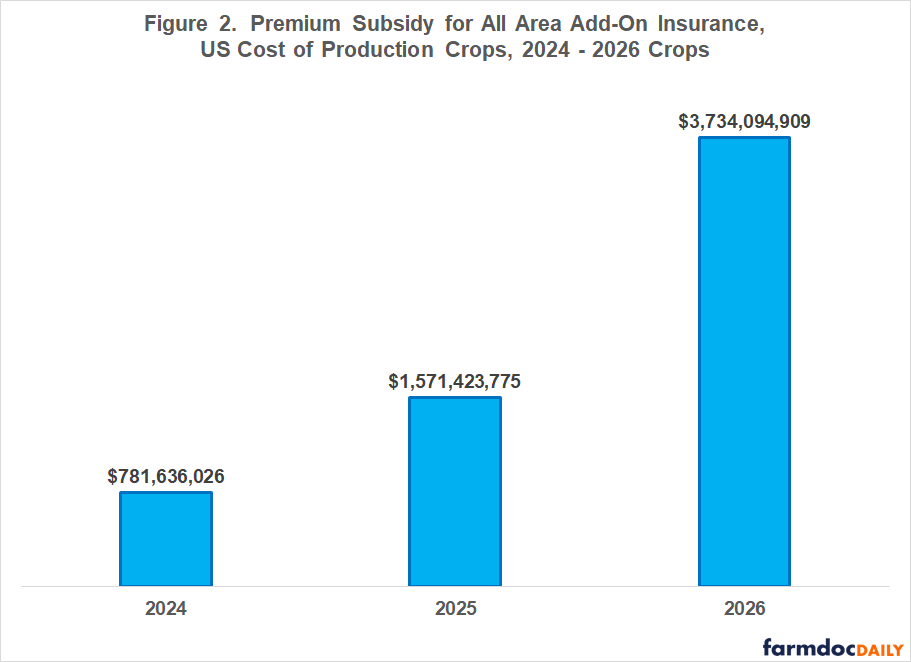
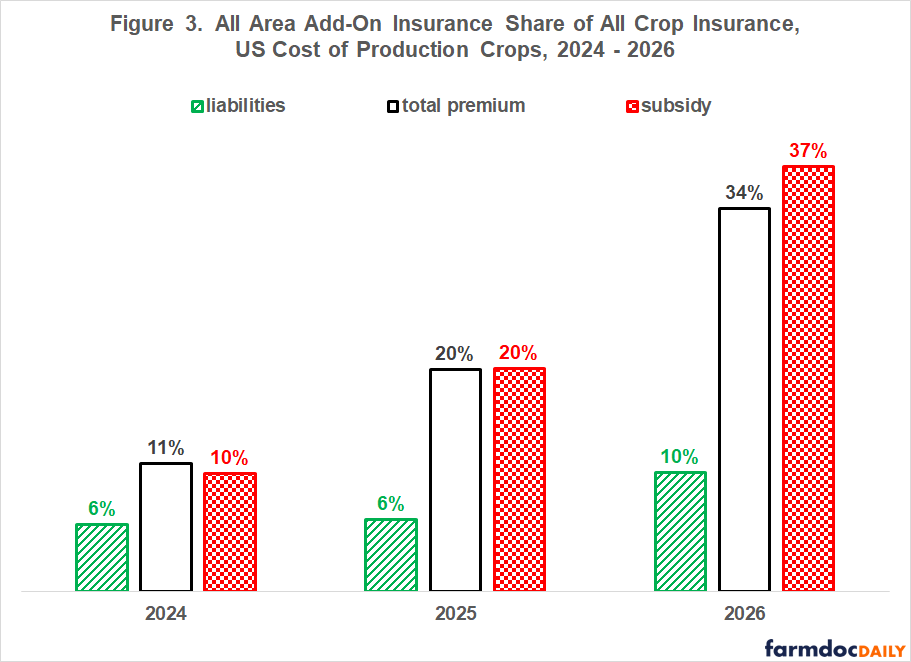
Over the last two years, administrative actions and the 2025 Farm Bill have raised to 80% the federal premium subsidy rate for area insurance added on top of individual farm insurance (see farmdoc daily, December 10, 2025). Farmers responded. For the crops that USDA (US Department of Agriculture) reports a cost of production (barley, corn, cotton, oats, peanuts, rice, sorghum, soybeans, wheat), all acres insured in all area add-on insurance products increased by 146 million acres between the 2024 and 2026 crop years (see Figure 1). Their federal premium subsidies grew by nearly $3 billion (see Figure 2). Area add-on insurance’s share of total insured liabilities, total premiums, and federal premium subsidies for the nine crops also increased notably, especially for total premiums and premium subsidies (see Figure 3). Other characteristics are explored in the rest of this article. The data are from the Summary of Business, USDA, Risk Management Agency.
Add-on Insured Acres by Product
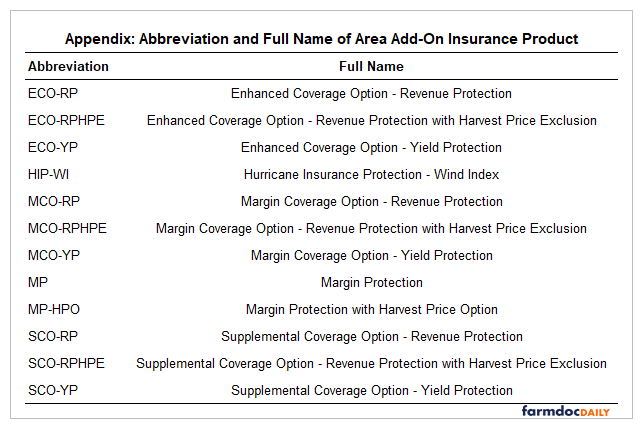
By far, the two most purchased 2026 area add-on insurance products were ECO (Enhanced Coverage Option) and SCO (Supplemental Coverage Option) for RP (Revenue Protection) individual farm insured acres (see Figure 4). To be able to buy ECO and SCO, an individual farm insurance product must be bought for the same acre. The individual farm insurance determines the type of ECO and SCO insurance. Fewer than one million acres were insured in ECO and SCO bought for acres insured with individual farm RPHPE (revenue without HPO (Harvest Price Option)) and YP (Yield Protection). For the full name of all product abbreviations in Figure 3, see the appendix table.
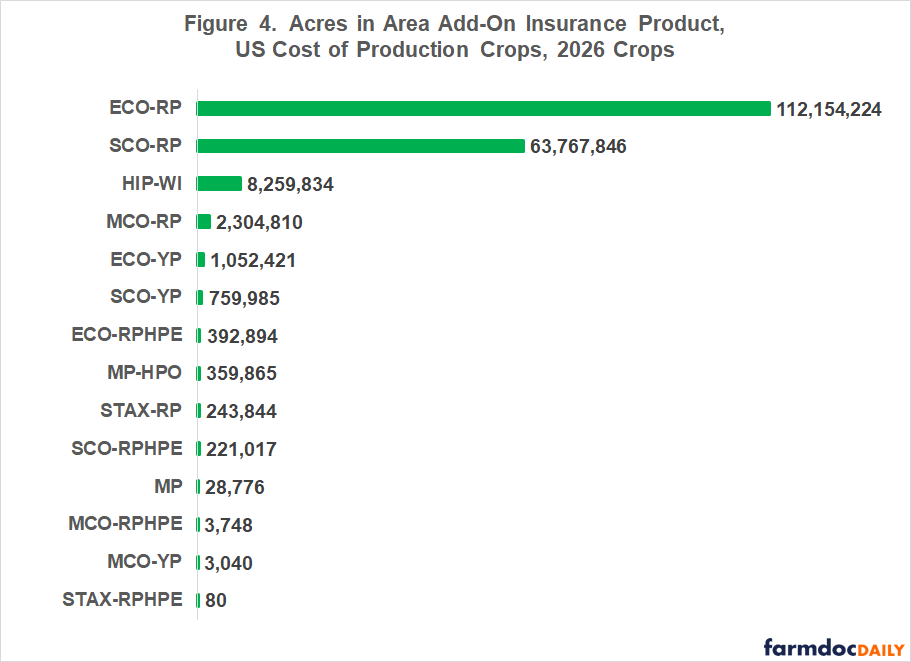
Acres in ECO-RP and SCO increased, respectively, by 98 and 53 million between the 2024 and 2026 crop years. Their combined increase exceeded the increase in all acres in all area add-on insurance (146 million). Acres in HIP-WI (Hurricane Insurance Protection – Wind Index), input-output margin products (all begin with “M”), and cotton only STAX (Stacked Income Protection Plan) products were each lower in 2026 than 2024. These three product types cannot be bought with ECO / SCO due to overlapping payments. The results for 2026 suggest ECO / SCO are preferred over the other add-on products, an implication that bears watching next year.
Approximately 85% of acres in HIP-WI, the third most purchased area add-on insurance, are in North Carolina, Texas, Georgia, Louisiana, and South Carolina (descending order), states where hurricane damage can be extensive. Corn, soybeans, and cotton (descending order) accounted for roughly 80% of HIP-WI acres.
ECO-RP Share of RP Acres by Crop
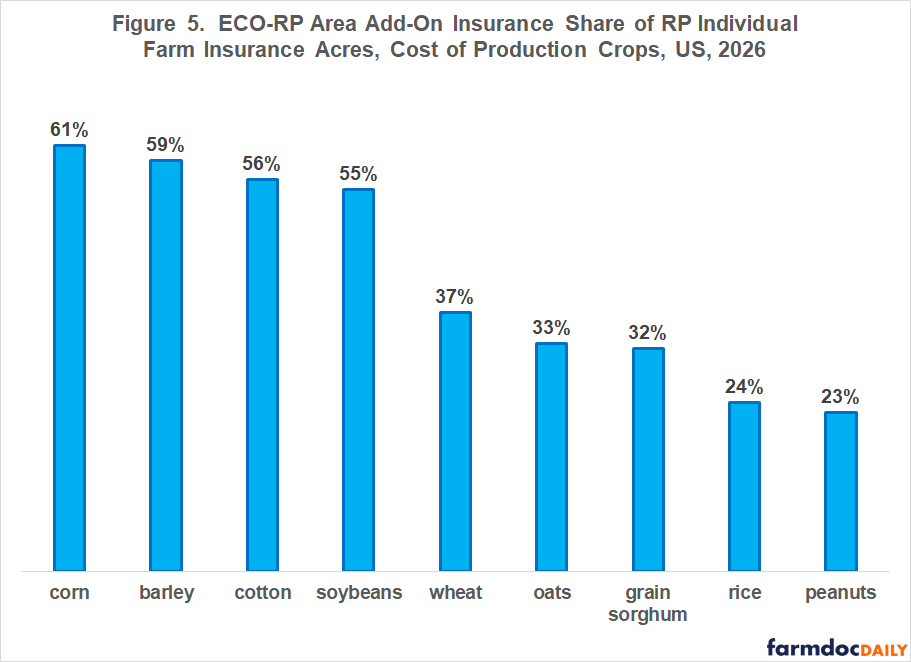
SCO and ECO can both be purchased for a single acre. Therefore, area add-on insurance for individual crops is compared only for ECO-RP and RP, the most frequently bought add-on and individual farm insurance. ECO-RP’s share of RP insured acres varies considerably, from 61% for corn to 23% for peanuts (see Figure 5). Barley, cotton, and soybeans also have shares above 50% while rice’s share is also below 25%.
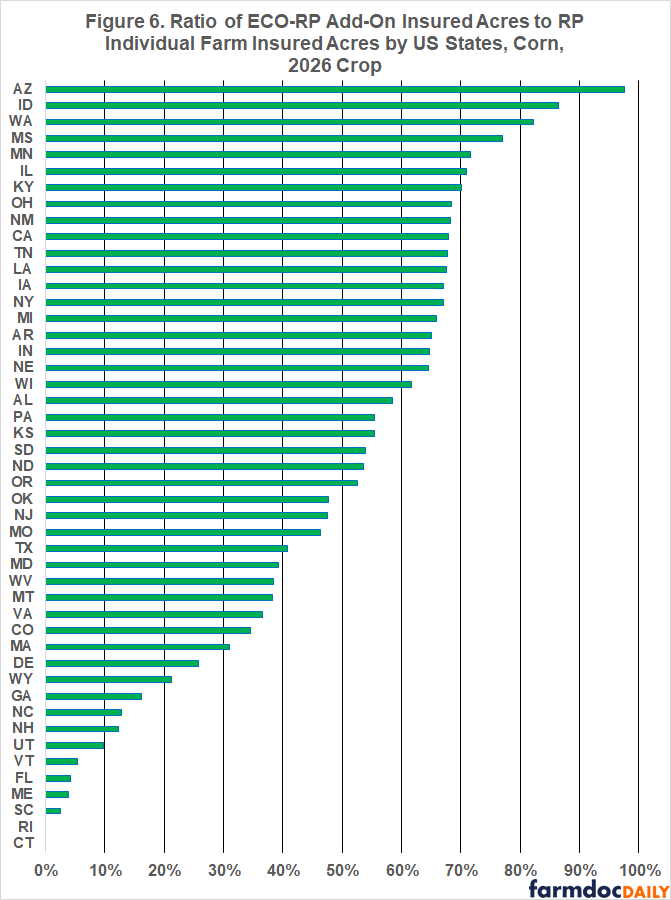
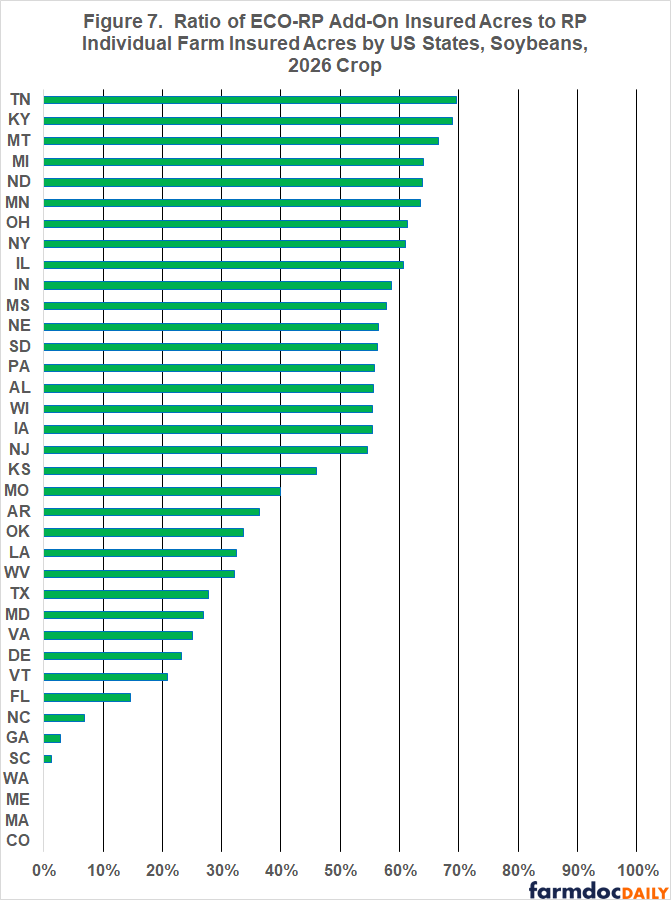
Use of ECO-RP relative to RP is further examined for corn and soybeans by state. Considerable variation again exists. For corn, share of RP insured acres for which ECO-RP was bought ranged from 0% for Connecticut and Rhode Island to 98% for Arizona. For soybeans, the range was 0% for Colorado, Maine, Massachusetts, and Washington to 69% for Kentucky and Tennessee. The corn belt states of Illinois, Indiana, Iowa, Minnesota, and Ohio had at least 65% and 55%, respectively, of corn and soybean RP acres in ECO-RP. No spatial geographical patterns are obvious for either crop.
Discussion
Growth in area add-on insurance, specifically ECO and SCO, can only be described as massive over the last two crops years.
Massive growth is not surprising given an 80% subsidy.
Further growth seems a reasonable assumption, given the usual adoption curve driven by learning, in this case, about the existence, performance, and subsidized price of area add-on insurance.
Even conservatively assuming no more growth and that current values reflect future values for the nine cost-of-production crops, the 2024-2026 comparison implies a $30 billion increase in federal spending on crop insurance premium subsidies over the 10-year federal budgetary window due to area add-on insurance.
The Congressional Budget Office increased its 10-year budget score for federal premium subsidies from $102 billion to $132 billion between the 2024 and 2026 fiscal year baselines, but this includes other 2025 Farm Bill changes, including an increase in premium subsidies for individual farm insurance. Future increases in premium subsidy baselines seem likely.
Questions to monitor:
- Will farmers’ experience lead them to conclude that add-on area insurance provides cost-effective risk management? Farmers abandoned area insurance for individual farm insurance in part because the mismatch that can occur between loses in their area and on their own farms was large enough to undermine their willingness to buy area insurance. Will the same happen with add-on area insurance?
- Will the large increase in premium subsidies due to increased purchase of area add-on insurance be seen as excessive and thus curtailed?
- Will area add-on insurance exacerbate or ameliorate crop insurance’s impacts on crop practices, inputs, and management?
- Will the change in ECO coverage from 86%-95% to 90%-95% and associated increase in SCO coverage from 86% to 90% that goes into effect for 2027 crops change insurance decisions?
References
Congressional Budget Office. August 2026. USDA Mandatory Farm Programs. https://www.cbo.gov/data/baseline-projections-selected-programs
US Department of Agriculture, Risk Management Agency. July 2026. Summary of Business. http://www.rma.usda.gov
Zulauf, C. "Circumventing the Federal Budget Process: Crop Insurance Premium Subsidies." farmdoc daily (15):227, Department of Agricultural and Consumer Economics, University of Illinois at Urbana-Champaign, December 10, 2025.
Appendices
Disclaimer: We request all readers, electronic media and others follow our citation guidelines when re-posting articles from farmdoc daily. Guidelines are available here. The farmdoc daily website falls under University of Illinois copyright and intellectual property rights. For a detailed statement, please see the University of Illinois Copyright Information and Policies here.