








Wheat Double-Crop Soybean Profitability in Recent Years
Current projections indicate that wheat followed by double-crop soybeans will be more profitable in 2027 than either corn or stand-alone soybeans in southern Illinois. Wheat-double-crop soybeans generated the highest operator and land return among the three alternatives in 2022 and 2023 and are projected to do so again in 2026 and 2027. This article reviews Illinois wheat acreage, compares projected and historical returns, and discusses management considerations for southern Illinois farms.
Acres of Wheat in Illinois
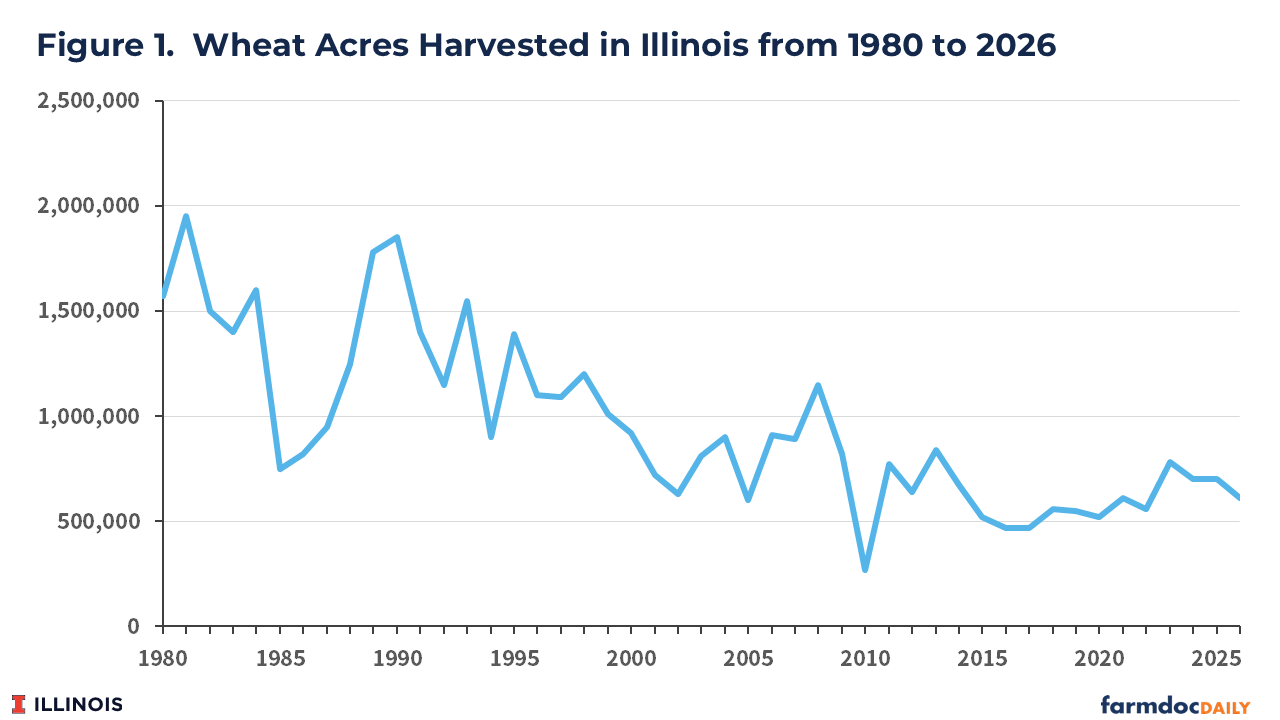
According to the U.S. Department of Agriculture’s National Agricultural Statistics Service (NASS), wheat acreage in Illinois has not exceeded 1 million acres since 2008 (see Figure 1). Planted acres reached a low of 470,000 in both 2016 and 2017, then increased to 780,000 in 2023. Higher commodity prices associated with the Ukraine-Russia conflict likely contributed to the 2023 increase. Wheat acreage then declined to 700,000 acres in 2024 and 2025 and to 610,000 acres in 2026.
Most of Illinois’s wheat acres are in southern Illinois. From 2021 to 2025, 60 to 75 percent of wheat planted in Illinois was in the southernmost four Crop Reporting Districts.
Double-crop soybeans follow a significant share, though not all, of Illinois wheat acres. NASS does not report double-crop soybean acreage. For farms enrolled in Illinois Farm Business Farm Management, double-crop soybean acres accounted for over 90 percent of wheat acres in 2021 through 2025 on southern Illinois farms. Other estimates suggest that 60% to 80% of Illinois wheat acres are double-cropped with soybeans (see Fontes).
Southern Illinois Budgets
Table 1 shows 2027 budgets for corn, soybeans, wheat, and double-crop soybeans in southern Illinois. The estimates come from the 2027 Illinois Crop Budgets published on farmdoc. Operator and land return, which equals gross revenue minus non-land costs, is projected at $135 per acre for corn, $204 for soybeans, $130 for wheat, and $179 for double-crop soybeans.
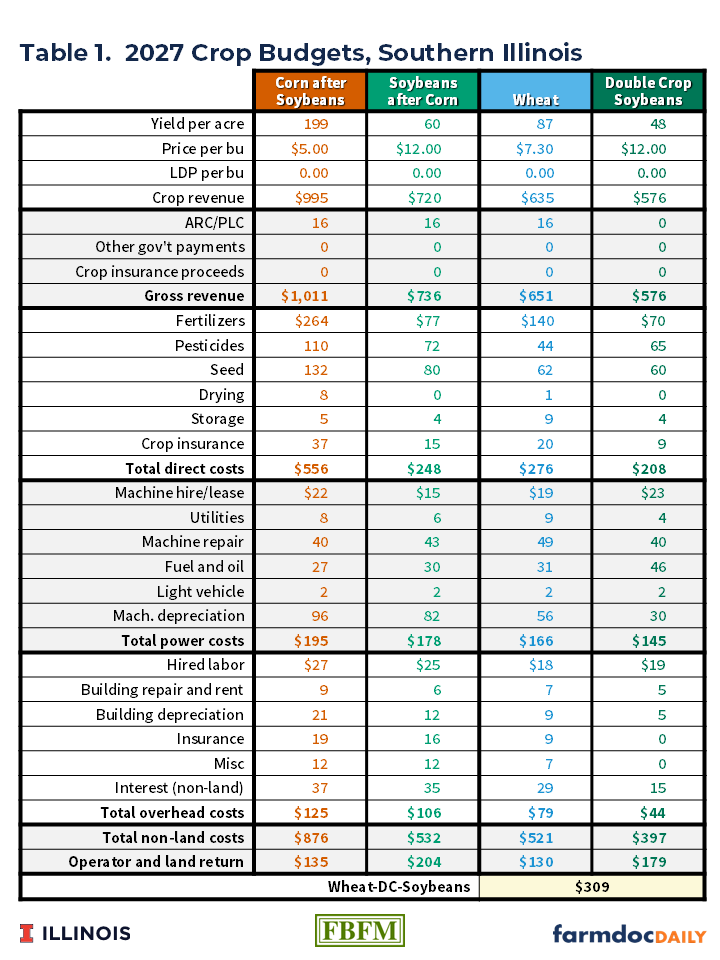
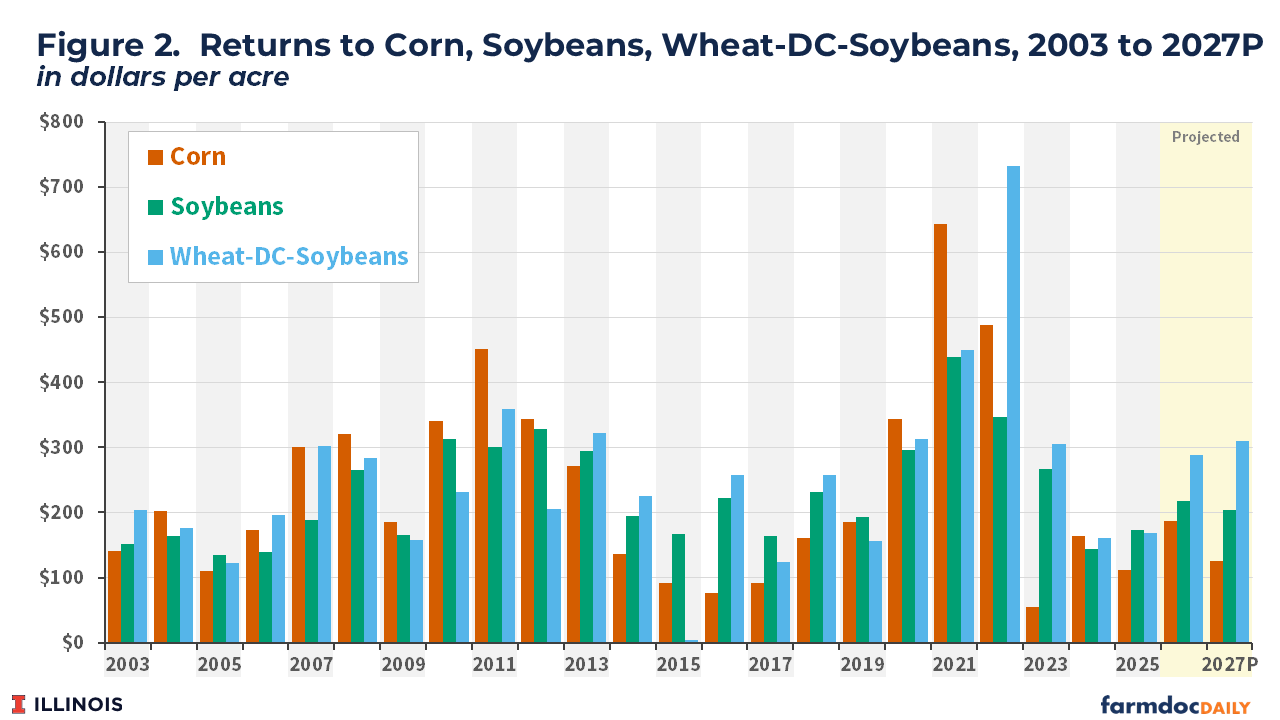
At $130 per acre, the projected return for stand-alone wheat is below corn ($135) and soybeans ($204). This relationship is typical. From 2003 through 2025, stand-alone wheat had a lower return than both corn and soybeans in all years.
Combining wheat with double-crop soybeans increases the projected operator and land return to $309 per acre. That return is $174 per acre higher than corn and $105 per acre higher than stand-alone soybeans. Given current price, yield, and cost estimates, wheat-double-crop soybeans have a sizable projected return advantage in southern Illinois.
Wheat-double-crop soybeans also had the highest return among the three alternatives in several recent years (see Figure 2). For 2026, the combination is projected to have an operator and land return of $289 per acre, compared with $186 for corn and $217 for soybeans. Wheat-double-crop soybeans also had the highest return in 2022 and 2023. 2022 was the most notable year, when the combination returned $733 per acre, compared with $488 for corn and $347 for soybeans.
The relative profitability of wheat-double-crop soybeans has increased in recent years. Table 2 reports average operator and land returns for corn, soybeans, and wheat-double-crop soybeans over four five-year periods. From 2006 through 2010, corn had the highest average return at $264 per acre, compared with $214 for soybeans and $234 for wheat-double-crop soybeans. Corn remained highest from 2011 through 2015 at $259 per acre, compared with $257 for soybeans and $223 for wheat-double-crop soybeans. From 2016 through 2020, wheat-double-crop soybeans had the highest average return at $222 per acre, only $1 more than soybeans.
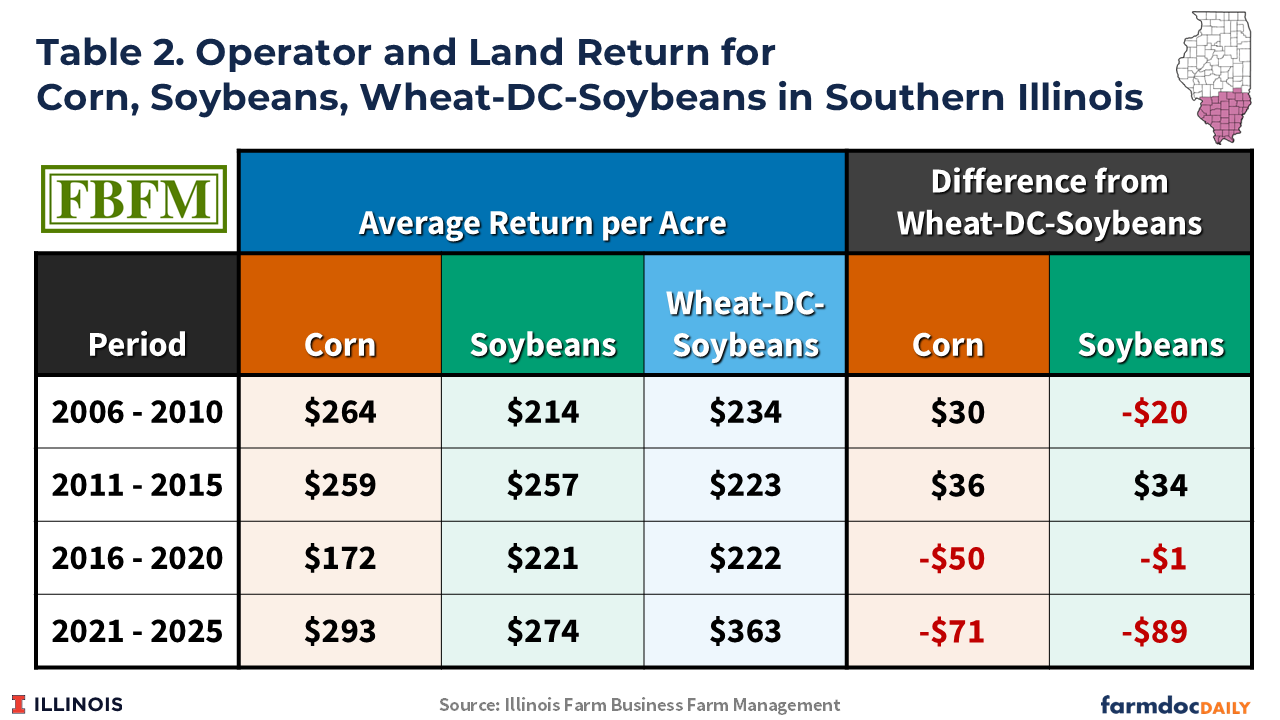
From 2021 through 2025, wheat-double-crop soybeans had the highest average return at $363 per acre. That average was $70 per acre higher than corn at $293 and $89 per acre higher than stand-alone soybeans at $274. Much of the advantage resulted from the $733 return for wheat-double-crop soybeans in 2022.
Discussion
The continuing relative profitability of wheat-double-crop soybeans suggests that southern Illinois farmers may wish to consider adding more of this system to their rotations. As with any rotation change, the decision should account for more than projected returns. Wheat changes the timing and coordination of field operations, and the system must fit the farm’s labor, machinery, and management capacity. A winter wheat crop adds field activities in the fall (planting), spring (crop protection), and early summer (harvest of the wheat crop and planting of double-crop beans) as well as the management requirements associated with input, crop protection, and marketing decisions for a second crop.
Wheat-double-crop soybeans should be viewed as a production system that requires investment in knowledge and experience. Experience suggests that successful wheat production requires intensive management, including several spring fungicide and fertilizer applications. Early wheat harvest is also important because double-crop soybeans must be planted quickly after harvest, both for improved germination as Midwest rainfall usually declines as summer proceeds and for the crop to reach maturity before the first frost.
The preceding implies that the system carries additional risks. Dry weather after wheat harvest can sharply reduce double-crop soybean yields, and occasional low yields should be expected. Double-crop soybean yields can vary widely based on the importance of timely planting and the shorter growing season. Producers are exposed to price risks for multiple crops in a double-crop system. The projected return advantage therefore should be evaluated over multiple years rather than as a one-year opportunity.
Our experience and the results presented here apply to southern Illinois. Research continues in central Illinois (Nafziger and Fontes, Fontes). A shorter growing season in central Illinois and overall soil productivity could change the economics of wheat-double-crop soybeans compared to southern Illinois.
References
Fontes, G. "Double-Crop Soybean Management Practices – Project Report." Department of Crop Sciences, University of Illinois Urbana-Champaign, January 13, 2026.
Nafziger, E., and Giovani Preza Fontes, . "Wheat and Double-Crop Soybeans." Department of Crop Sciences, University of Illinois, May 15, 2023.
Paulson, N., G. Schnitkey, C. Zulauf and B. Zwilling. "Illinois Crop Budgets for 2027." farmdoc daily (16):157, Department of Agricultural and Consumer Economics, University of Illinois Urbana-Champaign, September 1, 2026.
Schnitkey, G. and N. Paulson. "Revenue and Costs for Illinois Grain Crops." Illinois Farm Management Handbook, farmdoc, Department of Agricultural and Consumer Economics, University of Illinois Urbana-Champaign, September 1, 2026.
Disclaimer: We request all readers, electronic media and others follow our citation guidelines when re-posting articles from farmdoc daily. Guidelines are available here. The farmdoc daily website falls under University of Illinois copyright and intellectual property rights. For a detailed statement, please see the University of Illinois Copyright Information and Policies here.