








Trying to Picture a Base Acre Update Through a Hypothetical Change in 2025 Payments
Echoes of a failed vote on an unfinished Farm Bill can still be heard, although the rumble of much bigger news tends to drown them out. As just one example, the U.S. Treasury reported on August 19th that total U.S. debt exceeded $40 trillion for the first time (Cunningham, August 21, 2026; Lawder and Bogage, August 19, 2026). Even that milestone has been overshadowed by other events. While it registers less than most, nagging concerns with the design of farm payment policies remain and this article revisits base acres, which are used to make payments from the Agriculture Risk Coverage (ARC) and Price Loss Coverage (PLC) commodity programs. The discussion herein presents a thought experiment on base acres using average acres planted from 2021 to 2025 to estimate an updated base acre calculation. The changes in acres are then used to calculate changes to expected payments for 2025. The discussion is an attempt to get a better picture of the base acre issue by using a hypothetical, and one that will not happen—Congress will not change base acres for the 2025 payments and those payments will not be impacted even if Congress were to authorize an update in the future. The goal is to shed some light on this issue and add to the picture.
Background
The Unfinished Farm Bill remains unfinished, and the likelihood of Congressional action in the 119th Congress seems increasingly unlikely (farmdoc daily, August 13, 2026). The brief and unsuccessful markup by the Senate Committee on Agriculture, Nutrition, and Forestry left many questions unanswered. Among them are questions about whether Congress should update the base acres used for making ARC and PLC payments. This single policy design remains obscure and often shrouded in confusion.
Begin with this basic understanding: base acres are based on a history of acres planted to the farm; payments, therefore, are not made on the acres of a crop planted in any given crop year. This is by design. The current base acre system was enacted by the 1996 Farm Bill using base acres established from the 1990 Farm Bill, which used the average acres planted in the years prior. A primary justification for this design was to avoid having payments impact the farmer’s planting decisions, such as planting more of a crop with low prices because of high payments. A mandatory base acre update would replace the existing base acres enrolled for program payments with an average of the acres planted to the program crops over a fixed set of years. The last update to base acres was voluntary and enacted by the 2002 Farm Bill. Landowners were allowed to reallocate base acres by the 2014 Farm Bill (farmdoc daily, July 20, 2023; August 10, 2023; August 17, 2023; January 15, 2026; January 22, 2026; January 29, 2026; February 12, 2026; February 16, 2026). In other words, millions of base acres are likely receiving payments based on crops planted 30 or more years ago.
Based on previous updates and reallocations, a base acre update is likely to be based on the average acres planted and prevented from being planted over a recent historical period. One possible option, and the one used in this hypothetical, is an update using the 5-crop year period from 2021-2025. There are plenty of other design options, such as rolling or Olympic averages. It is likely that almost any update would realign acres used for payments to the more recent crop rotations and planting decisions on the ground. The concerns and controversy raised exposes that there is more to the matter, however. This article seeks to add to the information on the issue, while acknowledging that much more work needs to be undertaken to better sort out and understand this potential revision to farm policy.
Discussion
Before delving into the discussion of the impacts of a hypothetical base acre update, a note on data is needed. All data used comes from USDA’s Farm Service Agency (FSA) downloads for program data and planted acres (USDA-FSA, “ARC and PLC Data” and “Crop Acreage Data”). The discussion uses the county level datasets. Close observers are likely to notice discrepancies, especially when comparing aggregated county level totals with reported national totals. This hypothetical uses base acres enrolled in the programs for 2025, for example, which is lower than total base acres reported by FSA at the national level. Enrolled base acres are signed up for the programs and would receive payments if triggered; not all base acres are enrolled each program year, and they are not lost if they are not enrolled but simply would not receive a payment if triggered. Challenges with each county level dataset compound when compiling multiple datasets, here for 11 of the 23 program crops.
The discussion builds a simple hypothetical using the expected ARC/PLC payments for the 2025 crop. These payments have not been made (scheduled for October). Most of the projected payment rates are not final but much of the information necessary to calculate payments is known and available. That information was used to calculate a PLC payment rate (the final or projected deficiency between the effective reference price and the marketing year average (MYA) price multiplied by the county average PLC yield) and an ARC-CO payment rate (actual revenue (MYA price times county average yields) compared to the five-year (2019-2023) benchmark revenue) per base acre. Both programs pay on 85% of the base acres enrolled on a farm. All payment projections are calculated using 85% of the base acres enrolled. For the 2025 payments, farmers will receive the higher of the ARC and PLC payment rates on their enrolled base acres regardless of which program they enrolled their base acres. This is a one-year exception due to Congress having made major changes to the ARC and PLC programs in the 2025 Farm Bill, which was enacted after farmers had made their 2025 crop year enrollment decisions. The normal situation is that farmers receive payments only from the program they elected. This unique feature has been included in the payment projections for this hypothetical. The hypothetical uses projected payment rates, not final payment rates because they have not been reported. There will be revisions in the calculations (especially at the individual crop and county level), but the general points discussed herein will hold.
One additional note: the Reconciliation Farm Bill authorized an addition of 30 million more base acres, beginning with the 2026 crop year (P.L. 119-21, Sec. 10302). The allocation of those additional base acres also has not been reported. As such, these additional base acres are not considered in this hypothetical (farmdoc daily, July 1, 2025; July 11, 2025). Depending on how they are allocated, the additional base acres would substantially alter the impacts of an update on future payments, but likely in the same manner as discussed in this hypothetical.
Moreover, it is important to keep in mind that all projected payments and changes in payments are hypothetical for discussion purposes. Any changes to payments are not going to happen because there is no chance that Congress requires a base acre update that would apply to the 2025 crop year payments. This is a hypothetical of how payments could change if they were made on an updated base acres rather than current enrolled baes acres. Again, the changes in the payments for 2025 discussed in this article will not take place.
Table 1 provides the first overview of this simple base acre update hypothetical at the national level for the major program crops. It compares the enrolled base acres in 2025 to the average acres planted to each crop in 2021 to 2025 (including acres prevented from being planted). IN total, this hypothetical base acre update adds more than 17 million base acres for these 11 program crops as compared to the 2025 enrolled base acres.
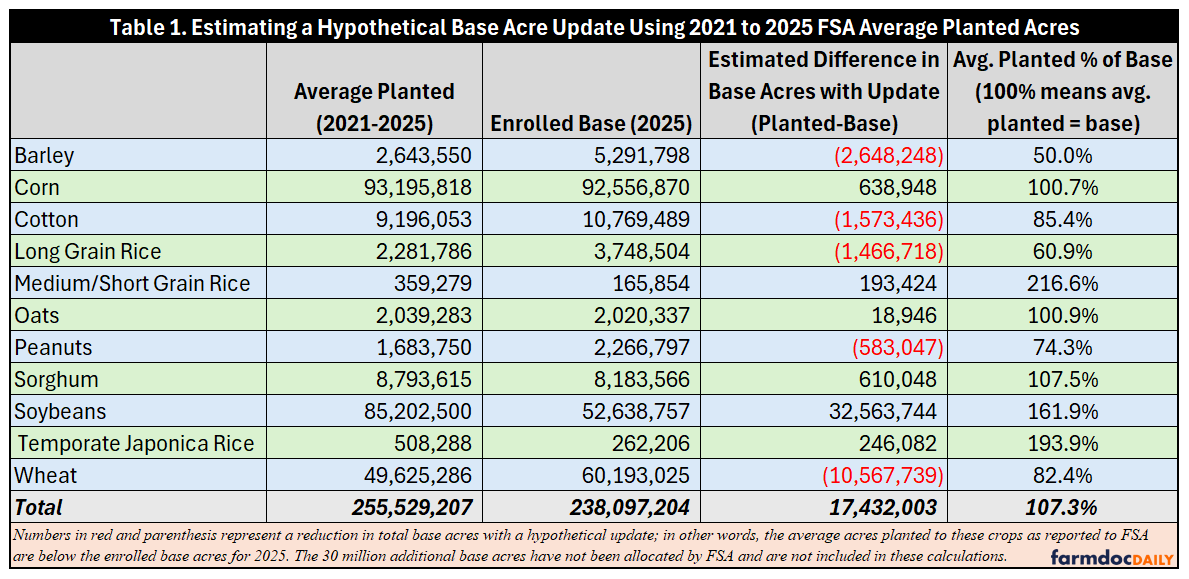
Clear in Table 1, a simple update would impact the program crops differently. Most notably, soybeans would be expected to add over 32 million base acres and corn less than 1 million base acres, while other crops would lose base acres. This is a result of the large increase in acres planted to soybeans, as well as the low level of base acres for soybeans as established after the 2002 Farm Bill.
Table 2 adds estimated changes in expected total payments for this hypothetical of paying 2025 payments on the 2021-2025 average planted acres instead of enrolled base acres for 2025. In this hypothetical, total payments would decrease by nearly $600 million. Comparing the two tables, the reduced spending would be expected because base acres shift from crops with high payment rates to crops with lower payment rates. The differences are largely a function of the disparities in reference prices in PLC, which trigger payments and are fixed in statute by Congress. The higher the reference price relative to market year average prices, the more likely a PLC payment is triggered and the larger the payment rate. Therefore, shifting base acres from those with high payment rates to those with relatively lower payment rates would reduce payments. For 2025, for example, the largest projected payments per base acre (projected payment rate per unit of production multiplied by the PLC county average yield) belong to long grain rice base acres with some counties expected to receive over $400 per base acre. By contrast, very few payments for soybean base acres are expected to exceed $80 per base acre, with the highest payments per soybean base acre from ARC, not PLC. Shifting base from $400 per base acre to less than $80 per base acre would reduce payments and program costs.
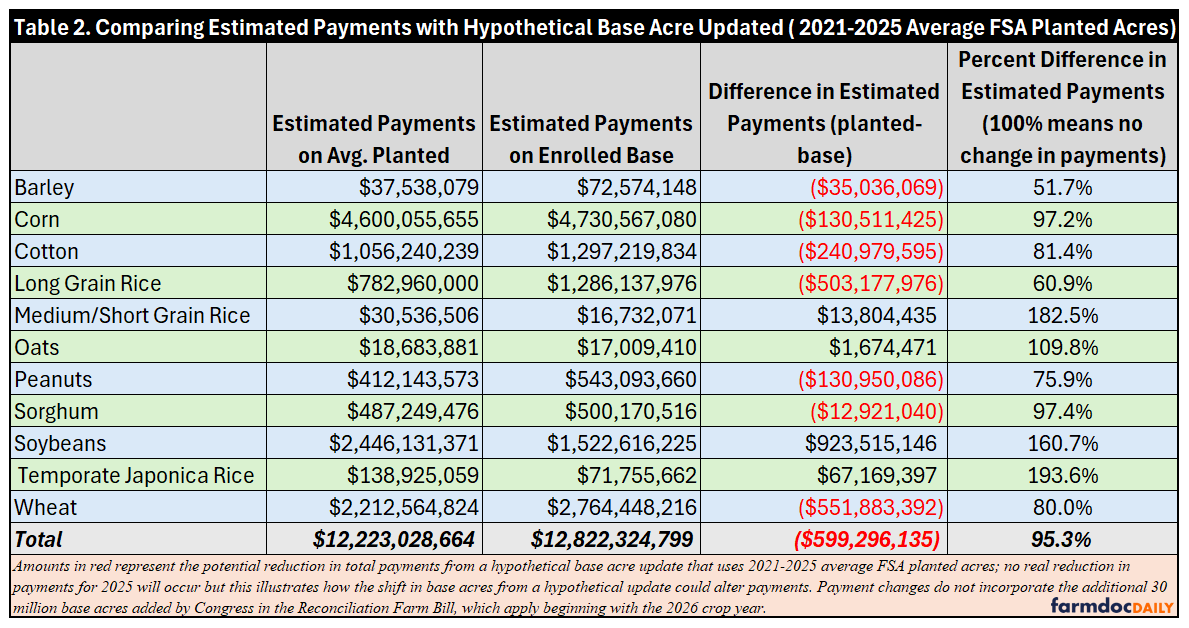
Figure 1 adds to the picture of the impacts on payments from this hypothetical base acre update, projecting payment changes in an interactive map. The map visualizes the change in projected 2025 payments by county, totaled across all 11 of the crops reviewed in this discussion. Hovering over a county will provide more information as to the total changes in projected 2025 payments by each commodity in that county. This gives a sense as to which crops are most responsible for the change in projected payments.
As noted, reduced payments are the result of shifting base acres from high payment rate crops, like long grain rice, to lower payment rate crops, like soybeans. This also indicates the degree to which crops like soybeans are being planted on base acres of other crops, receiving the higher payments as a result. Thus, the negative projected changes in payments could also be seen as a form of overpayment. Further analysis would add important details to this picture.
Concluding Thoughts
The picture of a base acre update discussed in this article is hypothetical but illustrative. It does add important perspectives on the issue, however, helping to shed light on a matter that remains largely obscure. Congress has not authorized an update to base acres since the 2002 Farm Bill, although it did allow a reallocation of base acres in the 2014 Farm Bill. Congress does not appear likely to authorize an update to base acres anytime soon, likely because of the potential changes in payments demonstrated in this hypothetical. Importantly, any update would not apply to the payments for the 2025 crop year that are scheduled for October.
The picture ultimately presented with this hypothetical is that a simple update from the 2025 enrolled base acres using acres planted in the 2021 to 2025 crop years could increase total base acres while decreasing spending by the programs. This is not an illusion. It is the result of shifting base acres from those with high payment rates, like cotton and rice, to base acres with lower payment rates, like soybeans. This shift would happen because farmers have been planting more soybeans, including on base acres of almost all crops, including those crops with large payments.
Of course, the overall impact on payments and spending cannot be known in advance because it depends on market prices and yields in the unknowable future. The further into that future payments are projected, the less certain and more speculative the projections become. Notably, PLC did not trigger payments for any base acres other than peanuts in crop year 2021, and no payments for any base acre in 2022 and 2023 (only peanut, seed cotton, and temporate japonica rice in 2024). PLC payments were not triggered because market year average prices were above reference prices.
A base acre update would, however, better reflect the planting decisions and crop rotations of farmers today, rather than 30 years ago (or more)—and better than adding another 30 million base acres on top of this out-of-date allocation. It would also preserve the decoupled aspect of the policy design, dampening any distortionary impacts of payments on planting decisions. Such a revision to the programs would better align federal taxpayer support with actual farm risk, including input costs. A crop planted to a base acre of a different crop receives a payment that could differ substantially from the costs or risk of the crop planted. This feature also provides very different income outcomes for farmers growing the same crops, solely due to the differences in base acres. For now, the matter of a base acre update remains speculative, but it exposes issues with this policy design that are worth deliberation.
References
Coppess, J. "Farm Bill 2023: Reviewing Pieces of the Base Acres Puzzle." farmdoc daily (13):134, Department of Agricultural and Consumer Economics, University of Illinois at Urbana-Champaign, July 20, 2023.
Coppess, J. "Farm Bill 2023: The Intersection of Base Acres and Reference Prices." farmdoc daily (13):147, Department of Agricultural and Consumer Economics, University of Illinois at Urbana-Champaign, August 10, 2023.
Coppess, J. "Farm Bill 2023: Another Perspective on Reference Prices and Base Acres." farmdoc daily (13):152, Department of Agricultural and Consumer Economics, University of Illinois at Urbana-Champaign, August 17, 2023.
Coppess, J. "Off Base, Part 1: Reviewing Issues and Problems with Base Acre Policy." farmdoc daily (16):7, Department of Agricultural and Consumer Economics, University of Illinois at Urbana-Champaign, January 15, 2026.
Coppess, J. "Off Base, Part 2: The View from the CBO Baseline." farmdoc daily (16):10, Department of Agricultural and Consumer Economics, University of Illinois at Urbana-Champaign, January 22, 2026.
Coppess, J. "Off-Base, Part 3: Picking Winners & Losers with Policy." farmdoc daily (16):13, Department of Agricultural and Consumer Economics, University of Illinois at Urbana-Champaign, January 29, 2026.
Coppess, J. "Off-Base, Part 4: A Fundamental Flaw in the Policy." farmdoc daily (16):22, Department of Agricultural and Consumer Economics, University of Illinois at Urbana-Champaign, February 12, 2026.
Coppess, J. "Off-Base, Part 5: Farm Policy Has Been Here Before; Lessons Reinforced by History." farmdoc daily (16):24, Department of Agricultural and Consumer Economics, University of Illinois at Urbana-Champaign, February 16, 2026.
Cunningham, Mary. “National debt tops $40 trillion after doubling in less than a decade, Treasury data shows.” CBS News.com. August 21, 2026. https://www.cbsnews.com/news/national-debt-tops-40-trillion-doubles/.
Lawder, David and Jacob Bogage. “US debt crosses $40 trillion threshold after doubling under Trump and Biden.” Reuters.com. August 19, 2026. https://www.reuters.com/world/us-debt-crosses-40-trillion-threshold-after-doubling-under-trump-biden-2026-08-19/.
Schnitkey, G., C. Zulauf, N. Paulson and J. Coppess. "Reconciliation Bill Proposals to Add Base Acres." farmdoc daily (15):120, Department of Agricultural and Consumer Economics, University of Illinois at Urbana-Champaign, July 1, 2025.
Zulauf, C., G. Schnitkey and N. Paulson. "The New Base Acre Provisions in the 2025 Farm Bill." farmdoc daily (15):126, Department of Agricultural and Consumer Economics, University of Illinois at Urbana-Champaign, July 11, 2025.
Disclaimer: We request all readers, electronic media and others follow our citation guidelines when re-posting articles from farmdoc daily. Guidelines are available here. The farmdoc daily website falls under University of Illinois copyright and intellectual property rights. For a detailed statement, please see the University of Illinois Copyright Information and Policies here.