








2026 Crop Insurance Harvest Prices for Corn and Soybeans
October settlement prices of Chicago Mercantile Exchange (CME) futures contracts are used to set harvest prices on Federal crop insurance products for corn and soybeans in the Midwest. Harvest prices are $4.75 per bushel for corn and $12.63 per bushel for soybeans. Both are above their projected prices, which are $4.62 for corn and $11.09 for soybeans.
Because the harvest price is above the projected price for both crops, yield losses will be required to trigger payments under individual and area policies, including Supplemental Coverage Option (SCO) and Enhanced Coverage Option (SCO). Revenue Protection (RP) sets its guarantee at the higher of the projected or harvest price. As a result, RP will make higher insurance payments than Revenue Protection with the Harvest Price Exclusion (RP-HPE), which does not have the guarantee increase provision. Yield Protection (YP) will value covered yield losses at the projected price.
Corn
The 2026 harvest price for corn is $4.75, the average of the December 2026 CME corn futures contract during October. Figure 1 shows daily settlement prices during October and how the average of the settlement prices changed throughout the month. The December 2026 corn contract started October with settlement prices near $5 per bushel but then declined to around $4.50 by the end of the month. The average of the settlement prices declined to the final harvest price of $4.75 by the end of the month.
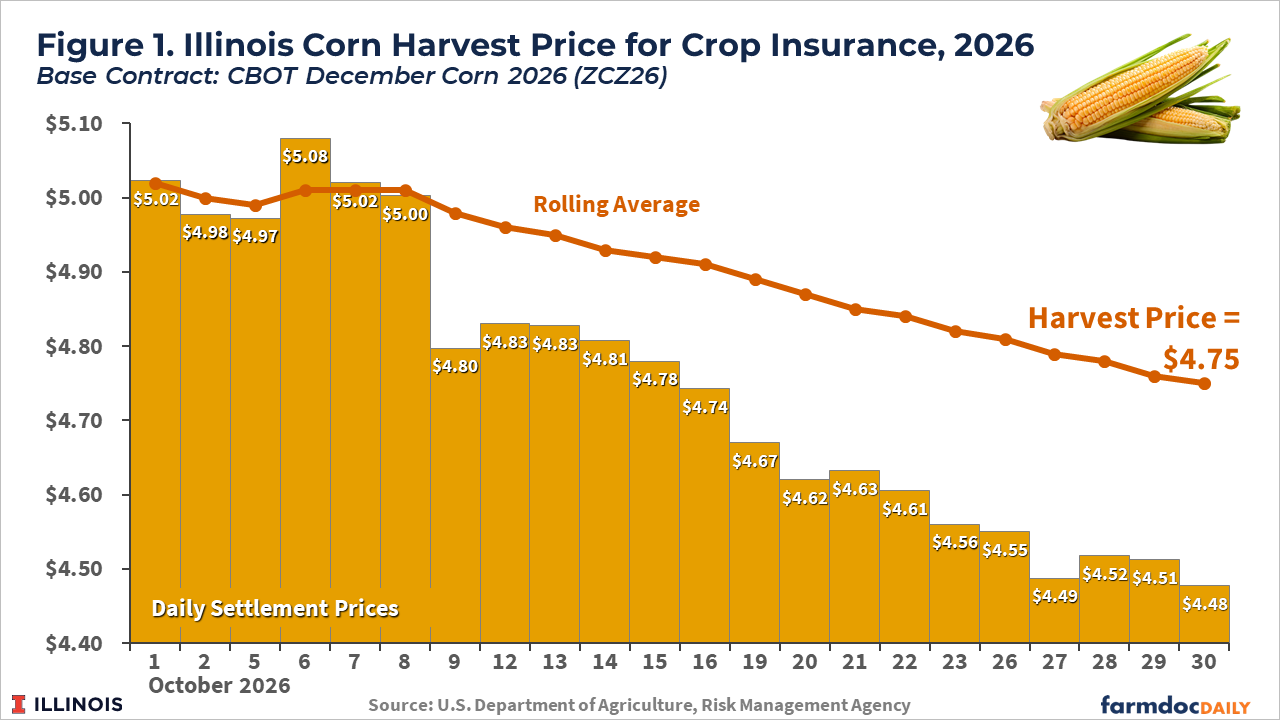
The $4.75 harvest price is $0.13, or 2.8%, above the 2026 projected price for corn of $4.62. As shown in Figure 2, the harvest price for corn was below the projected price in each of the last three years from 2023 to 2025. Corn’s harvest price exceeded the projected price was during the three consecutive crop years from 2020 through 2022. Over the last 10 years, from 2017 to 2026, the average difference between the harvest and projected prices for corn has been -$0.09 per bushel.
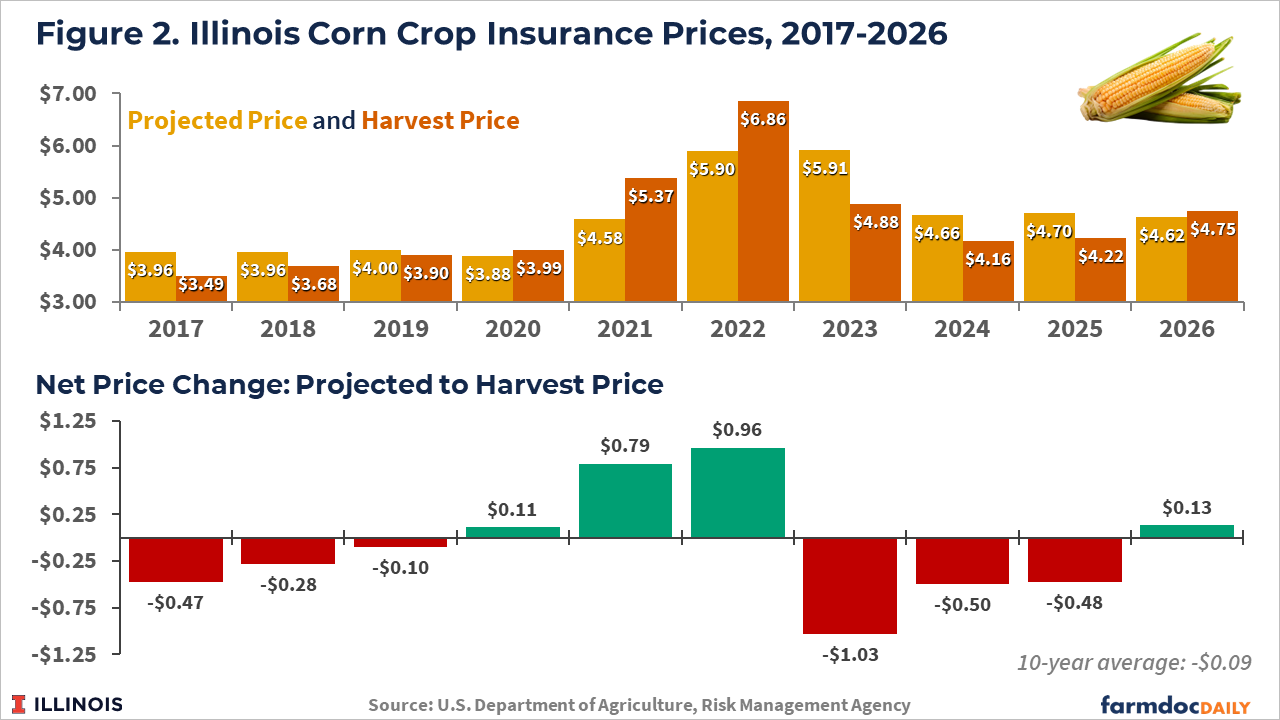
The increase in the harvest price for corn implies that yield losses will need to be realized to trigger payments on RP, RP-HPE, and YP policies at all coverage levels. RP will require smaller yield losses to trigger payments than RP-HPE coverage at the same coverage level because the guarantee uses the higher harvest price. YP coverage will trigger payments at the same level of yield losses as RP, but payments will be smaller since YP values yield losses at the lower projected price.
The latest 2026 corn yield estimate for Illinois from the USDA is 208 bushels per acre, lower than the 214 bushel per acre average yield for Illinois in 2025 but still slightly above trend yield estimates. Yields for many farms will be above crop insurance guarantee levels, but some farms will experience yield losses sufficient to trigger insurance payments on individual policies in Illinois and other corn growing areas of the US.
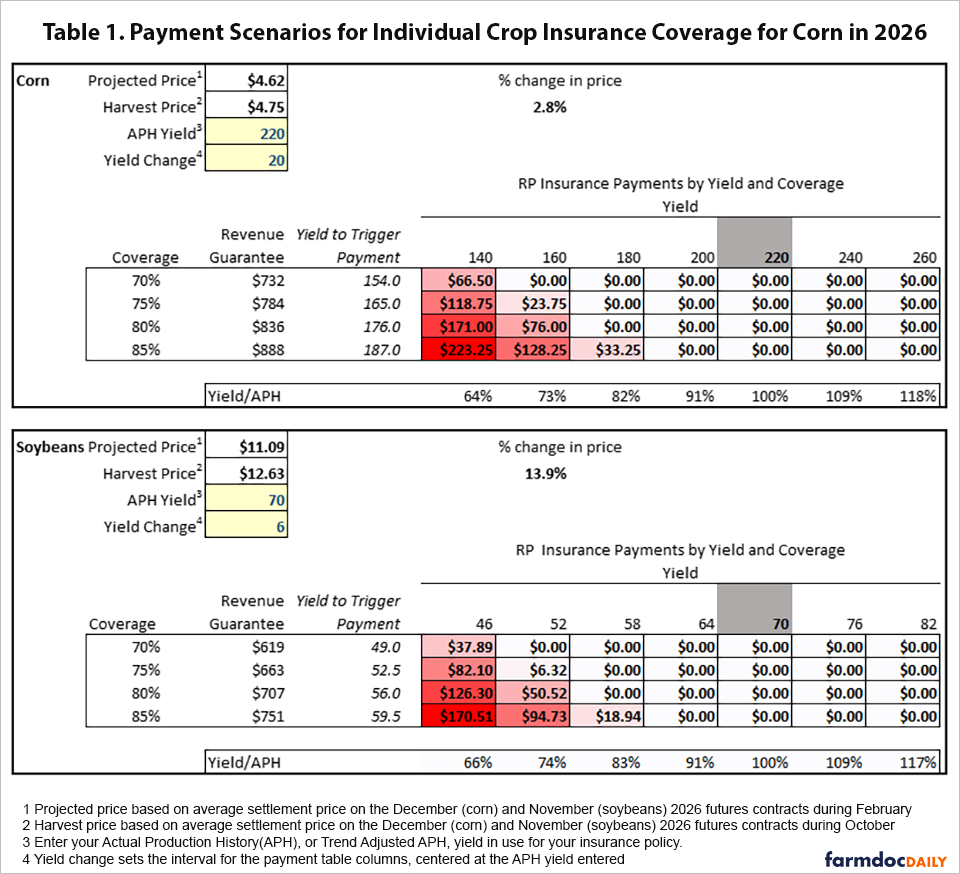
The upper panel of Table 1 provides example indemnity payment scenarios from RP coverage for corn having a guarantee yield of 220 bushel per acre. An RP policy at an 85% coverage would trigger payments with a corn yield of 187 bushels per acre or lower. At a 180-bushel corn yield the indemnity would be $33.25 per acre, increasing to $128.25 per acre with a corn yield of 160. RP policies at 80% coverage would trigger payments for this farm with yields at or below 176 bushels per acre, while yields would need to be at or below 165 to trigger payments with a 75% coverage level.
The scenarios in Table 1 come from an insurance payment Excel calculator which can be downloaded here. You can examine payment scenarios for RP coverage by entering the APH yield for your individual farm. Tables with scenarios for RP-HPE and YP coverage are also provided in separate worksheets in the calculator.
Soybeans
The 2026 harvest price for soybeans is $12.63. This harvest price is based on average settlement prices for the November 2026 CME soybean futures contract during October. Figure 3 shows daily settlement prices during October and how the average of the settlement prices changed throughout the month. The November 2026 soybean contract started October with settlement prices near $12.80 per bushel, increasing to around $13 per bushel, and then declined to around $12.20 by the end of the month. The average of the settlement prices declined to the final harvest price of $12.63 by the end of the month.
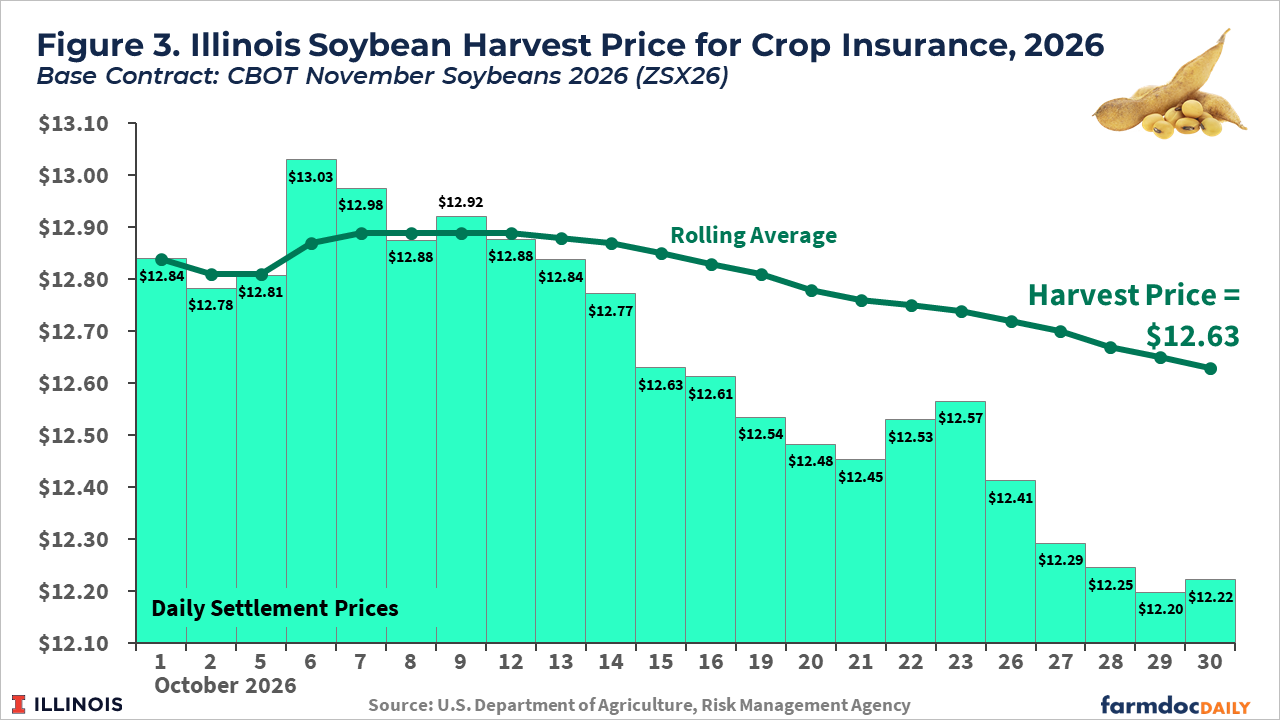
The $12.63 harvest price is $1.54, or 13.9%, above the 2026 projected price for soybeans of $11.09. As shown in Figure 4, the harvest price for soybeans was below the projected price in each of the last four years from 2022 to 2025. The last time the soybean harvest price exceeded the projected price was in 2020 and 2021. Over the last 10 years, the average difference between the harvest and projected prices for soybeans has been -$0.21 per bushel.
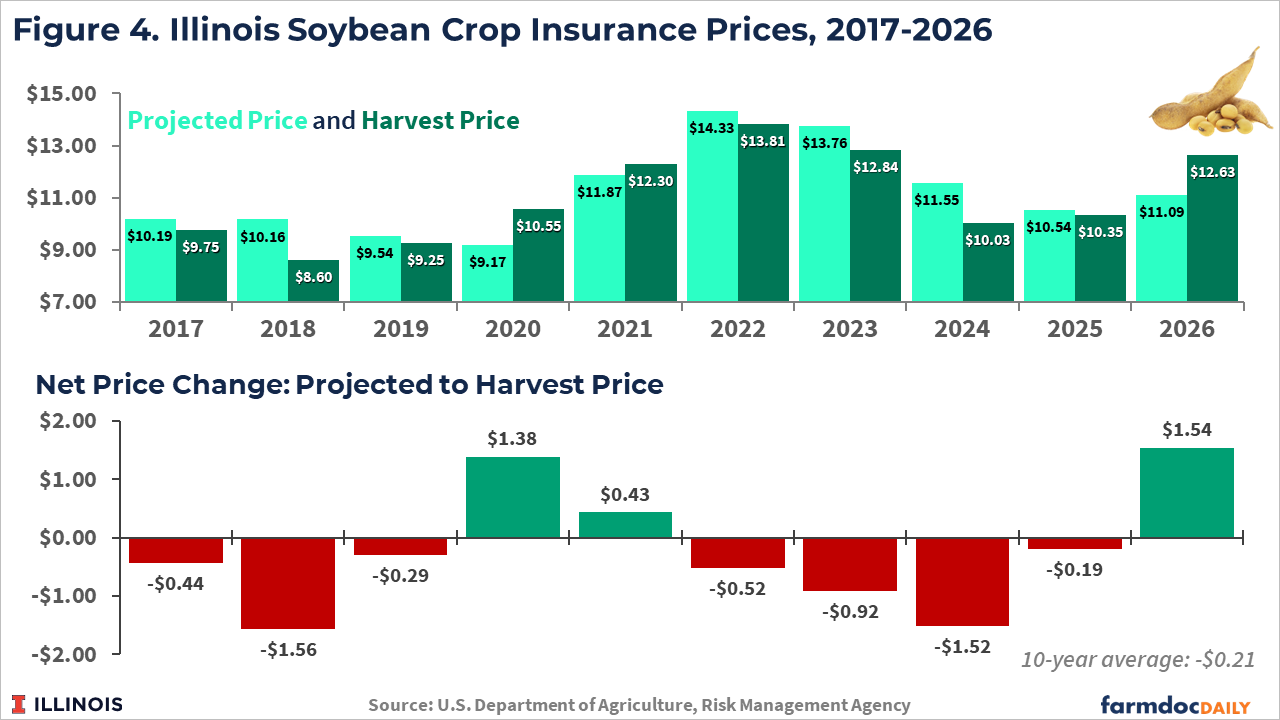
As with corn, the increase in the harvest price for soybeans implies that yield losses will be needed to trigger payments. Smaller yield losses will be needed to trigger RP or YP payments compared with RP-HPE, and RP payments will be larger than YP payments given the higher harvest price. The latest 2026 soybean yield estimate for Illinois from the USDA is 68 bushels per acre, higher than the 62.5 bushels per acre average yield for Illinois in 2025 and above trend yield estimates for 2026. Again, individual insurance payments are not expected to be widespread across most farms in Illinois but there will be cases where yield losses are sufficient to trigger insurance payments in some parts of Illinois and other areas of the US.
The lower panel of Table 1 provides example indemnity payment scenarios for a guarantee yield for soybeans at 70 bushels per acre. RP at an 85% coverage would trigger payments with a soybean yield of 59.5 bushels or lower. At a 58-bushel soybean yield the indemnity for this farm would be $18.94 per acre, increasing to $94.73 per acre with a soybean yield of 52 bushels per acre. RP at 80% coverage would trigger payments for this farm with soybean yields at or below 56 bushels per acre, while soybean yields would need to be at or below 52.5 to trigger payments on a 75% RP policy.
Scenarios for RP, RP-HPE, and YP can also be examined for soybeans in the simple Excel calculator available here.
Comment on Supplemental Insurance Plans – SCO and ECO
ECO and SCO, the supplemental area-based insurance plans, will also require area yield losses (relative to the county’s yield guarantee) to trigger payments in 2026. The higher coverage levels for the supplemental plans – 95% or 90% for ECO and 86% for SCO – mean that smaller yield losses will trigger payments compared with the individual policies. As with the individual policies, smaller yield losses will be required to trigger ECO or SCO payments for policies coupled with underlying RP or YP coverage while larger yield losses will be needed for cases where the supplemental plans are coupled with RP-HPE. In cases where payments are triggered, ECO or SCO combined with RP will have larger payments than when combined with YP because of the harvest price being higher.
Conclusions
The 2026 harvest prices for crop insurance are above the projected prices for both corn and soybeans, meaning that yield losses will be required to trigger payments. Because of the higher harvest price, required yield losses to trigger payments for RP-HPE will be larger than for RP or YP. The higher harvest price also means that payments triggered by RP policies will be larger than for the same coverage on the other individual plans. Smaller yield losses will be required to trigger payments from the supplemental area plans SCO and ECO because of their higher coverage levels. However, payments from those programs will not be known until RMA releases county yields for 2026, which typically occurs in June.
Disclaimer: We request all readers, electronic media and others follow our citation guidelines when re-posting articles from farmdoc daily. Guidelines are available here. The farmdoc daily website falls under University of Illinois copyright and intellectual property rights. For a detailed statement, please see the University of Illinois Copyright Information and Policies here.