








Timely Payments: The Case for Commodity Programs That Pay at Harvest
Since 2019, ARC-CO (Agriculture Risk Coverage – county version) and PLC (Price Loss Coverage) payments have approximately followed market returns: large when market losses are large and small when markets are profitable (see Figure 1). But these payments, which (based on statutes) are made starting in October of the next crop year, have not been timely. They bear no relationship with market returns at the time of payment (see Figure 2). To provide specific illustrations of this disconnect, 2019 crop year payments covered 48% of 2019 harvest losses ($6.2 vs. -$13.2 billion) and 2020 crop year payments covered 53% of 2020 harvest losses ($2.2 vs. -$4.2 billion). However, 2019 crop year payments arrived at the 2020 harvest, overcompensating for 2020 harvest losses ($6.2 vs -$4.2 billion); while 2020 crop year payments arrived at the 2021 harvest, adding $2.2 billion to $30.4 billion in market profits. For farmers and their lenders, the timing of payments is important. Paying at harvest would notably improve commodity program relevance for managing a farm.
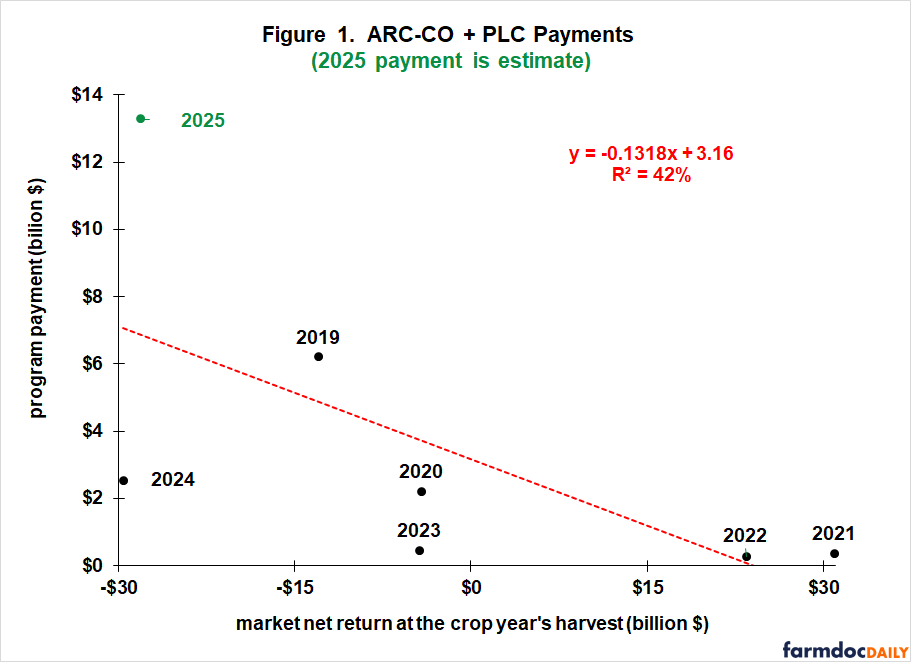
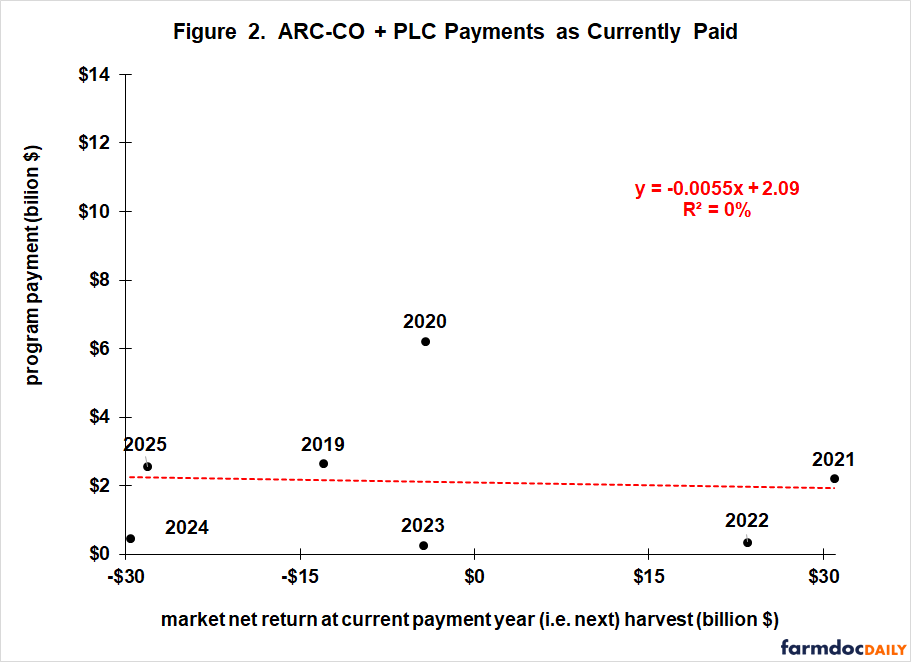
Figures 1 and 2 use market net return at harvest reported by USDA (US Department of Agriculture), Economic Research Service and ARC-CO and PLC payments reported by USDA, Farm Service Agency and University of Illinois at Champaign-Urbana (farmdoc daily, November 11, 2025, and May 14, 2026). Net returns and payments are combined for the nine crops for which USDA computes an economic cost of production (COP): barley, corn, cotton, oats, peanuts, rice, sorghum, soybeans, wheat. The net return data are discussed in detail in farmdoc daily, February 5, 2026.
Proposed Harvest Price Loss (HPL) Design (replacement for PLC)
HPL is a harvest price loss design at the US level. Payment occurs if crop insurance harvest price is less than benchmark price. Benchmark price can be fixed by Congress or be a function of the average of recent insurance harvest prices. Payment is made during the month following peak harvest on a crop’s base acres.
Proposed Harvest Revenue Loss (HRL) Design (replacement for ARC-CO)
HRL is a harvest revenue loss design at the US level (see Data Note). Payment occurs if harvest revenue per acre is less than benchmark revenue per acre. Harvest revenue is calculated as the US yield estimate made by USDA, National Agricultural Statistics Service during the month when most of the crop is harvested times the crop insurance harvest price. Benchmark revenue is a function of the average of recent harvest revenues. Payment is made during the month following peak harvest on a crop’s base acres.
Discussion
A repeated lesson of US financial crises dating to the 1930s Great Depression is the importance of providing timely assistance. Commodity programs are effectively standing financial crisis programs, specifically for multiple years of low returns. Crop insurance does not cover this risk as it resets coverage each year at that year’s projected price.
Assistance by the current ARC-CO and PLC commodity programs have not been timely since 2019.
The proposed Harvest Price Loss (HPL) and Harvest Revenue Loss (HRL) commodity program designs would
- make payments within a month of a crop’s peak harvest month;
- reduce overlap of commodity and insurance payments by using the same price;
- restore an original safety net objective of reducing a farmer’s need to sell a crop at harvest; and
- reflect the early payment feature of recent ad hoc economic assistance. Ad hoc assistance is often a leading indicator of desired crop safety net changes (farmdoc daily, July 29, 2020).
Timely assistance (1) reduces the chance that assistance adds to market profits, thus putting more upward pressure on crop input prices; and (2) reduces the chance that payments for market losses is unacceptably small, thus removing a potential justification for ad hoc assistance.
As with any policy design option, tradeoffs and issues need to be considered and studied. These include:
- ARC currently has a shallow loss county / area component that no longer could be offered with a harvest payment design. County yields are not determined until June-July of the next year. ARC was first authorized in the 2014 Farm Bill before the 95% coverage Enhanced Coverage Option area add-on product to individual insurance was created. Availability of ECO, with its now 80% premium subsidy, may reduce the need for ARC’s county shallow loss component.
- Changing commodity programs so they pay at harvest means, from a federal budget perspective, that the 11th year cost moves into the 10-year budget baseline. This cost would need to be offset. Some, perhaps much, of the cost savings can come from a US instead of a county revenue program. Yield variability, a key revenue program cost factor, is usually notably lower for the US than for counties.
- Decoupling of payments from current planted acres is a key design feature of commodity programs. The impact of any design change on decoupling needs assessment. HPL and HRL would continue to pay on base not planted acres but thought needs to be given to whether changing the timing of payment would alter the degree of decoupling.
- ARC-CO and PLC programs use a 12-month market year average price and thus comingle return to production with return to storage. HPL and HRL would pay at harvest and thus coincide with production return only. An issue is whether storage return should be part of commodity program design.
- Quality and accuracy of data required to operate a program always needs to be considered. For example, US average cash price during the peak harvest month may be found to be a more accurate and representative price than the harvest insurance price. This change would however push payment back by one month but may be a tradeoff worth making.
In summary, ARC-CO and PLC have a design flaw that undermines their usefulness for farmers and their lenders. This design flaw needs careful and thoughtful attention, both regarding its importance and any response to address it.
Data Note
HPL and HRL could also have a state design. USDA releases yield estimates for major production states and crop insurance prices are available by state. For smaller producing states, yields would need to be estimated using a different methodology or the current estimation procedures would need to be expanded to include additional states.
References and Data Sources
Monaco, H., G. Schnitkey, N. Paulson, J. Coppess and C. Zulauf. “2025 ARC/PLC Final Estimates.” farmdoc daily (16):85, Department of Agricultural and Consumer Economics, University of Illinois at Urbana-Champaign, May 14, 2026.
Paulson, N., G. Schnitkey, J. Coppess, C. Zulauf and H. Monaco. “Estimates of 2024 ARC-CO and PLC Payments.” farmdoc daily (15):208, Department of Agricultural and Consumer Economics, University of Illinois at Urbana-Champaign, November 11, 2025.
US Department of Agriculture, Economic Research Service. July 2026. Cost of Production. https://www.ers.usda.gov/data-products/commodity-costs-and-returns/
US Department of Agriculture, Farm Service Agency. July 2026. ARC-PLC Program Data https://www.fsa.usda.gov/resources/programs/arc-plc/program-data
Zulauf, C., D. Orden and G. Schnitkey. “Has the US Crop Safety Net Become Excessive?” farmdoc daily (16):18, Department of Agricultural and Consumer Economics, University of Illinois at Urbana-Champaign, February 5, 2026.
Zulauf, C., G. Schnitkey, J. Coppess, N. Paulson and K. Swanson. “Ad Hoc Payments: A Leading Indicator of Farm Policy Change.” farmdoc daily (10):140, Department of Agricultural and Consumer Economics, University of Illinois at Urbana-Champaign, July 29, 2020.
Disclaimer: We request all readers, electronic media and others follow our citation guidelines when re-posting articles from farmdoc daily. Guidelines are available here. The farmdoc daily website falls under University of Illinois copyright and intellectual property rights. For a detailed statement, please see the University of Illinois Copyright Information and Policies here.