








ARC-CO and PLC Payments: Improving Farmers’ Decision Making
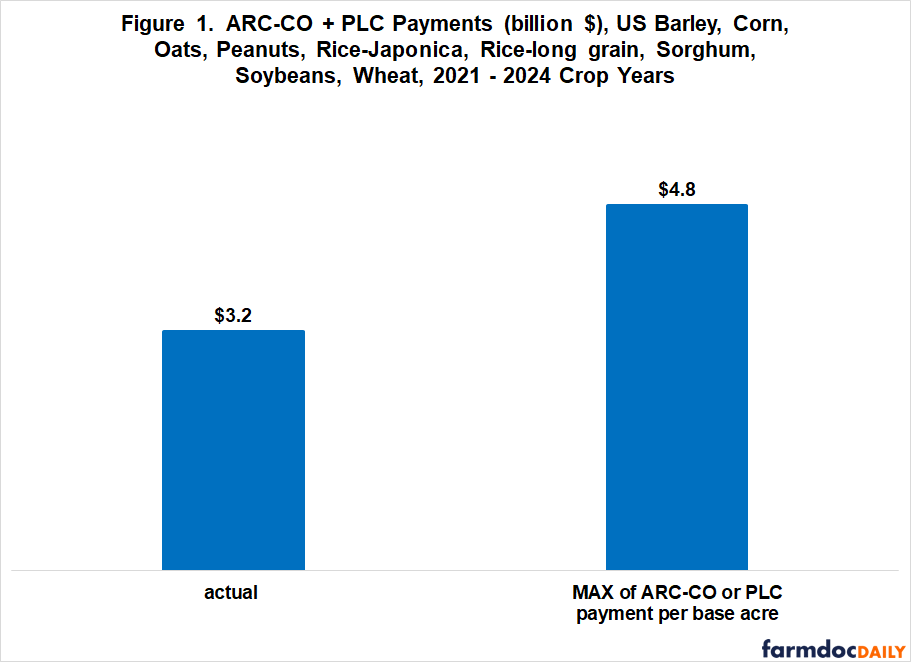
Crop farmers will have to choose a commodity program for the 2026 crop year. An annual decision was also made for the 2021-2024 crop years. Farmers’ choices for these four years resulted in ARC-CO (Agricultural Risk Management – County) and PLC (Price Loss Coverage) paying a total of $3.2 billion to base acres of barley, corn, oats, peanuts, rice-Japonica, rice-long grain, sorghum, soybeans, and wheat (see Figure 1 and Note 1). These payments were however $1.6 billion or 33% below the amount farmers would have received if all base acres had received the maximum between ARC-CO or PLC, as is the case for 2025 crops (see Note 2). If farmers had instead followed a simple decision guide, payments would have totaled $4.5 billion, or only 7% below the possible maximum (see Figure 1). Actual payments are from the USDA, FSA (US Department of Agriculture, Farm Service Agency) and the University of Illinois at Urbana-Champaign (farmdoc daily, November 11, 2025),
Decision Guide
The decision guide is:
- Choose PLC if the program crop’s average US cash price for January of the current crop marketing year is less than the crop’s effective reference price for the upcoming (i.e. decision) crop marketing year.
- Otherwise, choose ARC-CO.
The guide makes use of two pieces of information:
- PLC only pays if market year average price is less than the effective reference price.
- Speculative prices, including prices of most crops, follow a time path strongly impacted by random shocks not known until they occur. These shocks may increase or decrease price. An implication of this price formation model is that today’s price is the best estimate of tomorrow’s price unless you know the precise random shocks that will occur.
The decision guide in essence assumes the current crop marketing year’s January price is a good predictor of the upcoming crop marketing year’s average price. The January price is late in the decision window but known before it typically closes. The decision indicator focuses on whether PLC should be chosen, and, by consequence, if ARC-CO should be chosen too.
To illustrate the decision guide, USDA, FSA announced a $4.01 / bushel effective reference price for 2024 crop marketing year corn. The January 2024 US average cash corn price, which is in the 2023 crop marketing year, was $4.74 / bushel. Since the January 2024 cash price was above the 2024 effective reference price ($4.74 vs. $4.01), the decision guide signaled to “not elect PLC.” ARC-CO should be chosen. Note, the corn crop marketing year is from September through August.
What If Analysis
The commodity program decision guide is applied in a “what if” analysis for the 2021-2024 crop year decisions for base acres of barley, corn, oats, peanuts, rice-Japonica, rice-long grain, sorghum, soybeans, and wheat. These crops are a diverse set of large and small acreage crops with different agro-production and market characteristics. The “what if” analysis assumes that the actual ARC-CO and PLC payments per base acre remain the same and that all US base acres for the crop would follow the signal generated by the decision guide. The analysis is at the US level.
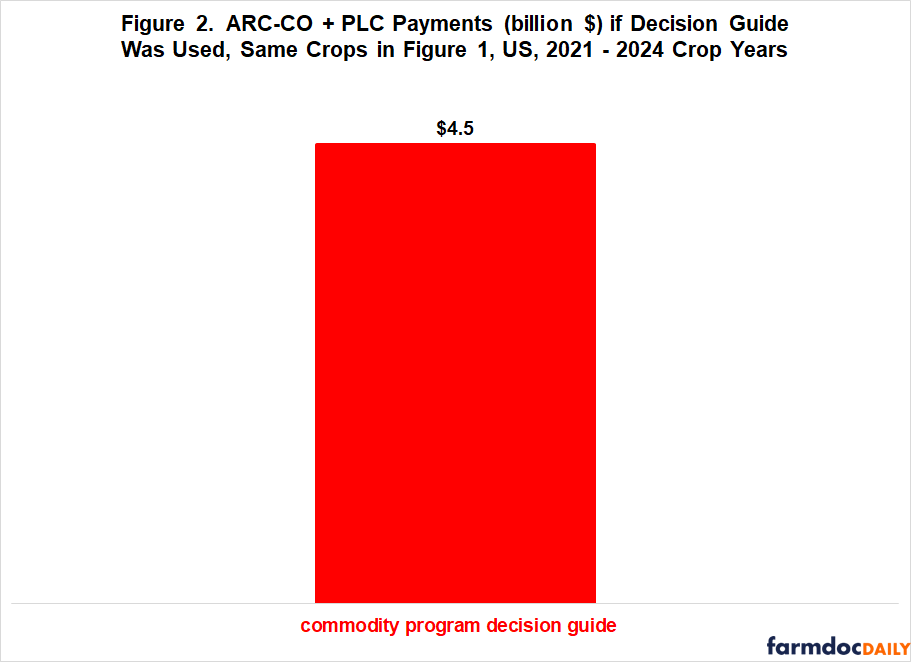
Given the assumptions and data, the decision guide correctly predicted whether ARC-CO or PLC would make the highest per acre payment for 89% (i.e. 32) of the 36 crop-year observations. For corn, soybeans, and wheat; the correct prediction share was 92% (11 of 12). Payments totaled $4.5 billion, or $1.3 billion more than actual ARC-CO and PLC payments for the 2021-2024 crop years.
Discussion
As a group, US farmers’ decision on which commodity program to elect captured only about 67% of potential ARC-CO and PLC payments during the 2021-2024 crop years.
A 2022 article by Fischer, et al also found considerable divergence of actual from potential commodity program payments. They examined paying the maximum of ARC-CO and PLC payment per base acre. Consistent with implication of the payments in Figure 1 of this article, they found this option to be expensive. A notable source of funding would have to be found.
Another approach is to develop decision guides that improve decision making performance. Guides exist, but to the authors’ knowledge have not been examined for their performance.
This article proposes a simple decision guide that a “what if” analysis found would have captured around 93% of potential 2021-2024 crop year ARC-CO and PLC payments, compared to 67% actually paid to farmers, a substantial improvement.
All decision guides break down and give wrong signals at times. This is why we call it a guide. It helps inform, not make the decision. Commodity program decisions may be made for reasons other than maximizing payments, but it is commonly accepted that this is the primary motivation. Last, many variations of this article’s decision guide exist, as well as other decision guides. The intent is to introduce the general idea behind the proposed decision guide, to show that, at least over 2021-2024, this simple decision guide nontrivially would have improved payments to farmers, and to encourage further examination with the goal of improving performance of the farm bill commodity programs by improving farmer decision making.
Notes
- Seed cotton has a different decision matrix than other program commodities. A cotton farmer is precluded from being in commodity programs if they elect to buy the STAX insurance product, which is available only for seed cotton. Given seed cotton’s different decision matrix, it was decided to be analytically conservative and exclude seed cotton from the analysis.
- The 2025 Farm Bill waived the annual decision for the 2025 crop year due to significant changes made to 2025 crop year commodity programs after farmers had made their 2025 crop year decisions. For 2025, farmers will receive the higher of ARC-CO or PLC payment per base acre for their FSA farms.
References
Fischer, Bart L., Henry L. Bryant, James M. Raulston, and Joe L. Outlaw. 2022. Simplifying the farm safety net. Applied Economic Perspectives and Policy. 44(3): 1195–1203. https://doi.org/10.1002/aepp.13268.
Paulson, N., G. Schnitkey, J. Coppess, C. Zulauf and H. Monaco. "Estimates of 2024 ARC-CO and PLC Payments." farmdoc daily (15):208, Department of Agricultural and Consumer Economics, University of Illinois at Urbana-Champaign, November 11, 2025.
US Department of Agriculture, Economic Research Service. July 2026. Cost of Production. https://www.ers.usda.gov/data-products/commodity-costs-and-returns/
US Department of Agriculture, Farm Service Agency. July 2026. ARC-PLC Program Data https://www.fsa.usda.gov/resources/programs/arc-plc/program-data
US Department of Agriculture, Risk Management Agency. July 2026. Summary of Business. http://www.rma.usda.gov
Disclaimer: We request all readers, electronic media and others follow our citation guidelines when re-posting articles from farmdoc daily. Guidelines are available here. The farmdoc daily website falls under University of Illinois copyright and intellectual property rights. For a detailed statement, please see the University of Illinois Copyright Information and Policies here.