








Lettuce Talk About Food Safety: Consumer Responses to Recent Outbreaks
Over the last month, it has been hard to miss the news of outbreaks and recalls. Cyclospora-contaminated iceberg lettuce sickened over 11,000 across 20 states and led to a recall in mid-July of the product in both food service settings and retail stores across a larger set of states (FDA, 2026a). Salmonella-contaminated eggs has sickened 134 across 18 states and led to a recall near the end of July (FDA, 2026b). E. coli-contaminated frozen blueberries sickened 17 cases across Florida and Georgia and led to multiple recalls in July (FDA, 2026d). Salmonella-contaminated jalapeños sickened 431 across 32 states and led to a recall at the beginning of August (FDA, 2026c). And recently, an investigation of both E. coli and salmonella in sprouts began, with 55 current cases across 15 states and a recall announced on August 22 (FDA, 2026e). Investigations of these outbreaks are ongoing. Notably, recalls also affected several chain restaurants (FDA, 2026a; FDA, 2026c), increasing the news coverage and public attention to the events.
Previous research has highlighted that outbreaks affect consumer demand for the product and firm value (e.g., Pozo and Schroeder, 2016; Bakhtavoryan, Capps, and Salin, 2014; Peake, Detre, and Carlson, 2014; Thomsen and McKenzie, 2001). Further, outbreaks can sometimes have spillovers for others on the shelf. For example, reducing demand for non-recalled products within the category or products used in a complementary manner (e.g., if demand for salad greens go down, so does demand for salad dressing). Additionally, when multiple, sequential outbreaks occur, consumer responses can sometimes become more significant (e.g., Fahs, Mittelhammer, and McCluskey, 2009) and national media attention can increase (e.g., Kalaitzandonakes, Ellison, and Serra Devesa, 2024). Reports have noted that the Cyclospora outbreak dampened demand for multiple fresh produce categories and demand for some restaurants (Nelson, 2026; Crawford, 2026).
In this post, we review results from the Gardner Food and Agricultural Policy Survey from the last two years to understand evolving perceptions of food safety and responses to the recent outbreaks and recalls.
Data
In this post, we review data from the Gardner Food and Agricultural Policy Survey. This survey is conducted quarterly with approximately 1,000 U.S. adult consumers. The survey is conducted online via Qualtrics. In each wave, quotas are used to recruit respondents to match the U.S. population in terms of age, income, gender, and region. Surveys are affected by sample bias, meaning that those who are more likely to participate may differ from those who do not participate in surveys in ways that affect outcome measures. In this post, we review results from waves 11 (November 2024) to 18 (August 2026), including several food safety questions included only in wave 18.
Results
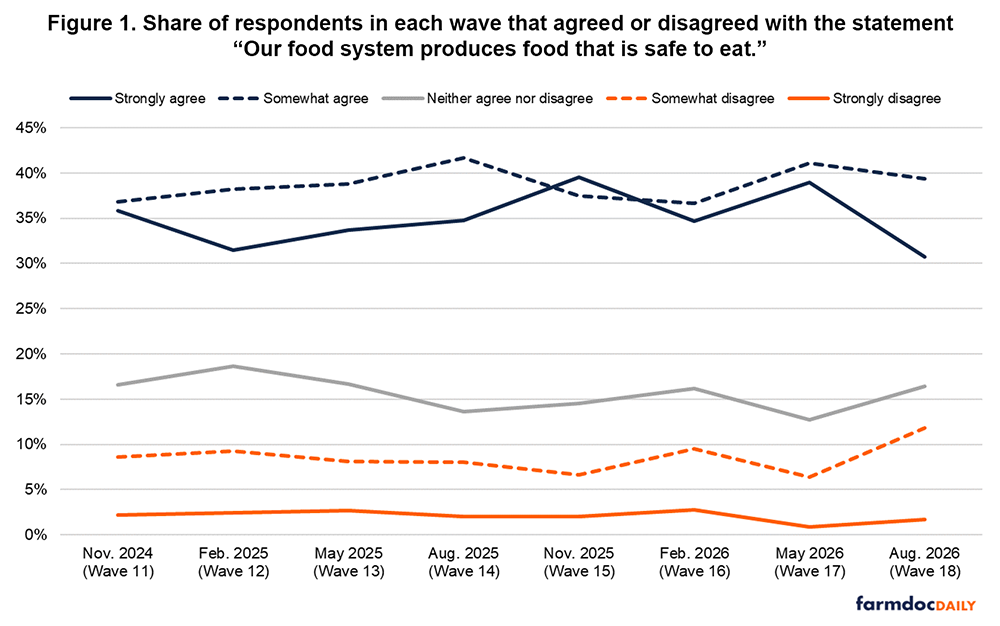
Overall, U.S. consumers agree that the food system produces food that is safe to eat, however, confidence has recently declined (see Figure 1). In August, the share of consumers that strongly agree declined and the share of consumers that somewhat disagreed increased.
Respondents’ concern about foodborne illness specifically differs by food category. Concern around fresh vegetables, in particular, has grown, with 40% of respondents in August indicating they were very worried about foodborne illness when purchasing this category. Concerns about fresh fruit also rose. While multiple restaurants (e.g., Taco Bell, Chipotle, QDOBA) were affected by the recalls, we do not see changes in concerns for this category overall. Similarly, we do not see changes in concern relating to eggs.
Table 1. Share of respondents in each wave that indicated they were very worried about foodborne illness when purchasing each type of food
| Issue Area | Nov. 2024 (Wave 11) | Feb. 2025 (Wave 12) | May. 2025 (Wave 13) | Aug. 2025 (Wave 14) | Nov. 2025 (Wave 15) | Feb. 2026 (Wave 16) | May. 2026 (Wave 17) | Aug. 2026 (Wave 18) |
| Meat or poultry | 39% | 38% | 36% | 37% | 41% | 36% | 39% | 38% |
| Seafood | 36% | 34% | 33% | 33% | 38% | 32% | 37% | 34% |
| Fresh fruits | 30% | 30% | 28% | 27% | 33% | 27% | 30% | 36% |
| Fresh vegetables | 31% | 31% | 29% | 27% | 35% | 29% | 33% | 40% |
| Dairy | 30% | 30% | 31% | 27% | 31% | 26% | 31% | 30% |
| Eggs | 30% | 35% | 32% | 31% | 35% | 27% | 31% | 32% |
| Processed foods | 33% | 31% | 33% | 29% | 34% | 30% | 33% | 30% |
| Foods from restaurants | 34% | 34% | 32% | 32% | 34% | 28% | 33% | 32% |
Note: Respondents are asked, “On a scale from 1 to 7 where 1=not at all worried and 7=extremely worried, how worried are you about foodborne illness (e.g., E. coli, Salmonella, Listeria) when purchasing each of the following types of food?” Here, we report the share that rated each category either 6 or a 7. The order of categories was randomized to prevent ordering effects.
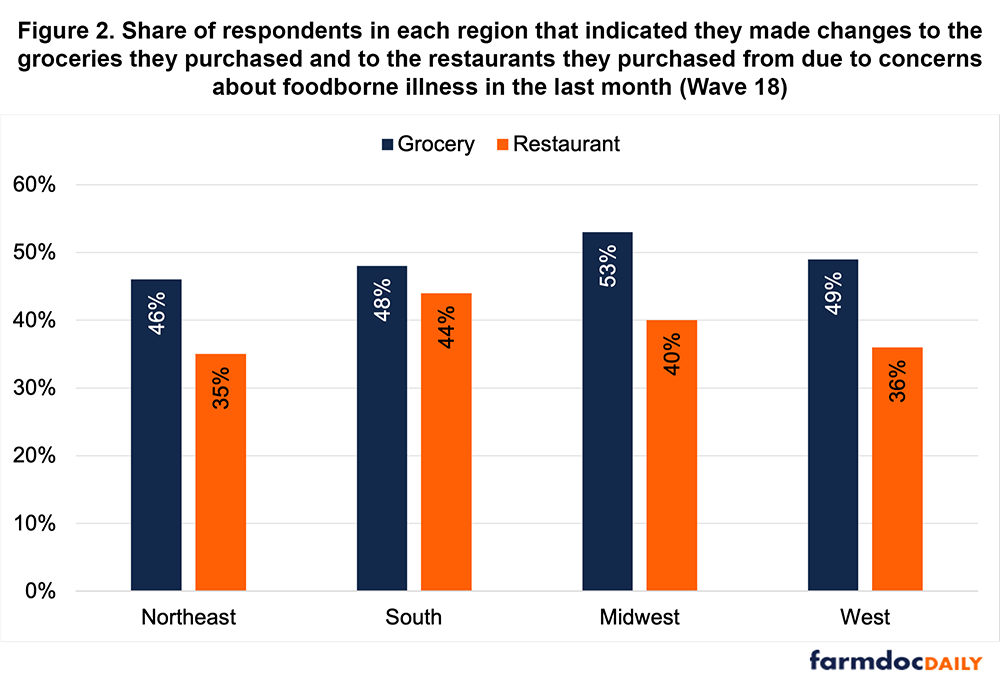
Finally, in August (wave 18), respondents were asked about their awareness and responses to recent outbreaks. The majority indicated they were aware of the outbreaks and recalls that affected lettuce (74% aware), jalapeños (60% aware), and eggs (53% aware). Beyond awareness, respondents were asked if they made any changes to the types of foods they purchased in the last month due to concerns about foodborne illness. We find that, overall, 49% of respondents indicated they made changes to the groceries they purchased and 40% indicated they had made changes to the restaurants they purchased from.
Awareness and responses differed somewhat across region (Figure 2). Awareness of the food safety events differed slightly, with awareness of the outbreaks affecting lettuce and jalapeño being highest in the Midwest (78% and 63%, respectively) and awareness of the event affecting eggs was highest in the West (58%) and South (53%). Consumers in the Midwest reported making changes to the foods they purchased at the highest rate across regions.
These results are generally in line with regional differences in outbreaks, too, as cases were concentrated in different areas. Lettuce had the highest number of cases in Michigan, Ohio, and Missouri (FDA, 2026a), jalapeños had the highest number of cases in Colorado and Minnesota (FDA, 2026c), and eggs had the highest number of cases in Texas (FDA, 2026b). Further, cases related to frozen blueberries were in Florida and Georgia (FDA, 2026d) and cases related to sprouts were concentrated in Minnesota and Wisconsin (FDA, 2026e).
Conclusions
Over the past month, several multistate outbreaks and recalls have occurred in several food categories. Results from the Gardner Food and Agricultural Policy Survey highlight that consumers were generally aware of ongoing recalls, with awareness being the highest for the Cyclospora outbreak affecting lettuce that sickened over 11,000 people (FDA, 2026a). Comparing results from the last two years, we show that in August concerns around food safety broadly and foodborne illness exposure via fresh vegetables increased. Further, we find that 49% of respondents said they made changes to the groceries they chose to purchase in the last month and 40% of respondents said they made changes to the restaurants they chose to purchase from in the last month due to concerns about foodborne illness.
Consumer perceptions of food category safety have important implications for food system players, including farmers, food manufacturers, grocery retailers, and restaurants. Additionally, concerns around food safety have implications for those in policy, as the public considers food safety and inspection the most important role of relevant federal agencies (farmdoc daily, September 24, 2025) and candidates’ statements on food safety and inspection are expected to impact Midterm election votes (farmdoc daily, June, 4, 2026).
References
Bakhtavoryan, R., Capps Jr, O. and Salin, V., 2014. The impact of food safety incidents across brands: the case of the Peter Pan Peanut Butter Recall. Journal of Agricultural and Applied Economics, 46(4), pp.559-573. https://doi.org/10.1017/S1074070800029102
Crawford, E. 2026. Cyclospora outbreak reshapes grocery shopping and restaurant traffic beyond recalled lettuce. https://www.foodnavigator.com/Article/2026/08/04/cyclospora-outbreak-changes-grocery-shopping-habits/
Ellison, B., J. Coppess and M. Kalaitzandonakes. "Do Changes in Food and Agriculture Policy Align with Changes in Public Priorities?" farmdoc daily (15):175, Department of Agricultural and Consumer Economics, University of Illinois at Urbana-Champaign, September 24, 2025. https://farmdocdaily.illinois.edu/2025/09/do-changes-in-food-and-agriculture-policy-align-with-changes-in-public-priorities.html
Fahs, F., Mittelhammer, R.C., and McCluskey, J.J. 2009. E. coli Outbreaks Affect Demand for Salad Vegetables. AAEA Choices. https://www.choicesmagazine.org/UserFiles/file/article_72.pdf
FDA [U.S. Food & Drug Administration]. 2026a. Investigation of Multistate Outbreak of Cyclospora Illnesses: Iceberg Lettuce (July 2026). https://www.fda.gov/food/outbreaks-foodborne-illness/investigation-multistate-outbreak-cyclospora-illnesses-iceberg-lettuce-july-2026
FDA [U.S. Food & Drug Administration]. 2026b. Outbreak Investigation of Salmonella: Eggs (July 2026). https://www.fda.gov/food/outbreaks-foodborne-illness/outbreak-investigation-salmonella-eggs-july-2026
FDA [U.S. Food & Drug Administration]. 2026c. Outbreak Investigation of Salmonella: Jalapeño (August 2026). https://www.fda.gov/food/outbreaks-foodborne-illness/outbreak-investigation-salmonella-jalapeno-august-2026
FDA [U.S. Food & Drug Administration]. 2026d. Outbreak Investigation of E. coli O145:H28: Frozen Blueberries (July 2026). https://www.fda.gov/food/outbreaks-foodborne-illness/outbreak-investigation-e-coli-o145h28-frozen-blueberries-july-2026
FDA [U.S. Food & Drug Administration]. 2026e. Outbreak Investigation of Shiga Toxin-producing E. coli & Salmonella: Sprouts (August 2026). https://www.fda.gov/food/outbreaks-foodborne-illness/outbreak-investigation-shiga-toxin-producing-e-coli-salmonella-sprouts-august-2026
Kalaitzandonakes, M., J. Coppess and B. Ellison. "Grocery Bills and the 2026 Midterm Elections." farmdoc daily (16):98, Department of Agricultural and Consumer Economics, University of Illinois at Urbana-Champaign, June 4, 2026. https://farmdocdaily.illinois.edu/2026/06/grocery-bills-and-the-2026-midterm-elections.html
Kalaitzandonakes, M., Ellison, B. and Serra Devesa, M.T., 2025. The financial impact of foodborne illness outbreaks at restaurants: Chipotle Mexican Grill. Agribusiness, 41(2), pp.381-400. https://doi.org/10.1002/agr.21898
Nelson, S. 2026. Report: Cyclospora Concerns Push Shoppers Toward Frozen, Canned Foods. Path to Purchase Institute (P2PI). https://p2pi.com/report-cyclospora-concerns-push-shoppers-toward-frozen-canned-foods
Peake, W.O., Detre, J.D. and Carlson, C.C., 2014. One bad apple spoils the bunch? An exploration of broad consumption changes in response to food recalls. Food Policy, 49, pp.13-22. https://doi.org/10.1016/j.foodpol.2014.06.006
Pozo, V.F. and Schroeder, T.C., 2016. Evaluating the costs of meat and poultry recalls to food firms using stock returns. Food Policy, 59, pp.66-77. https://doi.org/10.1016/j.foodpol.2015.12.007
Thomsen, M.R. and McKenzie, A.M., 2001. Market incentives for safe foods: an examination of shareholder losses from meat and poultry recalls. American Journal of Agricultural Economics, 83(3), pp.526-538. https://doi.org/10.1111/0002-9092.00175
Disclaimer: We request all readers, electronic media and others follow our citation guidelines when re-posting articles from farmdoc daily. Guidelines are available here. The farmdoc daily website falls under University of Illinois copyright and intellectual property rights. For a detailed statement, please see the University of Illinois Copyright Information and Policies here.