








Rural Broadband Infrastructure and Its Implications for Households and Agriculture
Introduction
Fast, reliable broadband is essential infrastructure for rural communities. Rural broadband allows entrepreneurs to do business, provides access to telehealth services, and enables access to online educational opportunities (Biedny and Whitacre, 2022). The availability of rural broadband has also created greater remote work opportunities which has better positioned rural communities to both attract new residents and to retain current residents (Low, Rahe, and Van Leuven, 2023). Greater broadband capacity also enables agricultural producers to adopt more automated technologies and processes (Khanna et al., 2024). Moreover, Qu et al. (2025) found that faster broadband internet increases farmland values and cash rents, thereby suggesting that improved connectivity can enhance the value of agricultural land.
The Infrastructure Investment and Jobs Act led to significant federal investments in growing the broadband infrastructure, most notably through $42.45 Billion Broadband Equity, Access, and Deployment (BEAD) program. Part of this program supported efforts to map the current rural broadband infrastructure and identify gaps. As part of this program’s local implementation, 28 counties elected to participate in broadband mapping efforts and as a result, University of Illinois Extension surveyed over 11,700 households in these counties between 2022 and 2025. In addition to gathering respondents’ perceptions of broadband access, the survey measured service quality by asking participants to complete a speed test. The survey also asked about the state of rural broadband for agricultural entities, given the relative importance of agriculture to these communities. These survey findings reflect trends in rural Illinois, but these same challenges are faced by rural and agricultural communities throughout the Midwest.
This article highlights some of the key findings from this survey to examine whether the existing broadband infrastructure meets the needs of households and agricultural producers. This article first considers household broadband quality and regional differences in service levels. It shows how agricultural entities perceive their broadband service and concludes by discussing the remaining challenges to broadband expansion and the partnerships needed to improve rural connectivity.
For Households, Quality Matters More than Mere Access
Broadband access is necessary, but not always sufficient to meet current needs. Changing demands (e.g., streaming services, AI applications) require higher quality broadband service for both households and businesses. Despite the need for higher quality broadband services, the current infrastructure has not kept pace. Figure 1 shows the 28 counties surveyed and the extent to which they were unserved or underserved. Based on the speed tests, nearly four out of five surveyed rural residents with a fixed broadband connection reported speeds that qualified as either ‘unserved’ (below 25/3 Mbps) or ‘underserved’ (below 100/20 Mbps) under Federal Communications Commission (FCC) benchmarks.
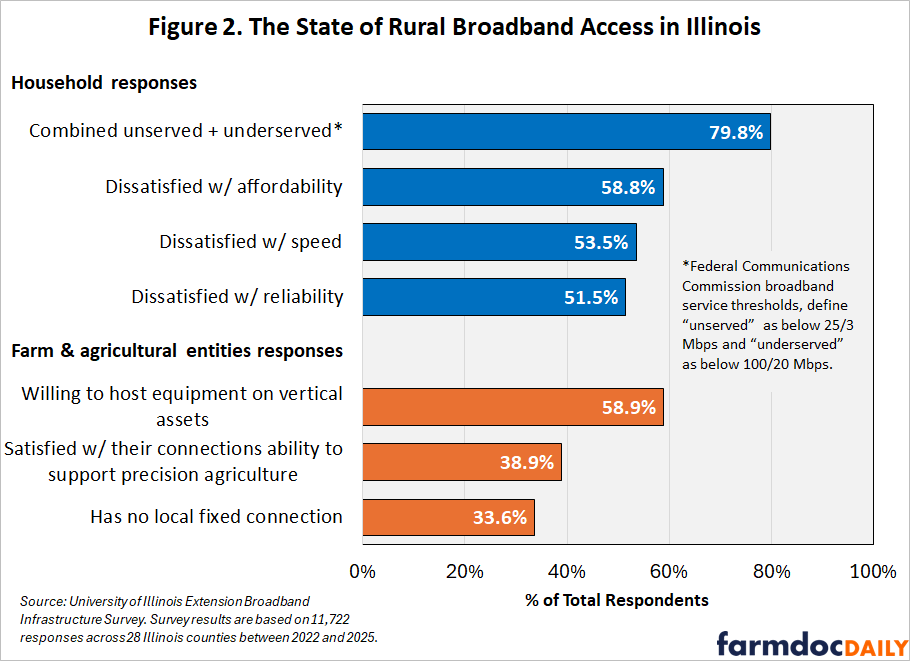
Respondent perceptions of their broadband service showed similar challenges. Figure 2 shows that almost 60% of surveyed households expressed dissatisfaction with the affordability of their broadband service. Over 50% of respondents were dissatisfied with their broadband service’s speed and reliability. The UI Extension survey ran over three years, but these conditions did not show a sharp improvement in 2024–25 relative to 2022–23 on these same measures. This may indicate that even though satellite alternatives may close access gaps, but they may not yet address the quality issues in the same way as fixed infrastructure.
Not every rural county begins with the same level of broadband infrastructure, and the survey data reflect these differences. To better understand these patterns, the 28 surveyed counties were grouped according to USDA’s 2023 Rural-Urban Continuum Codes, which classify counties by their metropolitan status and the size of their largest urban population.[1]
- Metro-adjacent counties: These counties fall within metropolitan statistical areas but retain substantial rural character. Combined, these counties reported a high unserved and underserved rate (85.6%). Proximity to more urban areas does not guarantee quality service throughout the county. However, this proximity to metro-area providers is an underused lever that could be used to address these challenges.
- Larger nonmetro trade centers: These counties are anchored by towns of at least 20,000 people. Relative to the other county groups, these counties reported the best unserved and underserved rate (64.9%). This may indicate that a concentrated population center can support competitive service even outside larger metro areas.
- Small-town nonmetro counties: Combined, these counties had the greatest unserved and underserved rate among county groups (88.2%).
- Rural/remote counties: Despite being the most sparsely populated group, its unserved and underserved rate (80.0%) was closer to the state average. As a result, “most rural” and “least connected” are not always synonymous.
Broadband Availability and Quality Can Impact Agricultural Development
Production agriculture relies on high-quality broadband to support their farm management and business operations, and this infrastructure is critical for the expansion and adoption of digital agriculture. Activities like precision agriculture (e.g. GPS guided equipment), equipment connectivity (e.g., monitoring irrigation systems), and remote monitoring (e.g., livestock health and location, grain bin conditions, etc.) require quality broadband infrastructure. Where connectivity fails, producers report manually transferring data or driving into town to find a signal, undercutting the return on the investments made in precision agriculture.
A small share (~6%) of survey respondents self-identified as agricultural entities and answered several questions specific to agriculture. The survey data show a consistent gap between broadband access and the demands of a modern farm. Less than half of these respondents were satisfied with their connections. Figure 2 shows that only 39% of farm and agricultural entities indicated that they were satisfied with their connection’s ability to support precision agriculture. Moreover, a third of these respondents indicated that they had no local fixed connection, meaning that they relied either on satellite broadband or some kind of mobile or cellular broadband (i.e., mobile hotspot, dedicated wireless device).
That said, the survey did show that there are willing partners to help address some of these issues. Nearly 60% of farm and agricultural entities expressed a willingness to host broadband equipment on their property to support broadband expansion. This expansion—and the need to overcome many ‘last mile’ challenges—will be critical for agriculture because that infrastructure needs to extend to more distant farms and fields rather than residential communities.
Expanding Rural Broadband Is Critical, But Challenges Remain
These survey results show that although many rural households now have access to broadband service, the existing infrastructure often falls short of meeting evolving household and business needs. The survey’s open-ended responses describe what it feels like to live inside these gaps. A recurring theme was not the absence of broadband infrastructure, but the inability to connect to nearby fiber. Respondents described fiber-optic lines being installed along adjacent highways, across nearby fields, or even past their properties, yet this infrastructure remains unavailable because the service was intended for schools, commercial customers, or public institutions. Others reported being unable to obtain service unless neighboring households agreed to multi-year contracts or shared the substantial costs of last-mile construction, which can cost tens of thousands of dollars. Satellite internet has emerged as a practical alternative for some locations, but the monthly service fees and upfront equipment costs can create financial burdens for households and small operations operating on tight budgets.
Households are not the only users affected by these connectivity challenges. Agriculture has distinct broadband needs that extend beyond residential service requirements, and both must be addressed as rural communities continue to develop. Reliable, high-quality broadband is increasingly important to the competitiveness of production agriculture—a key industry for many rural communities. Although the survey results here highlight trends in Illinois, it is safe to assume that the main takeaways are relevant in other rural communities throughout the Midwest and many other parts of the country. Rural broadband access has expanded, but improving service quality and reliability remains an important priority. Ensuring that broadband supports household well-being, agricultural innovation, and regional economic growth will require continued collaboration among federal, state, and local governments, broadband service providers, community organizations, and an engaged citizenry.
Notes
[1] U.S. Department of Agriculture, Economic Research Service. 2023 Rural-Urban Continuum Codes. https://www.ers.usda.gov/data-products/rural-urban-continuum-codes
References
Biedny, C. and Whitacre, B.E. (2022). "The Broadband Serviceable Location Fabric, Rural America, and Agriculture" Choices. Quarter 3. Available online: https://www.choicesmagazine.org/choices-magazine/theme-articles/making-it-count-applying-science-to-support-universal-broadband/the-broadband-serviceable-location-fabric-rural-america-and-agriculture
Khanna, M., Atallah, S. S., Heckelei, T., Wu, L., & Storm, H. (2024). Economics of the adoption of artificial intelligence-based digital technologies in agriculture. Annual Review of Resource Economics, 16(1), 41-61. https://doi.org/10.1146/annurev-resource-101623-092515
Low, S. A., Rahe, M. L., & Van Leuven, A. J. (2023). Has COVID-19 made rural areas more attractive places to live? Survey evidence from Northwest Missouri. Regional Science Policy & Practice, 15(3), 520-540. https://doi.org/10.1111/rsp3.12543
Qu, X., Lu, Q., Li, M., & Zhang, W. (2025). “Broadband internet speed upgrades and the farmland market: A shift-share instrumental variable approach.” American Journal of Agricultural Economics. 108:566-598. https://doi.org/10.1111/ajae.12559
Disclaimer: We request all readers, electronic media and others follow our citation guidelines when re-posting articles from farmdoc daily. Guidelines are available here. The farmdoc daily website falls under University of Illinois copyright and intellectual property rights. For a detailed statement, please see the University of Illinois Copyright Information and Policies here.