








The Central Crop Safety Net Issue: When Should a Loss be a Loss?
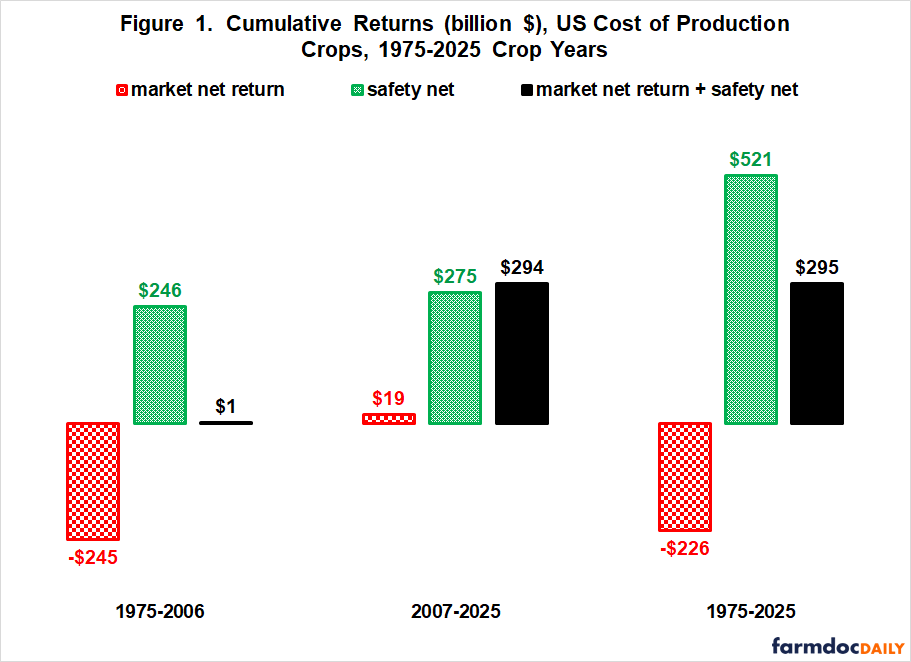
Over the last 50 years, the private market has not covered the cost to produce the nine crops for which USDA (US Department of Agriculture) computes a cost of production (COP); however, these losses have more than been covered by the crop safety net (Figure 1, right columns). Even more important is the change dating to 2007. Prior to the 2007 crop year, the crop safety net functioned to offset private market losses (Figure 1, left columns). Since 2007, it has functioned to enhance profits as the market has covered cumulative production cost (Figure 1, middle columns). This dramatic change reflects the growth of crop insurance and ad hoc payments, especially in times of market prosperity.
Data and Procedures
Market return is net of the economic cost to produce and harvest barley, corn, cotton, oats, peanuts, rice, soybeans, and wheat. Costs include an opportunity cost for unpaid family labor and owned land. The crop safety net is composed of commodity, crop insurance, and ad hoc & emergency programs. Insurance payments are net of farm-paid premiums. For detailed discussion of the data and calculations, see the farmdoc daily of February 5, 2026. The data for the 2025 crop year includes an estimate of commodity program payments to be made in October 2026 (see Data Note).
Cumulative Profitability
Cumulative profitability matters. No farmer plans to farm only one year. It is a multiyear commitment. Moreover, US field crop agriculture is characterized by multiyear periods of consecutive annual profits or losses (see Figure 2). Multiyear loss periods were 1981-2006, 2014-2020, and 2023-2025. Over 1981-2006, the safety net offset most but not all (88%) of cumulative market losses. Since 2007, the safety net has not only covered all cumulative market losses but provided a profit during the multiyear loss periods of 2014-2020 and 2023-2025. Moreover, the safety net added to market profits by 70% and 41% over the multiyear profit periods of 2007-2013 and 2021-2022, respectively.
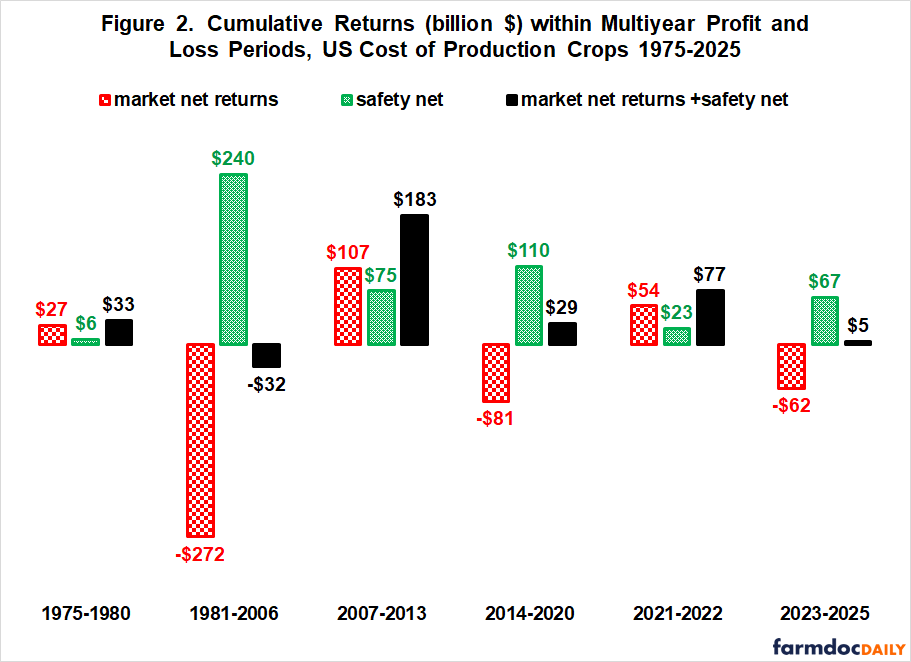
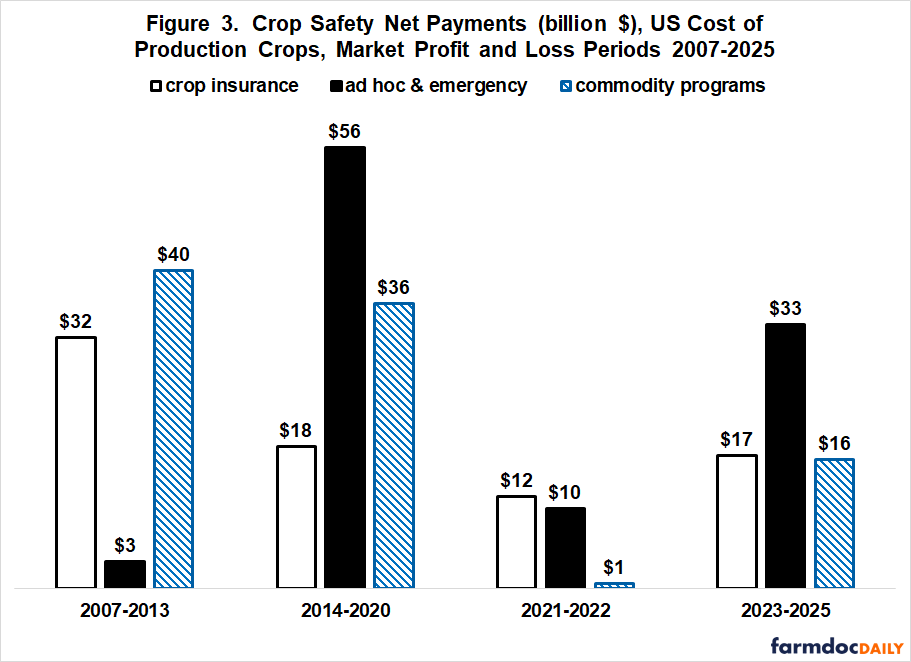
Figure 3 explores the role of the safety net component programs by profit and loss periods since 2007. It is important to first note that the 2014 Farm Bill discontinued a fixed per acre direct income payment program responsible for 83% ($33 billion) of commodity program payments during 2007-2013. Without counting the fixed payments from 2007-2013, (1) crop insurance made the most payments in both multiyear profit periods (2007-2013, 2021-2022) while (2) commodity program payments were smallest in the two multiyear profit periods, consistent with their historic countercyclical performance. Ad hoc & emergency payments were large in the last three multiyear periods, including the 2021-2022 profit period. For a more detailed discussion of the historic countercyclical performance of the crop safety net, see Zulauf and Orden and the farmdoc daily of April 16, 2025.
Discussion
Market losses are more common than market profits for the US field crop sector. No one likes losses, but they are important to incentivize efficiency in a market economy at both the individual firm and sector levels.
Moreover, the crop safety net has changed from covering most but not all market sector losses in the 1981-2006 period of losses to more than covering sector market losses in years of losses and supercharging profits in years of market profits since 2007. This dramatic change prompts the policy question, “What share of sector market losses should the safety net cover?”
This question is seminal. Farmers value the continuity of their farm. It is thus reasonable to expect that they will spend some, maybe a lot of safety net payments above market losses on crop inputs, increasing their demand and price, thus raising the cost of production. Capitalizing public support payments into private production costs makes input providers and manufacturers, landowners, other asset holders, insurance providers, and lenders safety net beneficiaries with a stake in preserving and expanding it. This prompts another policy question, “Is this the intended outcome of the US crop safety net?”
Payments in years of sector profitability are particularly troubling both in terms of fairness and supercharging market profits. Crop insurance and ad hoc programs are largely responsible for these payments. Their role in years of prosperity should be carefully examined.
In addition, since multiyear periods of profits and losses have characterized the US field crop sector since 1975 (i.e. for 50 years), US crop safety net policy needs to move away from an individual year to a multiple year orientation consistent with market reality.
While a sector perspective is important in evaluating the crop safety net, its impact will likely vary across crops and regions, topics for future exploration.
Data Note
As of July 6, 2026, crop safety net payment to 2025 crop year COP crops are (1) $9.6 billion in reported ad hoc Farmer Bridge Assistance payments, (2) $2.2 billion in reported net crop insurance indemnities, and (3) $13.3 billion in University of Illinois estimated corn, long-grain rice, peanut, sorghum, soybean, and wheat commodity program payments (farmdoc daily of May 14, 2026).
References
Monaco, H., G. Schnitkey, N. Paulson, J. Coppess and C. Zulauf. "2025 ARC/PLC Final Estimates." farmdoc daily (16):85, Department of Agricultural and Consumer Economics, University of Illinois at Urbana-Champaign, May 14, 2026.
Zulauf, Carl, and David Orden. 2026. “US Farm Bill in 2025: Ad Hoc Assistance becomes an Expanded Multi-Year Safety Net.” EuroChoices. Published April 10. https://doi.org/10.1111/1746-692X.70030
Zulauf, C., D. Orden and G. Schnitkey. "Has the US Crop Safety Net Become Excessive?" farmdoc daily (16):18, Department of Agricultural and Consumer Economics, University of Illinois at Urbana-Champaign, February 5, 2026.
Zulauf, C., N. Paulson, J. Coppess and G. Schnitkey. "Countercyclical Performance of Commodity, Insurance, and Ad Hoc Crop Programs." farmdoc daily (15):71, Department of Agricultural and Consumer Economics, University of Illinois at Urbana-Champaign, April 16, 2025.
Disclaimer: We request all readers, electronic media and others follow our citation guidelines when re-posting articles from farmdoc daily. Guidelines are available here. The farmdoc daily website falls under University of Illinois copyright and intellectual property rights. For a detailed statement, please see the University of Illinois Copyright Information and Policies here.