








Rural Health Disadvantages in the United States
Over the last 20 years, rural Americans have been dying at a higher rate than urban residents – and the gap is growing. According to the U.S. Department of Agriculture (USDA), the rural-urban mortality gap is largest for adults in their prime working years (i.e., 25-54 years old), and for natural-cause mortality (i.e., deaths caused solely by internal factors, excluding deaths by accidents, suicide, and physical trauma).
As rural Americans aged 25-54 die at increasing rates from cancer, heart disease, and circulatory disease, the resulting workforce losses will have significant consequences for the rural communities.
A robust rural workforce enhances local business productivity, fosters entrepreneurship, and supports higher wages, and demographic and health conditions are known to affect rural worker availability (White, 2025b). This farmdoc daily summarizes research on what might be driving rural health disadvantages published last month by University of Illinois and USDA economists (Restrepo, Dobis, Low and Thomas, 2026).
Findings suggest that increased sedentary activity, poor diet, obesity, nicotine use, and the cumulative effect of cardiometabolic diseases may be contributing to rural health disparities. Further, living in a rural area per se might not be linked to health disparities; rather, community context or place-based characteristics are more likely to drive the growing rural health disparities.
Working-Age People in Rural America Have Growing Natural Cause Mortality Rates
U.S. mortality rates generally declined as incomes rose, medical treatments were discovered, and preventive medicine advanced. The USDA, however, recently documented a growing gap between urban and rural natural cause mortality rates.
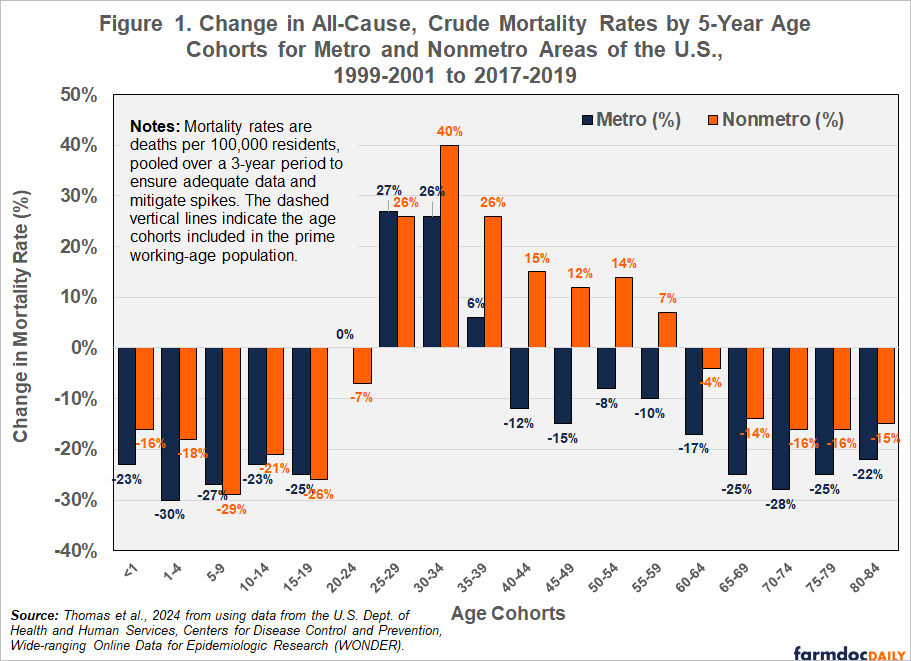
Figure 1 highlights a disturbing trend that began in the late 1990s— mortality rates increased among working-age adults in rural (nonmetro) counties. In 2019, natural-cause mortality rates for the prime working-age population (25-54) in rural areas were 43% higher than in urban areas; in 1999-2001, this figure was only 6% (Thomas et al., 2024). Further, the more rural the area, the greater the increase in natural-cause mortality rates (Thomas et al., 2025).
The rural-urban mortality rate gap varies by demographic group. According to Thomas et al., 2024, Non-Hispanic Whites had the greatest growth in prime working-age natural-cause mortality rates in rural areas compared with urban areas, with increases of 33 percentage points (females) and 29 percentage points (males) during the study period (1999-2001 to 2017-19). That is, White Non-Hispanic working-age women are most affected by recent increases in rural mortality rates.
The Influence of Diet, Obesity and Sedentary Activity Increased
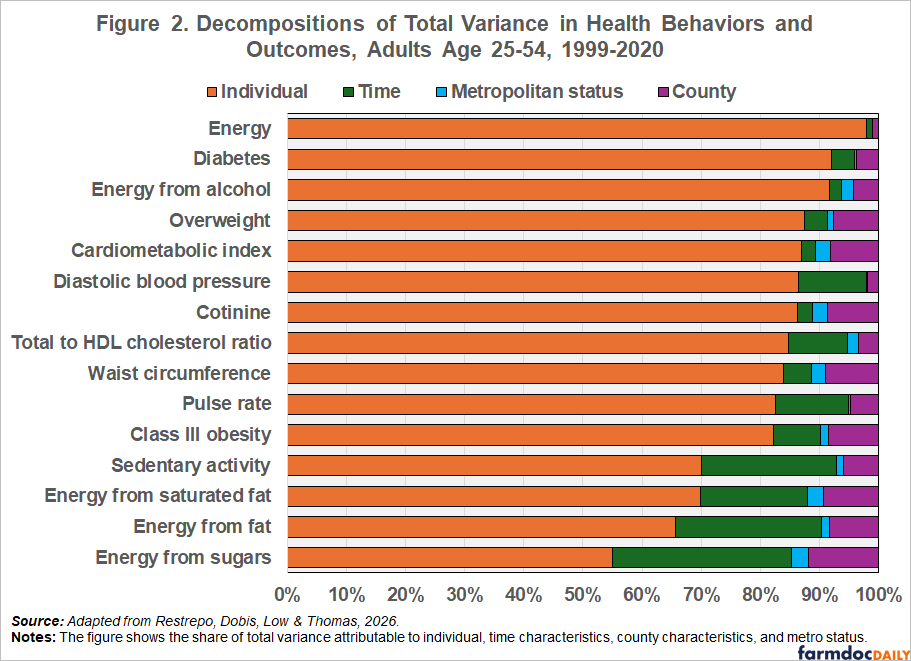
Figure 2 categorizes the variation in individuals’ health behaviors and outcomes during the study period. Differences in people’s diet, weight, activity, and cardiologic health were decomposed into four categories. Individual characteristics (e.g., age, race, gender, education, family income) are represented by the orange segment, and we expect most of the variation in health behaviors and outcomes to be driven by individual differences. County characteristics (e.g., food environment, natural amenities, access to gyms) are purple and we see that they generally have a greater influence than county metropolitan status (nonmetro, small metro, large metro), which is in teal. The green bar represents the health variation associated with the passage of time and seasonality.
Temporal factors over the 20-year study period (1999-2020) were related to diet and sedentary activity (green segments in Figure 2). They explained more of the variation in calories from sugars and fats, as well as being sedentary (i.e., less physically active) than metro status. These behavioral differences are likely linked to health outcomes – specifically, pulse rate, blood pressure, diabetes, and obesity.
Interestingly, the cardiometabolic index, our proxy for chronic stress on organs, was only weakly associated with time. In this research, the cardiometabolic index is a proxy for the biological state in which wear and tear on organs and tissues reaches a level that predisposes a person to disease (e.g., heart disease, diabetes, high blood pressure). The cardiometabolic index attempts to assess the cumulative effect of chronic stress over time by including measures of cholesterol, blood pressure, pulse rate, obesity, and diabetes. A higher cardiometabolic index indicates that an individual has more of these conditions.
Health Disparities Vary Across Counties
The county factors (purple segments) in Figure 2 represent the influence of place or community, measured as county of residence, on variation in health disparities. The purple segments capture the impact of the food environment, the physical activity environment, the county’s population, and per capita income. We see that county characteristics generally explain more of the variance in health behaviors and outcomes than the metro/nonmetro status indicator (teal segments). This suggests one’s community affects health outcomes more than simply living in a rural area. No single county characteristic drove these results, but the findings suggest that a wide variety of place-based characteristics are associated with health behaviors and outcomes, and that these factors are likely cumulative, suggesting there is no easy fix that county commissioners or other elected officials can make to improve residents’ health.
Rural Adults Carry More Cardiometabolic Risk Factors
The research also used regression analysis to estimate the association between 24 different health behaviors and outcomes and living in a nonmetropolitan area, focusing on working-age people. After removing the statistical variance coming from county characteristics, we found that rural respondents had statistically significantly higher levels of nicotine use (as measured by cotinine in the blood), diabetes, obesity, blood pressure, share of calories from and saturated fat, and the cardiometabolic index.
The cardiometabolic index finding for rural (nonmetro) residents is noteworthy. Compared with working-age people living in large urban areas, those in smaller metro areas and nonmetro areas had 5.2% and 6.5% more cardiometabolic conditions, respectively. These are relatively large, statistically significant magnitudes that suggest chronic stress—manifest as organ wear and tear—may contribute to rural-urban health gaps.
These findings suggest that diet is a major determinant of health differences between rural working-age populations and those in metropolitan areas. Nicotine use is especially relevant for rural populations in the South (Thomas et al., 2024).
Conclusions and Implications
The research suggests that the local or community context (e.g., county-level characteristics) contributes to the rural-urban health disparities we identified. It is plausible that differences in healthcare resources and health behaviors across urban and rural areas could contribute to the rise in natural-cause mortality rates in rural areas (Thomas et al., 2024).
These findings support the hypothesis that rural populations may be at a health disadvantage, especially among the prime working-age adults who contribute the most to the rural workforce and economy. Rural hospitals are reducing services or closing,[i] and rural full-service grocery stores are disappearing or being replaced by dollar stores with a smaller array of products (Lopez et al., 2024). These trends could further exacerbate future rural health disparities.
Will the introduction of GLP-1 weight-loss drugs decrease rural-urban health disparities? Or, will challenges related to the cost of GLP-1s and changes they create in the rural food system widen disparities (Kalaitzandonakes et al., 2024)? These drugs decrease hunger, so consumers are at risk of malnutrition if they don’t eat well, which can be difficult in a food desert. Access to the drugs and a nutritious, balanced diet may be more difficult for rural residents. Employers may have an outsized role in their employees’ health insurance, healthcare resources, pharmaceutical availability, and the related food environment for their employees.
It is possible that chronic stress could be contributing to rural-urban health gaps, manifesting as wear and tear on bodily organs. Stress may be higher in rural areas[ii] and may affect health outcomes, but stress is hard to measure. Individual factors like childhood experiences, health, employment, education, community, finances, local industry, food access, healthcare access and the environment all contribute to stress and health behaviors and outcomes. There are implications for rural populations who have recently lost access to food and health education, such as services through Extension.
Communities with workforce shortages may consider how improving the food environment and health behaviors might improve health outcomes. Health problems compound worker productivity and availability, and workforce shortages are a problem in rural areas for many reasons. A strong health care system and food environment may be beneficial for rural economic development.
Note About Research Methods
In conducting this research, co-authors and I analyzed a broad set of individual health behaviors and outcomes, including biomarkers from anonymized National Health and Nutrition Examination Survey data, 1999-2020. This was conducted in a secure Federal data laboratory to ensure the confidentiality of survey respondents. Having individual-level, nurse-obtained health measurements (biomarkers) is arguably the best option for understanding the factors that may be associated with the widening rural-urban mortality gap over the last two decades. We believe this research was the first to combine individual health behaviors and outcomes with place-based (county-level) characteristics across three levels of rurality (large metro, small metro, and nonmetro) in the U.S. The place-based characteristics used in this study included food, retail, and physical activity environments, per capita income, labor force participation and population. More details are available in the study underlying this farmdoc daily, which is publicly available with open access at: https://doi.org/10.1016/j.ehb.2026.101623
Notes
[i] See for example https://www.shepscenter.unc.edu/programs-projects/rural-health/rural-hospital-closures/ and https://extension.missouri.edu/media/wysiwyg/Extensiondata/Pro/ExCEED/Docs/MissouriEconomy_RuralHealthcare_v2i7_12Apr21.pdf
[ii] See for example https://www.ers.usda.gov/amber-waves/2019/october/larger-farms-and-younger-farmers-are-more-vulnerable-to-financial-stress and https://www.climatehubs.usda.gov/hubs/northwest/topic/outdoor-and-emergency-workers and https://farmstress.org/
References
Kalaitzandonakes, M., B. Ellison, T. Malone and J. Coppess. "Consumers’ Expectations about GLP-1 Drugs Economic Impact on Food System Players." farmdoc daily (15):49, Department of Agricultural and Consumer Economics, University of Illinois at Urbana-Champaign, March 14, 2025.
Lopez, Rigoberto, Keenan Marchesi, and Sandro Steinbach. 2024. “Dollar Store Expansion and Independent Grocery Retailer Contraction.” Applied Economic Perspectives and Policy 46(2): 514–533. https://doi.org/10.1002/aepp.13398
Restrepo, Brandon J., Elizabeth A. Dobis, Sarah A. Low, and Kelsey L. Thomas. 2026. "Rural Health Disadvantages in the United States: Evidence from Nationally Representative Data." Economics & Human Biology 62: 101623. https://doi.org/10.1016/j.ehb.2026.101623
Thomas, Kelsey L., Elizabeth A. Dobis, and David A. McGranahan. 2024. The Nature of the Rural-Urban Mortality Gap. Economic Information Bulletin No. 265. Washington, DC: U.S. Department of Agriculture, Economic Research Service. https://dx.doi.org/10.32747/2024.8321813.ers
Thomas, Kelsey L., Elizabeth A. Dobis, and David A. McGranahan. 2025. "Rising Rural Mortality Rates from Natural Causes for Working-Age Adults Lead to Widening Gap with Urban Counterparts." Amber Waves. U.S. Department of Agriculture, Economic Research Service. March 18. https://www.ers.usda.gov/amber-waves/2025/march/rising-rural-mortality-rates-from-natural-causes-for-working-age-adults-lead-to-widening-gap-with-urban-counterparts
White, M. 2023. "Youth Employment Trends in the Midwestern United States." farmdoc daily (13):154, Department of Agricultural and Consumer Economics, University of Illinois at Urbana-Champaign, August 21.
White, M. 2025a. "Recent Population Growth Trends in the North Central United States." farmdoc daily (15):64, Department of Agricultural and Consumer Economics, University of Illinois at Urbana-Champaign, April 7.
White, M. 2025b. "Demographic Shifts and Economic Opportunities for the Rural Workforce." Choices 40, no. 3. Available Online at: https://www.choicesmagazine.org/choices-magazine/submitted-articles/demographic-shifts-and-economic-opportunities-for-the-rural-workforce
Disclaimer: We request all readers, electronic media and others follow our citation guidelines when re-posting articles from farmdoc daily. Guidelines are available here. The farmdoc daily website falls under University of Illinois copyright and intellectual property rights. For a detailed statement, please see the University of Illinois Copyright Information and Policies here.