








2014-2024 ARC-CO and PLC Payments: Improving Farmers’ Decision Making
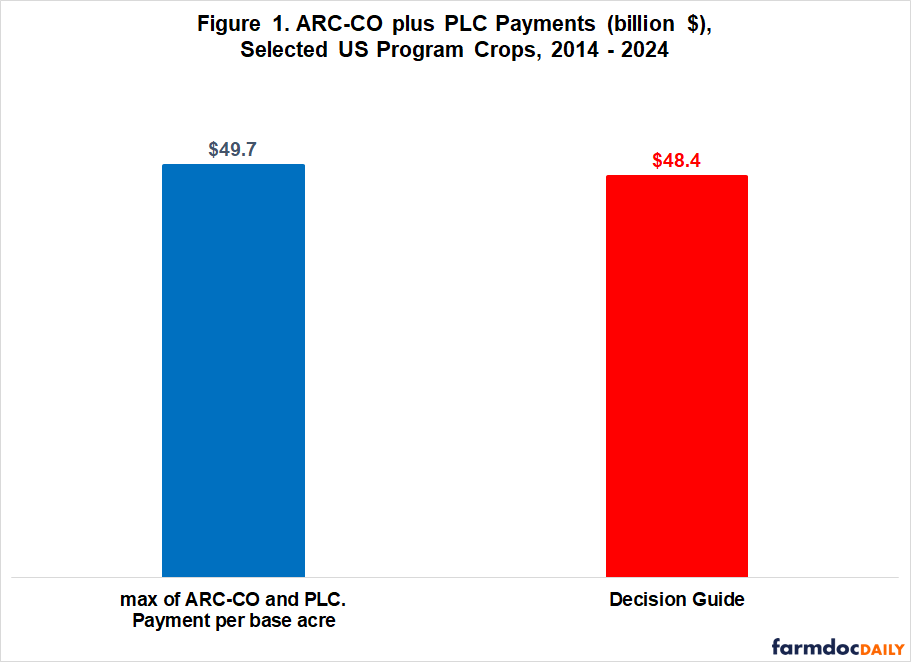
This article continues the analysis of a decision guide for the annual choice between ARC-CO (Agricultural Risk Management – County) and PLC (Price Loss Coverage). In an analysis discussed in the August 5, 2026, farmdoc daily, the decision guide was found to result in base acres of barley, corn, oats, peanut, rice-Japonica, rice-long grain, sorghum, soybean, and wheat receiving 93% of potential payments over the 2021-2024 crop years. Farmers’ choices yielded only 67% of potential payments. Potential payments equal actual payments received if all base acres received the higher of ARC-CO or PLC payment per base acre, as is the case for 2025 crops (see Note 1). This analysis is expanded to include the 2014-2020 crop years, a period of generally high commodity program payments, and canola, large and small chickpeas, seed cotton, flaxseed, lentils, dried peas, and sunflowers (see Note 2). The analysis finds that, if farmers had followed the decision guide, they would have received 97% of potential payments (see Figure 1).
Decision Guide
The decision guide is:
- Choose PLC if the program crop’s average US cash price for January of the current crop marketing year is less than the crop’s effective reference price for the upcoming (i.e. decision) crop marketing year.
- Otherwise, choose ARC-CO.
For further discussion of the guide, including its rationale, see the August 5, 2026, farmdoc daily.
A “what if” analysis is conducted. It addresses how the decision guide would have performed if it had. been used annually for the 2014-2024 crop years while assuming (1) ARC-CO and PLC payments per base acre remain the same and (2) all base acres of a crop follow the decision guide. The analysis in this article is at the national US level. Individual farm and county situations can and will vary from the national situation due to variation in weather during the crop year and in PLC program yields across farms, among other factors. However, it is unclear why the differences between the farm / county and the nation would bias up or down the findings of this national analysis.
The August 5, 2026, farmdoc daily analysis had two objectives: (1) compare payments from using the decision guide with payments resulting from annual farmer decisions and (2) compare payments from using the decision guide with maximum possible payments. The former objective is not appropriate for the 2014-2020 crop years because farmers made one-time decisions covering the 2014-2018 crop years and the 2019-2020 crop years. They were not annual decisions. Therefore, this analysis only compares annual payments from following the decision guide to maximum potential annual payments (i.e. higher of ARC-CO or PLC payment per base acre).
Performance by Decision Guide Price Ratio
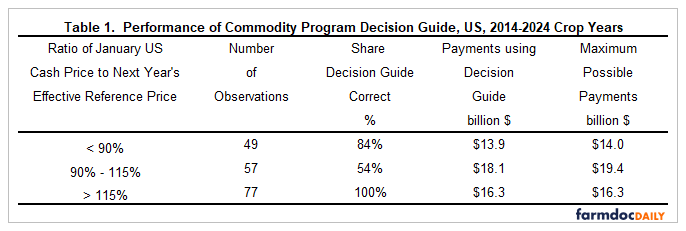
It is reasonable to expect that the more the US January cash price and the effective refence price diverge, the more likely the decision guide will give the correct signal and provide the maximum possible payment. This expectation is met (see Table 1). When the decision guide ratio of the US January cash price to next crop year’s effective reference price was less than 90%, it correctly predicted 84% of the time that PLC would pay the most per base acre. Payments totaled 99.7% of the maximum possible. When the price ratio guide exceeded 115%, it correctly predicted 100% of the time that ARC-CO would pay the most per base acre. Payments were 100% of the maximum possible. When the price ratio guide was between 90% and 115%, its predicted commodity program made the highest payment only a little over half the time. However, it still provided 93% of maximum possible payments. A key reason for the latter is the similarity in average payment per base acre by ARC-CO and PLC in these 57 observations: $13 for ARC-CO vs. $16 for PLC. ARC-CO and PLC payment per base acre averaged respectively, $19 vs. $55 when the decision guide was less than 90% and $11 vs. $1 when the decision guide was greater than 115%. The wide difference between ARC-CO and PLC payments in the two extreme categories is consistent with the different focuses of ARC-CO on low market revenue relative to recent years and of PLC on low prices relative to Congressionally set minimums.
Discussion
This analysis confirms that useful guidance for the annual program commodity decision was provided by the ratio of the US January cash price to the effective reference price for the next crop year. This decision guide captured 97% of potential payments over the 2014-2024 crop years.
One rationale for ad hoc economic assistance is that standing programs pay too little. Decision guides that result in farmers receiving a larger share of potential ARC-CO and PLC payments thus dampen one rationale for ad hoc economic assistance.
To underscore the final point in the previous article, all decision guides break down and give wrong signals at times. This is why we call it a guide. It helps inform, not make the decision. Commodity program decisions may be made for reasons other than maximizing payments, but it is commonly accepted that this is the primary motivation. Other decision guides and variations of this decision guide exist. Hopefully, the finding that a simple decision guide nontrivially would have improved payments to farmers over the 2014-2024 crop years will encourage further research with the goal of improving performance of the farm bill commodity programs by improving farmer decision making.
Notes
- The 2025 Farm Bill waived the annual decision for the 2025 crop year due to its significant changes to 2025 crop year commodity programs after farmers had made their 2025 crop year decisions. For 2025, farmers will receive the higher of ARC-CO or PLC payment per base acre for their FSA farms.
- The US Department of Agriculture, National Agricultural Statistics Service does not report a monthly price for these program commodities: crambe, mustard, rapeseed, rice – medium -short grain excluding California, safflower, and sesame.
- Lowest decision guide price ratio with an incorrect prediction was 73% for 2017 flaxseed.
References
US Department of Agriculture, Farm Service Agency. July 2026. ARC-PLC Program Data https://www.fsa.usda.gov/resources/programs/arc-plc/program-data
Zulauf, C., H. Monaco, G. Schnitkey and N. Paulson. "ARC-CO and PLC Payments: Improving Farmers’ Decision Making." farmdoc daily (16):139, Department of Agricultural and Consumer Economics, University of Illinois at Urbana-Champaign, August 5, 2026.
Disclaimer: We request all readers, electronic media and others follow our citation guidelines when re-posting articles from farmdoc daily. Guidelines are available here. The farmdoc daily website falls under University of Illinois copyright and intellectual property rights. For a detailed statement, please see the University of Illinois Copyright Information and Policies here.