








Fertilizer and Fuel Prices Higher Heading into Fall 2026
Average prices of fertilizers and diesel fuel are higher as the fall harvest season approach compared with the past two years. Higher fuel prices will increase fuel costs associated with harvest activities for the 2026 crop. Higher fertilizer prices will increase the cost of fall fertilizer applications for the 2027 crop year. The high prices combined with increased volatility and uncertainty associated with the war in Iran present challenges for farmers and their management decisions this fall.
Fertilizer and Fuel Prices
Prices examined in this article come from the Illinois Cost of Production report which is provided on a bi-weekly basis by USDA’s Ag Marketing Service (USDA-AMS). The report provides information on nitrogen, phosphorous, and potassium fertilizers products and also includes prices for diesel fuel and biodiesel. The prices are averages based on quotes collected from retailers during the period between reports. The most recent report was released on Friday August 7th, 2026.
Anhydrous Ammonia
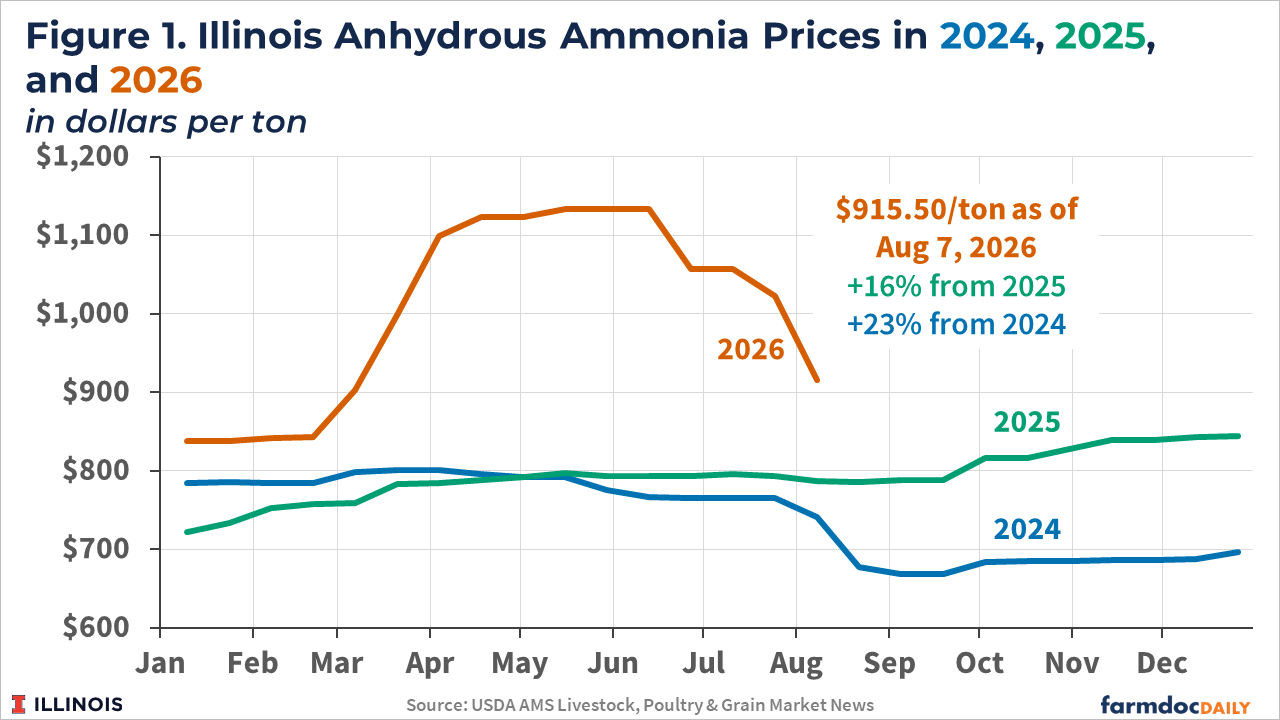
Figure 1 compares average anhydrous ammonia prices in Illinois in 2026 to prices in 2025 and 2024. Anhydrous is a commonly used source of nitrogen, with fall applications providing a significant portion of nitrogen needs for the following year’s crop in many areas of Illinois and throughout the Midwest. The latest price, as of August 7th, is $915.50 per ton. This is 16% higher than anhydrous prices at the same time last year and 23% higher than the same time in 2024. Anhydrous prices started the year higher than in 2024 and 2025, averaging around $840/ton through the end of February before rising sharply following the start of the war in Iran. Anhydrous prices exceeded $1,100/ton from early April into mid-June and have since declined to current levels. Prices, and price volatility, are likely to remain elevated relative to previous years as the conflict in Iran continues.
Diammonium Phosphate (DAP)
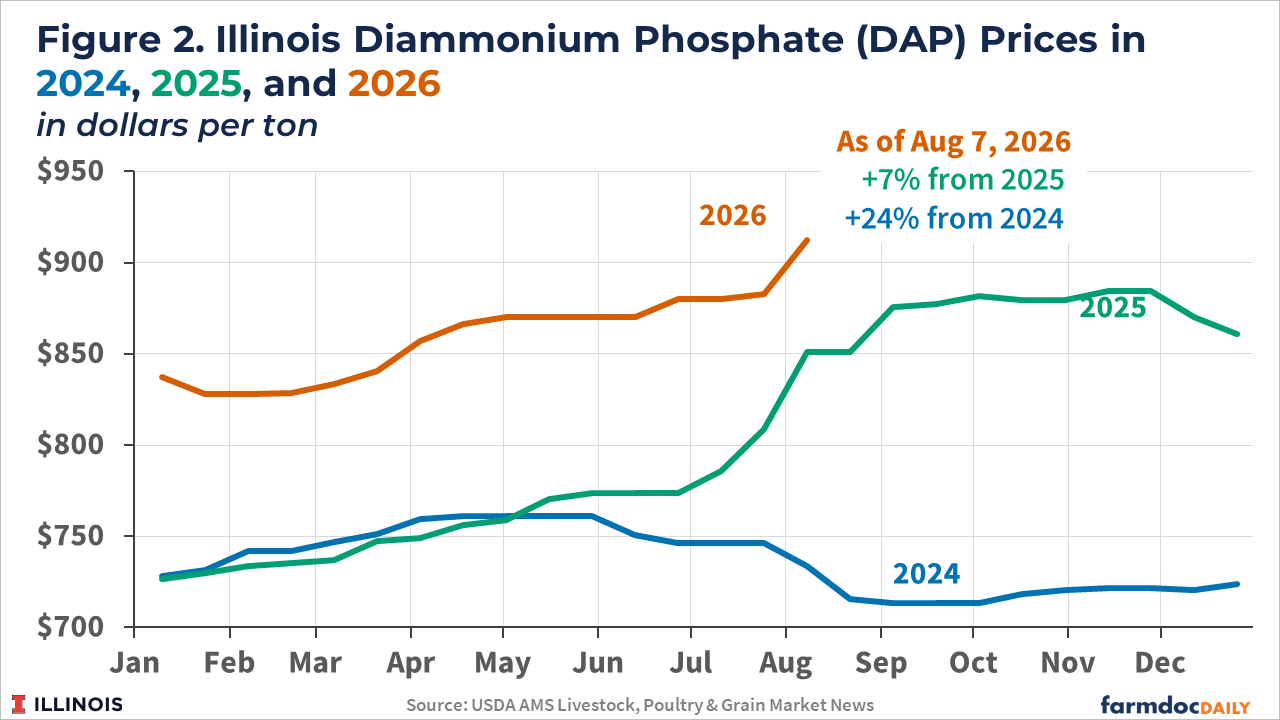
Figure 2 provides average DAP prices in Illinois in 2026, 2025, and 2024. As of August 7th DAP prices had reached an average of $912.22/ton, 7% higher than the same time in 2025 and 24% higher than in August of 2024. DAP prices average between $700 and $750 per ton during 2024. In 2025 they rose to more than $880 per ton by December before declining back under $850 per ton through the first quarter of 2026. DAP prices have been on the rise since late February, increasing consistently from around $830 per ton to more than $900 per ton in the most recent reports.
Potash
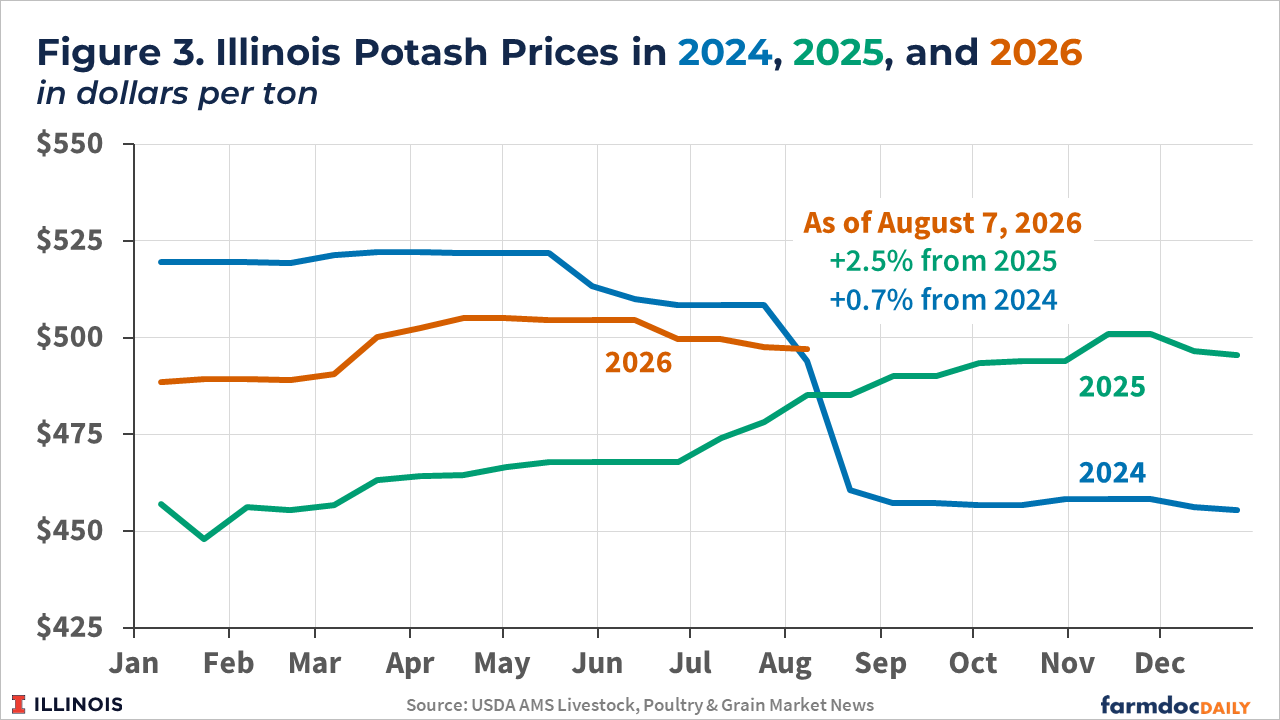
Figure 3 provides potash prices in Illinois for 2024, 2025, and 2026. Potash prices spent the first few months of 2024 averaging nearly $525 per ton before falling to close to $450 per ton by the end of that year. Prices then increased consistently throughout 2025 to end the year around $500 per ton. Thus far in 2026, potash prices have remained in the $490 to $505 per ton range. Prices are increased relative to 2025 and similar to the same time in 2024.
Diesel Fuel
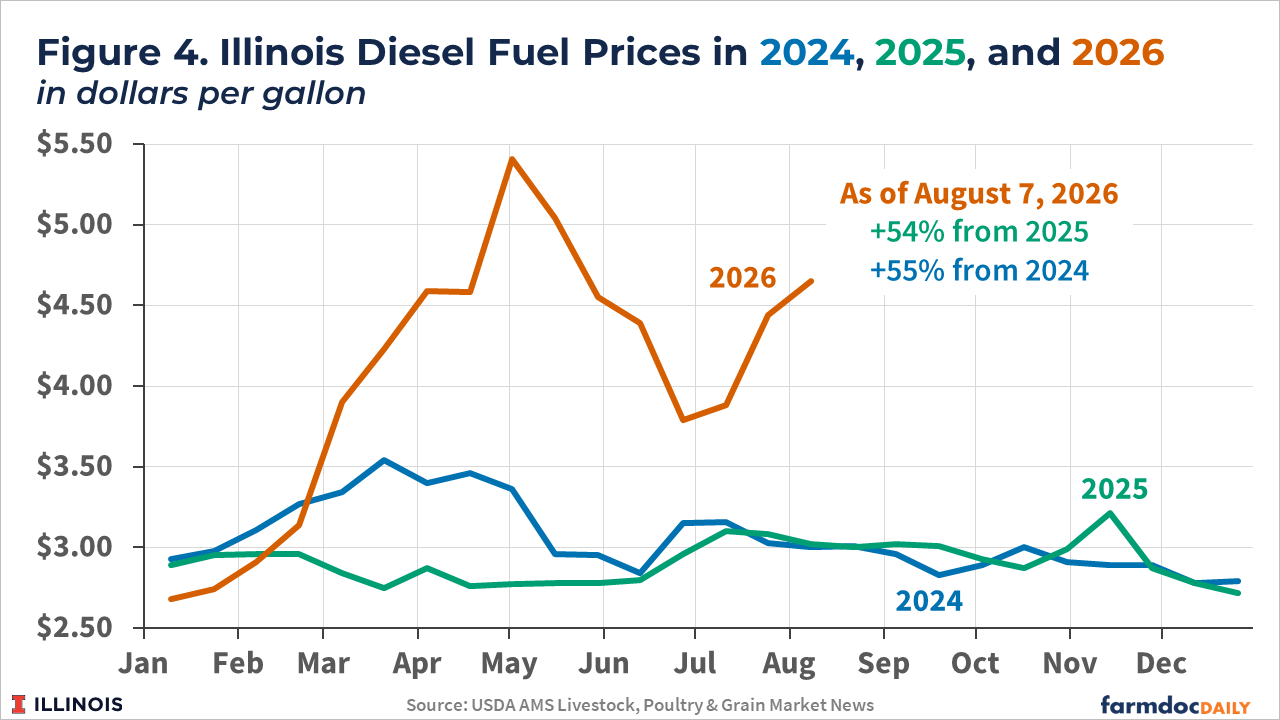
Figure 4 reports average diesel fuel prices in Illinois for 2024, 2025, and 2026. After beginning 2026 below $3.00 per gallon, average diesel prices in Illinois have risen sharply, reaching a peak of nearly $5.50 per gallon in early May, falling back below $4.00 per gallon in late June and early July, and then increasing again to $4.65 per gallon as of August 7th. Current diesel prices are more than 50% higher than they were at the same time in 2024 and 2025.
Implications
Fertilizer and fuel prices are generally higher than they were at the same time in the last two years. Fall harvest for the 2026 crop, and planning for 2027, will soon begin. Fuel costs for harvest activities are expected to be considerably higher based on the large increase in diesel fuel prices over the past 6 months which are primarily attributed to the war with Iran.
Fertilizer prices, particularly for nitrogen and phosphorous products, are higher than they have been at the same time in the past two crop years. Nitrogen and phosphorous fertilizer prices have generally been on the rise since the fall of 2024. DAP prices rose more significantly in late summer and early fall of 2025, while anhydrous prices saw a sharper increase since the start of the war in Iran. Fall applications – common for products like anhydrous ammonia and DAP – will be more costly than in recent years.
In areas where they are common, farmers may reconsider fall applications, shifting a greater share of their nutrient needs for the 2027 crop to the spring. In the case of DAP, farmers may even consider utilizing phosphorus in the soil and replacing a larger amount in future years (see farmdoc daily articles from June 29 and July 27, 2026 for further discussion on phosphorous management). Shifting a portion of nutrient applications from fall to spring could result in lower costs if prices fall. However, the Iran conflict seems likely to continue to impact these markets via elevated prices. Damaged infrastructure and logistics issues in the Strait of Hormuz could continue to linger even if conflict activities are ceased (see farmdoc daily articles from March 23, March 27, April 24, and April 29, 2026).
Increasing planned soybean acreage relative to corn for 2027 is another strategy to reduce overall fertilizer costs for the farm operation. Prices and productions costs have tended to favor the return prospects for soybeans over corn in recent years (see farmdoc daily articles from June 2 and August 4, 2026).
Fall 2026 management decisions for the 2027 crop year are setting up to be even more difficult than usual. A diversified portfolio approach where a portion of nutrient needs for 2027 are priced this fall, despite high price levels, seems warranted. This would provide some protection against further price increases into the winter and spring. Revisiting application rates, considering the maximum return to nitrogen (MRTN) recommendations and soil testing for replacement needs for phosphorous and potassium, are also more valuable strategies in high fertilizer price environments.
References
Arita, S., R. Chakravorty, J. Kim, W. Y. Lwin and S. Steinbach. "Strait of Hormuz Closure and Fertilizer Supply Risks for U.S. Agriculture." farmdoc daily (16):48, Department of Agricultural and Consumer Economics, University of Illinois at Urbana-Champaign, March 23, 2026.
Arita, S., M. Wang, J. Kim, R. Chakravorty and S. Steinbach. "Strait of Hormuz Disruption Scenarios and Fertilizer Purchasing Risks for U.S. Crop Producers." farmdoc daily (16):75, Department of Agricultural and Consumer Economics, University of Illinois at Urbana-Champaign, April 29, 2026.
Bergschneider, L. and A. Margenot. "Rethinking Phosphorus and Potassium, Part 1: Soil Testing 101." farmdoc daily (16):113, Department of Agricultural and Consumer Economics, University of Illinois at Urbana-Champaign, June 29, 2026.
Bergschneider, L., Y. Freiberg and A. Margenot. "Rethinking Phosphorus and Potassium, Part 2: Grain Removal Values." farmdoc daily (16):132, Department of Agricultural and Consumer Economics, University of Illinois at Urbana-Champaign, July 27, 2026.
Mashange, G. "The Strait of Hormuz: Why Global Trade Dependency Turns a Localized Conflict into a Global Crisis." farmdoc daily (16):52, Department of Agricultural and Consumer Economics, University of Illinois at Urbana-Champaign, March 27, 2026.
Mashange, G. and G. Gardner. "Middle East Ceasefire Fails to Ease U.S. Fertilizer Price Pressure on Farmers." farmdoc daily (16):72, Department of Agricultural and Consumer Economics, University of Illinois at Urbana-Champaign, April 24, 2026.
Paulson, N., G. Schnitkey and C. Zulauf. "Historical Corn versus Soybean Returns in Illinois." farmdoc daily (16):96, Department of Agricultural and Consumer Economics, University of Illinois at Urbana-Champaign, June 2, 2026.
Schnitkey, G., N. Paulson, C. Zulauf and B. Zwilling. "Historic Corn and Soybean Profitability and 2027 Planting." farmdoc daily (16):138, Department of Agricultural and Consumer Economics, University of Illinois at Urbana-Champaign, August 4, 2026.
Disclaimer: We request all readers, electronic media and others follow our citation guidelines when re-posting articles from farmdoc daily. Guidelines are available here. The farmdoc daily website falls under University of Illinois copyright and intellectual property rights. For a detailed statement, please see the University of Illinois Copyright Information and Policies here.