








The Other Base Update Issue: PLC Base Yield
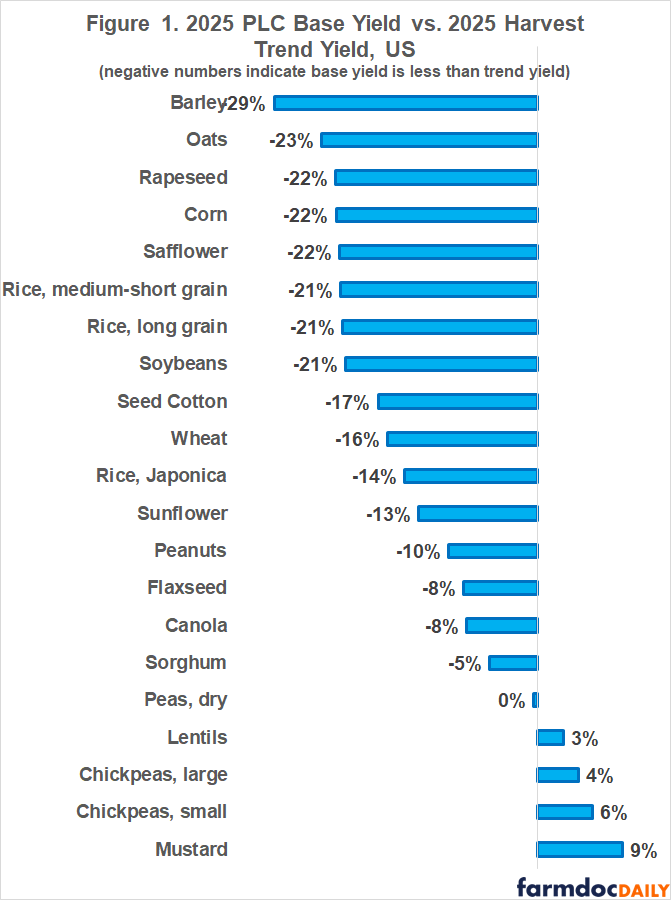
Crop commodity program base acres have attracted considerable attention ever since their authorization in the 1980s (farmdoc daily, January 15, 2026; January 22, 2026; January 29, 2026; February 12, 2026; and February 16, 2026). However, another commodity program base exists: Price Loss Coverage (PLC) base yield. As with base acres, PLC base yields are established using a historical period and fixed until Congress authorizes an update. Thus, like base acres, once set, PLC base yields start to diverge from current yields for most crops as crop practices and genetics improve. For the 2025 crop year, only lentils, large and small chickpeas, and mustard have a US average PLC base yield above US trendline yield (see Figure 1 and Note 1). Barley, oats, rapeseed, corn, two types of rice, and soybeans have a PLC base yield that is more than 20% below trendline yield. The rest of this article addresses the interaction of a joint required update of base acres and yields.
Base Acres
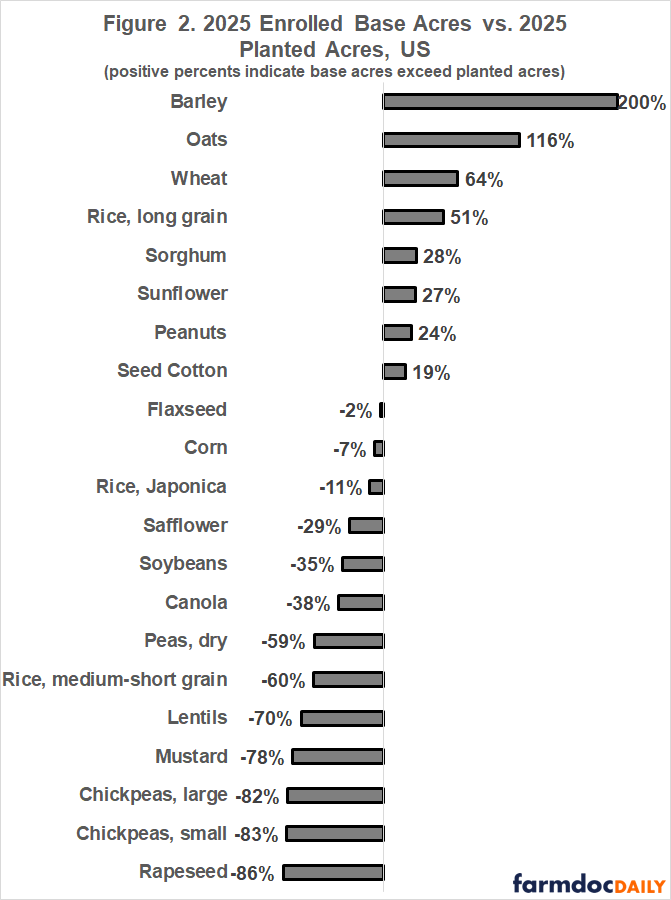
Base acres were created to mitigate the impact of commodity program payments on planting decisions. By making payments on historic, not current acres farmer cannot increase current year government payments by planting more acres to crops expected to have higher payments. However, a policy drawback exists. Crop mix changes over time as supply and demand change differently by crop. A huge range has emerged in the relationship between base and planted acres, with the size of the gap reinforced by another policy decision to give landowners an option to not update base acres when an update has been offered, thus concentrating base acres in crops with higher payments over time. In 2025, base acres enrolled in commodity programs ranged from 200% above planted acres for barley to 86% below planted acres for rapeseed (see Figure 2 and Note 2). The wide range of differences amongst program crops has resulted in calls to better align base and planted acres so that commodity program payments better align with actual crop production risks and input expenditures (farmdoc daily, August 13, 2026).
Joint Base Acre and Yield Update
The rationale noted in the preceding section for creating base acres also applies as a rational for creating PLC base yields. It is thus not uncommon for some type of base acre adjustment and PLC base yield adjustment to occur at the same time. The most recent joint adjustment was authorized in the 2014 Farm Bill.
To provide an indication of the impact of a joint update of base acres and PLC base yields, we compare US PLC production (US average PLC yield times US base acres) with US expected production (US trendline yield times planted and considered planted acres). For the eight crops whose base acers exceed planted acres, jointly updating base acres and PLC yields nontrivially reduces the loss in supported production (red line in Figure 3) compared with the loss in base acres (black line in Figure 3). Notably, a -16% decline in base acres for seed cotton becomes a +2% increase in base production.
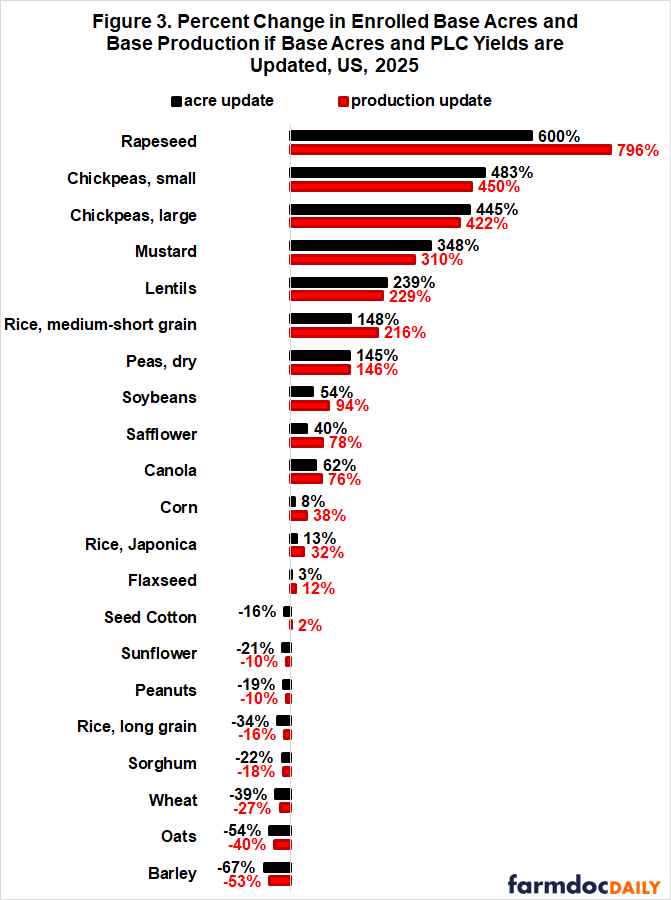
On the other hand, for the majority of the 13 crops for which base acres are less than planted acres, supported production increases more than their base acres because current PLC base yields are less than current harvested yields. In short, they gain from both an update of base acres and PLC base yields. For example, supported production of corn and soybeans, the two largest US crops, increase by 38% and 94%, respectively. In comparison, their increase in base acres is 8% and 54%, respectively.
Policy Discussion
Historical base acres and yields intertwine with reference prices to determine payments by PLC. These three policy parameters need to be considered jointly if changes are made to one of them. Updating base acres cannot be considered independently of a crop’s base yield and reference price.
A required update of base acres is unlikely unless losses are reduced for crops that lose and payments remain largely disconnected from planting decisions. The surge in peanut acres under the 2014 Farm Bill’s generic base acre experiment (farmdoc daily, May 18, 2017) underscored in no uncertain terms the historical lesson that farmers will plant for government payments.
Updating base acres will likely generate federal budget savings, assuming no change in PLC base yields and PLC reference prices. One way to moderate these loses is to use the savings from the base acre update to jointly update PLC base yields. A joint update will result in some programs crops, notably corn and soybeans, gaining from both higher base acres and higher PLC base yields. Moreover, other potential uses for these savings exist that may be better improvements to the crop safety net.
One way to minimize the impact of government payments on current plantings is to set base acres equal to a long period moving average, for example 10 years. A continuous update occurs, but payments are made on historical, not current planted acres.
A transition could also be built into the policy shift. Current base acres could be used for the first 10 historical years. In each succeeding year, the most recent past year’s planted acres replace the oldest base acre. After 10 years, current base acres would be completely replaced.
A caveat to any public policy design change is that implementation issues also need to be considered. A particular consideration for the two preceding suggestions is their impact on determining base acres for the nontrivial number of Farm Service Agency farm reconstitutions that occur each year. These types of considerations can impact the specific way a general policy decision is implemented.
To summarize, aligning payment acres with planted acres will better align commodity program payments with the risks farmers currently face. However, clear policy considerations and tradeoffs exist that must be addressed. This article is offered to stimulate discussion of these intertwined issues.
Notes
- Linear trendline yields for 2025 were estimated using yield per harvested acre as reported by USDA, NASS (US Department of Agriculture, National Agricultural Statistics Service) for the 1974 or earliest continuously available crop year through the 2024 crop year, then projected to the 2025 crop year. If the linear trendline was not statistically significant, the average of available yields was used as the 2025 projected yield. Base yields are from USDA, FSA (Farm Service Agency).
- Planted acres for a crop were set equal to US harvested acres as reported by USDA, NASS, plus failed and prevent planted acres as reported by USDA, FSA. This definition is used because planted and harvested acres diverge considerably for several crops, most prominently wheat, barley and especially oats. A likely key reason for the divergence is the planting of these crops as cover crops and companion crops when establishing forages. Base acres are from USDA, FSA.
References
Coppess, J. "Off Base, Part 1: Reviewing Issues and Problems with Base Acre Policy." farmdoc daily (16):7, Department of Agricultural and Consumer Economics, University of Illinois at Urbana-Champaign, January 15, 2026.
Coppess, J. "Off Base, Part 2: The View from the CBO Baseline." farmdoc daily (16):10, Department of Agricultural and Consumer Economics, University of Illinois at Urbana-Champaign, January 22, 2026.
Coppess, J. "Off-Base, Part 3: Picking Winners & Losers with Policy." farmdoc daily (16):13, Department of Agricultural and Consumer Economics, University of Illinois at Urbana-Champaign, January 29, 2026.
Coppess, J. "Off-Base, Part 4: A Fundamental Flaw in the Policy." farmdoc daily (16):22, Department of Agricultural and Consumer Economics, University of Illinois at Urbana-Champaign, February 12, 2026.
Coppess, J. "Off-Base, Part 5: Farm Policy Has Been Here Before; Lessons Reinforced by History." farmdoc daily (16):24, Department of Agricultural and Consumer Economics, University of Illinois at Urbana-Champaign, February 16, 2026.
Coppess, J. "The Unfinished Farm Bill Remains Unfinished and Sends a Warning." farmdoc daily (16):145, Department of Agricultural and Consumer Economics, University of Illinois at Urbana-Champaign, August 13, 2026.
Zulauf, C., G. Schnitkey, N. Paulson and J. Coppess. "Generic Base’s Impact on Planted U.S. Acres: A Multi-Commodity Perspective." farmdoc daily (7):92, Department of Agricultural and Consumer Economics, University of Illinois at Urbana-Champaign, May 18, 2017.
Disclaimer: We request all readers, electronic media and others follow our citation guidelines when re-posting articles from farmdoc daily. Guidelines are available here. The farmdoc daily website falls under University of Illinois copyright and intellectual property rights. For a detailed statement, please see the University of Illinois Copyright Information and Policies here.