








The 2027 Margin Coverage Option (MCO) Decision
The Margin Coverage Option (MCO) is an area-based crop insurance endorsement that provides protection against operating margin shortfalls, which can be driven by revenue decreases, cost increases or a combination of both. The decision to buy MCO for crop year 2027 must be done by September 30th, 2026. For the 2027 crop year, the coverage band of MCO was changed, now providing protection from 95% down to 90%. This change reflects the fact that coverage for Supplemental Coverage Option (SCO) increased to 90% from 86% and Enhanced Coverage Option (ECO) changed to 95% down to 90%. The price discovery period recently ended and projected prices for crops and inputs have been determined, which allows for premium calculations. This article discusses the tradeoffs of using MCO in a farm operation’s insurance portfolios.
MCO Recap
The Margin Coverage Option (MCO) offers area level coverage against operating margin shortfalls. It is based on crop futures prices, county yields, and input futures prices along with calculated input quantities based on expected county yields. MCO is available for corn, soybeans, spring wheat, cotton, rice and grain sorghum in selected counties.
MCO is an endorsement to traditional crop policies (Yield Protection (YP), Revenue Protection (RP), Revenue Protection with Harvest Price Exclusion (RP-HPE) and Area Production History (APH)). Given the coverage band overlap, it cannot be purchased with Enhanced Coverage Option (ECO) but can be used with Supplemental Coverage Option (SCO). Like ECO and SCO, the MCO subsidy rate is also 80%.
In 2026, MCO adoption was modest, with just over 2.3 million acres covered (see farmdoc daily August 26, 2026).
The deadline for MCO purchases for corn and soybeans is September 30th. The decision is made this fall, for a policy that will be in effect for crop year 2027.
Projected margins for next crop year are determined based on the Risk Management Agency (RMA) expected county yields (same yields as for ECO and SCO), and crop and input futures prices from this fall. Inputs considered for margin calculations are urea (for corn only), diammonium phosphate (DAP), potash, diesel, and natural gas (for irrigated practices only). Input quantities are calculated by multiplying the county expected yield by input specific coefficients.
Based on projected margins and revenues, a trigger margin is calculated. If the final margin is below the trigger margin, a payment is triggered.
Final margin is calculated using RMA final county yields – typically released in June of the following calendar year (e.g. June 2028 for 2027 MCO coverage) – crop harvest futures prices in the fall (same as for COMBO products, ECO and SCO), and input futures prices in the spring (average during April of the relevant May futures contracts).
MCO is similar, but different than Margin Protection (MP). First, MCO is an endorsement policy that requires an underlying policy, whereas MP can be purchased on its own. Coverage bands and subsidies differ. The input products and quantities are similar but not the same. For MP, there are also fixed costs and interest rates on the calculation.
For more details on how MCO payments are calculated, see farmdoc daily September 16, 2025 and May 6, 2026. More information is also available at https://www.margincoverageoption.com/.
Changes in coverage bands for crop year 2027
The One Big Beautiful Bill Act (OBBBA) increased the SCO coverage level from 86% to 90% starting in crop year 2027. The Federal Crop Insurance Corporation (FCIC) Board of Directors approved corresponding coverage level changes for ECO and MCO, which will have coverage bands from 95% to 90% starting crop year 2027.
The same total supplemental revenue coverage level options exist, but with a different split between these products. In essence, SCO is expanding to incorporate the 90% coverage level ECO option while ECO will shift exclusively to a 95% coverage level and 5% coverage band (95% down to 90%). MCO follows that change on the margin side – a 90% coverage level option will no longer be offered and MCO will exclusively cover from 95% down to 90%.
Crop Year 2027 Projected Prices
MCO uses a fall projected price discovery period for crops and inputs. Projected prices for corn and soybeans are the average from August 15 to September 14, 2026 of December and November 2027 futures contracts, respectively. For inputs, projected prices are the average from August 15 to September 15 of May 2027 futures contract, when available. Potash is the exception, with its price being defined as an index of the other inputs’ futures prices.
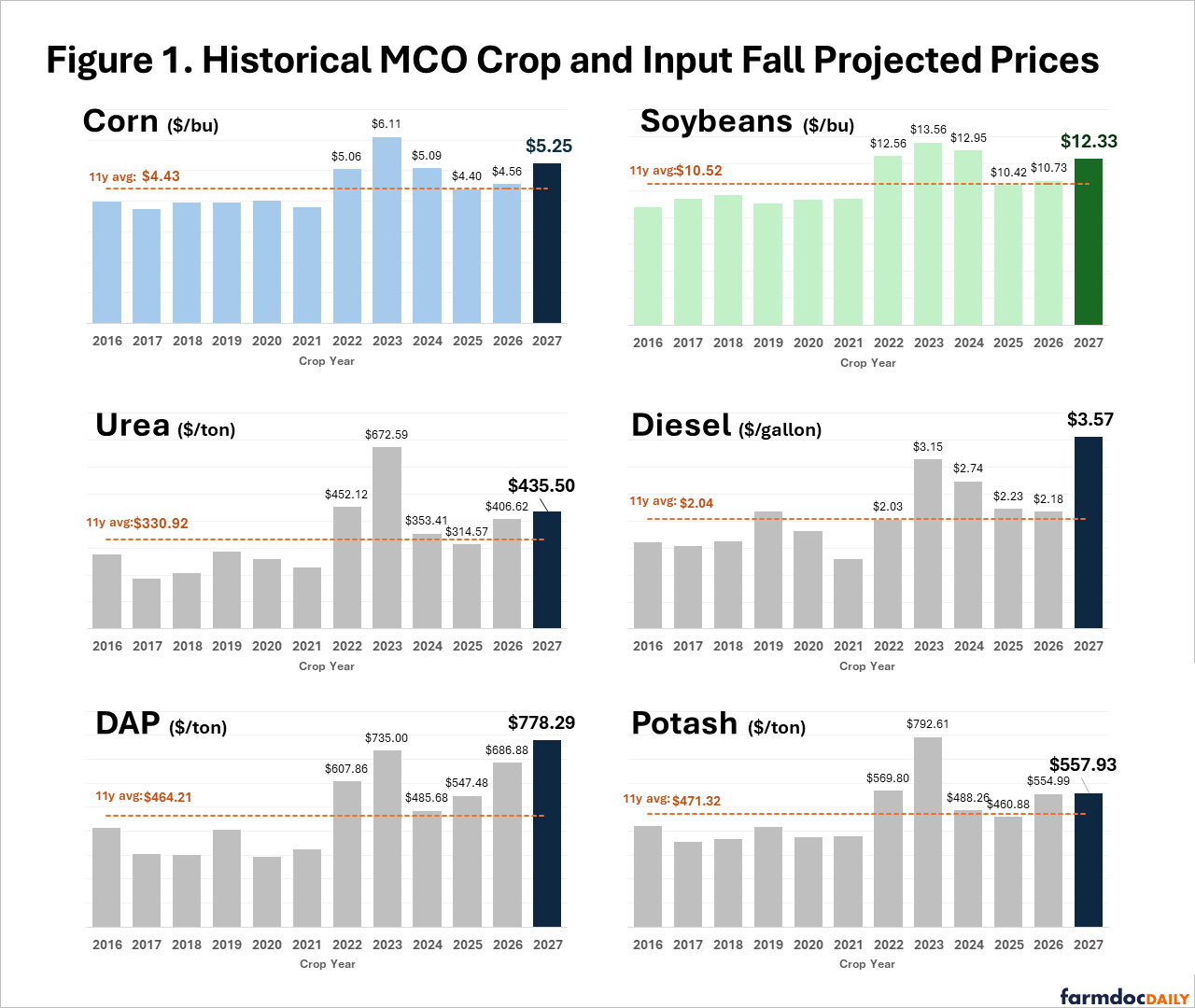
Projected prices for MCO are shown in Figure 1, along with a historical perspective since 2016. These values are available in the MCO website, and official prices will be released by RMA. Corn projected price is $5.25 per bushel, the highest fall projected price since 2016 except for 2023. Soybeans fall projected price is $12.33 per bushel, below 21-23 values, but higher than the last 11-year average.
Diesel and DAP 2027 projected prices are the highest fall projected prices in the last 11 years, at $3.57 per gallon and $778.29 per ton, respectively. Urea and Potash (an index of urea, DAP and natural gas) 2027 projected prices are $435.50 and $557.93 per ton, respectively, above the last 11-year average and in line with the average for the last 5 years.
2027 Farmer Premiums and Expected Payments
With projected prices set, trigger margins and premiums can be calculated. Aside from projected prices and expected yields, premiums depend on the base rate set by RMA, which reflects expected risk. Farmer paid premiums by crop and area can be retrieved from: https://www.margincoverageoption.com/.
Final payments will depend on actual county yields and final/harvest input and crop prices. As an example, we look at what 2027 payments would be using an average historical total cost shock of approximately 10%, and without any cost shock. Although the average cost increase was 10%, it ranged from +63% in 2021 to -34% in 2023 (see farmdoc daily, May 6, 2026). Figure 2 summarizes net MCO payments for a corn farmer with underlying RP coverage and 200 bushels of approved yield in Redwood County, MN.
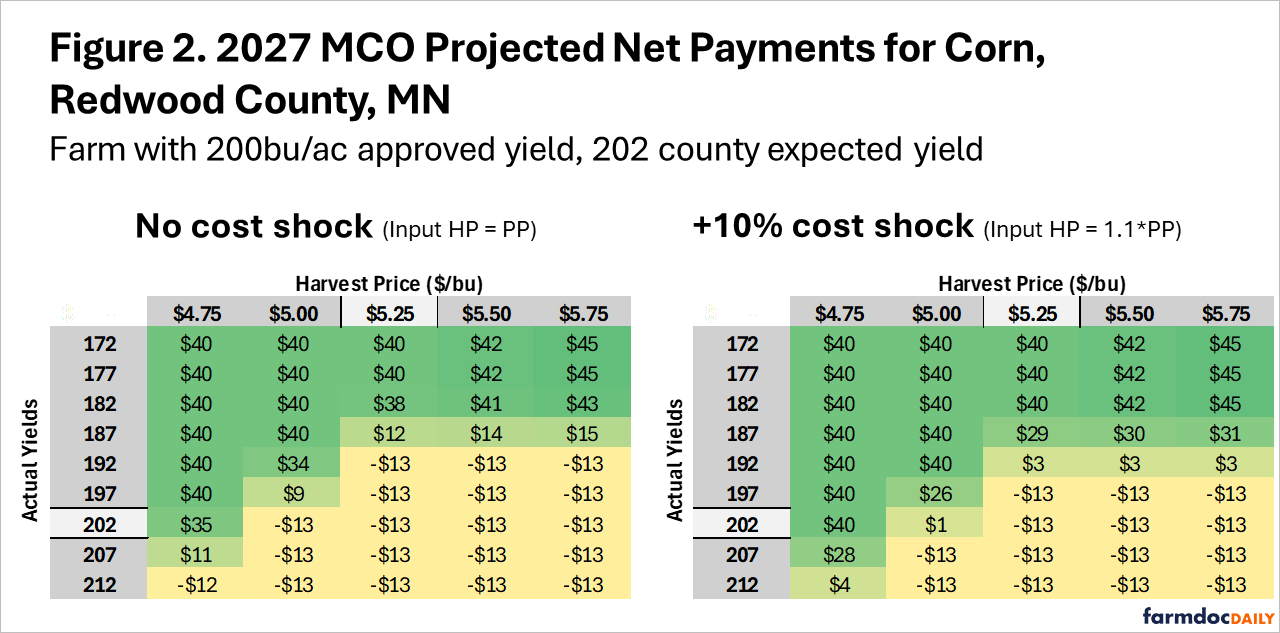
In a scenario without any cost shock and final yields equal to expected, crop harvest prices would have to drop to between $4.75 and $5 to result in a positive net payment (indemnities minus farmer paid premium). If crop harvest prices are the same as projected, yields would have to be below 190 to trigger a positive net payment.
In the case of a 10% positive cost shock, or cost increase, margins are reduced and higher yields and/or prices would result in a positive net payment. If yields are in line with expected, harvest prices need to be $5 to trigger a positive net payment. In the case of crop harvest prices in line with projected, yields below 195 would trigger a positive net payment.
Considerations for adding MCO for 2027
A few considerations when deciding whether to purchase MCO for next crop year.
If an add-on product is going to be among a producer’s choice, considerations with basis risk must be considered (see farmdoc daily, February 19, 2026). Farm losses, either margin or revenue, will not necessarily match area losses, which could decrease Add-on’s ability to cushion farmer losses.
With regards to the coming decision, the biggest trade-off on using MCO is that it competes with ECO. MCO and ECO subsidy rates are both 80%. Historically, MCO and ECO have very similar average payments across most counties in the U.S. for corn and soybeans (see farmdoc daily, September 23, 2025).
These payments, however, can differ significantly over the years. Payments for MCO can exceed those from ECO in years when costs increase from fall to spring, as was the case in 2021 and 2022. However, historical analysis suggests that payments from MCO will more commonly be triggered by crop revenue declines. MCO can be thought as an ECO-like product with a projected price in the fall instead of the spring and with a cost shock component.
MCO also would have triggered bigger payments in years when crop price declines and previous fall projected prices were higher than spring projected prices, such as 2024 (see farmdoc daily, September 23, 2025). MCO provides an opportunity to purchase add-on coverage based on prices projected in the fall, providing an element of “locking in” current price levels. 2027 projected prices are high compared to last years, even higher to spring projected prices (see farmdoc daily, March 3, 2026). On the other hand, little is known at this point about the next year’s crop, including relative prices, weather, and other factors present when planting decisions will be finalized.
Premiums are another consideration. Historically, premiums for the two are similar but in any given year it will depend on differences in base rates, projected prices, and implied volatilities. Higher base rates, projected prices, or implied volatilities (for ECO) increases premiums all else equal. In 2026, base rates were comparable with each other, and over time using these rates with historical projected prices (fall for MCO and spring for ECO) would have resulted in similar average net payments between MCO and ECO.
Ideally, one would compare payments and premiums over time. ECO payments relative to premiums (the loss ratio) have been very low in parts of the Midwest for corn and soybeans, resulting in negative average net payments (see farmdoc daily, July 23, 2024). Other regions have had relatively high loss ratios (see Ifft, 2024). MCO was introduced last year, so no loss experience was recorded yet, since 2026 county yields will be known next year. If rated properly, farmers should experience a positive net benefit over time, with differences between ECO and MCO in years arising from cost shocks and differences in projected prices primarily.
In summary, MCO may be more attractive than ECO to producers who are concerned protecting against (i) a decline projected prices from the fall to the spring, (ii) an increase in implied volatility from the fall to the spring, and (iii) input price increases. Some producers also have to the option to mix use of ECO and MCO across crops or county lines. While this can be a complicated decision, our analysis suggests that the more consequential decision for producers in the long run will be whether or not to purchase add-on coverage in the first place, not whether MCO or ECO is used.
Finally, in deciding on whether to add MCO (or ECO), it is also important to consider interactions with other policies and Title I (ARC/PLC) programs in terms of a producer’s overall risk management portfolio.
Along with these considerations, me (Henrique Monaco), assistant professor of applied economics at the University of Minnesota, will join Jenny Ifft from Kansas State University for a webinar on the 2027 MCO decision. The free webinar will be September 18th at noon. Registration can be done here. Considerations, past MCO performance and more will be discussed to help farmers in making this decision.
References
Monaco, H., G. Schnitkey, N. Paulson and C. Zulauf. "A New Area-Based Crop Insurance Product: MCO (Margin Coverage Option)." farmdoc daily (15):169, Department of Agricultural and Consumer Economics, University of Illinois at Urbana-Champaign, September 16, 2025.
Monaco, H., G. Schnitkey, N. Paulson and C. Zulauf. "Margin Coverage Option (MCO) Historical Analysis." farmdoc daily (15):174, Department of Agricultural and Consumer Economics, University of Illinois at Urbana-Champaign, September 23, 2025.
Monaco, H., G. Schnitkey, N. Paulson, B. Sherrick and C. Zulauf. "Revisiting the Basis Risk when evaluating SCO and ECO." farmdoc daily (16):27, Department of Agricultural and Consumer Economics, University of Illinois at Urbana-Champaign, February 19, 2026.
Monaco, H., N. Paulson, G. Schnitkey and C. Zulauf. "Margin Coverage Option (MCO) 2026 Input Harvest Prices." farmdoc daily (16):79, Department of Agricultural and Consumer Economics, University of Illinois at Urbana-Champaign, May 6, 2026.
Paulson, N., G. Schnitkey, H. Monaco, B. Sherrick and C. Zulauf. "Projected Prices and Volatility Factors for 2026." farmdoc daily (16):35, Department of Agricultural and Consumer Economics, University of Illinois at Urbana-Champaign, March 3, 2026.
Schnitkey, G., B. Sherrick, C. Zulauf, N. Paulson and J. Baltz. "Performance of SCO and ECO in the Midwest." farmdoc daily (14):136, Department of Agricultural and Consumer Economics, University of Illinois at Urbana-Champaign, July 23, 2024.
Zulauf, C., H. Monaco, J. Coppess and G. Schnitkey. "2026 Area Add-On Insurance Purchases by US Farmers." farmdoc daily (16):153, Department of Agricultural and Consumer Economics, University of Illinois at Urbana-Champaign, August 26, 2026.
Disclaimer: We request all readers, electronic media and others follow our citation guidelines when re-posting articles from farmdoc daily. Guidelines are available here. The farmdoc daily website falls under University of Illinois copyright and intellectual property rights. For a detailed statement, please see the University of Illinois Copyright Information and Policies here.