








Mixing Politics and Perceptions of AI and Data Centers: Results from the Gardner Food & Agricultural Policy Survey
Introduction
It has been less than four years since OpenAI introduced ChatGPT on November 30, 2022, launching the current AI era. Since that launch, monthly spending on data centers has increased from less than $1 billion per month in November 2022 to $5.4 billion per month reported in August 2026 (Our World in Data, 2026). Public opposition to data centers in polling has also been growing (Kennedy, 2026; Neuman, 2026; Howard, 2026; Meyer, August 19, 2026). That opposition, in turn, raises questions about the potential impact on American politics and the political parties, especially as Americans head to the polls for the midterm elections this November 3rd (Kochi, 2026; Bolton, 2026; Goodman, Elliott, & Plumer, 2026; Javaid, 2026; Capoot and Downs, 2026; Goldmacher, 2026). Surveys conducted by the Annenberg Public Policy Center (2026) and the University of Massachusetts Amherst Poll (2026) have found that majorities of Democrats, Republicans, and Independents opposed the construction of new data centers in their communities. As the build-out of the AI infrastructure continues, more questions will be raised about how public opinion will perceive the opportunities and challenges associated these developments.
In previous farmdoc daily articles (White et al. 2026a; White et al. 2026b), we analyzed survey responses across different community types (e.g., urban, suburban, rural). Those findings suggested that Americans were generally more skeptical of these developments than optimistic about their potential benefits. With an eye towards the rapidly approaching 2026 midterm elections, this article further reviews these survey results from the Gardner Food and Agricultural Policy Survey (GFAPS) but through the lens of political affiliation. Specifically, we examine how perceptions of the benefits and challenges associated with AI and data center development vary among self-identified Democrats, Republicans, and Independents/Others. Doing so provides insight into the extent to which attitudes toward these emerging technologies and their supporting infrastructure differ across political groups.
About the Data
Similar to our September Farmdoc Daily article (White et al., 2026), this article draws on survey data from two waves—Wave 16 (February 2026) and Wave 18 (August 2026)—of the quarterly Gardner Food and Agricultural Policy Survey (GFAPS). For every wave of this survey, Qualtrics recruits a sample of 1,000 U.S. adults to complete the online survey. Qualtrics uses quotas designed to closely reflect the national population by region, income, age, and gender. To explore the political issues with data centers, and by extension Artificial Intelligence (AI), we review results across respondents’ stated political party affiliation. In Wave 16, 34% identified as Republicans, 34% identified as Democrats, and 32% identified as Independent/Others. In Wave 18, 34% identified as Republicans, 37% identified as Democrats, and 29% identified as Independent/Others.
In this article, we focus on responses to two sets of questions. In both Wave 16 and Wave 18, participants were asked: “On a scale from 1 to 7, where 1 = not at all worried and 7 = extremely worried, how worried are you that Artificial Intelligence (sometimes called AI) will result in the following outcomes?” Respondents evaluated three potential consequences: (1) agricultural land being converted to data center use, (2) overuse of water resources, and (3) increased electricity costs resulting from new data centers.
Wave 18 included an additional question about the potential benefits associated with data center development. To this end, respondents were asked: “On a scale from 1 to 7, where 1 = not at all optimistic and 7 = extremely optimistic, how optimistic are you that if a new data center were built in your area, it would result in the following outcomes?” These participants were specifically asked to rate four possible benefits: (1) increased local tax revenue (such as property tax revenue), (2) jobs created by the data center, (3) expanded business opportunities for local firms and suppliers, and (4) infrastructure improvements, including roads, utilities, and broadband access. For both questions, the order of items was randomized to prevent order bias.
The potential impacts of AI/Data Centers raise concerns across the political spectrum.
Regardless of political affiliation, most survey respondents expressed concern about the potential impacts of AI and data center development.
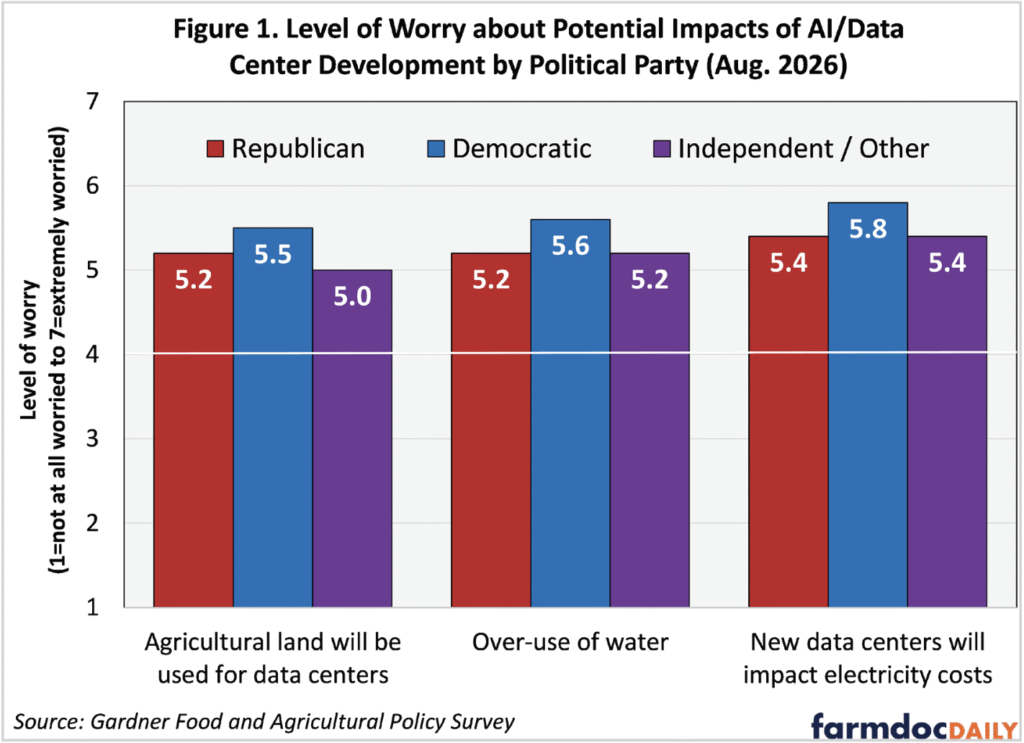
Figure 1 illustrates the level of concern reported by self-identified Republicans, Democrats, and Independents/Others about several potential consequences of AI and data center expansion. Democrats reported the highest levels of concern. The average concern rating for Democrats exceeded 5.5 (out of 7) for the impact of AI and data center development on agricultural land use, water consumption, and electricity costs. Republicans and Independents/Others expressed similar concern levels about water usage and electricity costs, while Republicans were slightly more concerned than Independents/Others about the use of agricultural land for data center development.
Between February and August 2026, concern levels increased across the board. Republican concerns about land and water usage increased from 4.5 to 5.2. Both Democrats and Republicans become more concerned about the use of agricultural land for data centers, with their relative level of worry increasing +0.7 and +0.8, respectively. These growing levels of concern have coincided with a period in which data center developers are increasingly seeking available sites, often in more rural areas. For instance, the Federal Reserve Bank of Dallas (2026) reported that in West Texas agricultural production is slowing down because significant acreage is being converted for data centers and alternative energy. Similarly, approximately one quarter of farm managers responding to the Illinois Society of Professional Farm Managers and Rural Appraisers (ISPFMRA) survey, indicated that they had been approached by data center developers in the first half of 2026 (Tsay, et al., 2026).
Intensifying concerns represent another bi-partisan trend.
Although Democrats continued to express the highest overall levels of concern, the intensity of those concerns increased across the political spectrum during the first half of 2026.
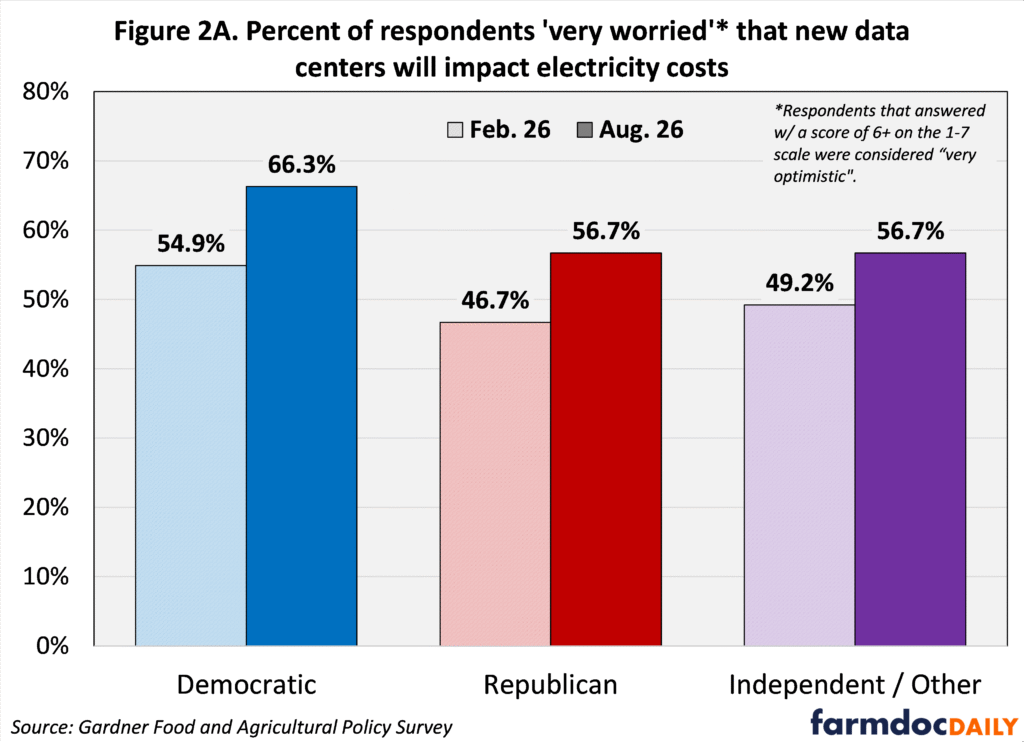
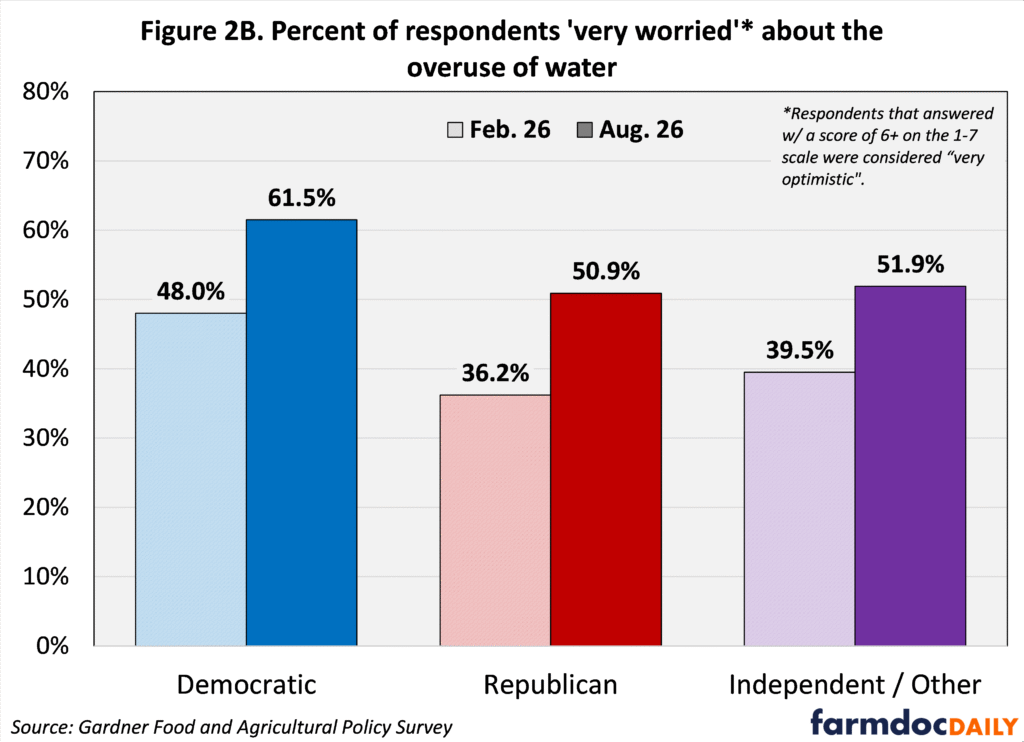
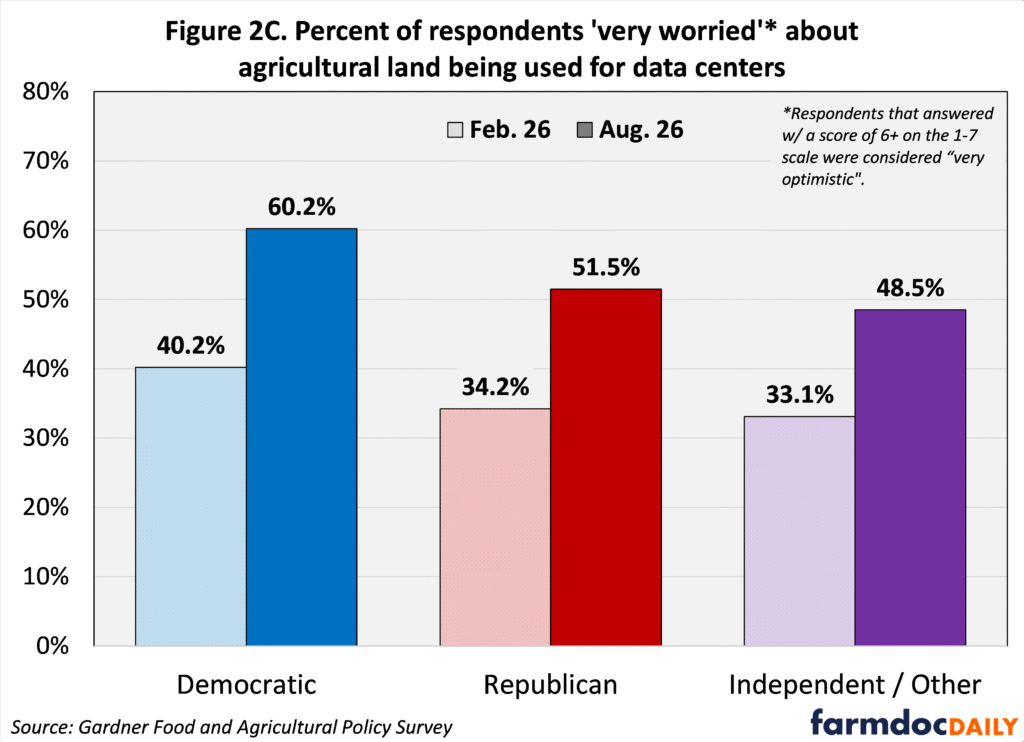
Figures 2A, 2B, and 2C show the share of respondents—by political party—who reported being “very worried” (defined as selecting a 6 or 7 on the 1-to-7 concern scale) about rising electricity costs, the overuse of water, and the conversion of agricultural land to data center use, respectively. The intensity of these concerns increased between February and August 2026 among Democrats, Republicans, and Independents/Others. In February 2026, concern about rising electricity costs among Democrats was the only instance where more than half of respondents reported being very worried. However, by August 2026 the share of respondents who were very worried had approached or exceeded 50% across all issues and political groups.
These figures also show that Democrats continued to report the highest levels of concern in August 2026, with more than 60% indicating they were very worried about the effects of AI and data center development on electricity costs, water use, and the conversion of agricultural land. Among Republicans and Independents/Others, the share reporting they were very worried about the impacts of electricity costs was almost 57%, while the shares concern about the development of agricultural land and the overuse of water clustered around 50%. Concern about the conversion of agricultural land increased the most between February and August, rising by 20.0 percentage points among Democrats, 17.3 percentage points among Republicans, and 15.4 percentage points among Independents/Others. Taken together, these results suggest that growing concern about AI and data center development is not confined to a single political party but instead represents a broader bipartisan trend.
Republicans are the most optimistic about the benefits, Independents/Others the least optimistic.
Proponents of data center development often cite benefits such as increased local tax revenues, job creation, greater local business opportunities, and infrastructure improvements (Boyce and Whitacre, 2026; Poole, 2026), but our earlier findings (White et al., 2026) showed that public perceptions about these benefits remained tepid.
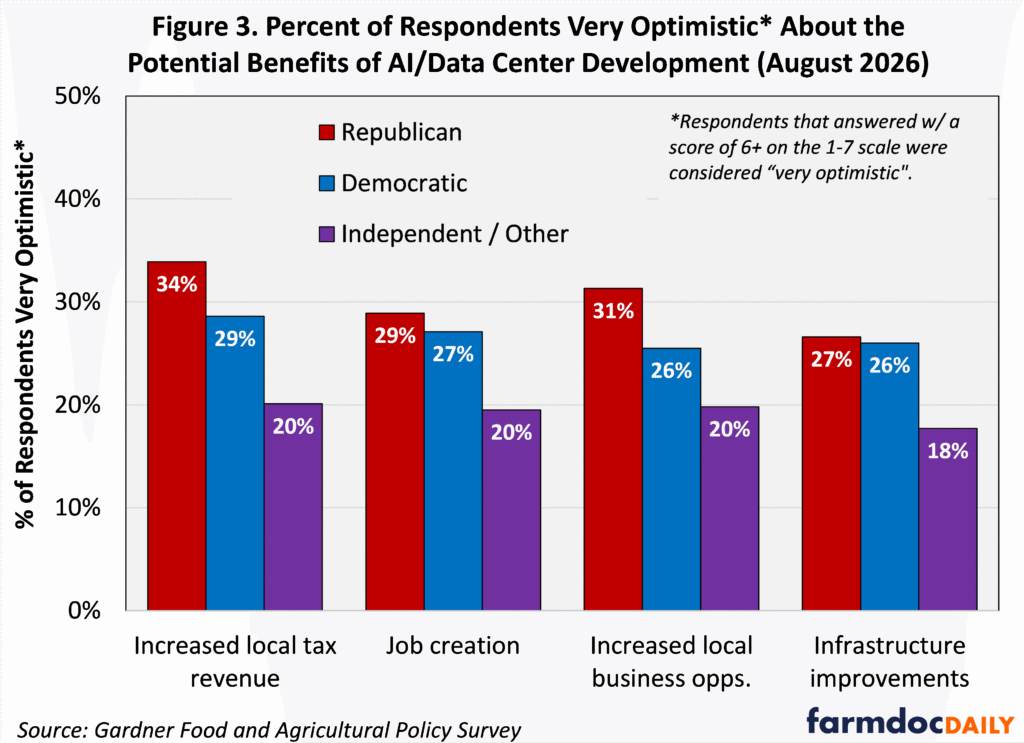
Nevertheless, Figure 3 shows that political persuasion does influence perceptions of the local benefits. For each of the identified potential benefits, Republicans were more likely to be ‘Very Optimistic’ (defined as selecting a 6 or 7 on the 1-to-7 optimism scale) than either Democrats or Independents/Others. Among these benefits, they were most optimistic about the potential for increased local tax revenues. By contrast, Independents/Others were much more skeptical than the other groups. Only 20% of Independents/Others were very optimistic of these benefits, a figure notably lower than Republicans or Democrats.
Debates over AI and Data Centers will continue, but likely evolve, over time.
Given the scale of current and planned investments in AI infrastructure, public concern about data center development may persist beyond the 2026 election cycle. Over the course of this year, the GFAPS results highlight that concern about electricity costs, water use, and the conversion of agricultural land is shared across the political spectrum. While Republicans tend to be somewhat more optimistic about the potential benefits of data center development, that optimism does not fully offset broader concerns about its impacts. These findings are broadly consistent with other national surveys and polling that document increasing skepticism toward data center development and growing opposition to new facilities in local communities. As a result, AI and the infrastructure that supports it will likely remain important topics in public debate and policymaking long after the midterm elections. The Gardner Food and Agricultural Policy Survey will continue monitoring public attitudes toward AI and data center development, including in the post-election period.
References
Annenberg Public Policy Center. (2026, August 11). Opposition to local data centers rises sharply, Annenberg survey finds. University of Pennsylvania. https://www.annenbergpublicpolicycenter.org/opposition-to-local-data-centers-rises-sharply-annenberg-survey-finds/
Bolton, A. (2026, September 10). Public anger over AI boom triggers GOP midterm worries. The Hill. https://thehill.com/homenews/senate/6080338-ai-data-centers-midterm-politics/
Boyce, M., & Whitacre, B. (2026, June). The economics of data centers: Considerations for communities (Fact Sheet AGEC-924). Oklahoma State University Extension. https://extension.okstate.edu/fact-sheets/the-economics-of-data-centers-considerations-for-communities
Capoot, A., & Downs, G. (2026, August 20). AI data center outrage is showing up everywhere from ads to elections. CNBC. https://www.cnbc.com/2026/08/20/ai-data-center-election-backlash.html
Federal Reserve Bank of Dallas. (2026). Agricultural Survey: Third Quarter 2026. https://www.dallasfed.org/research/surveys/agsurvey/2026/ag2603
Goldmacher, S. (2026, August 23). Data centers and the midterm elections. The New York Times. https://www.nytimes.com/2026/08/23/us/politics/data-centers-midterm-elections.html
Goodman, J., Elliott, R., & Plummer, H. (2026, September 9). Texas Republicans and data center anger. The New York Times. https://www.nytimes.com/2026/09/09/us/texas-republicans-data-center-anger.html
Howard, A. (2026, August 26). Data centers, midterms and politicians: As voters sour, candidates scramble. POLITICO. https://www.politico.com/news/2026/08/26/data-centers-midterms-politicians-voters-sour-01050143
Javaid, M. (2026, September 5). Voters are fed up with data centers. Both parties are trying to cash in for midterms. NPR. https://www.npr.org/2026/09/05/nx-s1-5913671/ai-data-center-campaign-spending
Kennedy, B. (2026, September 22). Americans’ views of data centers have turned more negative. Pew Research Center. https://www.pewresearch.org/short-reads/2026/09/22/americans-views-of-data-centers-have-turned-more-negative/
Kochi, S. (2026, October 1). Data centers become a midterm liability for Republicans. The Hill. https://thehill.com/homenews/senate/6121776-gop-worried-data-center-midterms/
Meyer, R. (2026, August 19). Exclusive: 75% of Americans now oppose local data center development. Heatmap News. https://heatmap.news/daily/data-center-opposition-poll-collapse
Our World in Data. (2026). Monthly spending on data center construction in the United States. Retrieved October 20, 2026, from https://ourworldindata.org/grapher/monthly-spending-data-center-us
Neuman, S. (2026, September 21). The data center backlash is reshaping American politics, one community at a time. NPR. https://www.npr.org/2026/09/21/nx-s1-5927288/data-center-election-voters-ai
Poole, K. (2026). The Digital Backbone: Data Centers, Community Tradeoffs, and Regional Competitiveness. Center for Regional Economic Competitiveness. https://www.crec.net/2026/08/the-digital-backbone-data-centers-community-tradeoffs-and-regional-competitiveness/
Tsay, J-H, Worrell, L., Schnitkey, G., and Gleason, T. (2026, August 27). Rents and Prices Outlook: Results from a Mid-Year Survey Conducted by the Illinois Society of Professional Farm Managers and Rural Appraisers [Webinar]. farmdoc daily. Available at: https://www.youtube.com/watch?v=lNcVXkeu8oM
University of Massachusetts Amherst Poll. (2026, September 14). Just 1 in 9 Americans support AI data center construction in their local communities. https://www.umass.edu/poll/about/reports/2026-09-national-public-opinion-poll-2
White, M., S. Low, M. Kalaitzandonakes, J. Coppess and B. Ellison. (2026, June 25). "Rural Americans are Concerned About the Impact of Data Centers." farmdoc daily (16):111, Department of Agricultural and Consumer Economics, University of Illinois at Urbana-Champaign.
White, M., S. Low, M. Kalaitzandonakes, and J. Coppess. (2026, September 14). "Changing Public Perceptions of AI and Data Center Development: Results from the Gardner Food and Agricultural Policy Survey." farmdoc daily (16):164, Department of Agricultural and Consumer Economics, University of Illinois at Urbana-Champaign.
Disclaimer: We request all readers, electronic media and others follow our citation guidelines when re-posting articles from farmdoc daily. Guidelines are available here. The farmdoc daily website falls under University of Illinois copyright and intellectual property rights. For a detailed statement, please see the University of Illinois Copyright Information and Policies here.