








Conservation Policy: The Baseline Shuffle and Tradeoffs in the Bardo
October marks the beginning of the federal fiscal year, which is payment season for farm policy (USDA, October 7, 2026; Farm Policy News, October 19, 2026). Payments are made in October because Congress included a timing shift in farm programs (Agriculture Risk Coverage (ARC) and Price Loss Coverage (PLC)), requiring payments be made after October 1 (7 U.S.C. §9016(e) and §9017(f)). As such, the payments made in October 2026 are for the 2025 crop year but booked in fiscal year 2027. The point of this is to reduce the overall costs of farm program payments in the 10-year spending projections by the Congressional Budget Office (CBO). It is a budget gimmick; by shifting the payments to the next fiscal year, the CBO cost projections include only nine out of the 10 years in a score. It is one of many notable examples of the differences under budget policy for farm payments compared to conservation policy, as discussed in this article.
Background
It is in October, with the new fiscal year, that the Commodity Credit Corporation (CCC) is typically replenished. The CCC is the primary funding mechanism for all farm program payments and conservation, it has also been used in recent years to make some ad hoc payments to farmers. The CCC operates through direct borrowing authority on the U.S. Treasury, which Congress has limited to $30 billion. Payments and other obligations are booked as net realized losses and Congress, through appropriations, reimburses those losses which restores the borrowing authority. In effect, the CCC operates as a credit card that Congress must pay off to permit further borrowing or use (15 U.S.C. §714b; Stubbs, May 15, 2025).
As reported, the total amount of ARC/PLC payments is almost $14 billion and is the largest amount paid out by these programs since they were enacted in the 2014 Farm Bill (farmdoc daily, October 13, 2026). Payments are somewhat lower than earlier projections because market year average crop prices were higher than projected. Most notably, however, program payments have more-than doubled from CBO’s projected $6.5 billion prior to the Reconciliation Farm Bill in last year’s One Big Beautiful Bill (OB3) Act of 2025. In addition to ARC/PLC payments, the CCC also funds the Marketing Assistance Loans (MAL) that farmers can take out on harvested crops. In recent years, farmers have taken out an average of $6.5 billion in loans, most of which is repaid by farmers nine months later (Rosch, October 20, 2026). Between them, ARC/PLC and MAL likely consume over $20 billion (two-thirds) of the CCC borrowing authority.
The beginning of the fiscal year is also when FSA pays annual rental payments under the Conservation Reserve Program (CRP), reported to total $1.8 billion (Farm Policy News, October 19, 2026). The authorization for CRP, which was extended by Congress last year through the end of FY2026 (i.e., September 30, 2026), has technically expired. While this will not impact any existing contracts, it does prevent USDA from enrolling or reenrolling acres in the program until Congress reauthorizes it or extends the authorization. This is because CRP was not included in the Reconciliation Farm Bill last year and it remains in a uniquely uncertain situation among all farm and conservation programs.
Finally, October is also when the CCC transfers funds to the Natural Resource Conservation Service (NRCS). These funds are available throughout the fiscal year to obligate for the financial assistance to farmers who implement conservation, as well as technical assistance to farmers and some operating costs. These funds are obligated for contracts with farmers under the Conservation Stewardship Program (CSP), the Environmental Quality Incentives Program (EQIP), the Agriculture Conservation Easement Program (ACEP), the Regional Conservation Partnership Program (RCPP), or other program authorities. The total amount spent on conservation assistance by these programs depends on contracting actions by NRCS throughout the fiscal year (as well as prior fiscal years) and will not be known until well after FY2027 ends. In its February 2026 Baseline, CBO projected $4.7 billion for FY2027 for EQIP, CSP, ACEP and RCPP. Notably, this total was down from $6.8 billion projected for FY2027 in CBO’s 2025 Baseline, prior to the OB3 changes (CBO, “Baseline Projections for Selected Programs: USDA Mandatory Farm Programs”).
These programs could consume at least $26.5 billion of the $30 billion CCC borrowing authority. Among other things, this has implications for any ad hoc payments such as the $8 billion in assistance announced by President Trump on (Farm Policy News, October 20, 2026; October 21, 2026). Congress will need to replenish the account—pay off the credit card—if those new ad hoc payments are to be made.
Discussion
Supporters of conservation policies could be forgiven for thinking that they have to play by a different set of rules, because they do—at least when it comes to budget policy and spending. That fact has been further exposed by the unfinished Farm Bills currently stuck in Congress (119 H.R. 7567; 119 S.5526). In each bill, the Ag Committees included a reduction in conservation funding, notably for EQIP: the House proposes to cut over $1 billion from EQIP, while the Senate bill proposes a $1.9 billion cut to the program. These cuts are presumably used to offset additional costs elsewhere, including for a new Forest Conservation Easement Program with $240 million in budget authority but no baseline. This exposes the zero-sum nature of current budget policy—that existing programs must be cut to increase spending in other programs, or to create new policy. Added to other recent actions by Congress, it also exposes the extent to which conservation policy must continue to abide by rules that farm payment policies do not, and which do not apply at all to ad hoc payments.
If the proposed reductions in EQIP are enacted into law, they would be in addition to what was cut from the program by Congress in the Reconciliation Farm Bill. As noted above, conservation investments are already expected to be over $2 billion less in FY2027 than they would have been without the changes enacted in that law. Worse, the further cuts would represent a decision by Congress to break the promise of additional funding for conservation that was included in the baseline shuffle in last year’s reconciliation bill. Both have real implications for farmer seeking to implement conservation practices on their farms.
Four years ago, Congress enacted the Inflation Reduction Act of 2022 (IRA) which provided a short-term boost in conservation funding of $18 billion available through fiscal year FY2031 (P.L. 117-169). Last year, in the Reconciliation Farm Bill included in OB3, Congress—in addition to cutting food assistance to low-income Americans and doubling farm assistance—shuffled the baseline for conservation programs (P.L. 119-21). This baseline shuffle rescinded the remaining IRA conservation funds and used most of the funds to increase the budget authority for EQIP, CSP and ACEP. Most of the increases were backloaded, becoming available only in the outyears of the 10-year CBO Baseline. CBO projected a total reduction in conservation spending (outlays) of $7.9 billion for FY2025 to FY2030, followed by increases in the remaining years of the score (through FY2034). Over the entire ten-years of the budget projection, however, farmers would still lose roughly $2 billion in funding as compared to what would have been available under the IRA (CBO, July 21, 2025). Overall conservation spending increases only when years beyond that 10-year score are counted, which is not only far into the future but is also completely dependent upon Congress not cutting the programs further—which Congress is now proposing to do only one year later.
Figure 1 illustrates the baseline shuffle for EQIP, CSP, ACEP and RCPP only (CRP spending is not included). Each of the blue lines are the CBO projections for spending (or outlays) from the additional IRA funding in the 2023, 2024 and 2025 baselines. Under the IRA, the years after FY2031 return to the baseline as authorized in the 2018 Farm Bill. The grey area and purple line represent the current baseline from FY2026 through FY2036. This is the revised baseline from the OB3/Reconciliation Farm Bill changes. Finally, the two lines with dots and dashes represent estimated changes to the spending that would result from the House and Senate unfinished Farm Bills, which reduce budget authority as noted above. To estimate outlays, the reductions were applied to the 2026 baseline outlay projections through FY2036.
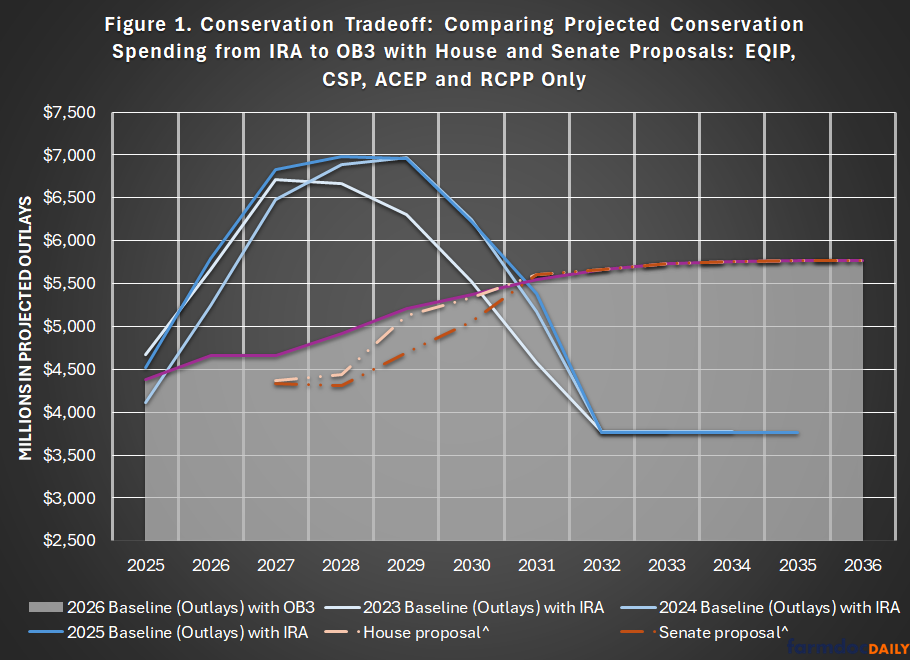
The difference between the blue lines and the purple line represents a tradeoff, funds that are shuffled from the near-term and spread across a longer-term in the baseline. Specifically, the conservation spending in the next few fiscal years falls from a maximum projection of $7 billion in FY2028 and FY2029 to below $5 billion in those years. Each of the further reductions in the near-term from the House and Senate unfinished Farm Bills would represent not a shuffle but an actual reduction; while the baseline is restored in FY2031 and beyond, it is not increased, and the near-term reductions are not replaced. Those reductions, ranging from $1 billion to $1.9 billion for the next four fiscal years represent actual cuts to conservation assistance. Each represents funding that will not be available to farmers if enacted.
It is from Figure 1 that we return to the conservation bardo discussed previously, and with a closer look at EQIP specifically (farmdoc daily, September 28, 2023). In the most recent three fiscal years (FY2023-FY2025), which includes the IRA funding increases, EQIP averaged 36,284 contracts obligating an average of $1.92 billion, or about $53,000 per contract. Between the highest projected outlays with IRA funding ($3.041 billion) and the reduced outlays under the Reconciliation Farm Bill ($2.147 billion) for FY2026, farmers lost a total of $894 million in EQIP funding last fiscal year. At $53,000 per contract, that equals almost 17,000 contracts that would have been approved but not funded—the conservation bardo—by EQIP in FY2026. That is a substantial consequence of the baseline shuffle. And if that same average is applied to the remaining reductions in funding through FY2030, the contracts that are likely left in the conservation bardo look like the estimates in the first line Table 1. If the House reductions to EQIP are enacted, the estimated number of additional unfunded, valid contracts is in line 2 and if the Senate reductions are enacted, the valid contracts not funded are estimated in line 3.
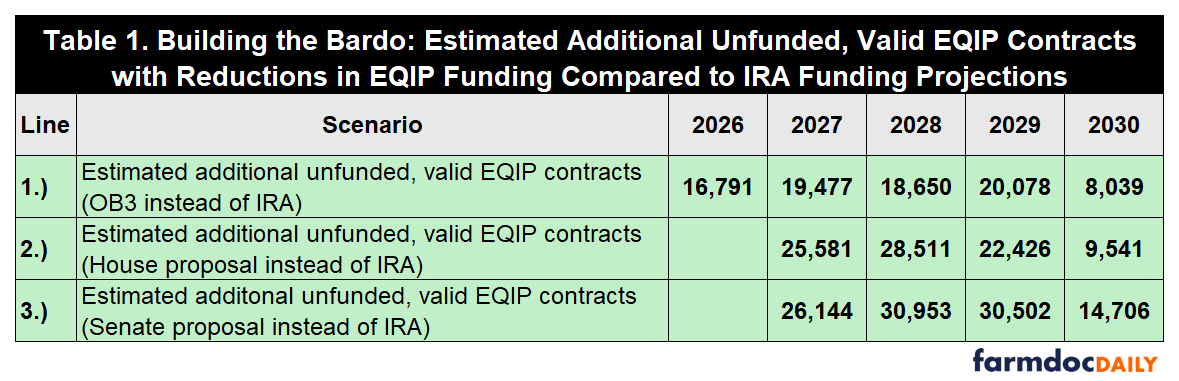
Table 1 represents the estimated impacts or costs of the tradeoff in the baseline shuffle in terms of contracts that presumably would have been funded but for the reductions in funding. Each lost contract represents a farmer seeking assistance to implement conservation on the farm. To the extent that each unfunded, valid contract results in a farmer not implementing conservation, there is a much bigger loss to society in terms of the benefits those contacts and conservation practices could have provided. Conservation policies are unique among the major federal assistance programs for farmers because the programs do more than compensate some farmers when prices are considered too low, or if there were losses due to natural disasters. Conservation assists the farmer or the landowner with some action on the farm that addresses concerns about natural resources, such as soil erosion or nutrient losses to public waterways. Conservation policy comes with specific responsibilities and actions—the taxpayer-provided assistance includes a form of public works requirements that are not matched in farm program payments, nor in crop insurance.
The baseline shuffle does much more damage to conservation policies and to farmers than anyone seems to realize when they are doing the shuffling. An unfunded but valid contract represents time a farmer spent working with NRCS to apply for the assistance, time which becomes wasted when the approved application does not result in a contract with funding. This drives up frustration by farmers with NRCS and with conservation policy, driving down their support for the policies.
Concluding Thoughts
Supporters of conservation policy are justified in thinking that they must play by a different set of rules, especially when it comes to program spending and budget matters. First and foremost, conservation programs are explicitly capped or limited by Congress, unlike farm program payments or crop insurance which have no budgetary limits. From the IRA, to OB3 and the unfinished Farm Bills, conservation’s are also the only policies that appear to be required to abide by standard budget rules—new policy must cannibalize existing conservation policy through internal spending offsets. In OB3, Congress also broke the cardinal political rule of the Farm Bill coalition, cutting food assistance to offset increases to farm program payments and crop insurance, but conservation had to cut its own funding to build long-term (or outyear) baseline.
Unfortunately, this is not a new phenomenon in farm policy. Conservation policies have always suffered compared to farm assistance, treated as secondary priorities at best, or sabotaged and sacrificed at worst. This is a through line from the Soil Conservation and Domestic Allotment Act of 1936 to the Soil Bank in 1956, into the modern era of policy with the Conservation Security/Stewardship Program, and now the IRA to OB3 baseline shuffle. If nothing else, this conflicts with many of the ideals for agriculture policy. In 2009, for example, Wes Jackson and Wendell Berry wrote that the U.S. needed “a national agricultural policy that is based upon ecological principles” and called for a “50-year farm bill that addresses forthrightly the problems of soil loss and degradation, toxic pollution, fossil-fuel dependency and the destruction of rural communities” (Jackson and Berry, January 4, 2009). America lost the unique and profound voice of Wendell Berry in August of this year (McFadden, August 31, 2026; Italie, August 31, 2026; Kingsolver, September 4, 2026). He died at a time when national agricultural policy is falling further and further from the ecological principles for which he eloquently advocated.
Fifty years can seem like forever in policy. Consider that 50 years ago President Gerald Ford used a pocket veto to reject a modest conservation bill titled the “Land and Water Resources Conservation Act” because he concluded it would create a “large and costly bureaucracy” (pocket veto message to Congress, dated October 26, 1976, inserted into the Congressional Record, October 1, 1976, at 35081; United States Senate, “Vetoes by President Gerald R. Ford”; The American Presidency Project, October 19, 1976; 94 S.2081). At the time, American farmers were drastically increasing the acres of land used to produce crops, part of the production incentives of the 1973 Farm Bill and the push by then-Secretary of Agriculture Earl Butz to increase production for export markets. As Iowa experienced some of its worst soil erosion in decades, then-Senator Dick Clark, along with Congressmen Tom Harkin and Berkley Bedell held a field hearing on soil conservation. Senator Clark opened the hearing by noting that soil erosion problems had “come to be taken for granted over the years” (U.S. Senate Committee on Agriculture and Forestry Hearing, July 6, 1976, at 1). He was particularly concerned with efforts to cut the meager conservation assistance available at the time, adding that “the programs responsible for protecting these resources are being taxed beyond their limit right now,” and that “conservation needs are greatly exceeding program capacity” (Id., at 2).
The concerns raised in the hearing would not be heeded for another decade. The heedlessness of the 1970s culminated in the twin crises of the 1980s, but would produce the landmark 1985 Farm Bill in which Congress created the modern Conservation Reserve Program and conservation compliance provisions (Coppess, 2024). There are warnings in this history that should resonate with matters like the conservation baseline shuffle and the bardo it builds, where all the cuts are in the near-term and any upside is pushed far into the future. This budget gimmickry matters only to those pretending that “restoring” long-term baseline funding projections means anything while ignoring, yet again, that it does little good for the needs of today. This argument depends on CBO projections of an unknowable future. It presumes that it is possible to make up the lost conservation investments, ignoring the fundamental reality that assistance a decade or more into that unknowable future does little good for farmers today, especially with the high costs and other challenges resulting from a chaotic Presidency. It also ignores something more concerning: for those funds to ever be used to help farmers deliver public benefits, every future Congress will have to keep the spending promises and not cut funding. It is therefore more concerning to recognize that the 119th Congress—the Congress that allegedly made those funding promises just last year—is already backtracking and proposing to cut conservation further. We can learn much from history, but only if we choose to.
References
Congressional Budget Office. “Estimated Budgetary Effects of Public Law 119-21, to Provide for Reconciliation Pursuant to Title II of H. Con. Res. 14, Relative to CBO’s January 2025 Baseline.” July 21, 2025. https://www.cbo.gov/publication/61570.
Coppess, Jonathan. Between Soil and Society: Legislative History and Political Development of Farm Bill Conservation Policy (Lincoln: University of Nebraska Press, 2024). https://www.nebraskapress.unl.edu/nebraska/9781496225146/.
Coppess, J. "Farm Bill 2023: NRCS Backlogs and the Conservation Bardo." farmdoc daily (13):177, Department of Agricultural and Consumer Economics, University of Illinois at Urbana-Champaign, September 28, 2023.
Hanrahan, Ryan. “ARC & PLC Payments to Hit Record $13.8 Billion for 2025.” Farm Policy News, University of Illinois Urbana-Champaign. October 19, 2026. https://farmpolicynews.illinois.edu/2026/10/arc-plc-payments-hit-record-13-8-billion-for-2025/.
Hanrahan, Ryan. “USDA to Provide $8 Billion in Diesel Fuel Aid to Farmers.” Farm Policy News, University of Illinois Urbana-Champaign. October 20, 2026. https://farmpolicynews.illinois.edu/2026/10/usda-to-provide-8-billion-in-diesel-fuel-aid-to-farmers/.
Hanrahan, Ryan. “Diesel Aid Could Push 2026 Government Payments to Farmers to Record $55 Billion.” Farm Policy News, University of Illinois Urbana-Champaign. October 21, 2026. https://farmpolicynews.illinois.edu/2026/10/diesel-aid-could-push-2026-government-payments-to-farmers-to-record-55-billion/.
Italie, Hillel. “Wendell Berry, Kentucky-born author who advocated a simpler life, has died at 92.” APNews.com. August 31, 2026. https://apnews.com/article/wendell-berry-obit-d20b66bb8a1d298153f760f30662a4f7.
Jackson, Wes and Wendell Berry. “A 50-Year Farm Bill.” The New York Times. January 4, 2009. https://www.nytimes.com/2009/01/05/opinion/05berry.html.
Kingsolver, Barbara. “Wendell Berry’s Message to Readers: All We Need Is Here.” The New York Times. September 4, 2026. https://www.nytimes.com/2026/09/04/books/review/wendell-berry-appreciation.html.
McFadden, Robert D. “Wendell Berry, Writer Who Extolled America’s Agrarian Past, Dies at 92.” The New York Times. August 31, 2026. https://www.nytimes.com/2026/08/31/us/wendell-berry-dead.html.
Paulson, N., H. Monaco, G. Schnitkey and C. Zulauf. "2025 Final ARC/PLC Payments." farmdoc daily (16):185, Department of Agricultural and Consumer Economics, University of Illinois at Urbana-Champaign, October 13, 2026.
Rosch, Stephanie. “Farm Bill Primer: MAL and LDP Farm Support Programs.” Congressional Research Service. IF12140. October 20, 2026. https://www.congress.gov/crs-product/IF12140.
Stubbs, Megan. “The Commodity Credit Corporation (CCC).” Congressional Research Service. R44606. May 15, 2025. https://www.congress.gov/crs-product/R44606.
The American Presidency Project. University of California Santa Barbara. “Memorandum of Disapproval of the Agricultural Resources Conservation Bill.” Gerald R. Ford. October 19, 1976. https://www.presidency.ucsb.edu/documents/memorandum-disapproval-the-agricultural-resources-conservation-bill.
U.S. Department of Agriculture. “USDA Announces Record Payments of $13.8 Billion for 2025 Crop Year Revenue and Price Safety Net Programs.” Press Release. October 7, 2026. https://www.usda.gov/about-usda/news/press-releases/2026/10/07/usda-announces-record-payments-138-billion-2025-crop-year-revenue-and-price-safety-net-programs.
U.S. Senate, Subcommittee on Environment, Soil Conservation, and Forestry, of the Committee on Agriculture and Forestry. “Federal Soil Conservation Cost-Sharing Program.” Hearings. (94th Congress, 2d Session; July 6, 1976; Council Bluffs and Moville, Iowa).
Disclaimer: We request all readers, electronic media and others follow our citation guidelines when re-posting articles from farmdoc daily. Guidelines are available here. The farmdoc daily website falls under University of Illinois copyright and intellectual property rights. For a detailed statement, please see the University of Illinois Copyright Information and Policies here.