








Trying to Reason with A Midterm Election Earthquake
Well, the American electorate certainly sent a message in the midterm elections on Tuesday. As of this writing, Democrats have won a substantial majority in the House of Representatives, 252 seats to 147, with 36 election results that remain outstanding. Democrats also won a majority of seats in the U.S. Senate. The current majority stands at 54 to 44 but awaits final vote tallies for close results in Mississippi and Alaska that could push the majority to 56 votes. This article provides some initial thoughts on this electoral outcome—an attempt to reason with a political earthquake—as well possible implications.
Historical or Not? Situating the 2026 Midterms
Democrats are projected to win majorities in Congress that nearly match those of 2008, which delivered then-Senator Barack Obama (D-IL) to the White House and increased the party’s margins in Congress from the 2006 midterm (second term of the George W. Bush Presidency) to 257-178 in the House and 57 to 41 in the Senate. Table 1 situates the 2026 midterm election in additional history, comparing it to recent midterm elections and other notable ones back to the end of World War II (compiled from: Winling et al., 2025). In 1946, Republicans regained control of Congress for the first time since 1930, during the Great Depression. It was the first midterm for President Harry Truman, who had become president after Franklin Roosevelt died in office in April 1945. FDR had won a fourth consecutive presidential election in 1944 with Truman as his Vice President.
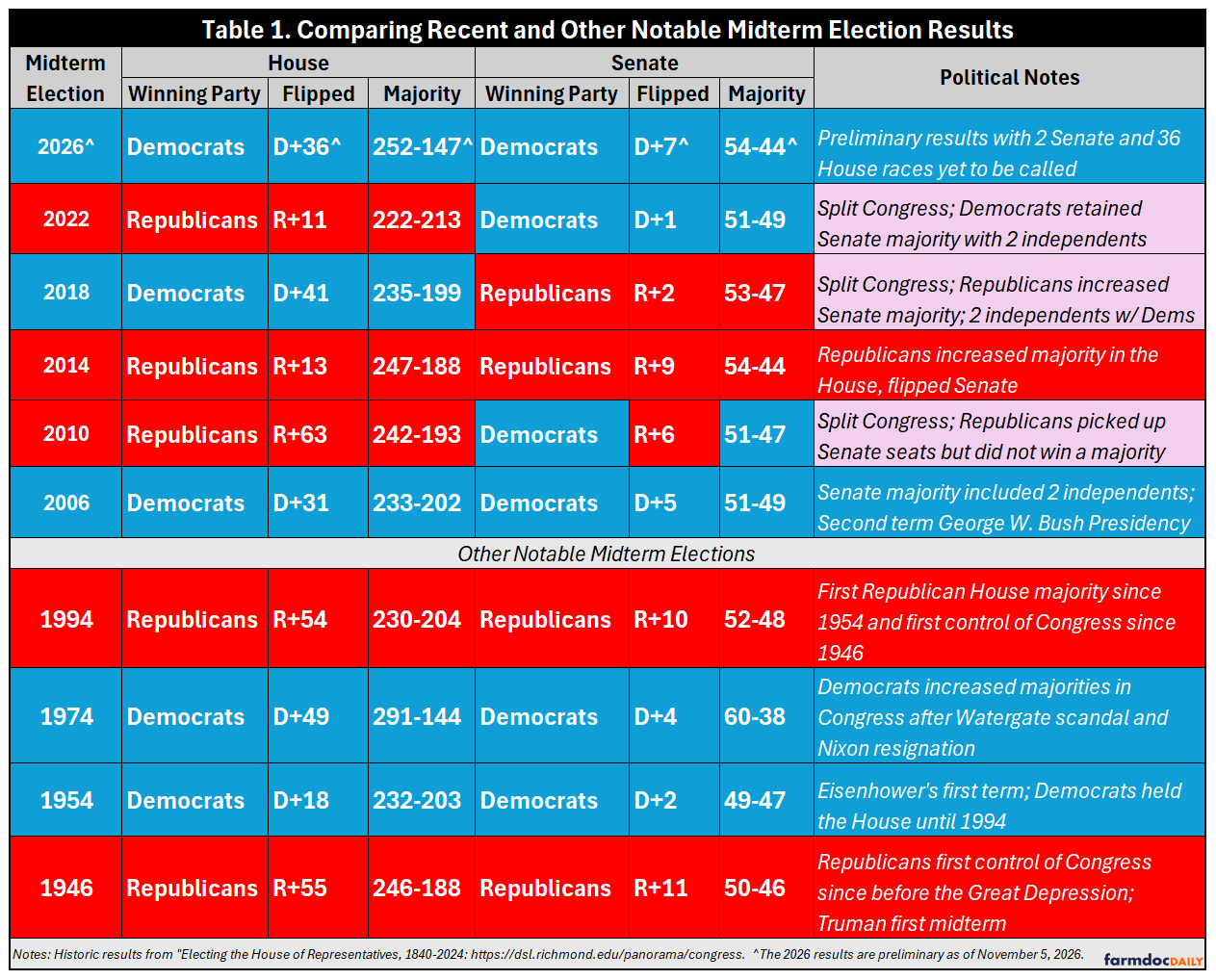
The numbers tell only part of the story, however, particularly for the Senate. Democrats didn’t just win seats but won them in states that have generally been considered out of reach. These are states in the South (North Carolina, South Carolina, and Texas) as well as Midwestern rural states (Iowa, Kansas, and Ohio) that have normally been considered reliably Republican. Each represents differences in electorate and candidate characteristics, but they all add up to a substantial majority and a historic win.
Next Up? A Lame Duck Session of Congress
The 120th Congress will be sworn into office and officially begin on January 3, 2027, which leaves the 119th Congress in place for the rest of this calendar year. The legislative session between the election and the seating of a new Congress is known as the lame duck session (U.S. Senate). It is generally a time for Congress to complete any unfinished business. It is also a time for decisions on leadership positions and committees, as well as crafting legislative priorities, strategy, and planning.
The highest priority is presumably funding the federal government, either through an omnibus appropriations bill or another continuing resolution. The current continuing resolution expires on December 11, 2026 (P.L. 119-103). If this matter is not resolved, the federal government would shut down. Congress also must enact the annual National Defense Authorization Act and possibly consider a supplemental appropriations bill for the war in Iran. President Trump has requested $70 billion in additional funding for the war. Note that Congress is expected to be in session for fewer than 25 days, and there appear to be many priorities, much of which were pre-election aspirations that are unlikely now (Tully-McManus, November 4, 2026; CFRB, November 3, 2026). On those lists, but falling to the last point, is the unfinished Farm Bill. What was uncertain and unlikely before, should be considered very much in doubt now.
The Senate has not taken up the bill reported by the Senate Committee on Agriculture, Nutrition, and Forestry in September (Farm Policy News, September 17, 2026; September 25, 2026; October 2, 2026). Expecting it to do so in a lame duck session seems unreasonable in the extreme. For comparison, the 2018 Farm Bill was enacted by the lame duck 115th Congress after Democrats won back the House, and signed into law on December 20, 2018 (P.L. 115-334). That Farm Bill was in a substantially different situation, however, because both the House and Senate had passed their versions of the Farm Bill—the Senate with a large, bipartisan majority—and were working out differences in a conference committee going into the election; the results for the House likely motivated a deal (Coppess, 2018). Moreover, Democrats had won the House, but Republicans increased their Senate majority. This time around, there is too little time to finish a bill that hasn’t passed the Senate and there likely is little political will after voters so resoundingly rejected the 119th Congress.
The other option is for an agreement to be worked out to attach a compromise version of the unfinished Farm Bill to the continuing resolution or omnibus appropriations legislation, or to any other legislation that gets considered in the short work period before the end of the year. This is also a difficult path. To attach the bill, there would have to be agreement across-the-board with legislative text free of any controversial provisions. Given the continuing controversies generated by the Reconciliation Farm Bill in last year’s One Big Beautiful Bill Act—especially the troubling and problematic cuts to the Supplemental Nutrition Assistance Program (SNAP)—getting agreement that avoids controversy seems highly unlikely as well. The 119th Congress rushed through changes to food assistance that have the potential to be destructive to people’s lives, state budgets, and SNAP as a federal program. The only upside is that some of the most damaging provisions do not begin operation until October 2027, leaving some (but not much) time for the new Congress (Aussenberg and Falk, November 4, 2026; CBPP, October 23, 2026; CBPP, October 22, 2026; Bauer and Schanzenbach, August 25, 2026).
The mostly likely outcome given those realities is that Congress simply extends the provisions that have expired, likely as part of a continuing appropriations resolution, and leaves town. This would kick the unfinished Farm Bill to the new Congress in the New Year. Admittedly, this is nowhere near an ideal outcome, but it may be the least bad. This might be the final bit of evidence that last year’s reconciliation stunt killed the Farm Bill coalition as we have known it for over fifty years (Coppess, 2026). No temporary fix or half-hearted compromise will change that now. An extension at least aligns with a simple principle for this lame duck session: this Congress should do no further harm.
Concluding Thoughts and Sharpened Points
Much political punditry fixates on the election results as a referendum on Donald Trump’s Presidency—and they are, from high costs to the wars and tariffs, as well as the corruption and chaos of his return to the office. But the results should also be understood as a rejection of the 119th Congress; arguably, this is the more important takeaway (Baker, November 4, 2026; Hulse, November 4, 2026). It also has the benefit of being more fundamental.
Concentration of political power is extraordinarily dangerous and destructive, a kind of political disease with the potential to kill a government and society (farmdoc daily, November 11, 2022). Therefore, the Constitution divides the immense powers of the federal government into three branches with different designs and functions. When it functions as intended, the design is expected to balance political power (farmdoc daily, January 26, 2023). Each branch’s ability to check the others should help maintain that critical balance.
In the Constitution, Congress is the first branch of the federal government created in Article I; ratification of that document vested Congress with the legislative power, the power to make law. This includes spending and taxes, declaring war, regulating commerce and more. Most of the Executive powers, by comparison, are derivative—to faithfully execute the laws enacted. Congress was never intended to play second fiddle to the President, nor be a rubber-stamp. Congress was expected to compete with the executive branch, not subordinate itself to the President. Doing so may be the primary political sin of the 119th Congress, and American voters rendered a clear verdict.
The rejection of this Congress provides a mandate for substantive changes, to be operationalized via the Article I powers. The 120th Congress will need to legislate, appropriate, investigate, and provide oversight—it will need to exercise its powers in competition with those of the executive and judicial branches. There is much to do and many things to fix; there are needs for structural changes—voting rights, gerrymandering, money in politics (campaign contributions and lobbying dollars), procedural rules, and more—as well as demands for policy changes—fixing SNAP and cuts to healthcare, plus addressing high costs and inflationary problems. The work ahead appears daunting.
In trying to reason with this all, consider once again how James Madison explained his concern that “the mild voice of reason, pleading the cause of an enlarged and permanent interest, is but too often drowned, before public bodies as well as individuals, by the clamors of an impatient avidity for immediate and immoderate gain” (The Federalist, No. 42). Madison’s concern appears incomplete in our current troubles. Time and again, outcomes favor corporate interests and other artificial entities over humans. Billions in campaign dollars attempt to keep the balance in their favor. Americans are justified in concluding that their voices and interests have been drowned out in service of immoderate gains—pain and frustration doesn’t get heard when corporate lobbyists have the last word. This is clear in everything from high food costs to data centers and the threats from Artificial Intelligence; it is clear in soaring inequalities in American society highlighted by this obscene spending on campaigns and political influence.
If such matters seem abstract, return to last year’s Reconciliation Farm Bill for a case study. The problems garnering the most attention were the cuts to SNAP and food assistance. Congress added paperwork burdens to struggling families and individuals, a cruel method for making it too difficult and time-consuming to apply for benefits, either pushing people out of the program or so frustrating them that they give up on applying. Congress did not stop there, however. The same legislation greatly increased federal payments to a narrow faction of farmers; most clearly, it also explicitly wrote into law favoritism for legal fictional entities over human farmers (farmdoc daily, September 4, 2025; July 17, 2025). Congress chose to allow the largest, most sophisticated farm operations to form as many pass-through entities as possible for the sole purpose of consuming more federal payments with each shell entity.
Farmers are struggling in this economy and many of them are genuinely hurting. But farm policy has been narrowed to an absurd system of simply issuing more and more federal payments. These payments mostly pass through the farmer’s hands into the bank accounts of landlords and massive, multinational corporations, keeping costs high and fueling demand for more payments. But the payments consistently provide too much to too few, and most often those who need it the least, while hurting too many, often those who need it the most, and damaging those farmers who represent the future. This is a recipe for self-destruction, but it doesn’t happen by accident. It happens when Congress seems to only hear the clamors of factional interests, the lobbyists and consultants operating as hallway farmers roaming the Hill and USDA. For them, the harvest is always more federal payments, no penny of which should ever be left on the taxpayer’s table if a shell entity can be created to capture it. It would only make sense to such hallway farmers to build up bureaucratic barriers between food and people (including kids) who need help paying for it, using the savings to cover the costs of bigger payments and prioritizing legal fictional entities with bureaucratic loopholes for the collection of even more federal payments.
When the government is out of balance it unbalances the entire society. On Tuesday, the humans responded in a powerful, but reasonable, voice. Importantly, that voice was collectively expressed by votes in an election rather than unrest in the streets. This midterm earthquake shakes the system. The electoral mandate, however, is only an opportunity, it is not self-executing. Political power does not work that way. The overarching question for the incoming Congress is whether the voices of the election will be heard and listened to. Will their interests be addressed, or will they be drowned once again by the same factional interests and narrow demands as before?
References
Aussenberg, Randy Alison and Gene Falk. “Supplemental Nutrition Assistance Program (SNAP): A Primer on Eligibility and Benefits.” Congressional Research Service, R42505. November 4, 2026. https://www.congress.gov/crs-product/R42505.
Baker, Peter. “Angry Voters Usher in Beginning of the End to the Trump Era.” The New York Times. November 4, 2026. https://www.nytimes.com/2026/11/04/us/politics/midterm-election-trump-voters.html.
Bauer, Lauren and Dian Whitmore Schanzebach. “The SNAP state cost-shift policy leaves the program’s existence to chance.” Brookings. August 25, 2026. https://www.brookings.edu/articles/the-snap-state-cost-shift-policy-leaves-the-programs-existence-to-chance/.
Center for Budget and Policy Priorities. “SNAP Tracker: People Are Losing Food Assistance as the Harmful 2025 Republican Reconciliation Law Is Implemented.” October 23, 2026. https://www.cbpp.org/research/food-assistance/snap-tracker-people-are-losing-food-assistance-as-the-harmful-2025.
Center for Budget and Policy Priorities. “Congress Must Delay SNAP Cost Shift to Stanch SNAP Participation Losses, Which Far Exceed CBO’s Estimates.” October 22, 2026. https://www.cbpp.org/blog/congress-must-delay-snap-cost-shift-to-stanch-snap-participation-losses-which-far-exceed-cbos.
Committee for a Responsible Federal Budget. “Lame Duck Session Shouldn’t Be an Excuse to Borrow More.” November 3, 2026. https://www.crfb.org/blogs/lame-duck-session-shouldnt-be-excuse-borrow-more.
Coppess, Jonathan. “More Farm in the Farm Bill: A Formula for Understanding the Demise of a Legislative Coalition.” Drake J. Agric. L. 31 (2026): 1. https://aglawjournal.wp.drake.edu/wp-content/uploads/sites/66/2026/09/a.-Coppess-Final.pdf.
Coppess, Jonathan W. "High cotton and the low road: An unraveling farm bill coalition and its implications." Drake J. Agric. L. 23 (2018): 353. https://aglawjournal.wp.drake.edu/wp-content/uploads/sites/66/2019/11/Coppess-Macro-Reprinted.pdf.
Coppess, J. "The Farm Bill in Reconciliation: Loophole as Rosetta Stone; Review and Comment." farmdoc daily (15):130, Department of Agricultural and Consumer Economics, University of Illinois at Urbana-Champaign, July 17, 2025.
Coppess, J. "The Reconciliation Farm Bill: Top Five Most Problematic Changes to Farm Policy, #1." farmdoc daily (15):161, Department of Agricultural and Consumer Economics, University of Illinois at Urbana-Champaign, September 4, 2025.
Coppess, J. "Considering Congress, Part 2: The Mortal Disease of Self-Government." farmdoc daily (12):170, Department of Agricultural and Consumer Economics, University of Illinois at Urbana-Champaign, November 11, 2022.
Coppess, J. "Considering Congress, Part 5: An Initial Critique of the Design." farmdoc daily (13):15, Department of Agricultural and Consumer Economics, University of Illinois at Urbana-Champaign, January 26, 2023.
Hanrahan, Ryan. “Ag Committee Advances Farm Bill 2.0 to Uncertain Future in Full Senate.” Farm Policy News. September 17, 2026. https://farmpolicynews.illinois.edu/2026/09/farm-bill-2-0-advances-to-uncertain-future-in-full-senate/.
Hanrahan, Ryan. “Farm Bill Action Unlikely in Senate Until After Midterm Elections.” Farm Policy News. September 25, 2026. https://farmpolicynews.illinois.edu/2026/09/farm-bill-action-unlikely-in-senate-until-after-midterm-elections/.
Hanrahan, Ryan. “Farm Bill Expires Again as Lawmakers Continue Negotiations.” Farm Policy News. October 2, 2026. https://farmpolicynews.illinois.edu/2026/10/farm-bill-expires-again-as-lawmakers-continue-negotiations/.
Hulse, Carl. “With Democrats’ Sweep, Congress Is Set to Reassert Power to Check Trump.” The New York Times. November 4, 2026. https://www.nytimes.com/2026/11/04/us/politics/democrats-house-senate-congress-trump.html.
Madison, James. “The Powers Conferred by the Constitution Further Considered.” The Federalist Papers, No. 42. January 22, 1788. https://guides.loc.gov/federalist-papers/text-41-50#s-lg-box-wrapper-25493406.
Tully-McManus. “Republicans’ last chance to cement their legacy in Trump’s Washington.” Politico.com. November 4, 2026. https://www.politico.com/news/2026/11/04/republicans-democrats-lame-duck-agenda-01149079.
Winling, LaDale, Robert K. Nelson, et al. Electing the House of Representatives, 1940–2024. In American Panorama: An Atlas of United States History, edited by Robert K. Nelson. Richmond: Digital Scholarship Lab, University of Richmond, 2025. https://dsl.richmond.edu/panorama/congress/.
Disclaimer: We request all readers, electronic media and others follow our citation guidelines when re-posting articles from farmdoc daily. Guidelines are available here. The farmdoc daily website falls under University of Illinois copyright and intellectual property rights. For a detailed statement, please see the University of Illinois Copyright Information and Policies here.