








The Split Personality of 2026 US Corn Yield Estimates
This crop year, market observers have a heightened cynicism about the veracity of US national average corn yield estimates after data processing errors led to the release of an erroneous estimate from the National Agricultural Statistics Service (NASS) in the September Crop Production report (Blythe, 2026). While the error was later corrected, the environment of yield estimate skepticism has been reinforced by a sequence of NASS yield estimates that have lowered, raised, and then lowered again the national average yield. The most recent of these adjustments came earlier this week in the November Crop Production report. The split personality of these estimates, alternately bullish and bearish for corn prices, runs counter to the tendency for USDA crop production forecasts to be smoothed across the forecasting cycle (Irwin and Good, 2024).
This article puts this variation in the estimated US national corn yield in the context of past changes and considers what these changes might mean for both the final NASS yield estimate to be released in early January and for corn prices. The back-and-forth in estimated yield has clearly moved prices, especially the October report, which raised the yield estimate by nearly three bushels per acre and coincided with a 20 cent per bushel drop in price on report day. During the growing season, this kind of yield uncertainty tends to be positive for price (Janzen, 2021). To the extent there is greater remaining yield uncertainty in 2026 than is typical, the price impact may be minimized due to its timing.
US yield uncertainty alone cannot sustain high prices. Other market forces, especially US corn export use and South American production may already be responding to the ambiguity around US corn supply in ways that are bearish for prices. This presents both an opportunity and a threat for farms with a significant share of corn production to sell after January 1, a typical situation for grain farms in the US Corn Belt (Janzen, 2023).
Changes in the USDA Corn Yield Estimate
Corn yield estimates used in USDA market outlook information such as the World Agricultural Supply and Demand Estimates (WASDE) begin with a trendline yield estimate (an extrapolation of long-run trends in yield) released in May. USDA adjusts the yield estimate based on observed conditions in report releases through the growing season, typically in the monthly Crop Production reports released from August to November, plus a final estimate released in January.
Figure 1 plots the cumulative adjustments to the US corn yield estimate, highlighting the current 2026 crop year but showing time paths for previous crop years since 2014. In this period, the range of estimated corn yield updates has been within plus or minus ten bushels per acre of the initial trendline yield estimate. The figure shows this year’s estimates are well within the historic range. Estimated yield has been as much as nearly five bushels per acre below the initial 183 bushel per acre yield estimate, but remains relatively close to the initial estimate.
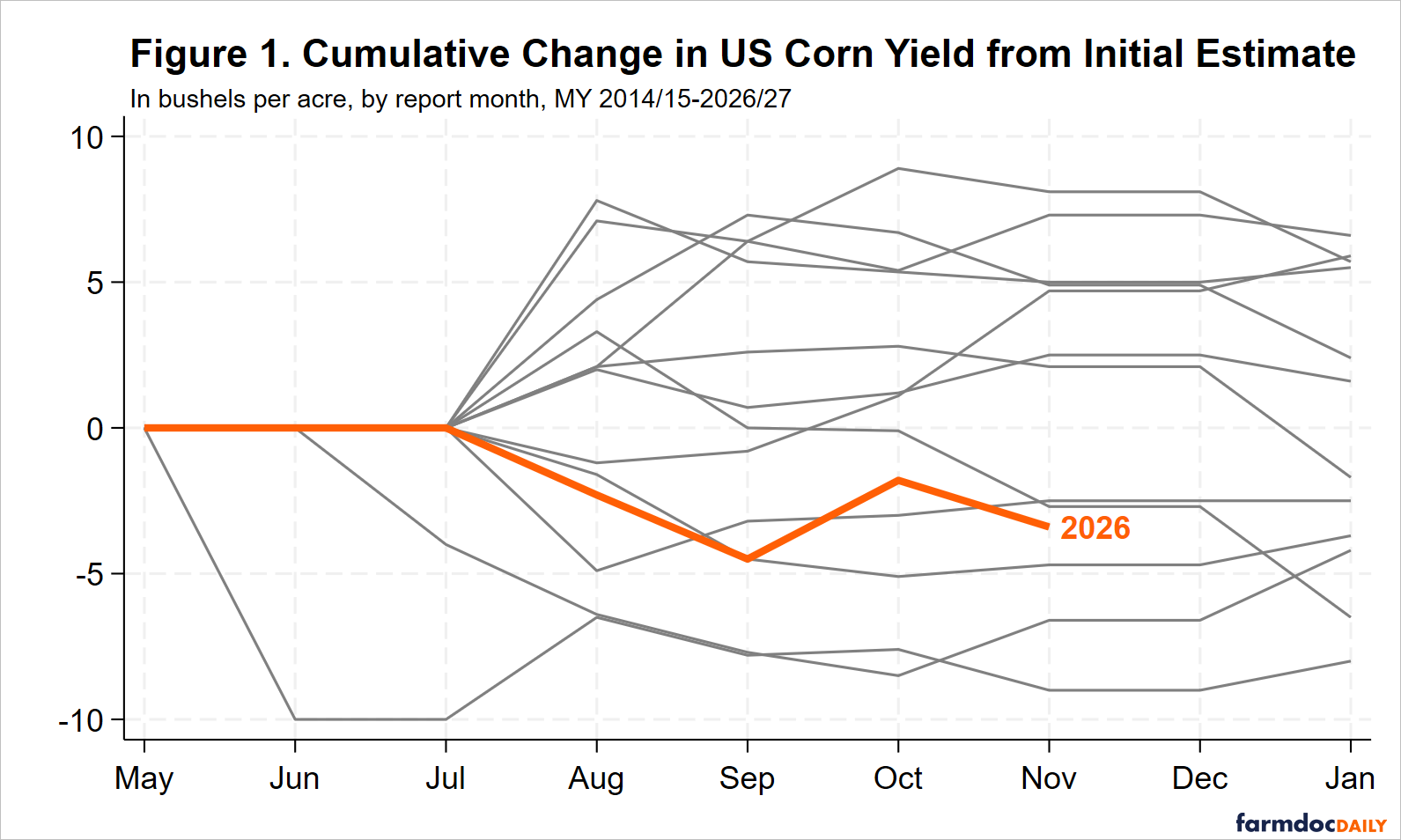
What is somewhat unique about the time path for the 2026 corn yield estimate is the recent sequence of negative and positive revisions. In many years, adjustments are correlated with previous adjustments, following the well-documented tendency of smoothing over time in USDA crop production forecasts (Irwin and Good, 2024). Yield forecast changes have not been smoothed this year. While the figure shows this is not the only year where forecast revisions oscillated in sign, such reversals are uncommon and the 2026 swings are among the larger ones in the sample for this time of year.
What Next for Corn Yield Estimates?
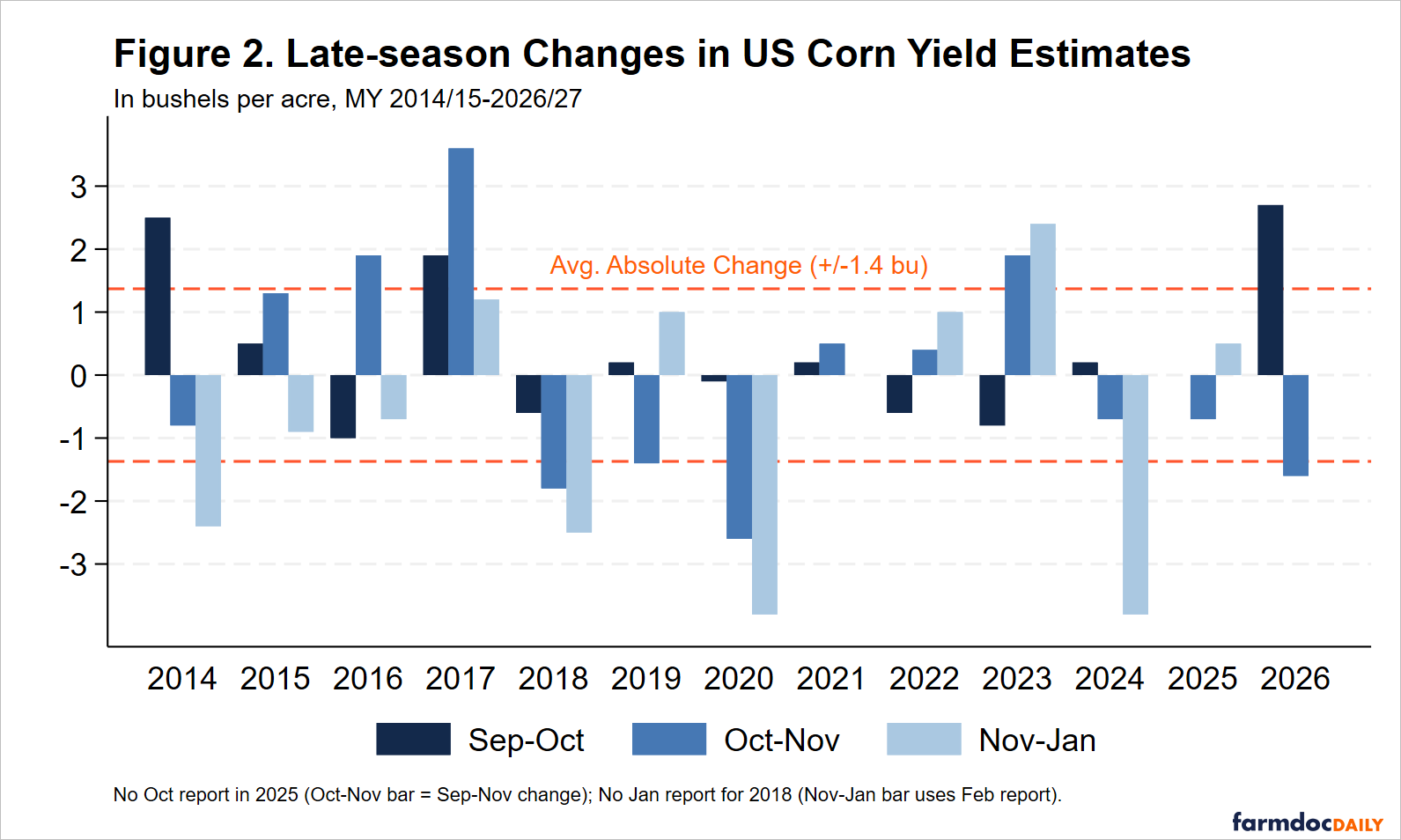
The back-and-forth corn yield revisions in October and November of 2026 are relatively rare and somewhat larger than typical revisions at this time of year. Figure 2 focuses on these late-season yield estimate changes. The average absolute month-to-month change (the magnitude of the revision regardless of direction) across the final three month-over-month forecast revisions is about 1.4 bushels per acre. Observed changes in 2026 have been bigger than this, consistent with the idea that there is perhaps more uncertainty about the national average yield this year than is typical.
Going forward, the final NASS corn yield estimate to be released on the January 12, 2027 report day will be closely watched. Figure 2 indicates no clear relationship between earlier revisions and the yield adjustment made in NASS’s January Crop Production estimate. Some might point to the large negative revisions in 2014, 2018, 2020, and 2024 as a reason to be skeptical of the current estimate for 2026 and optimistic about price prospects headed into the new calendar year. However, this small sample is much closer to anecdote than data. There is no statistically significant tendency in November-to-January yield revisions, though November-to-January changes tend to be slightly larger in magnitude than those in earlier months.
Marketing Implications
The combination of greater-than-normal yield uncertainty in 2026 and greater-than-average yield changes for the November-to-January NASS revision suggests the forthcoming January report day will be an important one for the corn market. Given the apparent lack of smoothing in this year’s corn production forecasts, the NASS estimate may be harder to anticipate. For price, one key takeaway from the historical time paths shown in Figure 1 is that the current yield estimate is below trend, but not far below it relative to the historic range of revisions. Even if USDA were to revise yields lower in January, price upside is limited by this starting point.
The corn market is not acting as if supplies are especially tight. Demand for US corn is not especially strong and there are no signs yet of South American supply disruption that would present a fundamental case for higher prices at this point in the marketing year. Put simply, the market has less room to build in a risk premium now than it typically does in June, July, and August. Farmers with corn to sell face an asymmetric bet heading into January: a lower final yield offers some upside, but that upside is capped by the relatively near-to-trend starting point and soft demand, while a higher final yield could push prices lower.
References
Blythe, B. “USDA Errors Raise Credibility Concerns Ahead of November Crop Reports.” Farm Futures, November 5, 2026. https://www.farmprogress.com/corn/usda-errors-raise-credibility-concerns-ahead-of-november-crop-reports
Irwin, S. and D. Good. "Revisiting Big Corn and Soybean Crops Get Bigger." farmdoc daily (14):180, October 3, 2024.
Janzen, J. "The Weather Risk Premium in New-Crop Corn Futures Prices." farmdoc daily (11):88, June 2, 2021.
Janzen, J. "Post-harvest Grain Marketing: Store and Ignore Versus Market Responsive Farms." farmdoc daily (13):228, December 15, 2023.
Disclaimer: We request all readers, electronic media and others follow our citation guidelines when re-posting articles from farmdoc daily. Guidelines are available here. The farmdoc daily website falls under University of Illinois copyright and intellectual property rights. For a detailed statement, please see the University of Illinois Copyright Information and Policies here.