








Dietary Guidelines for Americans: What They Are and What Consumers Want Them to Be
The Dietary Guidelines for Americans (DGA) serve as a guide on what to eat and drink to meet nutrient needs, promote health, and prevent disease. The guidelines inform Federal activities such as updating nutrition standards for the WIC program and developing nutrition education materials (DGA, n.d.). They are also used in the developing policies and practices to promote public health by state and local governments and other organizations (DGA, n.d.).
Every five years, the law requires that the guidelines are released by the US Departments of Agriculture (USDA) and Health and Human Services (HHS), based on recommendations provided by a scientific advisory committee, which is made up of experts in nutrition and medicine. The guidelines are required to be based on the most current body of nutrition science (DGA, n.d.).
The next edition (for 2025-2030) of the DGA is scheduled to be released in 2025 but has been notably delayed and is now expected in early 2026 (Callahan, 2025). The scientific report from the Dietary Guidelines Advisory Committee was published in 2024, but there are expectations that the final DGA will diverge from the advisory committee’s recommendations based on priorities of the MAHA movement (farmdoc daily, September 8). For example, some media outlets have reported that the dietary guidelines will stress the importance of eating protein and reduce emphasis on limiting saturated fats (Callahan, 2025; Choi, 2025; Green, 2025; Food Fix, 2025). Federal agencies requested input on the DGA and have received several thousand written comments and 79 oral comments.
In this post, we use data from Wave 15 (November 2025) of the Gardner Food and Agricultural Policy Survey (GFAPS) to examine how consumers think about the DGA. Specifically, we ask consumers to what extent they agree with some of the key recommendations from the 2020-2025 DGA and who they believe is and should be involved in developing the guidelines.
Methods
The GFAPS is an online survey that is fielded on a quarterly basis with approximately 1,000 US consumers. Quota sampling is used to match the US population in terms of gender, age, income, and geographic region.
In the November 2025 (wave 15) edition of GFAPS, we included several questions about the DGA. We first provided all respondents with a brief background on what the DGA is and how it is used. Then, we asked respondents about their familiarity with the DGA, where 1=not at all familiar and 7=very familiar. Next, we asked about which group(s) respondents thought are currently influential in developing the DGA. Response options included: medical experts; nutrition experts; US Department of Agriculture; US Department of Health and Human Services; the general public; elected officials; farmers; food and beverage manufacturers; and other. The order of groups was randomized to prevent ordering effects, and respondents could select multiple groups as being influential. As a follow up question, we then asked respondents how influential they thought each of these groups should be in developing the DGA. For each group, respondents could indicate strongly influential; somewhat influential; or not influential. Respondents were then asked how much they trust the recommendations provided by the DGA, where 1=do not trust and 7=trust very much. In the last set of DGA questions, we asked respondents to what extent they agreed or disagreed with some of the key recommendations from the 2020-2025 DGA, including:
- Make half your plate fruits and vegetables
- Focus on eating whole fruits (vs. fruit juice)
- Eat vegetables of all types
- Make half of your grains whole grains
- Eat a variety of lean proteins (can be animal-based or plant-based)
- Have fish or seafood twice a week
- Move to low-fat or fat-free dairy milk or yogurt
- Choose foods and beverages with less added sugars
- Choose foods and beverages with less saturated fat
- Choose foods and beverages with less sodium
- Cook with vegetable oils (e.g., canola oil, olive oil).
Recommendations were randomized to prevent ordering effects. For each recommendation, respondents could indicate strongly agree; somewhat agree; somewhat disagree; strongly disagree.
Results
Consumer beliefs about DGA recommendations
Figure 1 displays to what extent consumers agreed or disagreed with key recommendations from the 2020-2025 DGA. Overall, consumers generally agreed to a strong extent (75% or higher) with all recommendations. Over 50% strongly agreed with both the recommendation to eat all types of vegetables and to choose foods and beverages with less added sugars. The recommendations that were most likely to see dissent were eating fish or seafood twice a week and moving to low-fat or fat-free dairy milk or yogurt, with 24.3% and 24.9% of respondents somewhat or strongly disagreeing with these recommendations, respectively.
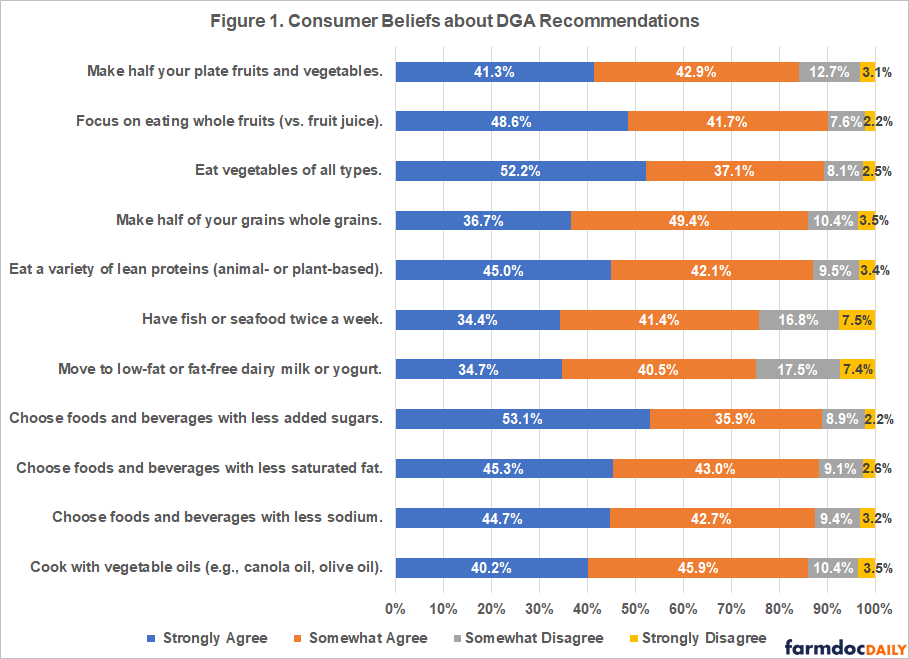
When looking to the next iteration of the DGA, there has been extensive discussion around the low-fat and fat-free dairy recommendation, as the MAHA initiative has made it clear that it wants to bring full-fat dairy products back. For example, the MAHA strategy report emphasizes a return of full-fat milk and dairy products in the school lunch program. Our results suggest this may be one area that consumers are more open to a change, though it should be noted that 3 in 4 consumers agreed with the current DGA recommendation.
Beliefs about who is and who should be influential in developing the DGA
Respondents believe that several groups are currently influential in developing the DGA, including the US Department of Health and Human Services (HHS; 61.7%), US Department of Agriculture (USDA; 56.0%), and nutrition experts (48.1%). Slightly more than one-third of respondents believe that medical experts (35.4%) and food and beverage manufacturers (34.6%) are currently influential in developing the DGA, with even fewer believing farmers (29.1%), elected officials (22.3%), and the general public (20.0%) are influential.
In terms of which groups should be influential in developing the DGA, figure 2 shows that respondents believe that nutrition experts, HHS, USDA, and medical experts should be the most influential, with roughly 90% or more of consumers believing these groups should be strongly or somewhat influential in the DGA development process. On the other hand, respondents are less enthusiastic about elected officials and the general public being involved in this process, with 34.7% and 26.5% indicating they should not be influential, respectively. Farmers and food and beverage manufacturers fell more in the middle, with 82.2% and 77.6% of respondents believing they should be strongly or somewhat influential in developing the DGA, respectively.

Variation in Beliefs About the DGA Development Process Across DGA Familiarity
Overall, respondents exhibited a moderate level of familiarity with the DGA; the average familiarity score was 4.40 (1=not at all familiar and 7=very familiar), with 51.2% of the sample rating themselves as more familiar (defined by a score of 5 or higher). We found that younger individuals and individuals with children were more likely to rate themselves as more familiar with the DGA; additionally, both Republicans and Democrats were more likely to rate themselves as more familiar with the DGA than individuals who identified as Independent/Other.
Beliefs about who is or should be involved in the DGA development process may ultimately impact trust in the DGA. Consumers indicated a moderate level of trust in the DGA, with an average score of 4.82 (1=do not trust and 7=trust very much). Those individuals who are more familiar with the DGA were also more trusting of it (average score for more familiar individuals = 5.46; average score for less familiar individuals = 4.14).
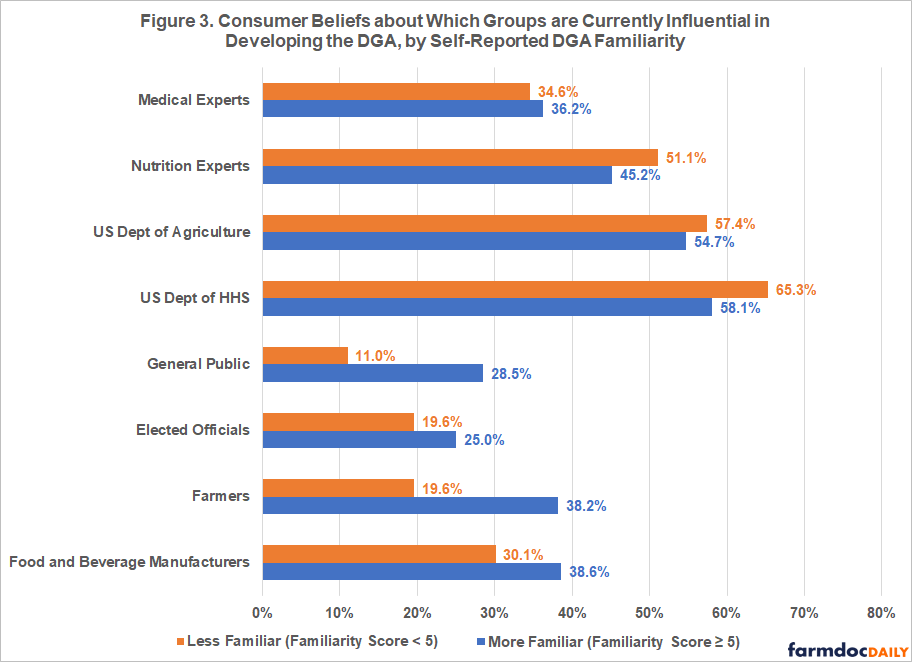
We also examined which groups consumers believe are currently influential in developing the DGA based on self-reported familiarity with the DGA. Figure 3 shows the respondents across those who reported they are more familiar with DGA (score of 5 or greater) with blue bars and those who were less familiar (score less than 5) in orange bars. We find that both groups viewed HHS, USDA, and nutrition experts as playing big roles in the DGA development. However, respondents who considered themselves to be more familiar with the DGA viewed its development as a much more inclusive process, with a larger share of respondents seeing a role for farmers, food and beverage manufacturers, elected officials, and the general public relative to respondents who indicated they are less familiar with the DGA.
In terms of who should be influential in DGA development, we similarly find that respondents who were more familiar with the DGA want it to be a much more inclusive development process, with over 40% of these respondents saying each group should be strongly influential. Those who are less familiar want to see more influential roles for nutrition and medical experts as well as government agencies over groups like the general public, elected officials, farmers, and food and beverage manufacturers.
Conclusion
The Dietary Guidelines for Americans (DGA) has a tremendous impact on how food and nutrition policy and programs are designed in the US, yet less is known about the public’s view of the DGA in recent years. This is particularly relevant in the current political environment, as many MAHA priorities, particularly those targeting the DGA, are justified as being demanded by the public.
Using data from Wave 15 of the GFAPS, we found that the vast majority of consumers (75% or greater) currently agree with recommendations from the 2020-2025 DGA. Over 50% strongly agreed with both the recommendation to eat all types of vegetables and to choose foods and beverages with less added sugars. Some recommendations like eating more fish and moving to low-fat or fat-free dairy didn’t resonate as much with some consumers, with disagreement rates of over 20%. While there is limited recent research on how the public views DGA recommendations, Nayga and Capps (1999) similarly found that consumers agreed at a high rate with DGA recommendations at that time. The recommendations have been updated over time to reflect advances in nutrition science (for example, emphasizing the incorporation of whole grains and reducing added sugars), and it seems the public has typically agreed with – though not necessarily followed – the guidance provided.
Further, we found that consumers have a moderate level of familiarity with the DGA, and consumers generally understand which groups (e.g., government agencies, nutrition experts) are likely to be influential in the DGA development process. Interestingly, we found that consumers who consider themselves more familiar with the DGA want to see many more groups, including farmers and food and beverage manufacturers, involved in its development relative to those who are less familiar. These groups can and often do play a role in DGA development by participating in the public comment period. Support for these groups’ participation is particularly interesting as consumers often express concern with food firm size and influence (e.g., farmdoc daily, March 7). Future research could explore public perceptions and preferences around what “influence” in the DGA process should mean for each group.
References
2025 Dietary Guidelines Advisory Committee. 2024. Scientific Report of the 2025Dietary Guidelines Advisory Committee: Advisory Report to the Secretary of Health and Human Services and Secretary of Agriculture. U.S. Department of Health and Human Services. https://doi.org/10.52570/DGAC2025. Accessed December 9, 2025.
Callahan, Alice. 2025. New Dietary Guidelines Delayed Until Early 2026. The New York Times. December 4. https://www.nytimes.com/2025/12/04/us/politics/dietary-guidelines-americans.html. Accessed December 9, 2025.
Choi, Joseph. 2025. RFK Jr. says new dietary guidelines coming soon: ‘We’re ending the war on saturated fats’. The Hill. November 17. https://thehill.com/homenews/5609015-kennedy-ends-war-saturated-fats/. Accessed December 9, 2025.
Dietary Guidelines for Americans. (n.d.). Purpose of the Dietary Guidelines. https://www.dietaryguidelines.gov/about-dietary-guidelines/purpose-dietary-guidelines. Accessed December 9, 2025.
Dietary Guidelines for Americans. (n.d.). Public Comments to the Departments. https://www.dietaryguidelines.gov/public-comments-departments. Accessed December 10, 2025.
Dietary Guidelines for Americans. (n.d.). Who’s Involved in Updating the Dietary Guidelines. https://www.dietaryguidelines.gov/about-dietary-guidelines/process. Accessed December 9, 2025.
Food Fix. 2025. RFK Jr. says dietary guidelines will end ‘war on saturated fats’. November 18. https://foodfix.co/rfk-jr-says-dietary-guidelines-will-end-war-on-saturated-fats/. Accessed December 10, 2025.
Green, Hannah Harris. 2025. RFK Jr to urge Americans to eat more saturated fats, alarming public health experts. The Guardian. October 25. https://www.theguardian.com/us-news/2025/oct/25/rfk-jr-saturated-fats. Accessed December 9, 2025.
Kalaitzandonakes, Maria, Jonathan Coppess, and Brenna Ellison. 2024. Sizing up the food system: US consumers’ perceptions of food system firm sizes and pricing. farmdoc daily, 14:47. https://farmdocdaily.illinois.edu/2024/03/sizing-up-the-food-system-us-consumers-perceptions-of-food-system-firm-sizes-and-pricing.html. Accessed December 10, 2025.
Kalaitzandonakes, Maria, Jonathan Coppess, and Brenna Ellison. 2025. Tracking Public Perceptions of MAHA. farmdoc daily, 15:163. https://farmdocdaily.illinois.edu/2025/09/tracking-public-perceptions-of-maha.html. Accessed December 10, 2025.
MAHA. (2025). Strategy Report: Make Our Children Healthy Again. https://www.whitehouse.gov/wp-content/uploads/2025/09/The-MAHA-Strategy-WH.pdf. Accessed December 10, 2025.
Nayga Jr., Rodolfo M., and Oral Capps Jr. 1999. US consumers’ perceptions of the importance of following the US dietary guidelines. Food Policy, 24(5): 553-564. https://doi.org/10.1016/S0306-9192(99)00053-6.
U.S. Department of Agriculture and U.S. Department of Health and Human Services. 2020. Dietary Guidelines for Americans, 2020-2025. 9th Edition. DietaryGuidelines.gov. Accessed December 9, 2025.
Disclaimer: We request all readers, electronic media and others follow our citation guidelines when re-posting articles from farmdoc daily. Guidelines are available here. The farmdoc daily website falls under University of Illinois copyright and intellectual property rights. For a detailed statement, please see the University of Illinois Copyright Information and Policies here.