








Chemical Collision: The Pesticide Provisions that Nearly Derailed the House Bill
Maybe breaking the Farm Bill last summer wasn’t such a good idea. At 2:26 a.m., the House of Representatives adjourned consideration of the Farm, Food, and National Security Act (FFNSA) of 2026 (H.R. 7567; House.gov, April 29, 2026). Adjournment left the bill as “unfinished business,” which seems an appropriate moniker for it. The House finished this stage of the complicated legislative process, however, passing the bill as amended by a vote of 224 to 200 (6 not voting) at 11:14 a.m. on April 30, 2026 (House Clerk, Roll Call Vote 154).
While packaged and labeled a Farm Bill, H.R. 7567 is neither a complete, nor a traditional, Farm Bill. Last summer’s budget reconciliation bill—the One Big Beautiful Bill Act of 2025 (P.L. 119-21)—enacted major changes and reauthorizations to critical components of the Farm Bill. That legislation included massive cuts to the Supplemental Nutrition Assistance Program (SNAP), reauthorization of farm payment programs through 2031 with revisions projected to double total payments to farmers, as well as concerning changes to crop insurance. Congress also reauthorized most of the conservation programs through 2031, except the Conservation Reserve Program (CRP). Therefore, FFNSA is the unfinished business of the Farm Bill, reauthorizing through 2031the numerous programs and authorizations that were left behind last year.
It is safe to say that any legislation attempting to clean up unfinished Farm Bill business would be controversial and difficult. Breaking the cardinal political rule of the Farm Bill—don’t cut food assistance to boost payments to farmers—while leaving numerous programs and priorities behind, left the once-powerful legislative coalition in tatters. The House Agriculture Committee chose to make that work vastly more difficult by including controversial provisions that would have provided substantial legal protections to the entities that manufacture and sell pesticides. It was the inclusion of these provisions that nearly derailed the unfinished Farm Bill (McCarthy and Razor, April 30, 2026; Tully-McManus et al., April 29, 2026; Yarrow and Hill, April 29, 2026; Hill and Yarrow, April 29, 2026; McCarthy, April 29, 2026; Kochi, Frazin, and Lillis, April 29, 2026; McCarthy and Hill, April 28, 2026; Yarrow and Hill, April 26, 2026; Yarrow, April 28, 2026). The timing was particularly bad because it coincided with the Supreme Court hearing arguments on a case involving damages for cancer from exposure to the herbicide glyphosate (Roundup) (Monsanto Co. v. Durnell, Supreme Court, No. 24-1068; Tabuchi, April 26, 2026; Farm Policy News, April 28, 2026).
Prior to passing H.R. 7567, the House agreed-to an amendment that struck the most controversial provisions from the bill, clearing its path to passage. The vote was 280 in favor of striking the pesticides provisions, to 142 opposed (13 not voting) (House Clerk, Roll Call 148). This article will review the provisions struck from FFNSA as an introduction to federal pesticide policy and to begin exploring some of the questions raised by the controversies over those provisions in the House debate.
The Federal Insecticide, Fungicide, and Rodenticide Act (FIFRA) authorizes the Environmental Protection Agency (EPA) to regulate the sale and use of pesticides (7 U.S.C. §136 et seq.). Congress designed the regulation of pesticides through a system of testing, risk assessment, registration, and labeling, meaning that no one can sell or distribute a pesticide unless it is registered and contains a label of approved uses, as well as restrictions on use or application. It is also a violation of the law to use a pesticide in a way that is not consistent with the approved uses or the label instructions, including restrictions on use (Esworthy and Yen, November 14, 2012; Heflin, May 2, 2025). The pesticide label is the controlling legal mechanism (the “label is the law,” so to speak); most enforcement actions are initiated by state regulators, triggered by alleged use of a pesticide contrary to the label (Ozymy and Jarrell, 2020).
For the issues confronting pesticides policy today, it is important to step back a quarter of a century to when a group of 29 Texas peanut farmers sued Dow Agrosciences L.L.C. over an herbicide marketed as “Strongarm” that damaged their crops for reasons not addressed in the registration or label (Bates v. Dow Agrosciences L.L.C., 544 U.S. 431, 435 (2005)). The farmers sought damages under the Texas Deceptive Trade Practices-Consumer Protection Act; Dow sought to have the case dismissed as pre-empted by FIFRA, which provides that States “shall not impose or continue in effect any requirements for labeling or packaging in addition to or different from those required” under FIFRA (7 U.S.C. §136v). Note that, aside from labeling or packaging requirements, states may regulate pesticides so long as they do not permit use or sales of pesticides otherwise prohibited under the federal law.
The issue before the Supreme Court in 2005 was whether the pre-emption provisions of FIFRA applied to lawsuits based on state tort or common law (Bates, 544 U.S., at 440). The Court concluded that FIFRA did not pre-empt such state law claims. The Court explained that pre-emption requires two conditions: (1) the State law “must be a requirement for labeling or packaging,” not “rules governing the design of a product”; and (2) “it must impose a labeling or packaging requirement” that adds to or is different from the EPA label under FIFRA (Bates, 544 U.S., at 444). The Court explained further that State laws requiring “manufacturers to design reasonably safe products,” or “to market products free of manufacturing defects” were not pre-empted by FIFRA so long as they did not require anything added or changed on the label and packaging (Id., at 444). Noting that “FIFRA does not provide a federal remedy to farmers and others who are injured,” the Court added that “the threat of a damages remedy will give manufacturers an additional cause to comply” with federal law—FIFRA “does not preclude States from imposing different or additional remedies,” it only precludes “different or additional requirements” on the label or packaging (Id., at 448 (emphasis in original)).
Returning to the unfinished business of the Farm Bill, the House Agriculture Committee included revisions to FIFRA that would have provided vast legal protections to pesticide manufacturing entities. These were tucked into the title that reauthorizes programs for specialty crop producers, which was an interesting drafting choice. The two provisions, Sections 10205 and 10206, were highly controversial and were removed from the bill by an amendment led by Representative Anna Paulina Luna (R-FL) (House Clerk, Roll Call 148; House Rules Committee, 119-H.R. 7567, (listed as amendment #29); House.gov, April 29, 2026 (listed as amendment #28)).
Figure 1 provides a highlighted image of the legislative text for Section 10205. The provision was cleverly drafted. The bookends of the highlighted phrase seem almost unremarkable, requiring national uniformity in pesticide labeling and continuing the prohibition on labeling or packaging requirements that differ from the federally approved label. Between those words are the heart of the controversy. While it is couched within the language of labeling that is FIFRA’s regulatory domain, this provision would have prohibited states and courts from penalizing or holding any pesticide manufacturing entity liable for their products.
Figure 1. Proposed Revisions to Pesticide Labeling Requirements in the House Legislation
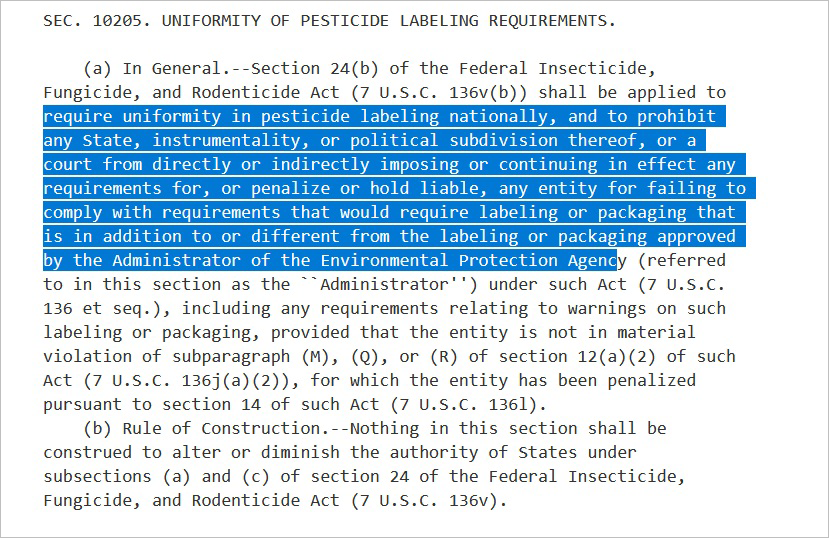
The words “indirectly imposing or continuing in effect,” “or penalize or hold liable,” and “requirements that would require” are extraordinarily expansive, doing much of the work. For example, damage awards or other penalties are requirements to pay which would meet this standard, and the middle phrase (“, or penalize or hold liable,”) likely would have provided separate protection against liability or penalties on its own.
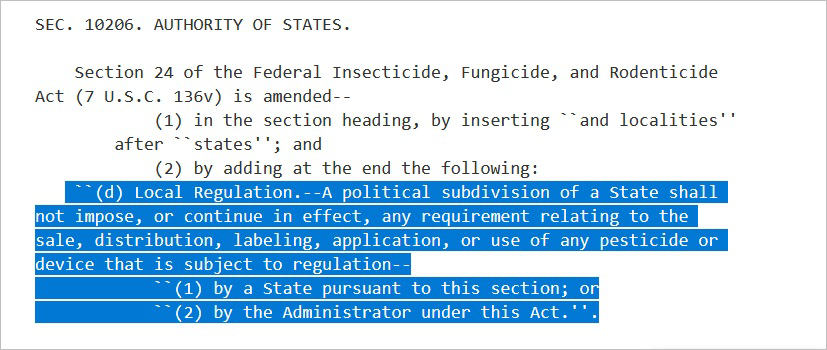
The second provision struck from the bill was Section 10206, and it was much more straightforward. It added a prohibition against any local governmental regulation of a labeled pesticide, not just prohibiting changes to labels and packaging. In other words, a town or city would not have been able to ban pesticide applications within its limits, nor could they have restricted applications near schools, playgrounds, or other sensitive areas. The provision would have added further restrictions on local authorities in addition to Section 10205. The highlighted legislative text is presented in Figure 2.
Figure 2. Pesticide Provision in the House Bill Limiting Local Authority Over Pesticides
The removal of these provisions presumably cleared the way for the H.R. 7567’s passage. The entire episode potentially provides important lessons for those inclined to such matters. Among these lessons are reminders about the extraordinary power of public deliberation over matters of policy, and the critical importance of voting in a system of representative self-government (Waldron, 1985). It can be messy and chaotic, but the value of working through disagreements over public policy in a public process cannot be overstated. The debate and the vote, even the chaos, demonstrated that revising FIFRA to protect the industry is not popular nor politically supported; the optics are bad and the politics are worse, especially in an election year (Philpott, October 22, 2025; Stone, April 28, 2026; Formuzis, August 4, 2025; Held and Alvey, September 9, 2025).
The issue also puts farmers in a difficult position. Many farmers benefit from the weed and pest controls these products offer, but not all farmers and not from all pesticides. There has been no shortage of lawsuits and conflicts, and worse, over pesticides among farmers in recent years (Brown, 2025). Importantly, the previous Supreme Court case was brought by farmers for damages to their crops from a pesticide. Without tort liability or other legal avenues, there are no remedies for damages caused by the products, including for farmers (Bates, 544 U.S., at 448).
As such, the controversy presents the potential to consider important questions about the FIFRA regulatory scheme, such as whether the labeling system is an effective way to regulate the manufacture and use of these chemicals, or potentially shifts too much of the burden to the applicator and the farmer. Whether the labeling system is the best and most effective way to manage these substances, is just one among many important questions if there is sincere interest in rethinking this policy. While these matters are beyond the scope of this article, they offer much for further research, analysis, and deliberation for those inclined to do so. One potential upside to this episode, therefore, is that it could serve as a catalysis for serious and critical conversations on the topic. One example took place in Chicago in March, when the Institute for Sustainability, Energy and the Environment (iSEE) at the University of Illinois held a Critical Conversation on pesticides issues (iSEE, Spring 2026).
In conclusion, there are missed opportunities and near misses. The House bill was a missed opportunity to correct the problematic policy changes enacted last summer, including to seriously adapt and adjust farm policy to help meet the challenges farmers are currently facing with input costs, market uncertainties, trade conflicts, wars, and more. These times demand policies that support innovation, adjustment and adaptation, not simply issuing more federal payments without doing the difficult, necessary work of addressing the underlying problems. Finally, today’s floor debate in the House was also a near miss. Congress could have taken a major step towards adding very problematic changes to pesticide policy. Whether anything has been learned will be determined by what we do next.
References
Brown, Nicholas W. 2025. “Drifting towards Solutions: Examining Dicamba’s Volatility Issues in Modern Agriculture.” Drake Journal of Agricultural Law 30(1). https://aglawjournal.wp.drake.edu/wp-content/uploads/sites/66/2025/08/a.-Brown-Final.pdf
Carney, Jordain, Meredith Lee Hill, and Myah Ward. 2026. “Hill Republicans Want Trump to Solve Their Internal Problems.” Politico, April 28, 2026. https://www.politico.com/live-updates/2026/04/28/congress/house-advanced-rule-to-floor-after-delay-00897699
Esworthy, Robert, and Jerry H. Yen. 2012. Pesticide Law: A Summary of the Statutes. CRS Report RL31921. Washington, DC: Congressional Research Service. November 14, 2012. https://www.congress.gov/crs-product/RL31921#ifn2
Formuzis, Alex. 2025. “MAHA’s Moment of Truth: Will RFK Jr. Stand Up for People Harmed by Pesticides?” Environmental Working Group, August 4, 2025. https://www.ewg.org/news-insights/news/2025/08/mahas-moment-truth-will-rfk-jr-stand-people-harmed-pesticides
Hanrahan, Ryan. 2026. “Supreme Court Seems Divided on Bayer’s Bid to Stop Roundup Lawsuits.” Farm Policy News, April 28, 2026. https://farmpolicynews.illinois.edu/2026/04/supreme-court-seems-divided-on-bayers-bid-to-stop-roundup-lawsuits/
Heflin, Jason O. 2025. “Preemption in the Federal Insecticide, Fungicide, and Rodenticide Act.” CRS Legal Sidebar LSB11304. Washington, DC: Congressional Research Service. May 2, 2025. https://www.congress.gov/crs-product/LSB11304
Held, Lisa, and Rebekah Alvey. 2025. “MAHA Report Moves Further Away from Restricting Pesticides.” Civil Eats, September 9, 2025. https://civileats.com/2025/09/09/maha-report-moves-further-away-from-restricting-pesticides/
Hill, Meredith Lee, and Grace Yarrow. 2026. “House Republicans Delay Farm Bill Vote after Internal Revolt.” Politico, April 29, 2026. https://www.politico.com/live-updates/2026/04/29/congress/gop-delays-farm-bill-vote-after-internal-revolt-00898568
Kochi, Sudiksha, Rachel Frazin, and Mike Lillis. 2026. “Pro-Pesticide Provisions Complicate Farm Bill’s Passage.” The Hill, April 29, 2026. https://thehill.com/homenews/house/5853925-pro-pesticide-provisions-complicate-farm-bills-passage/
McCarthy, Mia, and Calen Razor. 2026. “Capitol Agenda: Johnson Notches Wins, but Chaos Looms.” Politico, April 30, 2026. https://www.politico.com/live-updates/2026/04/30/congress/gop-budget-dhs-immigration-farm-fisa-00899601
McCarthy, Mia, and Meredith Lee Hill. 2026. “House Panel Moves 3 Priority Bills toward Floor Vote.” Politico, April 28, 2026. https://www.politico.com/live-updates/2026/04/28/congress/house-advanced-rule-to-floor-after-delay-00897699
McCarthy, Mia. 2026. “House Clears Critical Hurdle to Advance 3 Major Priorities.” Politico, April 29, 2026. https://www.politico.com/live-updates/2026/04/29/congress/house-floor-unfreezes-00898223
Ozymy, Joshua, and Melissa Jarrell. 2020. “Mislabeled: Exploring the History of Charging and Sentencing Patterns in Federal Insecticide, Fungicide, and Rodenticide Act (FIFRA) Criminal Prosecutions.” Drake Journal of Agricultural Law 25 (3). https://aglawjournal.wp.drake.edu/wp-content/uploads/sites/66/2023/03/2.-Ozymy-Ready-for-Publisher.pdf
Philpott, Tom. 2025. “Of Corn and Cancer: Iowa’s Deadly Water Crisis.” The New Republic, October 22, 2025. https://newrepublic.com/article/201118/corn-cancer-iowa-deadly-water-crisis
Stone, Will. 2026. “The MAHA Movement Is Mad About the Weedkiller Glyphosate and Trump’s EPA.” NPR, April 28, 2026. https://www.npr.org/2026/04/28/nx-s1-5801645/maha-epa-pesticide-glyphosate-trump
Tabuchi, Hiroko. 2026. “Supreme Court to Hear Arguments in Landmark Roundup Weedkiller Case.” New York Times, April 26, 2026. https://www.nytimes.com/2026/04/26/climate/supreme-court-bayer-monsanto-roundup-glyphosate.html
Tully-McManus, Katherine, Meredith Lee Hill, Mia McCarthy, and Jennifer Scholtes. 2026. “House Vote Hits 2-Hour Mark amid Revolts.” Politico, April 29, 2026. https://www.politico.com/live-updates/2026/04/29/congress/house-vote-grinds-on-00899392
University of Illinois, Institute for Sustainability, Energy, and the Environment. “Critical Conversations.” Spring, 2026. https://isee.illinois.edu/engagement/critical-conversations/past-critical-conversations/. Critical Conversations are supported by a generous gift from the Alvin H. Baum Family Fund.
Waldron, Jeremy. "Legislation, Authority, and Voting." Geo. LJ 84 (1995): 2185.
Yarrow, Grace, and Meredith Lee Hill. 2026. “House Lawmakers Lock in Plans for Farm Bill Vote.” Politico, April 29, 2026. https://www.politico.com/live-updates/2026/04/29/congress/house-lawmakers-lock-in-plans-for-farm-bill-vote-00899161
Yarrow, Grace, and Meredith Lee Hill. 2026. “The MAHA Revolt Threatening the Farm Bill.” Politico, April 26, 2026. https://www.politico.com/news/2026/04/26/the-maha-revolt-threatening-the-farm-bill-00891746
Yarrow, Grace. 2026. “House GOP Poised to Vote on Pesticide Language.” Politico, April 28, 2026. https://www.politico.com/live-updates/2026/04/28/congress/house-gop-moves-to-vote-on-pesticide-language-00895828
Disclaimer: We request all readers, electronic media and others follow our citation guidelines when re-posting articles from farmdoc daily. Guidelines are available here. The farmdoc daily website falls under University of Illinois copyright and intellectual property rights. For a detailed statement, please see the University of Illinois Copyright Information and Policies here.