








Agricultural and Construction Machinery Manufacturing in the Midwest: Employment, Exports, and Economic Importance
Although agriculture remains an important economic driver for many Midwestern communities (White, 2023), many regional economies also benefit from agricultural and construction equipment manufacturing. Original Equipment Manufacturers (OEMs) like John Deere, Caterpillar, CNH, and Vermeer are important employers throughout the Midwest. Not only do they create significant employment, but their expansive supply chains drive regional economic activity by creating additional jobs and revenue through domestic sales and exports.
Recently however, the agricultural, construction and mining machinery manufacturing industry has faced economic headwinds due to weaker farm incomes, reduced equipment purchases and tightening credit conditions (Mashange, 2025). For OEMs in this industry, higher machinery prices suppress demand for new equipment and extend replacement cycles. This makes equipment ownership more expensive and leads many farm operators to rethink equipment replacement and utilization strategies. As a result, they may use less equipment to farm the same amount of land or turn more toward cooperative agreements or partnerships to meet their needs (Schnitkey, Paulson, Zulauf and Zwilling, 2025).
Given the agricultural, construction and mining machinery manufacturing industry’s (NAICS 3331) importance for many regional economies, it is important to understand its scale and reach throughout the Midwest.[1] This brief highlights employment trends over time and the geographic distribution of industry jobs. It also examines state export trends since many of the industry’s leading companies serve global markets. The manufacturing of this critical machinery represents another way in which agriculture shapes the Midwestern economy.
Agricultural and Construction Machinery Manufacturing Is Highly Concentrated in the Midwest
According to the U.S. Bureau of Labor Statistics (BLS) Quarterly Census of Employment and Wages (QCEW), the agricultural, construction and mining machinery manufacturing industry employs roughly 200,000 U.S. workers. Current employment levels are comparable to those at the start of the century, but national employment in the industry reached a peak of more than 250,000 jobs in 2014, supported by high commodity prices, low interest rates, and strong farm incomes. This period also coincided with heightened demand for construction equipment purchases resulting from post-recession infrastructure spending and strong demand for mining equipment driven by the fracking boom.
Figure 1 shows how employment has changed over the past two decades in several select Midwestern states. In 2025, industry employment was greatest in Iowa (21,780) and Illinois (19,440), with Iowa’s employment surpassing Illinois in 2017. Iowa’s agricultural, construction, and mining machinery manufacturing employment is up 30% since 2002. By contrast, this industry’s employment in both Illinois and Wisconsin is down about 25% during the same period. Since 2023, agricultural, construction, and mining machinery manufacturing employment has declined nationally and across the Midwest.
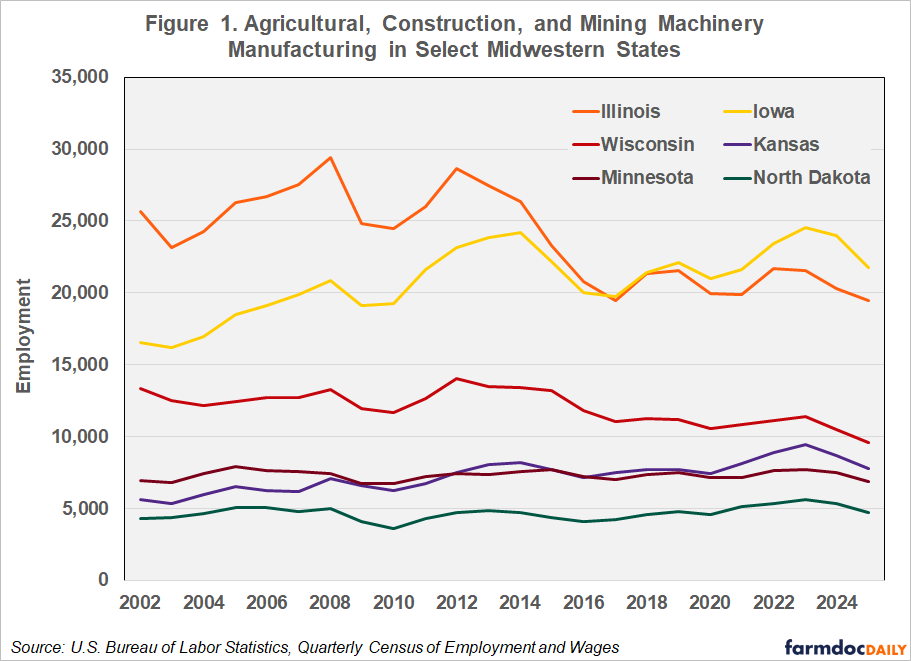
Figure 2 shows the geographic distribution of employment in the agricultural, construction, and mining machinery manufacturing industry. Texas accounts for over 35,000 jobs within this industry, but mining and oil and gas field machinery manufacturing (NAICS 33313) represents most of this employment (84%). Nevertheless, one out of every four jobs within the agricultural, construction, and mining machinery manufacturing can be found in just three midwestern states—Iowa, Illinois, and Wisconsin. As a result, industry employment is highly concentrated in these states. Relative to the nation, these jobs are 2.5 times more concentrated in Illinois and Wisconsin and almost 11 times more concentrated in Iowa.
Several large OEMs, and their extensive supply chains, drive many of these employment trends. In Illinois, John Deere and Caterpillar remain major employers in the Quad Cities and Peoria regions, respectively. In Iowa, John Deere maintains a substantial manufacturing presence in places like Waterloo, Ankeny, and Ottumwa, while Vermeer is a major employer in Pella. In Wisconsin, CNH operates a major manufacturing facility in Racine.
Beyond these states, significant agricultural and construction equipment manufacturing operations are located in the Fargo area of North Dakota (Bobcat); Hesston and Salina, Kansas (AGCO and Kubota, respectively); and Jackson and Benson, Minnesota (AGCO and CNH, respectively). These OEMs support extensive regional and national supplier networks, that generate demand for a wide range of other manufacturing industries that produce components such as batteries, tires, hoses, belts, electronics, and hydraulic systems. As a result, the agricultural and construction equipment industry serves as a key pillar of these states’ manufacturing sectors.
Across the Midwest, Industry Exports Remain Below Their 2017 Levels When Adjusted for Inflation
Leading firms in the agricultural, construction, and mining machinery manufacturing industry operate in highly globalized markets, making exports an important source of revenue for Midwestern manufacturers. The U.S. Census Bureau (USA Trade Online) provides state-level data on industry exports. Figure 3 shows the value of industry exports for selected Midwestern states in real (inflation-adjusted) dollars. Among these states, Illinois is the leading exporter of agricultural and construction machinery, driven in large part by the presence of John Deere and Caterpillar.
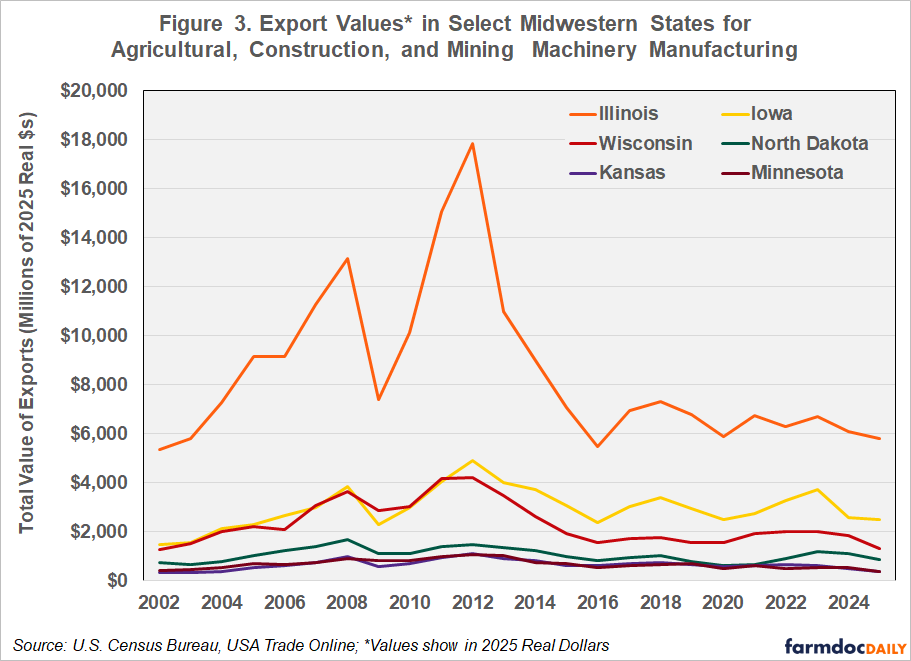
Export growth in Illinois, Iowa, and Wisconsin occurred during the early 2010s, due in part to higher commodity prices, strong farm incomes, and expanding agricultural production in major global markets such as Brazil. These trends also reflect differences in each state’s industrial composition. For example, construction and mining machinery manufacturing accounts for a relatively larger share of Illinois’s industry, whereas agricultural machinery and equipment production represents a relatively larger share of Iowa’s industry.
When adjusted for inflation, the value of agricultural, construction, and mining machinery exports from each state was lower in 2025 than in 2017. This decline reflects a combination of weaker commodity prices, slower growth in farm income, and trade-related headwinds. Tariffs contributed to these challenges by increasing input costs, reducing export competitiveness, and disrupting supply chains. Together with the expansion of agricultural markets abroad, these factors have encouraged many OEMs to expand their manufacturing capacity in key international markets (e.g., Brazil, China, India, etc.). This allows firms to serve customers more directly, adapt products to local markets and reduce exposure to trade barriers.
Key Takeaways
Agricultural, construction, and mining machinery manufacturing remains an important link between the Midwest’s agricultural and manufacturing sectors. Farmers are more likely to purchase new equipment and replace older machinery when farm incomes are strong. The impact of this industry extends well beyond the OEMs themselves, as major machinery manufacturers such as John Deere, Caterpillar, and CNH anchor extensive supplier networks that support thousands of additional jobs in metal fabrication, electronics, hydraulics, plastics, rubber products, transportation, and logistics. Consequently, this industry is not only a key driver of Midwestern manufacturing competitiveness, but also an important indicator of the broader agricultural economy.
Note
[1] This brief focuses on activities classified under NAICS (North American Industry Classification System) 3331—Agriculture, Construction, and Mining Machinery Manufacturing. This level of aggregation is used for two reasons. First, while more detailed 5-digit NAICS industries provide greater specificity for agricultural, construction, and mining machinery manufacturing, data suppression occurs more frequently at those levels. Second, U.S. Census Bureau export data are only available at the 4-digit NAICS level. Using NAICS 3331 therefore provides greater data availability and consistency across the employment and export analyses presented in this brief.
References
Mashange, G. "The Current State of the Farm Machinery and Equipment Market." farmdoc daily (15):197, Department of Agricultural and Consumer Economics, University of Illinois at Urbana-Champaign, October 24, 2025.
Schnitkey, G., N. Paulson, C. Zulauf and B. Zwilling. "Large Increase in Machinery Costs Suggests Need to Reconsider Machinery Purchase Decisions." farmdoc daily (15):189, Department of Agricultural and Consumer Economics, University of Illinois at Urbana-Champaign, October 14, 2025.
White, M. "Agriculture’s Contributions to County Economic Activity." farmdoc daily (13):24, Department of Agricultural and Consumer Economics, University of Illinois at Urbana-Champaign, February 10, 2023.
Disclaimer: We request all readers, electronic media and others follow our citation guidelines when re-posting articles from farmdoc daily. Guidelines are available here. The farmdoc daily website falls under University of Illinois copyright and intellectual property rights. For a detailed statement, please see the University of Illinois Copyright Information and Policies here.