








Farmland Values and Competitiveness in the United States and Brazil
Lower farmland values have long been considered a competitive advantage for Brazilian agriculture relative to U.S. agriculture (Colussi and Langemeier, 2026). However, strong farm profits, supported by periods of high commodity prices, have contributed to substantial increases in farmland values in both countries over the past two decades. This article compares farmland values in the United States and Brazil from 2002 to 2025, using data from Iowa and Mato Grosso – leading soybean- and corn-producing states in their respective countries. The comparison illustrates how differences in farmland value trends can affect production costs and the relative competitiveness of crop producers in the two countries.
Data and Methods
Iowa farmland values are obtained from the Iowa State University Land Value Survey, an annual survey conducted since 1941. The survey collects estimates from agricultural professionals with knowledge of local land markets, including farm managers, appraisers, agricultural lenders, real estate brokers, county assessors, and other market experts. Respondents estimate farmland values based on comparable sales and other relevant market conditions. This analysis uses the statewide weighted average value per acre across all land-quality grades from 2002 through 2025. Values are reported in nominal U.S. dollars per acre and reflect estimated market conditions as of November 1 of each year.
Farmland value estimates for Mato Grosso were provided by S&P Global Energy, a market intelligence company. The dataset contains annual average prices for grain-producing farmland in the Sinop region, in Northern Mato Grosso, from 2002 through 2025. Values are reported in current prices observed in each year and are not adjusted for inflation. The original series refers to the value of cleared, usable farmland, excluding areas of native vegetation or land reserved for environmental preservation. To ensure comparability with the Iowa series, the values were converted from Brazilian reais per hectare to U.S. dollars per acre using the annual average exchange rate for each year.
Farmland Value Trends in Iowa and Mato Grosso
Figure 1 compares nominal average farmland values in Iowa and Mato Grosso from 2002 to 2025, expressed in U.S. dollars per acre. Farmland values in Iowa and Mato Grosso are correlated, with a correlation coefficient between the two series of 0.958 during the study period. Farmland values increased in both states, although the pace and timing of appreciation differed. In Iowa, the average farmland value rose from $2,083 per acre in 2002 to $11,549 in 2025, with particularly strong increases of 72% between 2010 and 2013 and 57% between 2020 and 2023. Mato Grosso followed a more volatile path, with farmland values doubling between 2010 and 2014 and increasing by another 107% between 2020 and 2022. Values reached a peak of $11,145 per acre in 2022 before declining to $9,066 in 2025. Over the entire period, values increased at a compound annual growth rate of 7.7% in Iowa and 8.7% in Mato Grosso (see Figure 1).
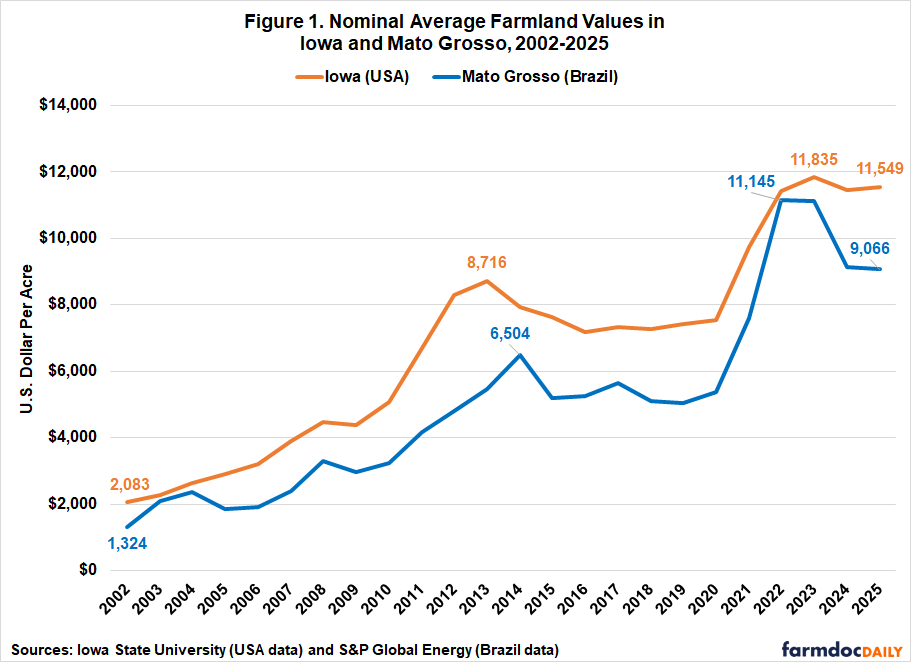
The gap between the two states narrowed during the commodity-price boom of 2021–2023, when farmland values in Mato Grosso approached those in Iowa. During this period, farm profitability reached historic highs in Brazil, driven by strong international demand, low global ending stocks, Russia’s invasion of Ukraine, and the depreciation of the Brazilian real against the U.S. dollar (see farmdoc daily, April 28, 2023). This encouraged increased leverage and investments in operations and expansion.
Since 2024, as soybean and corn prices have declined from their recent peaks, farmland values have remained relatively stable in Iowa while declining in Mato Grosso, leaving Iowa farmland values 27% higher in 2025. Brazil’s grain and oilseed farmland market has experienced low liquidity in recent years. The combination of shrinking farm revenues, persistent increases in input costs, and large grain supplies has created a challenging environment for Brazilian crop producers (see farmdoc daily, March 16, 2026). Short-term challenges related to lower profitability, persistent cost pressures, and tight credit conditions have also weighed on Iowa’s farmland market in recent years.
Despite these pressures, farmland values have remained resilient and are still at historically high levels in both Iowa and Mato Grosso. In Brazil, elevated land prices combined with tight profit margins have extended payback periods. High interest rates have added further pressure to financing conditions. Brazil’s benchmark Selic rate currently stands at 13.75%, compared with a federal funds target range of 3.75% to 4.00% in the United States. Inflation also remains somewhat higher in Brazil, with consumer prices up 4.2% over the past 12 months compared with 3.4% in the United States.
In Iowa, the farmland market remains supported by strong farm balance sheets – with 84% of farmland owned debt-free – and farm incomes that remain above long-term averages. Farmland is also viewed as a stable investment amid broader economic and geopolitical uncertainty (Chandio, 2025). Beyond its role as a long-term investment, farmland is often retained for family or sentimental reasons (Langemeier and Colussi, 2026), limiting the supply of land available for sale and helping support values.
Perspectives for the Future and U.S–Brazil Competitiveness
Looking ahead, there are signs of an improving outlook for farmland values in Brazil. Global corn and soybean prices have recently gained support from firm demand, geopolitical tensions in the Middle East, production risks associated with El Niño, and other supportive fundamentals. These factors have improved farmers’ margins and could create a more favorable scenario for 2027, provided soybean prices remain firm.
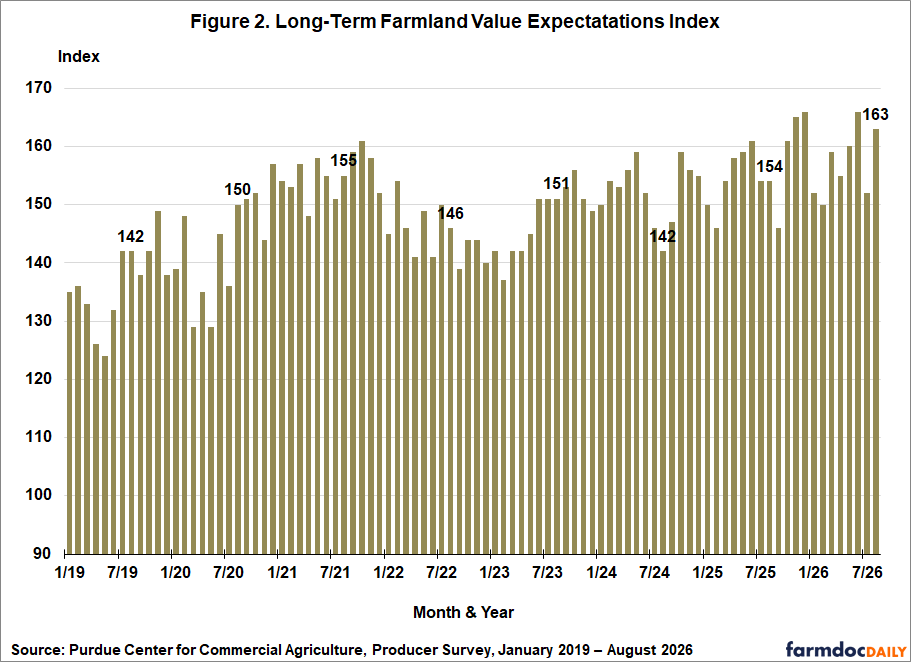
In the short term in the United States, farmland markets face pressures from low commodity prices, high costs, and high interest rates. However, the long-term outlook remains positive, with the market expected to remain stable until it turns strong again (Chandio, 2025). Producer expectations for farmland values also remain relatively positive. The Long-Term Farmland Value Expectations Index from the Purdue University-CME Group Ag Economy Barometer has generally remained above its pre-2020 levels, despite some recent volatility (see Figure 2). Viewed over the longer horizon, 2026 will likely be seen as part of a period of adjustment following the short but sharp price boom from 2020 to 2022. This period of adjustment is similar in many ways to the 2014 to 2019 adjustment period (Kuethe, 2026).
From a competitiveness perspective, rising farmland values in major Brazilian agricultural regions may narrow part of Brazil’s historical land-cost advantage relative to the United States. Land tenure also impacts how producers experience these increases. The Brazilian Agricultural Census reports that owned land accounted for 85% of the total area of agricultural establishments nationwide. By comparison, commercial grain farm operators in the U.S. Midwest rent or crop-share roughly three-quarters of the land they farm. Consequently, rising farmland values may affect producers who rent land through higher lease costs, while for those who own the land they operate, they increase the opportunity cost of land and the capital required to expand through purchases.
Final Considerations
Farmland values increased in both Iowa and Mato Grosso between 2002 and 2025, supported by strong farm profits during periods of high commodity prices. In Iowa, limited land availability and strong investment demand also supported values, while in Mato Grosso, export demand, currency depreciation, and agricultural expansion contributed to faster growth and greater volatility. The narrowing gap between the two regions indicates that Brazil’s historical advantage in farmland values has reduced over time. Even after the recent decline in Mato Grosso, however, farmland values in Iowa remained higher in 2025, suggesting that land continues to contribute to Brazil’s cost competitiveness.
The effect of farmland values on competitiveness also depends on land tenure. Because most Brazilian cropland is owner-operated, established producers are less directly exposed to increases in cash rents than producers in the U.S. Midwest, where rented cropland is more prevalent. However, higher land values raise opportunity costs and make farm expansion more capital-intensive, particularly under Brazil’s high interest rates.
The comparison should be interpreted with caution because the Iowa series represents a statewide estimate as of November 1 of each year, whereas the Mato Grosso series represents an annual average for the Sinop region. In addition, the Brazilian series is affected by annual exchange-rate movements, which have been substantial over the past two decades.
References
Chandio, R. “2025 Iowa State University Farmland Value Survey.” Ag Decision Maker, File C2-70, Iowa State University Extension and Outreach, revised December 2025.
Colussi, J. and M. Langemeier. "Brazil Heads for a Record Soybean Harvest as Farm Margins Approach Breakeven." farmdoc daily (16):44, Department of Agricultural and Consumer Economics, University of Illinois at Urbana-Champaign, March 16, 2026.
Colussi, J. and M. Langemeier. "U.S. and Brazil Soybean Competitiveness: Farm-Level Costs and Returns." farmdoc daily (16):29, Department of Agricultural and Consumer Economics, University of Illinois at Urbana-Champaign, February 23, 2026.
Colussi, J., G. Schnitkey, N. Paulson and J. Baltz. "Farmland Prices in Brazil More than Doubled in the Last Three Years." farmdoc daily (13):79, Department of Agricultural and Consumer Economics, University of Illinois at Urbana-Champaign, April 28, 2023.
Langemeier, M. and J. Colussi. “Why U.S. Farmers Own Farmland and What They Expect for Land Values.” Purdue Center for Commercial Agriculture, September 2, 2026.
Kuethe, T. “Indiana’s Farmland Market Holds Steady as Regions Swap Places.” Purdue Agricultural Economics Report, PAER-2026-24, Purdue University, August 17, 2026.
Disclaimer: We request all readers, electronic media and others follow our citation guidelines when re-posting articles from farmdoc daily. Guidelines are available here. The farmdoc daily website falls under University of Illinois copyright and intellectual property rights. For a detailed statement, please see the University of Illinois Copyright Information and Policies here.