








Illinois Crop Budgets for 2027
Today’s farmdoc daily article summarizes the initial release of our Illinois Crop Budgets for 2027. Despite increases in projected production costs, particularly for fertilizers and fuel, improved pricing prospects for the 2026 and 2027 crop years result in higher per acre return projections compared with recent years. However, projected returns remain below longer-run averages. Downward price movements could quickly shift marginally positive projected returns back into the red. Pricing more than the usual amount of 2026 crop at harvest may be warranted given recent increases in prices. Profitable hedging opportunities for 2027 production may exist.
Illinois Crop Budgets and Historic Revenues and Costs
The Illinois Crop Budgets publication has been updated to include projections for the 2027 crop year. Budgets are put together for four different region scenarios: northern Illinois, central Illinois high-productivity soils, central Illinois low-productivity soils, and southern Illinois. Crop budgets for corn, soybeans, and wheat are provided for all regions; a double-crop soybean budget, which assumes soybeans follow a winter wheat crop, is included for central and southern Illinois.
The Revenue and Costs for Illinois Grain Crops publication has also been updated and now includes historic information for the 2020 to 2025 crop years, and projections for 2026 and 2027. The historic revenues and costs are summarized from grain farms enrolled in the Illinois Farm Business Farm Management Association (FBFM).
Both publications can be found in the Management section of the farmdoc website.
Adjustments to 2026 Crop Budgets
Adjustments to the 2026 crop budgets were primarily made on the revenue side. The corn, soybean, and wheat prices in the 2026 budgets have been revised upward from the most recent version released in May 2026 (see farmdoc daily from May 19, 2026). Changes for corn and soybean prices were based on recent futures market trading and harvest delivery cash bids observed at various locations in Illinois. The 2026 corn price was increased from $4.50 per bushel to $4.95 per bushel. The soybean price was increased from $11.50 to $12.20 per bushel. Budget prices are intended to be measures of the average price received for the crop over the full marketing period. Both prices remain slightly below recent cash bids for fall delivery accounting for the fact that a portion of the current crop has likely been sold at lower prices earlier in the year.
The higher prices also resulted in partially offsetting reductions in projected payments from the ARC/PLC programs for 2026. ARC/PLC payment figures are averages by region that account for the mix of base acres across crops.
Expectations for crop insurance proceeds are now also included in the 2026 projections. These are based on expectations for some yield-driven insurance claims which are valued at a higher harvest price compared with spring insurance price levels. While average yields are still expected to be near trend levels, regional yield averages were adjusted down slightly from the May budgets to reflect significant rainfall events and high winds across some parts of Illinois which could result in yield damage. Final regional yields will become more certain as harvest gets underway shortly. Lower yields would be partially offset by additional insurance payments and vice versa.
The only change to 2026 cost projections was an increase in fuel and oil within the power cost category. This adjustment reflects the significant increase in diesel fuel prices that occurred following the start of the Iran war in late February and has continued throughout the summer (see farmdoc daily article from August 11, 2026).
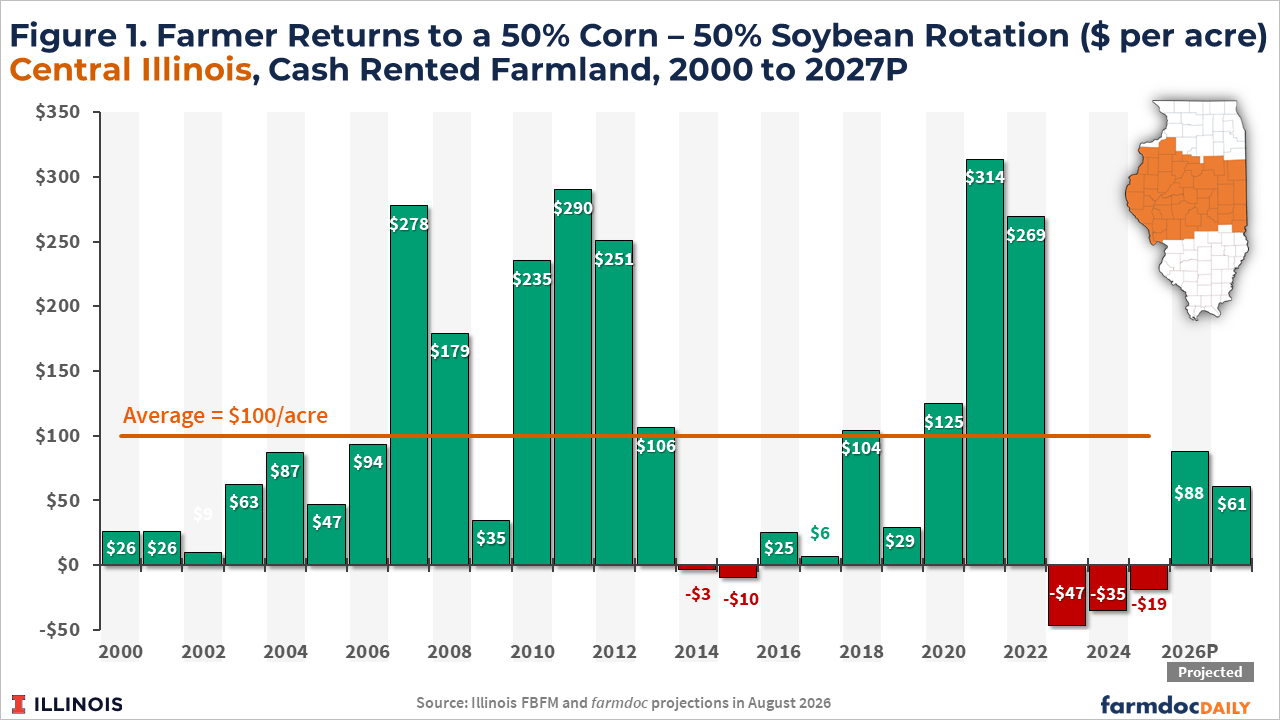
Overall, the adjustments led to improved return projections for corn and soybeans above costs including cash rent compared with the May projections. For the northern and central Illinois regions, projected returns on corn improved from around -$50 per acre to $50-60 per acre. In southern Illinois return projections improved from -$90 to right at break-even for corn. Soybean returns increased from $40-$60 per acre in northern and central Illinois to $90-$116 per acre. Projected soybean returns in southern Illinois remain around $30 per acre. While return projections have improved, they remain highly subject to further changes in prices and continue to be below longer-term return averages (see Figure 1 below). Overall, per acre returns are highly sensitive to prices given the relatively high productivity in Illinois. For example, a $0.50 move in corn prices, which is less than what has been experienced in harvest futures just over the past month, results in a more than $100 shift in returns.
2027 Crop Budgets
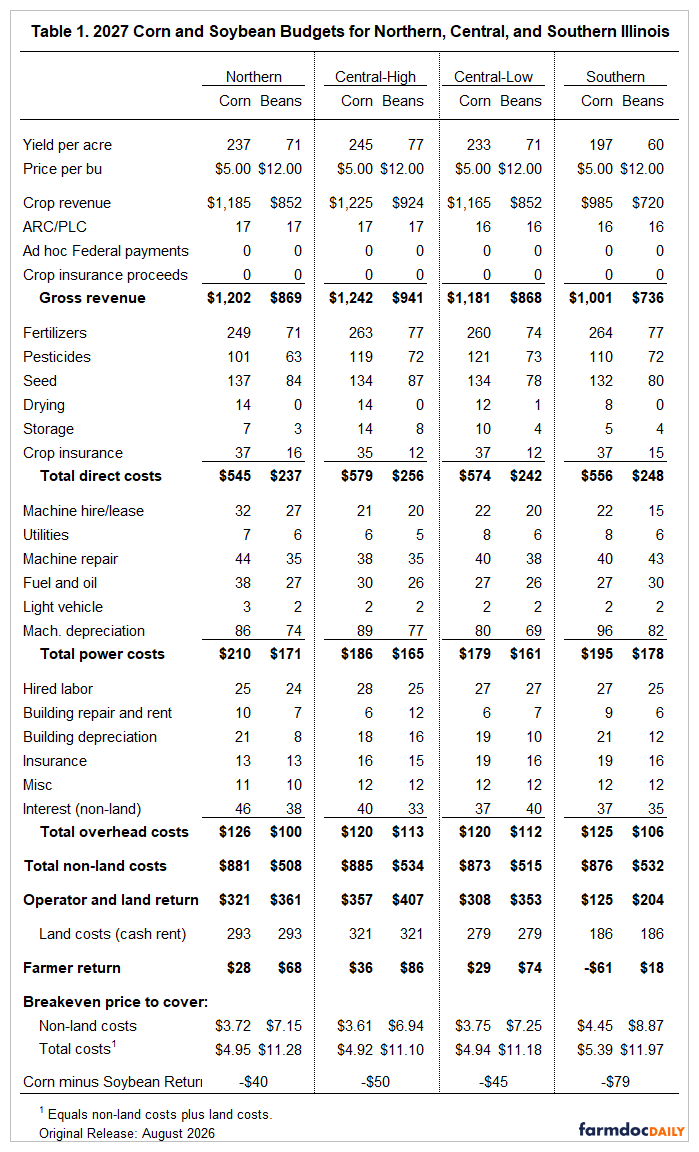
The initial release of corn and soybean crop budgets for 2027 are summarized for each region of Illinois in Table 1. Trend yield levels are assumed for each region. Price assumptions are based on current harvest futures for the 2027 crop, adjusted for typical basis in Illinois. The price projections are $5 per bushel for corn, $12 per bushel for soybeans, and $7.30 for wheat. A projected payment from the ARC/PLC programs is also included in our 2027 projections. Markets continue to face significant uncertainty, which means these prices, and the ARC/PLC payment projections, are still subject to significant swings, as are those for 2026.
Most individual cost items for 2027 are assumed to see moderate increases relative to those experienced in 2025 and projected for 2026 (see Table 2 for a comparison among 2025, 2026P, and 2027P for central Illinois high-productivity farmland). Larger cost increases are projected for fertilizers and crop insurance in the direct cost category, fuel and oil in the power cost category, and interest charges in the overhead cost category.
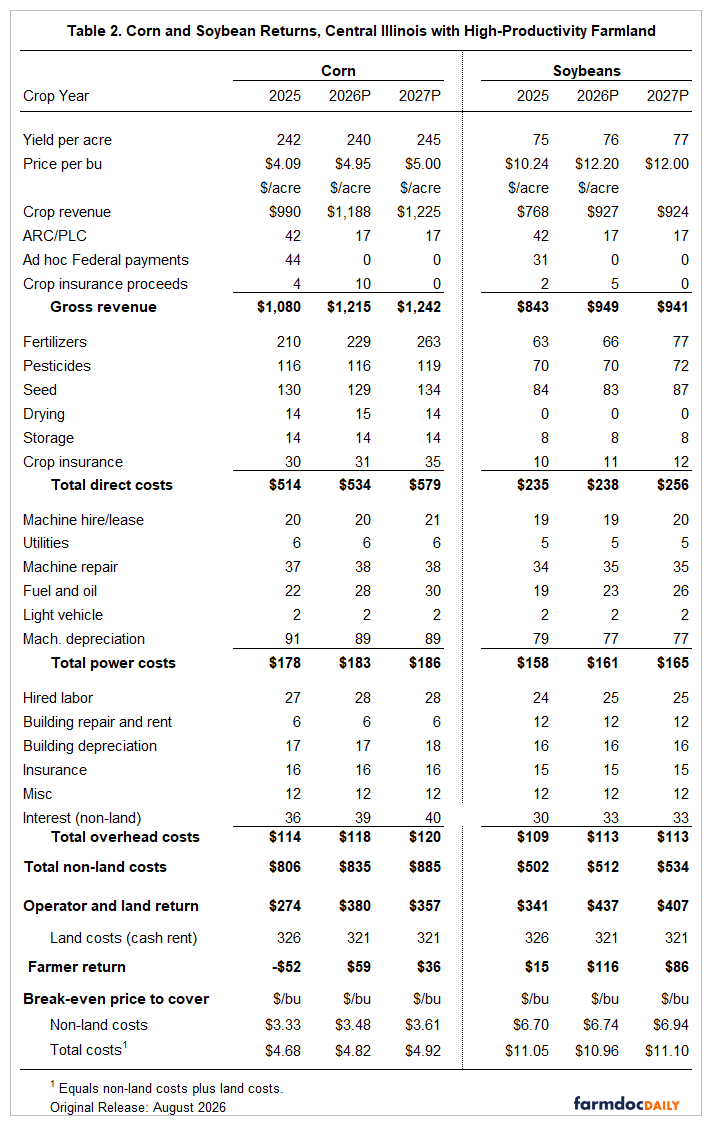
The higher fertilizer and fuel prices resulting from the Iran war are expected to impact costs across the full crop production cycle for 2027. Crop insurance premiums will be higher due to the higher crop prices as well as expectations for continued high uptake of supplemental area plans like SCO and ECO (see farmdoc daily from August 26, 2026). Interest charges are projected to continue to increase as high cost levels coupled with recent declines in working capital suggest strong demand for operating credit (see farmdoc daily articles from November 14, 2025 and June 12, 2026).
Despite reductions in capital purchases over the past two years, machinery depreciation is projected to remain high (see farmdoc daily article from August 18, 2026). Land costs, represented by the average cash rent for each region, are projected to remain stable from 2026 to 2027. A small decline in cash rents occurred from 2024 to 2025, and an additional small decline was projected for 2026. The higher commodity prices and improved return prospects suggest further declines in cash rent to be unlikely, which is consistent with the mid-year survey of farm managers conducted by the Illinois Society of Professional Farm Managers and Rural Appraisers (summary available here, more details available in the farmdoc webinar from August 27th, 2026).
Net farmer return projections for corn acres in 2027 are slightly above break-even for all costs including cash rent at $28 to $36 per acre for the northern and central Illinois regions while projected corn returns for southern Illinois are negative at -$61 per acre. Projected returns on soybeans are $68 to $86 per acre for northern and central Illinois and $18 per acre for southern Illinois. Continuing the trend from the past 15 years, projected returns for soybeans exceed those for corn (see farmdoc daily articles from June 2 and August 4, 2026). Soybeans are projected to have $40 to $50 per acre greater returns in northern and central Illinois, and nearly $80 per acre greater returns than corn in southern Illinois.
While the positive return projections provide a welcome departure from the negative average returns experienced from 2023 to 2025, they remain below longer-term average net return levels. This is illustrated in Figure 1 for a 50-50 corn-soy rotation in central Illinois on high-productivity farmland, where net farmer returns have averaged $100 per acre since 2000.
Break-even prices to cover total costs are just below $5 per bushel in northern and central Illinois and $5.39 per bushel in southern Illinois. Break-even prices to cover total costs on soybean acres range from $11.10 to $11.28 in central and northern Illinois and are nearly $12 per bushel in southern Illinois.
Discussion
Higher commodity prices point towards cautious optimism for corn and soybean returns in Illinois for 2026 and 2027. However, producers continue to face a number of headwinds.
Production costs continue to increase, with more significant increases in fertilizers and fuel this fall, and are expected to continue into and throughout the 2027 crop season. Cost increases have outpaced trend yield increases, resulting in rising break-even prices needed to cover those costs. Total costs, including cash rent on rented farmland, imply break-even prices of around $5 per bushel for corn and $11 per bushel for soybeans in northern and central Illinois. Break-evens in southern Illinois are nearly $5.40 and $12.
While current pricing opportunities suggest the potential for positive returns, those returns remain below longer-term averages. In addition, the increase in corn and soybean prices has largely occurred over just the past month. December 2026 corn futures traded at levels that would have suggested a $4.50 corn price, well below break-even levels for Illinois, throughout the spring and at even lower levels in June and July. Similarly, soybean futures would have suggested cash prices at or below $11.50 throughout the spring and into the summer before rallying to current levels.
Significant uncertainty will continue to impact commodity prices moving forward. Ongoing conflicts in the Middle East and Black Sea regions seem likely to continue to keep pressures on production costs and energy markets. Trade policies remain in flux and have led to shifts in market access for US agricultural exports. Marketing opportunities which can lock in prices above the cost of production for at least a portion of expected production for both the 2026 and 2027 crops warrant serious consideration. This is particularly true for operations that are in more vulnerable financial positions – those with heavy reliance on rented farmland, higher debt levels, and poorer liquidity positions.
Acknowledgment
The authors would like to acknowledge that data used in this study comes from the Illinois Farm Business Farm Management (FBFM) Association. Without Illinois FBFM, information as comprehensive and accurate as this would not be available for educational purposes. FBFM, which consists of 4,900+ farms and 80+ professional field staff, is a not-for-profit organization available to all farm operators in Illinois. FBFM field staff provide independent, on-farm counsel along with recordkeeping, farm financial management, business entity planning and income tax management. For more information, please contact our office located on the campus of the University of Illinois at 217-333-8346 or visit the FBFM website at www.fbfm.org.
References
Mashange, G. and B. Zwilling. "Examining Working Capital Trends in 2024 Amid Lower Net Farm Incomes." farmdoc daily (15):211, Department of Agricultural and Consumer Economics, University of Illinois at Urbana-Champaign, November 14, 2025.
Mashange, G. "Agricultural Credit Conditions in Illinois – First Quarter 2026." farmdoc daily (16):103, Department of Agricultural and Consumer Economics, University of Illinois at Urbana-Champaign, June 12, 2026.
Paulson, N., G. Schnitkey, C. Zulauf and B. Zwilling. "Spring Revision to 2026 Illinois Crop Budgets." farmdoc daily (16):88, Department of Agricultural and Consumer Economics, University of Illinois at Urbana-Champaign, May 19, 2026.
Paulson, N., G. Schnitkey and C. Zulauf. "Historical Corn versus Soybean Returns in Illinois." farmdoc daily (16):96, Department of Agricultural and Consumer Economics, University of Illinois at Urbana-Champaign, June 2, 2026.
Paulson, N., G. Schnitkey, R. Batts, B. Zwilling and C. Zulauf. "Fertilizer and Fuel Prices Higher Heading into Fall 2026." farmdoc daily (16):143, Department of Agricultural and Consumer Economics, University of Illinois at Urbana-Champaign, August 11, 2026.
Schnitkey, G., B. Zwilling, N. Paulson and C. Zulauf. "Capital Purchases and Machinery Depreciation on Illinois Grain Farms." farmdoc daily (16):148, Department of Agricultural and Consumer Economics, University of Illinois at Urbana-Champaign, August 18, 2026.
Schnitkey, G., N. Paulson, C. Zulauf and B. Zwilling. "Historic Corn and Soybean Profitability and 2027 Planting." farmdoc daily (16):138, Department of Agricultural and Consumer Economics, University of Illinois at Urbana-Champaign, August 4, 2026.
Zulauf, C., H. Monaco, J. Coppess and G. Schnitkey. "2026 Area Add-On Insurance Purchases by US Farmers." farmdoc daily (16):153, Department of Agricultural and Consumer Economics, University of Illinois at Urbana-Champaign, August 26, 2026.
Disclaimer: We request all readers, electronic media and others follow our citation guidelines when re-posting articles from farmdoc daily. Guidelines are available here. The farmdoc daily website falls under University of Illinois copyright and intellectual property rights. For a detailed statement, please see the University of Illinois Copyright Information and Policies here.