








Wind and Solar Leases in Foreign-Held U.S. Agricultural Land
A recent farmdoc daily article (Sherrick and Tsay, 2026) used the U.S. Department of Agriculture’s Agricultural Foreign Investment Disclosure Act (AFIDA) data to examine foreign ownership of U.S. agricultural land with emphasis on actual cropland, and presented a visualization tool to understand location and scale of foreign owned land. This article focuses on long term leases reported in AFIDA which total about 16.3 million acres, or about a third of all acres reported in AFIDA. Most of those leases appear to be tied to wind and/or solar development.
Using the same filters as in the earlier work, this article presents information related to: 1) amount of leased acreage held by foreign reporting entities tied to wind and solar projects; 2) where those leases are located; and 3) the countries from which the lessees originate.
What AFIDA Counts as a Lease
AFIDA is a disclosure law. It does not restrict foreign investment, but it requires foreign entities to report any interest in U.S. agricultural land, and the definition of an interest includes leases with a term of 10 years or longer. A long-term lease is reported in the same file as fee ownership but is coded separately to allow a separate tabulation.
Two important features matter for interpreting leased acres. First, AFIDA indicates the total acreage of the parcel associated with the lease, not the area actually used. A wind lease may cover an entire farm even though turbines, access roads, and other equipment occupy a small share of the leased area. Utility-scale solar is different where panels occupy most of the area within a project, so solar leases are more likely to take land out of crop production for the life of the project. Second, a lease does not transfer ownership. When the lease ends, the land remains with the owner.
Data and Methods
Data are from the USDA AFIDA current holdings file as of December 31, 2024. Long-term leases are records with Type of Interest 6, and foreign-held records follow the citizenship and country filters in (Sherrick and Tsay, 2026). The leases are further sorted into wind if the owner name contains words such as wind, turbine, windmill, Aeolus, or Zephyr; and classified as solar if the name contains words including solar, photo or photvoltaic, PV Farm, Sun Power, Sunrun, Sun Edison, SunEnergy, etc. Each record was assigned to only one category when the name contains both a wind and a solar term to avoid potential double counting. The categories do not overlap, and sum to the totals reported. Leases held by companies whose names contain none of these terms are not counted, but are included in other leases for future later analysis.
How Much Lease Acreage Is Tied to Wind and Solar?
Using these definitions, long-term leases held by foreign entities total 6.9 million acres, with 6.3 million acres (90 percent) in leases whose owner names identify a wind or solar project. Of these, 5.3 million acres (85 percent) are wind, 0.7 million acres (11 percent) are solar, and 0.25 million acres (4 percent) are held by entities whose names refer to both. Leased acres should not be considered to be the same as owned acres, because a lease and a fee interest convey very different rights.
What Kind of Land Is Under Lease?
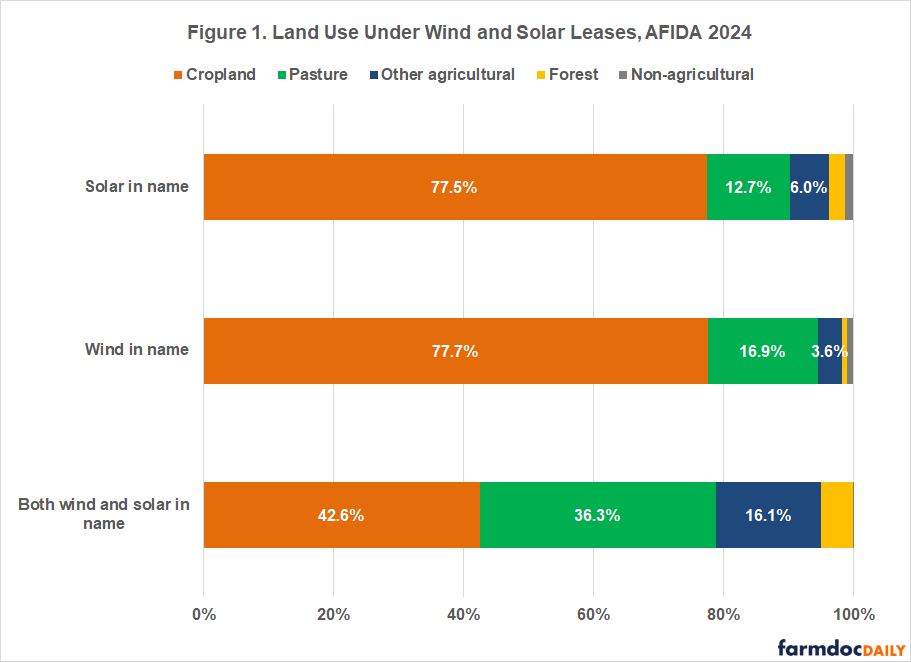
AFIDA also reports how the land in each parcel is used. Of the 6.3 million acres under foreign-held wind and solar leases, 76 percent is cropland, 17 percent is pasture, 4 percent is other agricultural land, and about 1 percent each is forest and non-agricultural land. Wind and solar leases have nearly the same share of cropland, 78 percent each. In Illinois, 98 percent of the lease acres are on cropland (Figure 1). These shares describe the whole leased parcel, not the area occupied by turbines or panels. On wind leases, most of the parcel typically stays in crop or livestock production. On solar leases, the area within a project is generally taken out of production for the life of the project.
Foreign-held wind and solar leases are reported in 555 counties in 42 states. Measured against each county’s land in farms, the share is small in most of these counties. In total, 312 counties are below 1 percent and another 158 are between 1 and 5 percent. Only 83 counties are at 5 percent or more, and 6 counties are at 25 percent or more. Because AFIDA reports whole-parcel acreage, these shares should be read as upper bounds on the land actually used by energy facilities.
The geographic pattern follows the nation’s wind resource. Leases are concentrated in the southern and central Plains (western Oklahoma, northwest and west Texas, Kansas, Nebraska, eastern Colorado, and New Mexico), with additional clusters in South Texas, the Dakotas, central Illinois, northern Indiana, and western and northern New York. Solar leases are more scattered. The largest solar acreages are in Texas, Indiana, Oklahoma, Illinois, and Nebraska, and solar accounts for most of the lease acres in states outside the top 15.
Leases by State
Table 1 lists the top 15 states with the most foreign-held wind and solar lease acres. Oklahoma leads with almost one million acres, followed by Texas, Nebraska, New Mexico, and Kansas. Because states differ greatly in size, the table also shows lease acres as a percentage of each state’s land in farms. Nationally, the share is 0.7 percent. Oklahoma has the highest share among the top 15 at 3.1 percent, followed by New York at 2.6 percent. New York ranks tenth in acres but has relatively little farmland. In Texas, the 0.9 million acres represent 0.7 percent of the state’s land in farms.
Illinois ranks seventh, or 1.4 percent of the state’s land in farms. Most of these acres are wind leases (317,451 acres), with 40,806 acres of solar leases. Leases are concentrated in central Illinois. McLean County has 133,340 lease acres and Logan County has 48,337 acres. By comparison, lease acres are about 14 times larger than foreign-owned acres in Illinois.
Table 1. Top 15 States with Foreign-Held Wind and Solar Lease Acres Reported in AFIDA 2024
| State | Wind acres | Solar acres | Wind & solar acres | Total energy acres as % of land in farms | Largest investor country |
| Oklahoma | 981,929 | 49,156 | 0 | 3.1% | Canada |
| Texas | 769,595 | 135,875 | 0 | 0.7% | Canada |
| Nebraska | 583,902 | 40,449 | 0 | 1.4% | Canada |
| New Mexico | 587,198 | 9,237 | 0 | 1.5% | Canada |
| Kansas | 551,668 | 12,672 | 0 | 1.3% | Canada |
| Colorado | 238,468 | 24,689 | 230,086 | 1.6% | Netherlands |
| Illinois | 317,451 | 40,806 | 0 | 1.4% | Canada |
| South Dakota | 301,144 | 2,720 | 0 | 0.7% | Canada |
| North Dakota | 206,025 | 3,937 | 0 | 0.5% | Italy |
| New York | 136,061 | 34,421 | 0 | 2.6% | Canada |
| Missouri | 114,072 | 23,176 | 19,015 | 0.6% | Italy |
| Montana | 154,537 | 315 | 0 | 0.3% | Canada |
| Indiana | 74,637 | 75,919 | 0 | 1.0% | Canada |
| Wyoming | 111,123 | 5,760 | 0 | 0.4% | Canada |
| Washington | 65,941 | 27,552 | 2,098 | 0.7% | Canada |
| All other states | 132,005 | 199,482 | 2 | 0.1% | |
| United States | 5,325,756 | 686,166 | 251,202 | 0.7% |
Source: TIAA Center for Farmland Research calculation using USDA AFIDA 2024
Discussions of foreign ownership of farmland often raise concerns about farmland values, food security, and national security, and the lease records speak to each in a different way. A commonly stated concern is that foreign leases somehow impact the supply chain or substitute competes with farmers in the land market. A long-term lease, however, does not involve purchasing land, and individuals often generate increased returns through leases for potential future development. On food security, most leased parcels are cropland, but the leases cover about 0.7 percent of U.S. land in farms, and on wind leases most of each parcel typically remains in production. Solar projects do take land out of production for the life of the project, and foreign-held solar leases cover about 0.7 million acres of parcel area nationally. Concerns about national security have focused mainly on investors from countries considered adversarial to the United States. In fact, nearly all foreign-held energy-lease acres are associated with investors from Canada and Western Europe.
Investor Countries
AFIDA records the country of the foreign investor for each filing. Among these wind and solar leases, Canada accounts for 59 percent of acres (3.7 million acres), followed by Italy (14 percent), the United Kingdom (6 percent), Denmark (6 percent), the Netherlands (5 percent), and France (4 percent). Together, ten countries account for 99 percent of the total, and all are in North America, Europe, or Australia. Canada is the largest investor country in 12 of the 15 states in Table 1. Italy leads in North Dakota and Missouri, and the Netherlands in Colorado. Because most filings are made by project-level companies, the country reported reflects the foreign investor behind the filing rather than where the developer operates.
Conclusions
Most long-term leases held by foreign persons are for wind and solar projects, covering 6.3 million acres, or about 0.7 percent of U.S. land in farms. In most counties the share is under 1 percent, and nearly all of these acres are associated with investors from Canada and Western Europe. Because the landowner retains title and AFIDA reports acreage as a whole parcel, lease acres are best viewed separately from ownership when assessing foreign holdings of U.S. agricultural land. More information can be found with county-level details on foreign ownership available in the TIAA Center’s interactive map at https://farmdoc.illinois.edu/farmland-center/tools-data/foreign-agricultural-land-ownership-map.
References
Sherrick, B. and J. Tsay. “Foreign Ownership of U.S. Agricultural Land.” farmdoc daily (16):171, Department of Agricultural and Consumer Economics, University of Illinois at Urbana-Champaign, September 23, 2026. https://farmdocdaily.illinois.edu/2026/09/foreign-ownership-of-us-agricultural-land.html
USDA Farm Service Agency. “Foreign Holdings of U.S. Agricultural Land Through December 31, 2024.” January 2026.
Disclaimer: We request all readers, electronic media and others follow our citation guidelines when re-posting articles from farmdoc daily. Guidelines are available here. The farmdoc daily website falls under University of Illinois copyright and intellectual property rights. For a detailed statement, please see the University of Illinois Copyright Information and Policies here.