








Consider ARC-IC for FSA Farms Planted Entirely to Corn
Agriculture Risk Coverage at the individual level (ARC-IC) deserves consideration for 2026 on Farm Service Agency (FSA) farms planted entirely to corn with relatively low yields. ARC-IC bases its revenue calculation on the crops planted in 2026, while ARC at the county level (ARC-CO) bases its revenue calculation only on a farm’s historical base acres. An all-corn farm with both corn and soybean base acres may therefore receive a larger payment from ARC-IC when corn generates a payment and soybeans do not. A McLean County, Illinois example illustrates this possibility.
Why Consider ARC-IC for 2026
The December 11, 2026 enrollment deadline comes after harvest, allowing farmers to evaluate ARC-IC using known farm yields. Market year average (MYA) prices remain uncertain. For corn and soybeans harvested in 2026, the marketing year ends in August 2027, and final MYA prices will be available in September 2027.
Our November 10, 2026 farmdoc daily article discusses situations that warrant evaluating ARC-IC, including farms with complete prevented planting or localized yield losses. Here, we focus on farms planted entirely to corn. The relevant comparison is the total payment for the FSA farm by the three different commodity program options, ARC-IC, ARC-CO and PLC (Price Loss Coverage).
Current projected prices, combined with below-trend yields, make this comparison particularly relevant in Illinois. As discussed in farmdoc daily on November 17, 2026, the state’s corn yield is projected at 200 bushels per acre, 17 bushels below trend. Below-trend yields alone do not assure a payment, however. Payments depend on revenue relative to each program’s benchmark.
An All Corn Farm in McLean County
Consider an FSA farm with 100 base acres, consisting of 60 corn base acres and 40 soybean base acres. All 100 planted acres are corn in 2026. Under ARC-CO or PLC, corn and soybean payments are calculated and paid out on their respective base acres regardless of the crops planted.
Table 1 uses a county corn yield of 210 bushels per acre, 25.9 bushels below the 235.9-bushel benchmark yield. The soybean yield is 70 bushels per acre, 3.3 bushels below its 73.3-bushel benchmark. These are illustrative county yields rather than final estimates. We assume MYA prices of $4.70 per bushel for corn and $12.10 for soybeans. The $4.70 corn price is retained for this illustration.
Table 1. Illustrative 2026 ARC-CO Payments in McLean County, Illinois
| Crop | Base acres | County yield (bu./acre) |
MYA price ($/bu.) |
Payment ($/base acre) |
| Corn | 60 | 210 | $4.70 | $69 |
| Soybeans | 40 | 70 | $12.10 | $0 |
Notes: Corn ARC-CO benchmark yield and price are 235.9 bushels per acre and $5.03 per bushel. Soybean ARC -CO benchmarks are 73.3 bushels per acre and $12.17 per bushel. Payment rates include the 85% payment-acre factor and are rounded to whole dollars. Source: accompanying Table 1 workbook. Sequestration is not considered (it applies to all commodity program payments).
Using the rounded payment rates in the final column of Table 1, the projected ARC-CO payment is $4,140 for the farm ($69 × 60 corn base acres + $0 × 40 soybean base acres). The soybean base acres generate no payment because assumed soybean revenue is above its guarantee. At these assumed prices, PLC would not trigger for corn or soybeans because prices exceed their effective reference prices.
Calculating the ARC-IC Benchmark
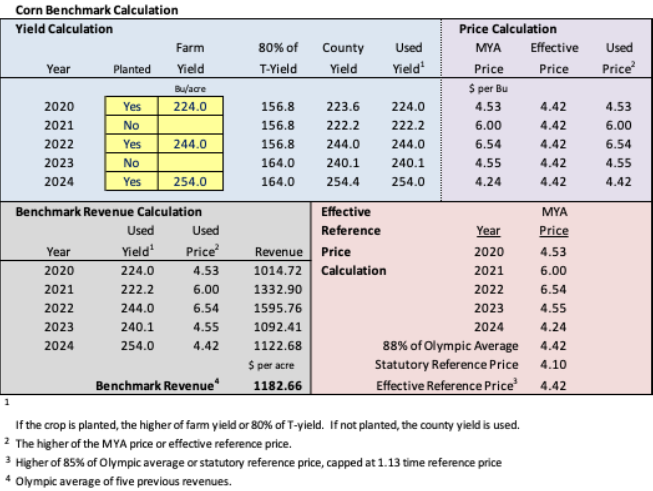
We use the 2026 Farm Bill What-If Tool to illustrate ARC-IC. This example assumes only this FSA farm is enrolled. The farm follows a corn-soybean rotation and had corn yields of 224 bushels per acre in 2020, 244 in 2022, and 254 in 2024. County yields are assigned for 2021 and 2023, when corn was not planted. If applicable, a floor of 80% of the county transitional yield is used in benchmark years when the crop was planted and actual yields were very low.
Table 2 reproduces the corn benchmark calculation. Each year’s revenue equals the yield used times the higher of that year’s MYA price or the 2026 effective reference price. The Olympic average excludes the highest and lowest annual revenues. Here, 2022 and 2020 are excluded, leaving an average corn benchmark revenue of $1,182.66 per acre.
Table 2. Corn Benchmark Revenue for the Example Farm
Because all planted acres are corn in 2026, the ARC-IC benchmark is based entirely on corn. Soybean benchmark revenue receives no weight in this example, even though the farm has 40 soybean base acres.
Comparing Whole Farm Payments
For ARC-IC, assume the farm’s 2026 corn yield is 210 bushels per acre, equal to the county yield assumed for ARC-CO. At $4.70 per bushel, actual farm revenue is $987.00 per acre. The ARC-IC guarantee is 90% of benchmark revenue for corn ($1,182.66), or $1,064.39 per acre. The resulting payments are $50.30 per base acre, which equals 65% of the difference between the $1,064.39 guarantee and $987 revenue. Not the lower payment rate here — ARC-IC pays on 65% of total base acres, compared with 85% for ARC-CO and PLC.
Table 3. Illustrative ARC-IC Payment for the Example Farm
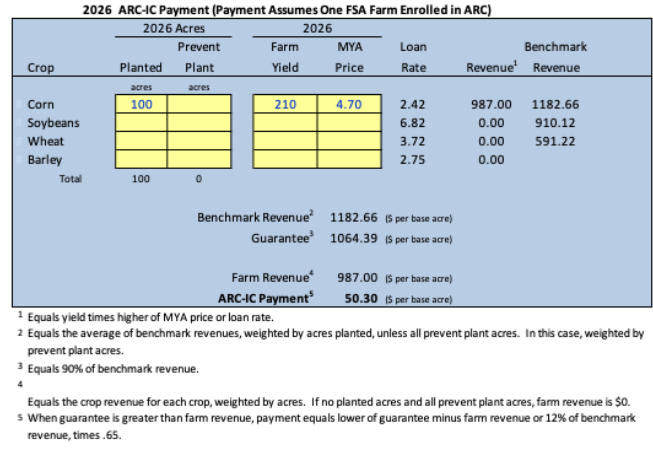
The $50.30 payments will be paid on 100 base acres, or $5,030 for the FSA farm. The $5,030 project payments for ARC-IC are $890 above the $4,140 for ARC-CO. The ARC-IC payment is higher because it is based on all corn, eliminating the $0 projected payment for soybeans and thus offsetting the lower 65% payment factor for ARC-IC. Note that ARC-IC here also better matches the loss experience on the farm for 2026. Corn was planted, and the ARC-IC payment is based entirely on the poor revenue relative to the farm’s historical benchmark for corn.
Factors That Can Change the Comparison
Relative farm and county yields matter. A lower farm yield increases the ARC-IC revenue shortfall, while a lower county yield increases the ARC-CO shortfall. At a fixed county yield, larger farm losses favor ARC-IC until its payment cap is reached. If county yields fall more than farm yields, ARC-CO becomes more competitive.
Prices also matter. Higher MYA prices reduce revenue shortfalls and can eliminate payments. Lower prices can increase payments until the caps are reached and may also trigger PLC. The ARC-IC advantage shown here should not be assumed to hold across all price and yield combinations.
In addition, base acres and planted acres matter. The benefit of ARC-IC illustrated here depends partly on having soybean base acres that generate no ARC-CO payment while all 2026 planted acres are corn. A farm with a larger share of corn base acres would have a higher whole-farm ARC-CO payment under the same assumptions, reducing the advantage of ARC-IC.
Last, enrolling other FSA farms in ARC-IC can change the result. All FSA farms a producer enrolls in ARC-IC within a state are combined for the revenue calculation. Strong revenue on another enrolled farm can offset this farm’s shortfall. Evaluate the combined result before making an election. Historical farm yields on all FSA farms enrolled in ARC-IC also must be certified to FSA, adding to the documentation required for ARC-IC.
Summary
An FSA farm planted entirely to corn in 2026 may benefit from enrolling in ARC-IC when corn yields are relatively low, and the farm has soybean base acres that are currently projected to generate smaller ARC-CO or PLC payment. In the McLean County example, ARC-IC pays approximately $5,030 compared with $4,140 for ARC-CO. This result is specific to the assumed yields, prices, benchmark revenue, and base-acre mix.
Farmers can use the 2026 Farm Bill What-If Tool to compare total payments for each FSA farm using known 2026 farm yields, alternative MYA prices, and county yield expectations. Also evaluate any farms considered for ARC-IC together. We suggest starting with the FSA farm with the highest FSA payment per base acre and working down, adding one farm at a time. The all-corn situation is a reason to run the comparison, with the final choice based on the farm’s own records and expected payments.
We illustrate here a case where only corn is planted. State yield projections suggest that many farms will have FSA payments triggered for corn. However, low soybean yields can also trigger payments, and those situations should be considered as well.
References
Monaco, H., N. Paulson, G. Schnitkey and C. Zulauf. "The 2026 ARC/PLC Decision: Who Should Consider ARC-IC?" farmdoc daily (16):203, Department of Agricultural and Consumer Economics, University of Illinois at Urbana-Champaign, November 10, 2026.
Schnitkey, G., C. Zulauf and N. Paulson. "Illinois Yields in 2026 Below Trend." farmdoc daily (16):207, Department of Agricultural and Consumer Economics, University of Illinois at Urbana-Champaign, November 17, 2026.
farmdoc. “Farm Bill What-If Tool.” Last updated November 18, 2026. University of Illinois Urbana-Champaign. https://farmdoc.illinois.edu/fast-tools/arc-co-plc-model
Disclaimer: We request all readers, electronic media and others follow our citation guidelines when re-posting articles from farmdoc daily. Guidelines are available here. The farmdoc daily website falls under University of Illinois copyright and intellectual property rights. For a detailed statement, please see the University of Illinois Copyright Information and Policies here.