








The 2026 ARC/PLC Decision: Who Should Consider ARC-IC?
The December 11th deadline for the 2026 crop year ARC/PLC enrollment is approaching. Because the deadline is later than usual, most farmers have harvested their crops. Knowing individual farm yields will provide an indication of the county yields in ARC at the county level (ARC-CO) and allow better evaluation of the individual ARC program (ARC-IC). This article describes ARC-IC and how it differs from ARC-CO. Situations in which ARC-IC are attractive relative to ARC-CO or PLC also are discussed.
The 2026 Decision
The deadline for the 2026 crop year decision is December 11, 2026, as announced in a September press release from USDA. For each FSA farm, producers can either:
- Enroll base acres crop by crop in ARC-CO (Agriculture Risk Coverage – County Coverage) or PLC (Price Loss Coverage), or
- Enroll all base acres of all covered commodities on that FSA farm in ARC-IC (Agriculture Risk Coverage – Individual Coverage).
In 2025, the One Big Beautiful Bill Act (OBBBA) changes resulted in producers receiving the higher of the ARC-CO or PLC payment (see farmdoc daily, October 13, 2026). For 2026, the annual choice returns but the decision is much later than the usual March 15 deadline. Any payments triggered for the 2026 crop year would not be received until October 2027.
What ARC-IC Is
ARC-IC is a whole-farm revenue program. It pays when the farm’s own revenue per acre, pooled across all planted covered commodities, falls below a guarantee. ARC-CO, by contrast, pays crop by crop on county revenue.
The One Big Beautiful Bill Act (OBBBA) made changes to ARC and PLC programs. Those changes took effect for the 2025 program and will continue in 2026. For ARC-IC, the revenue guarantee and payment cap were increased. Following ARC-CO, the revenue guarantee is now 90%, and the payment cap is 12% of benchmark revenue. That means that relative to previous years, ARC-IC payments are more likely to happen and will be larger when they occur. For a more detailed discussion of the OBBBA changes to ARC and PLC see the farmdoc daily article from July 15, 2025.
The ARC-IC calculation follows three steps (see farmdoc daily, October 29, 2019 and February 4, 2020):
- Benchmark revenue. For each covered commodity planted in 2026, revenue is calculated for each year from 2020 to 2024 as the farm yield times the higher of the marketing year average (MYA) price or the effective reference price. For any years in which the crop was not planted from 2020 to 2024, replacement county yields provided by FSA are utilized. The Olympic average of these five revenues is the crop’s benchmark revenue. Crop benchmarks are then weighted by the acres planted to each crop in 2026. As a result, the benchmark changes with the current year’s crop mix.
- Actual revenue. 2026 farm yields times 2026 MYA prices, weighted by 2026 planted acres of each covered commodity.
- Payment. The guarantee (90% of benchmark revenue) minus actual revenue, capped at 12% of benchmark revenue, paid on 65% of the total base acres of the ARC-IC farm.
Farm yields are those certified to FSA on form CCC-863 for each FSA farm, which can be supported by RMA production records. When the farm yield in a benchmark year is below 80% of the county transitional yield (T-yield), 80% of the T-yield is used. When the crop was not planted on the farm in a benchmark year, the county ARC-CO yield is assigned for that year.
Key Differences to ARC-CO
Table 1 summarizes the main differences between ARC-CO and ARC-IC for 2026. Besides the whole farm vs. crop specificity, a key difference is that ARC-IC pays on 65% of base acres, while ARC-CO and PLC pay on 85%. For ARC-IC to provide greater support than ARC-CO, the covered farm-level revenue losses must exceed the county revenue loss by enough to compensate for paying on 20% fewer acres.
Table 1. Comparison of ARC-CO and ARC-IC for the 2026 Crop Year
| ARC-CO | ARC-IC | |
| Enrollment unit | Base acres for each covered commodity on an FSA farm enrolled in ARC-CO | Base acres for all covered commodities on all FSA farms enrolled in ARC-IC; FSA farms in the same state are combined. |
| Crops | One crop at a time | All covered commodities planted, pooled |
| Yields used | County yields | Farm yields certified to FSA (CCC-863) |
| Benchmark yield | The higher of trend adjusted county yield or 80% T-yield | The higher of farm yield or 80% T-yield. County Trend Adjusted Yields when crop was not planted. |
| Benchmark price | Olympic average of the higher of MYA prices or effective reference price, 2020–2024 | Higher of MYA in each year or 2026 effective reference price |
| Benchmark revenue | Benchmark county yield × benchmark price | Olympic average of farm revenue by crop from 2020–2024, weighted by 2026 planted acres |
| Actual revenue | 2026 county yield × 2026 MYA | 2026 farm yields × 2026 MYA, weighted by planted acres |
| Guarantee / cap | 90% / 12% of benchmark | 90% / 12% of benchmark |
| Payment acres | 85% of the crop’s base acres | 65% of total base acres |
| Payment depends on planting? | No. Paid on base acres regardless of what is planted | Yes. Only planted covered commodities count; prevented planting counts only if 100% of intended covered acres are prevented planted |
| Fruit, vegetable, wild rice planting | Payment reduced above 15% of base acres | Payment reduced above 35% of base acres |
How to Analyze ARC-IC
The Farm Bill What-If Tool includes an ARC-IC Calculator that is updated with all available information for 2026. Since 2026 farm yields are mostly known, the only major unknown is the 2026 MYA price. The November WASDE projects 2026/27 MYA prices at $4.60 per bushel for corn and $12.10 for soybeans. Wheat MYA prices are projected at $6.20. The MYA runs from September to August for corn and soybeans, and June to May for wheat. Thus, the final 2026 MYA won’t be known until the end of October 2027 for corn and soybeans, and the end of June 2027 for wheat.
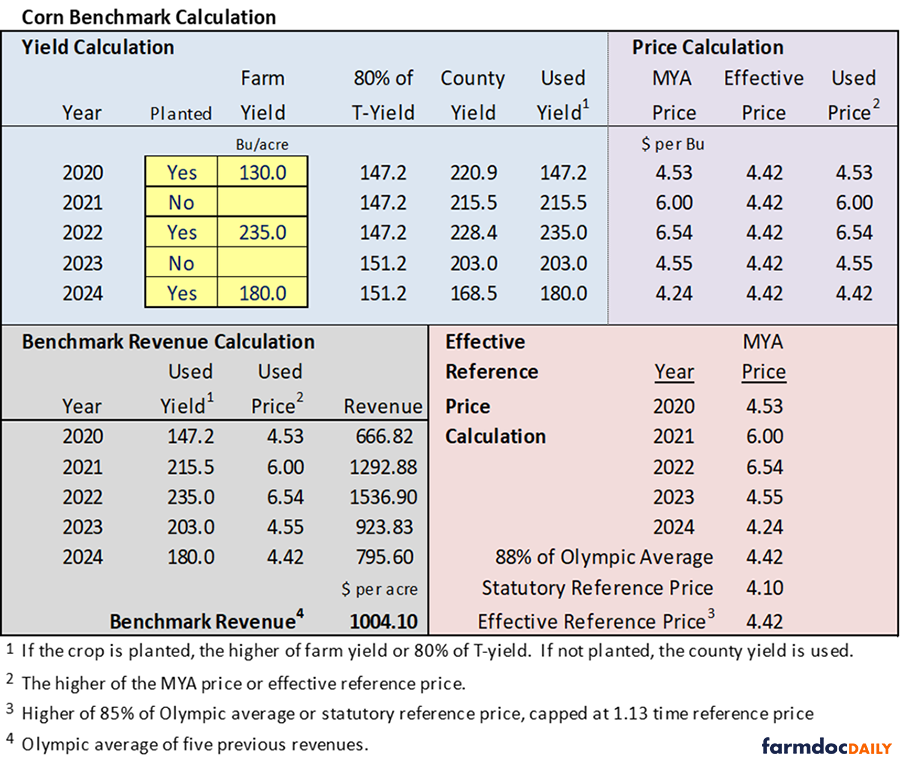
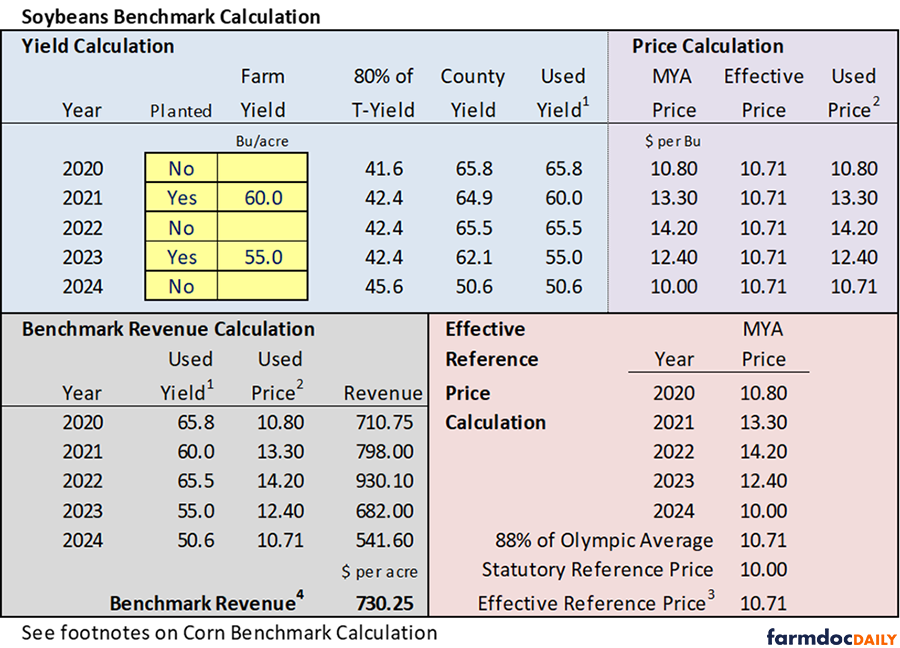
The calculator works in two steps. First, the user selects the county where the FSA farm is located and the covered commodities planted in 2026. Only crops planted in 2026 need to be entered. For each crop, farm yields are entered for each year from 2020 to 2024 in which the crop was planted. See figure 1 for example. The tool substitutes 80% of the T-yield for low yields (i.e. 2020 for corn) and the county yield for years the crop was not planted (i.e. 2021 and 2023 for corn, and 2020,2022,2024 for soybeans).
Figure 1. ARC-IC Calculator Benchmark Inputs for Blue Earth County, MN
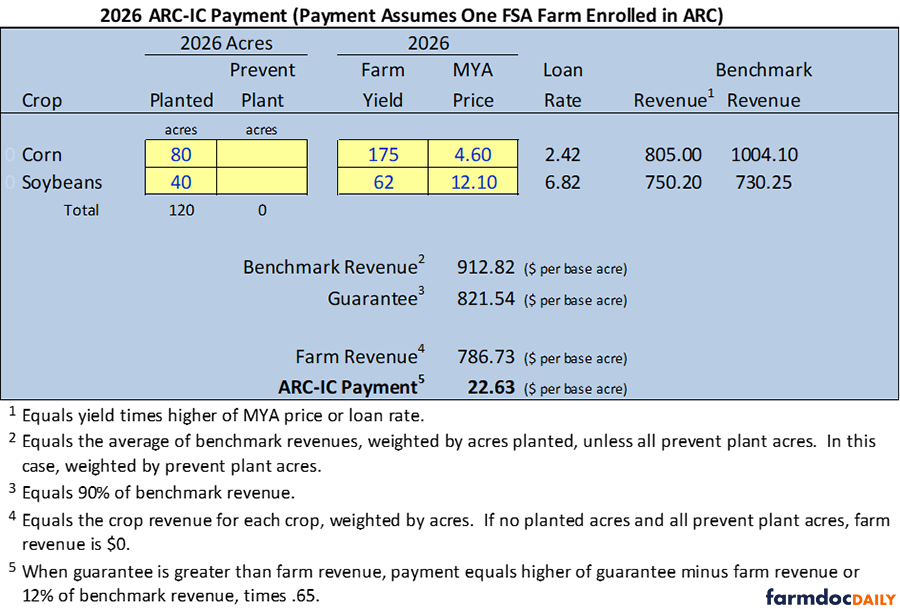
Second, the user enters 2026 planted acres, prevented planting acres, farm yields, and estimated MYA prices. The tool then reports the ARC-IC benchmark revenue, guarantee, actual revenue, and payment per base acre (Figure 2). In the example, 80 acres for corn and 40 acres of soybeans were planted in 2026. Thus, 2/3 (80 ÷120) of the farm revenue and benchmark revenue comes from corn, and 1/3 from soybeans. Corn had a localized loss while soybeans were in line with trends.
The result in this case, is an estimated payment of $22.63 per base acre in that farm. Payments per base acre already include the 65% factor, so they can be compared directly with per base acre payments for ARC-CO and PLC.
Figure 2. ARC-IC Calculator Payment Results for Blue Earth County, MN
The ARC-IC result should then be compared with ARC-CO and PLC payments for the same FSA farm. Those can be estimated with the What-If Tool or the online ARC/PLC Calculator or UMN ARC/PLC tool. Remember that ARC-IC applies to all covered commodities on the FSA farm, so the comparison must be with the sum of ARC-CO and/or PLC payments across all crops on that farm.
Discussion
ARC-IC has historically been a niche choice. Its use peaked when prevented planting was widespread in 2019, for the 2019 and 2020 program years. In 2019, about 6% of corn and soybean base acres were enrolled in ARC-IC, compared with about 1% in 2021 and 2022 (see farmdoc daily, November 23, 2020 and April 18, 2023). Still, the situations below can make ARC-IC worth a look (see farmdoc daily, October 29, 2019).
Who Might Find ARC-IC Attractive in 2026?
The whole FSA farm was prevented planted.
If all initially intended covered commodity acres on the farm were approved as prevented planting by FSA, actual revenue is zero and ARC-IC pays the maximum: 12% of benchmark revenue on 65% of base acres. If any covered commodity was planted, only the revenue of the planted crops is used. For example, a farm that took prevented planting on corn but planted soybeans will be evaluated on soybean revenue only (see farmdoc daily, February 4, 2020).
The FSA farm had a localized yield loss in 2026.
ARC-CO pays on county revenue. A farm that had a poor year while the county did not, due to hail, flooding, or drought on specific fields, will not be covered by ARC-CO but may receive an ARC-IC payment. Importantly, the localized losses are at the farm level, which includes all covered crops in the farm.
Having multiple crops in the farm might decrease the chances of a lower farm revenue given its diversification. As shown in the example above, if that farm had only corn planted in 2026, payments would have been larger since soybeans are increasing the farm revenue relative to the benchmark revenue.
Farm yields are much higher than county yields.
Higher farm yields raise benchmark revenue, and therefore the size of any payment, but they do not necessarily make a payment more likely. Assuming the farm and the county have the same percentage revenue loss, the farm benchmark would need to be roughly 30% higher than the county benchmark (85% ÷ 65% = 1.31) for ARC-IC to pay as much as ARC-CO.
Fruits, vegetables, or wild rice are planted on base acres.
Planting these crops above 15% of base acres reduces ARC-CO and PLC payment acres, while ARC-IC allows up to 35%. This narrows, but does not reverse, the payment acre gap between ARC-IC and ARC-CO.
Finally, ARC-IC requires more work. Farm yields must be certified to FSA, and ARC-IC payments have historically taken longer to process than ARC-CO and PLC payments (see farmdoc daily, November 23, 2020).
Combining Multiple FSA Farms
All FSA farms a producer enrolls in ARC-IC within a state are combined into one ARC-IC farm. FSA does not average the payments of each FSA farm. Instead, it averages benchmark revenue and actual revenue across all crops on all enrolled farms, weighted by planted acres (see farmdoc daily, February 11, 2020). Which FSA farms to enroll is therefore an important part of the decision.
The suggested strategy is to estimate ARC-IC payments for each FSA farm, rank them from highest to lowest, and then add farms one at a time, keeping each addition that increases the total payment. See farmdoc daily, February 18, 2020 and March 5, 2020 for more discussion on aggregating multiple farms. The farmdoc Old Excel version of the calculator allows for multiple farms comparison.
Summary and Other Resources
The December 11th deadline for the 2026 ARC/PLC decision comes after harvest, which gives farmers an unusual opportunity to evaluate ARC-IC with known farm yields. ARC-IC pays on only 65% of base acres, so unless for specific situations, ARC-CO or PLC might remain the better choice.
ARC-IC is worth evaluating for FSA farms that were entirely prevented planted or that had localized yield losses in 2026. When more than one FSA farm is considered, combinations should be evaluated, since pooling can either dilute or increase payments.
Producers are encouraged to use the ARC-IC Calculator in the Farm Bill What-If Tool and to compare results with ARC-CO and PLC estimates from the online ARC/PLC Calculator and/or the UMN ARC/PLC tool. Local FSA offices can confirm farm yield records and certification requirements for ARC-IC.
ARC-IC will also be discussed in the upcoming webinars on Tuesday, November 17th:
– farmdoc: “Final Look at the 2026 ARC/PLC Decision” (registration here).
– MN extension: “ARC vs PLC: Making Your 2026 Farm Bill Decision“(registration here).
References
Paulson, N., H. Monaco, G. Schnitkey and C. Zulauf. "2025 Final ARC/PLC Payments." farmdoc daily (16):185, Department of Agricultural and Consumer Economics, University of Illinois at Urbana-Champaign, October 13, 2026.
Paulson, N., G. Schnitkey, H. Monaco and C. Zulauf. "The 2026 ARC/PLC Decision: ARC-CO vs PLC." farmdoc daily (16):195, Department of Agricultural and Consumer Economics, University of Illinois at Urbana-Champaign, October 27, 2026.
Schnitkey, G., B. Brown, K. Swanson, C. Zulauf, N. Paulson and J. Coppess. "Strategies for Using ARC-IC." farmdoc daily (10):25, Department of Agricultural and Consumer Economics, University of Illinois at Urbana-Champaign, February 11, 2020.
Schnitkey, G., N. Paulson, C. Zulauf and J. Coppess. "Impacts of the Commodity Title Changes Under the One Big Beautiful Bill Act (OBBBA) for Midwestern Farms in 2025." farmdoc daily (15):128, Department of Agricultural and Consumer Economics, University of Illinois at Urbana-Champaign, July 15, 2025.
Schnitkey, G., C. Zulauf, R. Batts, K. Swanson, J. Coppess and N. Paulson. "ARC-IC: Payment Examples and Revised 2019 ARC-IC Payment Calculator." farmdoc daily (10):20, Department of Agricultural and Consumer Economics, University of Illinois at Urbana-Champaign, February 4, 2020.
Swanson, K., G. Schnitkey, C. Zulauf and N. Paulson. "Review of ARC-IC Farm Program Decision." farmdoc daily (10):202, Department of Agricultural and Consumer Economics, University of Illinois at Urbana-Champaign, November 23, 2020.
Zulauf, C., B. Brown, G. Schnitkey, K. Swanson, J. Coppess and N. Paulson. "The Case for Looking at the ARC-IC (ARC-Individual) Program Option." farmdoc daily (9):203, Department of Agricultural and Consumer Economics, University of Illinois at Urbana-Champaign, October 29, 2019.
Schnitkey, G., B. Brown, C. Zulauf, K. Swanson, J. Coppess and N. Paulson. "Multi-farm ARC-IC Tool and Other ARC-IC Information." farmdoc daily (10):30, Department of Agricultural and Consumer Economics, University of Illinois at Urbana-Champaign, February 18, 2020.
Swanson, K., G. Schnitkey, J. Coppess, C. Zulauf and N. Paulson. "Case Study: Farm Program Value Over Two Years." farmdoc daily (10):41, Department of Agricultural and Consumer Economics, University of Illinois at Urbana-Champaign, March 5, 2020.
Schnitkey, G., C. Zulauf, N. Paulson, and Jim Baltz. “ARC-CO: Background, Payments, and Perspectives for Corn.” farmdoc daily (13): 71, Department of Agricultural and Consumer Economics, University of Illinois at Urbana-Champaign, April 18, 2023.
USDA Farm Service Agency. 1-ARCPLC (Revision 1) Handbook, Amendment 14. January 2025.
Disclaimer: We request all readers, electronic media and others follow our citation guidelines when re-posting articles from farmdoc daily. Guidelines are available here. The farmdoc daily website falls under University of Illinois copyright and intellectual property rights. For a detailed statement, please see the University of Illinois Copyright Information and Policies here.