








Season’s Eatings: Holiday Meals and Food Price Concerns
Introduction
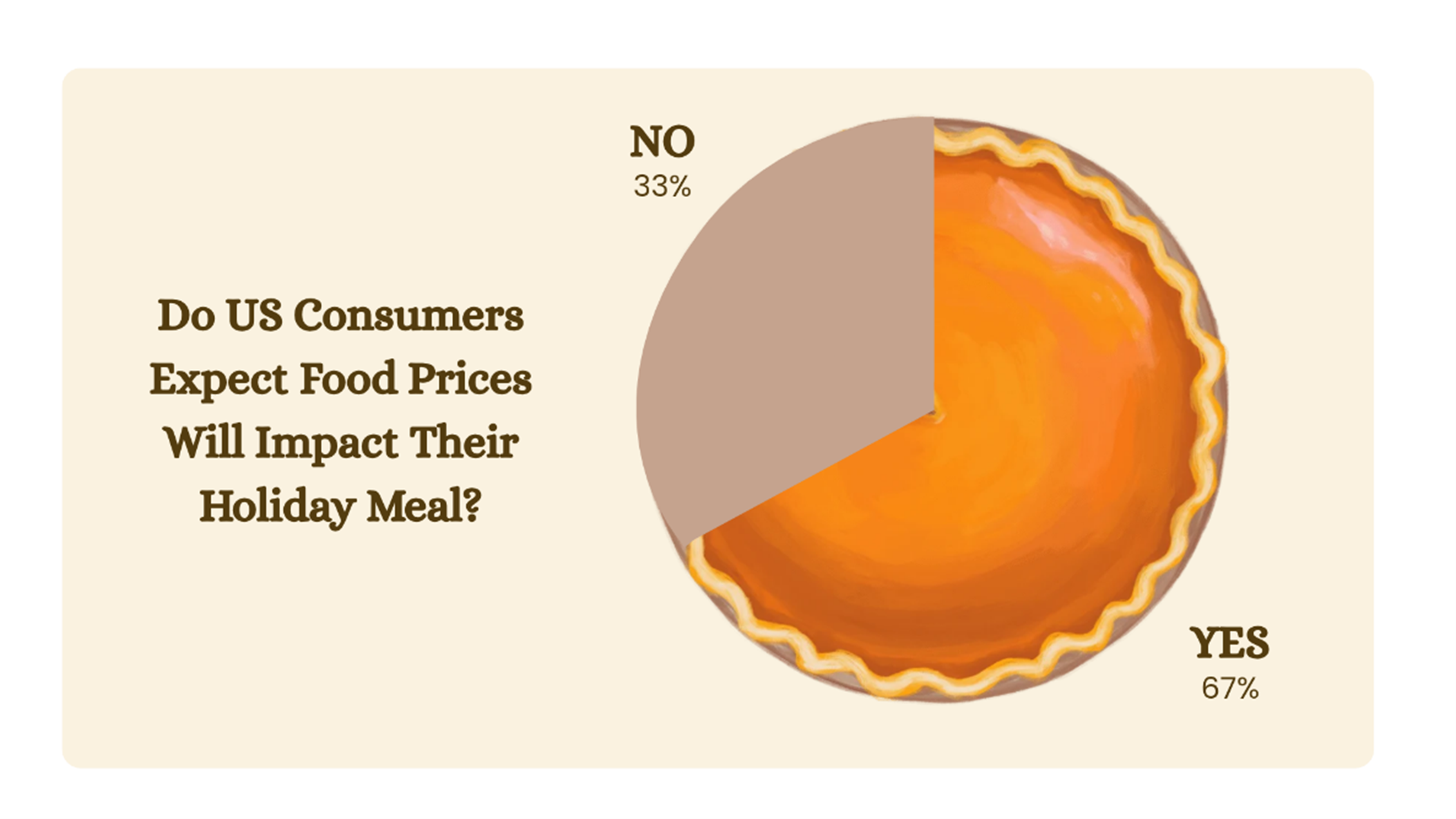
As the holiday season approaches, many households are planning gatherings and preparing tables for festive meals. An added stress for many during the holidays is the rising cost of food prices. In this article, we examine U.S. consumers’ holiday meal plans using data from the Gardner Food and Agricultural Policy Survey (GFAPS), conducted in November 2026. Specifically, we explore how concerns about food prices are shaping consumers’ meal plans and the types of proteins households plan to serve for two major holidays, Thanksgiving and Christmas. We find that 67% indicated that they expected food prices to affect their holiday meal. To manage costs, respondents most commonly reported shopping for deals on ingredients and shopping ahead of time to spread out costs. Notably, reducing the amount of meat at their holiday meal was a less common cost cutting strategy for consumers compared with last year (farmdoc daily, December 4, 2025). For Thanksgiving, over 80% of respondents celebrating the holiday reported planning to serve turkey, whereas for Christmas, pork, beef, and turkey were all common protein choices. Importantly, consumers’ choices at the grocery store have implications for many food system players, including farmers and ranchers.
Data
The Gardner Food and Agricultural Policy Survey is a quarterly survey conducted online to assess public perceptions of issues relevant to food and agricultural policy. Each quarter, Qualtrics Panels recruits approximately 1,000 adult US consumers using quotas to approximately match the US population in terms of age, gender, income, and region. In this post, we use results from the nineteenth wave, conducted in November 2026.
To assess holiday meal plans, respondents were first asked whether they celebrated nine common seasonal holidays (Thanksgiving, Christmas, Hanukkah, Kwanzaa, Diwali, New Years, Winter Solstice, Lunar New Year, Boxing Day, and other) and, for each, respondents were asked whether they typically celebrated with a meal. In our sample, 97% said they celebrate a winter holiday with a meal (n=1,033).
If a respondent indicated that they typically celebrated a winter holiday with a meal, they were asked whether they expected food prices to impact their holiday meal(s). Further, to elicit information about possible cost management strategies, those who expected food prices to affect their meals (n=1,033) were asked whether they expected to engage in fourteen possible strategies. These included changes to the meal itself (reduce the number of foods served at holiday meals, reduce the amount of food served at holiday meals, change the types of foods served at holiday meals, reduce the amount of meat served at holiday meals), how or when they would shop (shop ahead of time for holiday ingredients to spread out the cost, shop for deals on holiday ingredients), the role of guests (increase the amount of foods guests bring for the holiday meal, ask guests to pay a portion of the grocery bill for holiday meal, reduce the number of guests at holiday meals), changes to how they would access foods (reduce amount purchased from restaurants for holiday meals, increase use of a food bank or food pantry to get ingredients for holiday meals, increase use of government food assistance (SNAP, WIC, etc.) to get ingredients for holiday meals), and whether they planned to cancel the holiday meal completely. The order of strategies was randomized to prevent ordering effects. Respondents were able to select multiple strategies and were able to indicate they did not plan to engage in any strategies by selecting “none”.
Further, for those that planned to celebrate Thanksgiving with a meal (n=893) and Christmas with a meal (n=935), we asked what proteins, if any, they planned to serve. For each, respondents could select turkey, a non-turkey bird (e.g., duck, goose, game hen), beef (e.g., prime rib, steak), pork (e.g., ham), lamb, fish or other seafood, non-meat protein (e.g., tofu, beans), other, or indicate they did not plan to have a protein at the meal. The order of these protein sources was randomized to prevent ordering effects, and respondents could select multiple protein sources. We investigate overall selections and selections by concerns about food prices.
Results
How Consumers Expect Food Prices to Affect their Holiday Meals
We find that 67% indicated that they expected food prices to affect their holiday meal. This is a slight reduction compared to last year, when 69% respondents said they expected food prices to affect their meal plans (farmdoc daily, December 4, 2025). Importantly, results vary by income. Of the respondents whose household income is less than $25,000, 75% indicated that food prices would affect their holiday meal, whereas 51% of those with income of $200,000 or higher noted similar concerns.
Figure 1. Share of Respondents that Expect Food Prices to Affect Holiday Meal(s)
Amongst those who expected food prices to affect their holiday meals (n=1,033), we assessed strategies consumers were taking to manage costs (see Table 1). The most common strategies reported were shopping for deals on holiday ingredients and shopping ahead of time to spread out costs. This year, many grocery stores have worked to woo consumers, advertising holiday meal sales. For example, Walmart is advertising a $35 meal basket that serves 10 people, Aldi is promoting a meal bundle under $39 that serves 10 people, and Target is running a meal deal that costs $30 and serves 6 people (Bragg, 2026). Only 6% of those expecting food prices to affect their holiday meal said they plan to cancel the meal completely, down from 9% last year (farmdoc daily, December 4, 2025). Of particular note, 20% of those who expect their holiday meals to be affected by price said they planned to reduce the amount of meat served, down from about 25% last year (farmdoc daily, December 4, 2025).
Table 1. Cost Management Strategies Reported Among Respondents that Expected Food Prices to Affect Their Holiday Meal (N=1,033)
| Shop for deals on holiday ingredients | 53% |
| Shop ahead of time for holiday ingredients to spread out the cost | 46% |
| Reduce the number of foods served at holiday meals | 30% |
| Reduce the amount of food served at holiday meals | 28% |
| Change the types of foods served at holiday meals | 25% |
| Reduce amount purchased from restaurants for holiday meals | 21% |
| Reduce the amount of meat served at holiday meals | 20% |
| Reduce the number of guests at holiday meals | 17% |
| Increase the amount of foods guests bring for the holiday meal | 16% |
| Increase use of government food assistance to get ingredients for holiday meals | 16% |
| Increase use of a food bank or food pantry to get ingredients for holiday meals | 15% |
| Ask guests to pay a portion of the grocery bill for holiday meal | 7% |
| Plan to cancel the holiday meal completely | 6% |
| Other | 1% |
Note: Potential cost management strategies were only asked of those who expect food prices to affect their holiday meal (n=1,033). Respondents could select multiple strategies; thus options will not sum to 100%.
Protein Choices for Holiday Meals
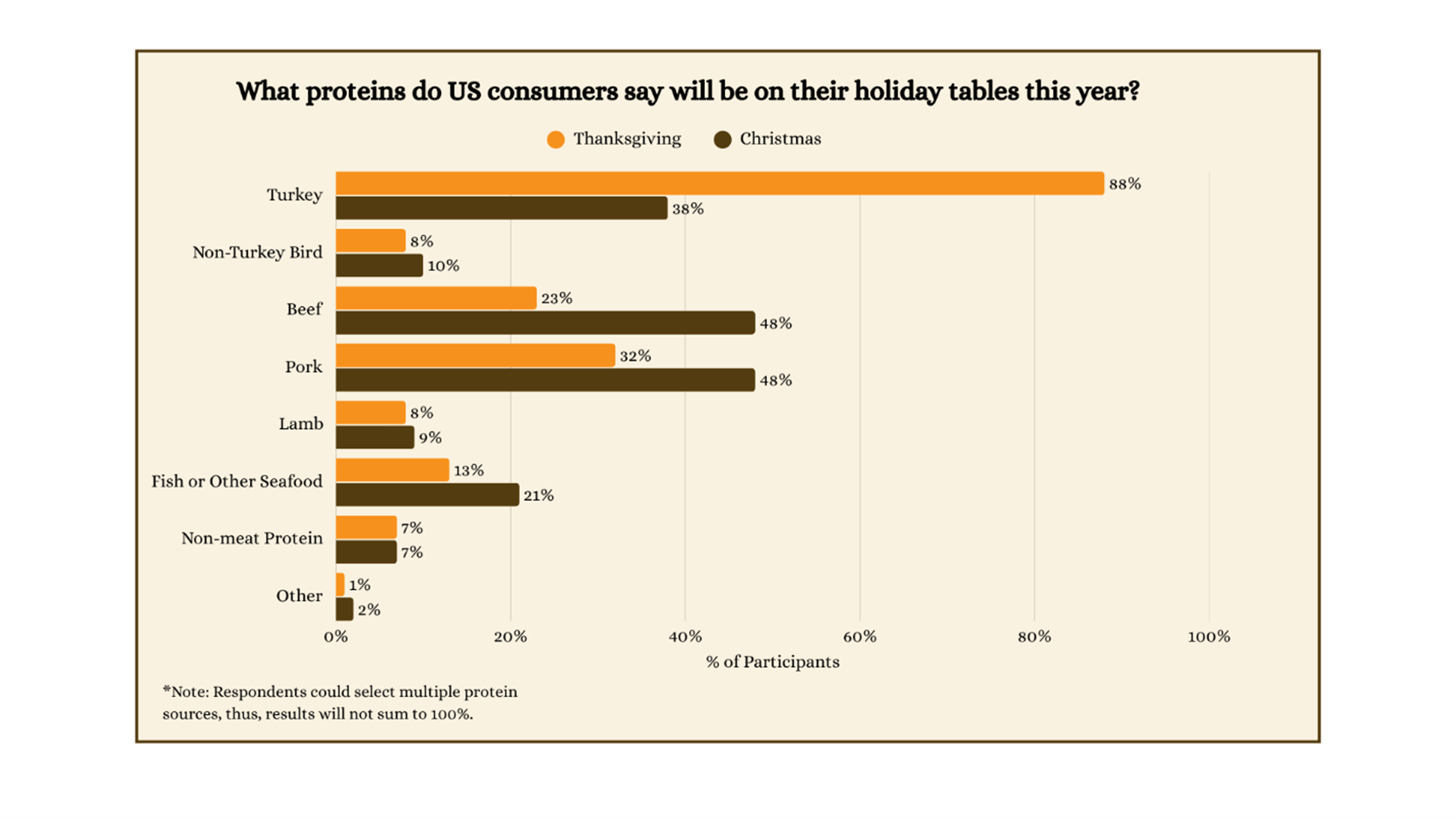
As Thanksgiving preparations are underway, households across the country are finalizing their menus and shopping lists. The American Farm Bureau’s annual Thanksgiving dinner cost estimates note that average meal costs have increased since last year, driven in part by higher turkey prices (2026). Despite this, turkey remains the dominant protein choice for Thanksgiving (see figure 2). Of the respondents, 88% stated that they will serve turkey, followed by 32% who will serve pork. Looking ahead to Christmas meals, consumers indicated they planned to serve pork (48%), beef (48%), and turkey (38%). For both meals, we found little difference in protein selection across whether or not consumers’ expected holiday prices to affect their meals.
Figure 2. Share of Respondents Serving Different Proteins at Thanksgiving and Christmas
Conclusion
As the holidays approach, consumers are making food decisions that have ripple effects for much of the food system. In this post, we review results from the Gardner Food and Agricultural Policy Survey, which finds that the majority of consumers expect food prices to affect their holiday meals. Most commonly, consumers plan to shop for deals and shop early to spread out food costs. Fewer consumers reported reducing the amount of meat they serve at their holidays this year compared to last year. Further, results show that consumers expect to stick with tradition this Thanksgiving, with over 80% saying they planned to serve turkey. For Christmas, protein sources varied more, with pork, beef, and turkey all being common choices.
References
Bragg, J. “Retailers shake up Thanksgiving dinner as food prices climb.” Axios, November 19, 2026. https://www.axios.com/2026/11/19/walmart-costco-thanksgiving-deals-dinner-kroger-aldi
Castillo, C., Parum, F. “Thanksgiving Dinner Cost Ticks Upward in 2026.” American Farm Bureau Federation, November 18, 2026. https://www.fb.org/intel/markets/thanksgiving-dinner-cost-ticks-upward-in-2026
Kalaitzandonakes, M., J. Coppess and B. Ellison. "Setting the Holiday Tables: How Do Consumers Say Food Prices Will Affect Their 2025 Holiday Meals?" farmdoc daily (15):223, Department of Agricultural and Consumer Economics, University of Illinois at Urbana-Champaign, December 4, 2025.
Disclaimer: We request all readers, electronic media and others follow our citation guidelines when re-posting articles from farmdoc daily. Guidelines are available here. The farmdoc daily website falls under University of Illinois copyright and intellectual property rights. For a detailed statement, please see the University of Illinois Copyright Information and Policies here.