








Old Gavels, New Hands: Can the Next Congress Begin to Repair Farm Policy?
The 120th United States Congress will be sworn into office on January 3, 2027. With the new Congress there will be new hands gripping old gavels in many committees and on the floors of the Capitol, the direct result of the midterm electoral earthquake (farmdoc daily, November 5, 2026). Among other things, this presents unique opportunities to begin to repair farm policy, a somewhat-rare chance to think anew, even innovate policies that desperately need it. Many long-term challenges for farm policy were made much worse by the Reconciliation Farm Bill, Title I of the One Big Beautiful Bill Act of 2025 (OB3) (P.L. 119-21; CBO, July 21, 2025). In it, Congress also broke the cardinal rule of Farm Bill politics, cutting food assistance to offset increases in farm payments, and probably killed the Farm Bill coalition as it has been known for fifty years. Sampling from articles in recent years, this article scouts out potential paths ahead.
Rescuing Food Assistance Takes Top Priority
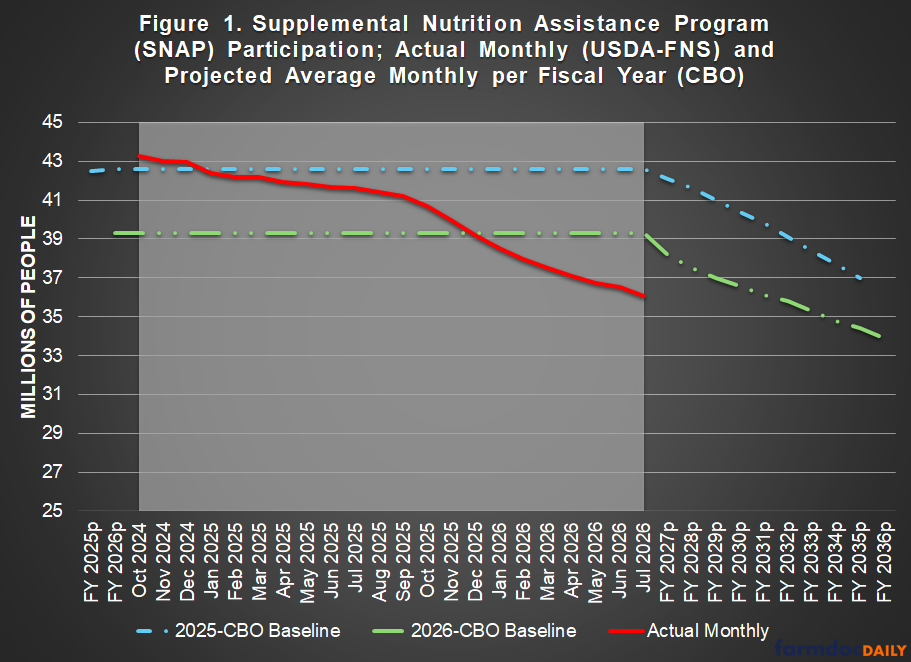
Before there can be any meaningful attempt to repair farm policy, the new Congress will have to address the egregious changes to food assistance and the Supplemental Nutrition Assistance Program (SNAP) that were enacted in OB3. As experienced by the unfinished Farm Bill, the problems created in SNAP form legislative roadblocks (farmdoc daily, August 13, 2026). Figure 1 highlights the issue with a snapshot of the participation rates for SNAP. Prior to OB3, CBO projected near-term participation averaging close to 43 million Americans each month (light blue line with dot and dashes; CBO Baseline, January 2025). Those projections dropped with OB3 to just above 39 million in the near term (light green line with two dots and dashes; CBO Baseline, February 2026). From October 2024 (beginning of fiscal year 2025) to July 2026 (fiscal year 2026), participation has dropped much further than projected (solid red line in gray area). The July 2026 actual monthly participation rate fell to 36 million people.
Last week, USDA proposed to take away automatic eligibility for those who are also eligible for Temporary Assistance for Needy Families (TANF) and estimated the changes will drop 6 million more people from the program (Mulvihill and Lieb, November 11, 2026; Reuters, November 10, 2026; Jones, November 11, 2026). If nothing else, USDA’s proposal further exposes the cruel method being deployed against SNAP, and by extension those who struggle to put food on the table. Most of the changes amount to constructing new bureaucratic barriers or raising existing ones higher, making it more difficult for poor people to access the benefits. These barriers either prevent people from being accepted or frustrating them to the point of giving up. They are hitting at a time when it costs more to buy food and to drive to get it (Bennett and Craig, November 10, 2026; Casselman and Wu, September 11, 2026; Thilmany, August 25, 2026; see also, Peng and Ortega, 2026; MSU Today, November 5, 2026).
These paperwork requirements do not help anyone get a job. They do not improve an uncertain job market, nor do they encourage large corporations to pay employees a living wage. They do not make a family any less poor, nor do they help with inflated costs. More bureaucracy does not reduce fraud or abuse. These changes merely make life more difficult, increasing the time tax and adding stress to the days of those who face plenty already (Lowrey, August 27, 2026; GAO, July 22, 2026; farmdoc daily, April 20, 2023; Fang, October 13, 2026; Meyer, October 13, 2026; Barua, July 20, 2026; US Bank, October 19, 2026; Chicago Fed, November 5, 2026; Federal Reserve, May 26, 2026). The problems will only get worse, and repairing them will become increasingly more expensive in Congressional Budget Office (CBO) ten-year cost projections (Rosenbaum et al., October 23, 2026; Lee, September 12, 2026; Berger, October 25, 2026).
Four Principles to Consider for Beginning to Repair Farm Policy
The need to repair farm policy is increasingly obvious, backed by loads of evidence. Problems abound, clearly demonstrated by the enormous amount of ad hoc assistance paid to farmers since 2018. Ad hoc assistance has warped expectations and many aspects of the political landscape, but it may be doing the most damage on the ground and for the farmers that its advocates claim to help. Payments are not relieving the input price squeeze, nor are they helping farmers adjust to the rapidly changing situations in the U.S. and around the world. The policy problems are trapping farmers, or worse, serving doses of bad medicine and recycling from a long, troubled history (farmdoc daily, June 23, 2026; March 12, 2026; February 16, 2026; September 25, 2025; April 21, 2025; October 22, 2024; May 30, 2024; August 31, 2023).
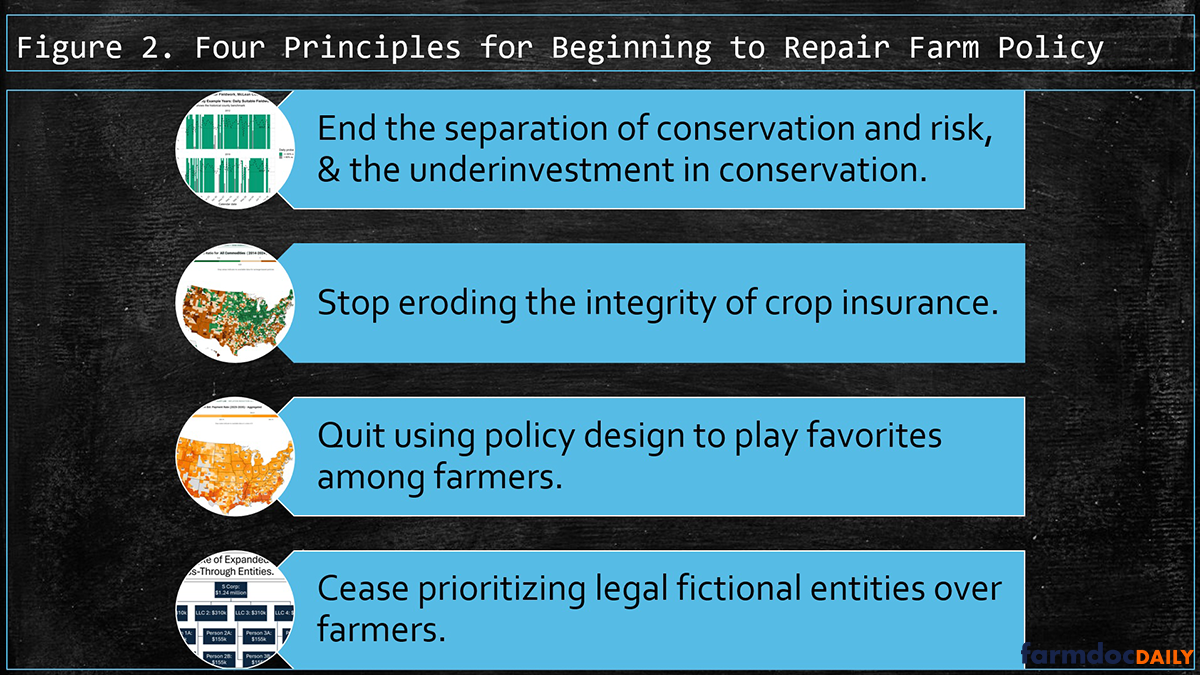
The breadth and depth of the challenges, as well as an entrenched political situation, counsel caution and deliberation informed by reasoning and analysis—strong arguments against leaping ahead to specific policy prescriptions. The discussion herein follows that line, working through four principles that could help guide any serious effort to repair farm policy by the next Congress. Figure 2 summarizes these four suggested principles.
- (1) End the Separation of Conservation and Risk & the Underinvestment in Conservation.
For far too long, Congress has separated conservation and farm risk management. In large part because of this separation, Congress has also consistently underinvested in conservation. Conservation programs are capped, limited or otherwise forced to live by budget rules that are not applied to farm payments or crop insurance, forcing tradeoffs that make matters worse, such as the EQIP bardo and the gutting of CSP (farmdoc daily, October 22, 2026; February 13, 2025; November 7, 2024; October 24, 2024; May 23, 2024; September 28, 2023; November 10, 2023; October 12, 2023). Underinvestment renders conservation assistance less effective and drives down support for it; it forces conservation to do too much with too little, spreading limited assistance over too many goals or priorities, and dependent on the heroic efforts of individuals rather than an investment in mutually beneficial outcomes.
The separation cuts both ways: while conservation policy lacks any connection to farm risk, farm policy is also disconnected from conservation. Many practices can build resiliency on the farm while delivering benefits, or reducing consequences, off the farm. It is a separation that narrows farm policy. Narrower policy is easier for factional interests to capture and rig for self-interest. Cleaner water, less soil erosion, and similar outcomes are mutually beneficial to farmers and communities, connecting farmers with the public that pays for it all.
While implementing conservation practices can benefit the farm and the farmer, those benefits likely accrue over a longer time horizon and do not always align with annual farm management and risk. Conservation practices might also add risk or complicate farm management in the short-term as the farmer travels the learning curve for successful and effective implementation (farmdoc daily, April 24, 2025; May 9, 2025; June 5, 2025; October 30, 2025). All of this must be considered in the realities of the intense competition among farmers at the local level, particularly over land and leases, across the Nation, and in a challenging global marketplace. If the learning curve renders a farmer less competitive locally in any crop year, the problems compound. Losing acres to farmers not adopting conservation sacrifices the conservation benefits and possibly the farmer and may drive home a lesson that conservation isn’t worth it.
Blending conservation and risk in policy rewards innovation, it can be designed to provide farmers implementing conservation competitive advantages, rather than disadvantages, on the local level that can extend nationally and even globally. That work begins with designing policy to backstop any yield consequences from implementing practices, especially within the deductible range of crop insurance—the first 15% of loss on an 85% crop insurance policy Designing policy under this principle will also need to incorporate price and market risk, as well as the risks farmers face with input costs. Blended policy can prioritize helping farmers manage, adjust, and adapt (farmdoc daily, May 7, 2026; May 21, 2026; May 28, 2026; September 10, 2026; October 8, 2026; February 26, 2026; March 31, 2026).
- (2) Stop Eroding the Integrity of Crop Insurance.
Like any bad storm, OB3 accelerated the erosion of the integrity of crop insurance, which started picking up speed with the addition of supplemental coverage policies that stack a county-wide coverage on top of the farmer’s individual policy (the Stacked Income Protection Plan for Producers of Upland Cotton (STAX), and the Supplemental Coverage Option (SCO) in the 2014 Farm Bill (P.L. 113-79, at Sec. 11017 and Sec. 11003, respectively; 7 U.S.C. §1508b; 7 U.S.C. §1508(c)(4)(C)). For an insurance program, these stacked policies raise numerous concerns because they operate more like direct subsidies or income support for farmers in high-risk areas, with cotton STAX a useful case study. The Reconciliation Farm Bill in OB3 increased the premium subsidy rate to 80% of the cost of the policy and farmers appear to be rapidly responding to the policy signals, magnifying these concerns (farmdoc daily, November 13, 2026; August 26, 2026; March 11, 2026; March 10, 2026; February 24, 2026; December 17, 2025; August 28, 2025; June 24, 2025; June 13, 2024; June 10, 2025; June 4, 2024).
Arguably the most blatant example, however, is the inexplicable additional subsidy for crop insurance companies if they write insurance policies in areas with high losses (farmdoc daily, August 14, 2025) ; 7 U.S.C. §1508(k)(10)). To put it nicely, this is an inducement to write policies in states where the losses are too high for the companies. This bonus subsidy for crop insurance companies compounds other concerning provisions, such as the yield exclusion added by the 2014 Farm Bill (P.L. 113-79, at Sec. 11009; 7 U.S.C. §1508(g)(4)(C); farmdoc daily, January 13, 2015). With provisions like these, it is little wonder that crop insurance ratings issues are becoming increasingly problematic and concerning (Durbin et al., November 6, 2026; farmdoc daily, July 28, 2026; July 21, 2026). These are clear indications of erosion in the performance and integrity of crop insurance, exposed in full on maps of loss ratios or net benefits (Policy Design Lab, Crop Insurance) farmdoc daily, September 24, 2026).
There are other issues that merit attention and review, deeper analysis, such as the way premium subsidy is calculated and use of harvest prices. Eroded integrity might also be hurting those who receive the most if it locks them into production systems and practices that are not feasible, too risky or otherwise need adjustment and change. If farmers are planting crops that cannot succeed in the climate or region because of insurance, that is bad for the farmers and the program. It is also bad for any natural resources consumed (even wasted). The bottom line here is that crop insurance is the primary risk management tool for farmers and the cornerstone of the farm support system. It is an insurance program, however, and Congress has required that total premium (both the farmer-paid premium and the taxpayer-paid premium subsidy) covers the indemnities paid. An insurance program that is out of balance for too long risks a spiraling of problems (farmdoc daily, April 11, 2024; May 15, 2024; April 3, 2025; May 30, 2023; July 31, 2025; July 20, 2026; April 10, 2023).
- (3) Quit Using Policy Design to Play Favorites Among Farmers.
Congress has consistently played favorites among farmers with policy design. For more-than fifty years, the preferred method for playing favorites in policy has been writing price-based payment thresholds into the statute, favoritism fixed in law on a crop-by-crop basis. While this has gone on for far too long, the Reconciliation Farm Bill made matters much worse. Table 1 summarizes the method using the 2025 payments made in October (farmdoc daily, October 13, 2026; November 25, 2025).
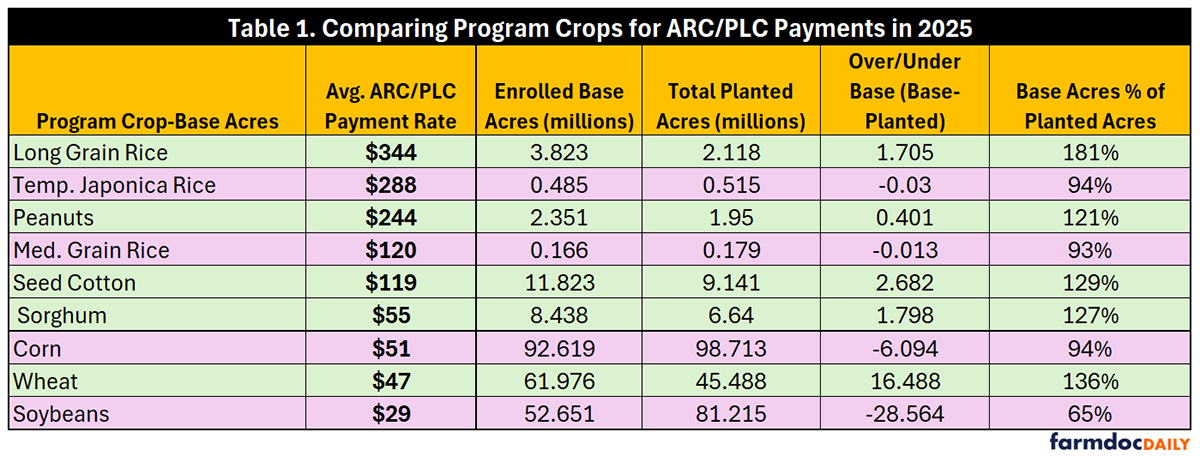
The vast disparities in payment rates per base acre in column 1 are the direct result of political decisions in Congress. The consequence of this favoritism is compounded by the decoupled base acres policy which couple more generous payments with better market margins. The payment rate disparities favor base acres and reference prices for seed cotton, rice, and peanuts. Farmers with those base acres can receive outsized payments because of the fixed reference prices, while growing more profitable crops on the base acres. Here it is important to keep in mind the intense competition in agriculture and how favoritism can play out (farmdoc daily, August 6, 2025; May 29, 2024; June 21, 2023; June 28, 2023). (farmdoc daily, February 12, 2026; January 29, 2026; January 15, 2026; August 21, 2025; November 7, 2023; May 16, 2024; November 19, 2024). Updating base acres to better reflect current production systems rather than those of 30 or 40 years ago can help but is ultimately insufficient for repairing farm policy—problems rooted in reference prices as much as base acres (farmdoc daily, October 23, 2026; September 3, 2026; August 3, 2026; July 13, 2026; April 14, 2026; April 16, 2025; April 11, 2025; March 28, 2025; February 24, 2025; February 6, 2025; February 5, 2026; May 7, 2024). Recognizing these realities returns to the first two principles: blending risk and conservation, while improving the integrity of crop insurance.
- (4) Cease Prioritizing Legal Fictional Entities Over Farmers.
Some stories deliver a punch to the gut, connecting comments, complaints, and concerns that farmers raise in meetings, or express more quietly and off to the side of public events (Spangler, November 3, 2026). Heard in frustrated words and pained whispers alike, is a message that farm policy—payments, crop insurance and more—is causing real damage in the countryside. A flood of payments into the accounts of the largest, most established and sophisticated, and, often, the oldest farmers is damaging other farmers. These payments are sacrificing those in the earlier stages of farming, who lack all the accrued advantages, and who are often trying to innovate against the tides. Consider well-worn arguments about farm consolidation: that those larger operations are more efficient, have greater economies of scale, and are better. If that were true, then those entities have the least justification for federal assistance. Large, efficient operations with all the claimed competitive advantages of size, sophistication, and efficiencies should receive little or no federal assistance, they should not be the priority of policy because they should need it the least, if at all. If that is not true, then policies should not be propping up such entities or driving others into similar situations.
On this matter, the Reconciliation Farm Bill exposed completely and blatantly a fundamental problem: Congress has prioritized legal fictional entities, or pass-through entities, over human farmers, or family farmers. The method is an obscure and simple provision added to the law on payment limitations under the guise of “equitable treatment” for pass-through entities (P.L. 119-21, at Sec. 10306; 7 U.S.C. §1308(a)(5) and (e)(3). These provisions are the poisoned fruit of a special interest project, a hallmark of the hallway farmer, snuck into the reconciliation bill after having been previously rejected (115 H.R. 2, at Sec. 1603; Coppess, 2026; Ferrell et al., 2023; Coppess, 2018). The provision is all about harvesting payments—it’s advocates advise against leaving any taxpayer money on the table—and has nothing to do with overcoming nonexistent barriers to using entities in farming, as evidenced by their increased adoption prior to this provision’s enactment into law (farmdoc daily, December 31, 2025; September 4, 2025; July 17, 2025). The policy accelerates the funneling of more payments to larger operations, something unlikely to have needed any help (White and Hoppe, 2012; Sumner 2014; McFadden and Hoppe, 2017; Yu and Lim, 2024).
The provision gives legal fictional entities, corporations and LLCs, additional payment limits for each entity embedded into the operation. It only matters for operations large enough (i.e., with large base acreages) to receive payments exceeding $310,000 (with a spouse). Each additional embedded legal fictional entity earns the operation an additional payment limitation, and therefore more federal payments. It benefits only the largest, most sophisticated operations, pouring money into their accounts that can be used to bid up cash rents, land purchase prices, and cover the consumption of more inputs. Where a family, or human, farmer must add more people to get more payment limits and payments, a legal fictional pass-through entity merely needs to file paperwork with the state. Obscure, this may be the most defining characteristic of the many problems built into farm policy.
Concluding Thoughts
The midterm electoral earthquake has shaken America’s political landscape, revealing much damage done over many years. From political upheaval, there is a distinct choice: either settle back into what caused it or begin the challenging effort to repair and build anew. Repair is always more difficult than heedless destruction. The same holds true for farm policy, and this discussion surveyed some of the pieces of this complex and challenging puzzle, outlining four potential guiding principles for the project if it were to be undertaken.
Reality and realpolitik likely require triage, prioritizing those who are hungry and the many hollowed-out communities that have been left behind. Like it or not, any efforts to repair farm policy most likely depend on whether the new Congress can address the growing problems facing food assistance; necessary for political reasons, as well as (and more importantly) for those in our country who struggle to purchase food and partake in the abundance of American agriculture. It may not be necessary for the two to be recoupled, however, nor for the new Congress to expend political capital, time or energy. Whether the shattered Farm Bill coalition can be put back together again could be little more than a distraction. “Silver and gold,” after all, “Won’t buy back the beat of a heart grown cold” (Dylan and Hunter, “Silvio,” 1988). It may even be necessary for repairs to farm policy to happen on their own, preventing factional interests from taking SNAP hostage again to continue to hide problematic policy behind the CBO baseline.
References
Barua, Akrur. “Resilience with a pinch of caution for the US labor market.” Deloitte.com. July 20, 2026. https://www.deloitte.com/us/en/insights/topics/economy/spotlight/private-sector-job-growth.html.
Bennett, Geoff, Molly Mazilu, and Bridget Craig. “U.S. inflation report highlights strain of rising food, energy and housing costs.” PBS News Hour. November 10, 2026. https://www.pbs.org/newshour/show/u-s-inflation-report-highlights-strain-of-rising-food-energy-and-housing-costs.
Berger, Eric. “Trump administration has pushed 5m Americans off food stamps.” The Guardian. October 25, 2026. https://www.theguardian.com/us-news/2026/oct/25/trump-food-stamp-cuts.
Board of Governors of the Federal Reserve System. “Report on the Economic Well-Being of U.S. Households in 2025—May 2026.” May 26, 2026. https://www.federalreserve.gov/publications/2026-economic-well-being-of-us-households-in-2025-employment-and-job-quality.htm.
Casselman, Ben and Edison Wu. “What Years of Inflation Have Done to American Prices.” The New York Times, September 11, 2026. https://www.nytimes.com/interactive/2026/09/11/business/economy/inflation-us-prices-gas-food-tariffs.html.
Cilento, S., J. Coppess and M. Skidmore. "Mastering the Early Years: Lessons on the Cover Crop Learning Curve, Part 3." farmdoc daily (15):103, Department of Agricultural and Consumer Economics, University of Illinois at Urbana-Champaign, June 5, 2025.
Cilento, S., J. Coppess and M. Skidmore. "Beyond the Adoption Decision: Lessons on the Cover Crop Learning Curve, Part 2." farmdoc daily (15):86, Department of Agricultural and Consumer Economics, University of Illinois at Urbana-Champaign, May 9, 2025.
Cilento, S., J. Coppess and M. Skidmore. "Missing the System for the Adoption: Lessons on the Cover Crop Learning Curve, Part 1." farmdoc daily (15):77, Department of Agricultural and Consumer Economics, University of Illinois at Urbana-Champaign, April 24, 2025.
Cilento, S., M. Skidmore and J. Coppess. "Mother Nature Bats Last: Lessons on the Cover Crop Learning Curve, Part 4." farmdoc daily (15):200, Department of Agricultural and Consumer Economics, University of Illinois at Urbana-Champaign, October 30, 2025.
Congressional Budget Office. “Baseline Projections: Supplemental Nutrition Assistance Program.” February 2026. https://www.cbo.gov/system/files/2026-01/51312-2026-02-snap.pdf.
Congressional Budget Office. “Estimated Budgetary Effects of Public Law 119-21, to Provide for Reconciliation Pursuant to Title II of H. Con. Res. 14, Relative to CBO’s January 2025 Baseline.” July 21, 2025. https://www.cbo.gov/publication/61570.
Congressional Budget Office. “Baseline Projections: Supplemental Nutrition Assistance Program.” January 2025. https://www.cbo.gov/system/files/2025-01/51312-2025-01-snap.pdf.
Coppess, J. Between Soil and Society: Legislative History and Political Development of Farm Bill Conservation Policy (Lincoln: University of Nebraska Press, 2024). https://www.nebraskapress.unl.edu/nebraska/9781496225146/.
Coppess, J. The Fault Lines of Farm Policy: A Legislative and Political History of the Farm Bill (University of Nebraska Press, 2018). https://www.nebraskapress.unl.edu/nebraska/9781496205124/the-fault-lines-of-farm-policy/.
Coppess, J. “More Farm in the Farm Bill: A Formula for Understanding the Demise of a Legislative Coalition.” Drake J. Agric. L. 31 (2026): 1. https://aglawjournal.wp.drake.edu/wp-content/uploads/sites/66/2026/09/a.-Coppess-Final.pdf.
Coppess, J. "High cotton and the low road: An unraveling farm bill coalition and its implications." Drake J. Agric. L. 23 (2018): 353. https://aglawjournal.wp.drake.edu/wp-content/uploads/sites/66/2019/11/Coppess-Macro-Reprinted.pdf.
Coppess, J. "Trying to Reason with A Midterm Election Earthquake." farmdoc daily (16):201, Department of Agricultural and Consumer Economics, University of Illinois at Urbana-Champaign, November 5, 2026.
Coppess, J. "Conservation Policy: The Baseline Shuffle and Tradeoffs in the Bardo." farmdoc daily (16):192, Department of Agricultural and Consumer Economics, University of Illinois at Urbana-Champaign, October 22, 2026.
Coppess, J. "The Unfinished Farm Bill Remains Unfinished and Sends a Warning." farmdoc daily (16):145, Department of Agricultural and Consumer Economics, University of Illinois at Urbana-Champaign, August 13, 2026.
Coppess, J. "Flashback, 1979: What the Previous Cliff Might Tell Us About the Potential One Ahead." farmdoc daily (16):42, Department of Agricultural and Consumer Economics, University of Illinois at Urbana-Champaign, March 12, 2026.
Coppess, J. "Now Would Seem Like a Good Time to Think Seriously About the CRP." farmdoc daily (16):32, Department of Agricultural and Consumer Economics, University of Illinois at Urbana-Champaign, February 26, 2026.
Coppess, J. "Off-Base, Part 5: Farm Policy Has Been Here Before; Lessons Reinforced by History." farmdoc daily (16):24, Department of Agricultural and Consumer Economics, University of Illinois at Urbana-Champaign, February 16, 2026.
Coppess, J. "Off-Base, Part 4: A Fundamental Flaw in the Policy." farmdoc daily (16):22, Department of Agricultural and Consumer Economics, University of Illinois at Urbana-Champaign, February 12, 2026.
Coppess, J. "Off Base, Part 1: Reviewing Issues and Problems with Base Acre Policy." farmdoc daily (16):7, Department of Agricultural and Consumer Economics, University of Illinois at Urbana-Champaign, January 15, 2026.
Coppess, J. "Off-Base, Part 3: Picking Winners & Losers with Policy." farmdoc daily (16):13, Department of Agricultural and Consumer Economics, University of Illinois at Urbana-Champaign, January 29, 2026.
Coppess, J. "The Reconciliation Farm Bill: Top Five Most Problematic Changes to Farm Policy, #1." farmdoc daily (15):161, Department of Agricultural and Consumer Economics, University of Illinois at Urbana-Champaign, September 4, 2025.
Coppess, J. "The Reconciliation Farm Bill: Top Five Most Problematic Changes to Farm Policy, #2." farmdoc daily (15):157, Department of Agricultural and Consumer Economics, University of Illinois at Urbana-Champaign, August 28, 2025.
Coppess, J. "The Reconciliation Farm Bill: Top Five Most Problematic Changes to Farm Policy, #3." farmdoc daily (15):152, Department of Agricultural and Consumer Economics, University of Illinois at Urbana-Champaign, August 21, 2025.
Coppess, J. "The Reconciliation Farm Bill: Top Five Most Problematic Changes to Farm Policy, #4." farmdoc daily (15):147, Department of Agricultural and Consumer Economics, University of Illinois at Urbana-Champaign, August 14, 2025.
Coppess, J. "The Reconciliation Farm Bill: The Top Five Most Problematic Changes to Farm Policy, #5." farmdoc daily (15):139, Department of Agricultural and Consumer Economics, University of Illinois at Urbana-Champaign, July 31, 2025.
Coppess, J. "The Farm Bill in Reconciliation: Loophole as Rosetta Stone; Review and Comment." farmdoc daily (15):130, Department of Agricultural and Consumer Economics, University of Illinois at Urbana-Champaign, July 17, 2025.
Coppess, J. "Conservation Quandaries, Part 1: Too Much and Not Enough." farmdoc daily (15):28, Department of Agricultural and Consumer Economics, University of Illinois at Urbana-Champaign, February 13, 2025.
Coppess, J. "History and the 2024 House Farm Bill." farmdoc daily (14):102, Department of Agricultural and Consumer Economics, University of Illinois at Urbana-Champaign, May 30, 2024.
Coppess, J. "The Conservation Question, Part 9: The Arrested Development of the Conservation Security Program." farmdoc daily (13):206, Department of Agricultural and Consumer Economics, University of Illinois at Urbana-Champaign, November 10, 2023.
Coppess, J. "The Incredible Shrinking of the Conservation Stewardship Program." farmdoc daily (13):187, Department of Agricultural and Consumer Economics, University of Illinois at Urbana-Champaign, October 12, 2023.
Coppess, J. "Farm Bill 2023: NRCS Backlogs and the Conservation Bardo." farmdoc daily (13):177, Department of Agricultural and Consumer Economics, University of Illinois at Urbana-Champaign, September 28, 2023.
Coppess, J., C. Navarro, P. Shan, L. Fu, S. P. Satheesan, B. Zhang and R. Batts. "Updates from the Policy Design Lab: Crop Insurance and Soybeans." farmdoc daily (16):172, Department of Agricultural and Consumer Economics, University of Illinois at Urbana-Champaign, September 24, 2026.
Coppess, J. and C. Zulauf. "Trying to Picture a Base Acre Update Through a Hypothetical Change in 2025 Payments." farmdoc daily (16):158, Department of Agricultural and Consumer Economics, University of Illinois at Urbana-Champaign, September 3, 2026.
Coppess, J., G. Schnitkey, B. Sherrick, N. Paulson and I. Flores. "The Dilemma of Actuarial Soundness, A Legislative History." farmdoc daily (14):70, Department of Agricultural and Consumer Economics, University of Illinois at Urbana-Champaign, April 11, 2024.
Coppess, J., G. Schnitkey, N. Paulson, B. Sherrick and C. Zulauf. "Reference Price Disparities & Why It Matters to Farmers." farmdoc daily (14):93, Department of Agricultural and Consumer Economics, University of Illinois at Urbana-Champaign, May 16, 2024.
Coppess, J. and I. Majumdar. "Inflation and Conservation, Part 2: When is Inflation “Not Just” Inflation?" farmdoc daily (14):193, Department of Agricultural and Consumer Economics, University of Illinois at Urbana-Champaign, October 24, 2024.
Coppess, J. and I. Majumdar. "An Inflation Question Not Asked: What About Conservation?" farmdoc daily (14):98, Department of Agricultural and Consumer Economics, University of Illinois at Urbana-Champaign, May 23, 2024.
Coppess, J. and J. Hutchins. "Farm Bill 2023: Is There Bad Medicine in Base Acres and Reference Prices?" farmdoc daily (13):158, Department of Agricultural and Consumer Economics, University of Illinois at Urbana-Champaign, August 31, 2023.
Coppess, J., K. Guan and E. J. Diaz-Vallejo. "Conservation & Risk, Part 1: Introduction and Hypothesis." farmdoc daily (16):80, Department of Agricultural and Consumer Economics, University of Illinois at Urbana-Champaign, May 7, 2026.
Coppess, J., M. Liu, E. J. Diaz-Vallejo and N. Loduca. "Conservation & Risk, Part 4: Approaching the Nitrogen Application Question." farmdoc daily (16):162, Department of Agricultural and Consumer Economics, University of Illinois at Urbana-Champaign, September 10, 2026.
Coppess, J. and M. White. "Farm Bill 2023: Questions About the Focus on SNAP Work Requirements." farmdoc daily (13):73, Department of Agricultural and Consumer Economics, University of Illinois at Urbana-Champaign, April 20, 2023.
Coppess, J. and O. Doering. "History & Tough Reality: When Payments Do More Harm Than Good, Consider Other Options." farmdoc daily (15):176, Department of Agricultural and Consumer Economics, University of Illinois at Urbana-Champaign, September 25, 2025.
Coppess, J. and Y. Peng. "Taking A Closer Look at the Conservation Tradeoff Issues." farmdoc daily (14):203, Department of Agricultural and Consumer Economics, University of Illinois at Urbana-Champaign, November 7, 2024.
Durbin, Dick, U.S. Senator. “Illinois And Midwestern Farmers Are Overcharged On Crop Insurance, Say Durbin, Duckworth, Budzinski, Sorensen, Call For USDA To Recalculate And Provide Refunds.” November 6, 2026. https://www.durbin.senate.gov/newsroom/press-releases/illinois-and-midwestern-farmers-are-overcharged-on-crop-insurance-say-durbin-duckworth-budzinski-sorensen-call-for-usda-to-recalculate-and-provide-refunds.
Fang, Lei. “Beyond Health Care: Has Labor Market Improvement Broadened in 2026?” Federal Reserve Bank of Atlanta. October 13, 2026. https://www.atlantafed.org/research-and-data/publications/policy-hub-macroblog/2026/10/13/beyond-health-care-has-labor-market-improvement-broadened-in-2026.
Federal Reserve Bank of Chicago. “Chicago Fed Labor Market Indicators.” November 5, 2026. https://www.chicagofed.org/research/data/chicago-fed-labor-market-indicators/latest-release..
Ferrell, Shannon L., Tiffany Dowell Lashmet, Bart Fischer, and Brad Karmen. "Paved with Good Intentions: Unintended Impacts of Farm Bill Payment Limitations on Farm Risk Management and Farm Transitions." Drake J. Agric. L. 28 (2023): 327. https://aglawjournal.wp.drake.edu/wp-content/uploads/sites/66/2024/04/Ferrell-Ready-for-Publish.pdf.
Glenn, J. and J. Janzen. "The Number and Composition of Legal Entities Engaged in Farming: Initial Evidence from FSA Payment Files." farmdoc daily (15):240, Department of Agricultural and Consumer Economics, University of Illinois at Urbana-Champaign, December 31, 2025.
Jones II, Arthur. “Trump administration moves to drop millions from SNAP food assistance under proposal.” ABCNews.com. November 11, 2026. https://abcnews.com/Politics/trump-administration-moves-drop-millions-snap-proposal/story?id=138031618.
Lee, Nathan. “Millions dropped from SNAP food assistance as funding faces September uncertainty.” ABCNews.com. September 12, 2026. https://abcnews.com/US/millions-dropped-fromsnapfood-assistance-funding-faces-september-uncertainty/story?id=136386092.
Leslie, Grant and Aaron Rudberg. “Building the Missing Market: A National Strategy for American Agriculture.” S2G Investments. September 17, 2026. https://www.s2ginvestments.com/report-missing-market-full-report.
Loduca, N., J. Coppess, M. Liu, E. J. Diaz-Vallejo, Y. Qin and K. Guan. "Conservation & Risk, Part 5: Examining a Risk-Payment Gap for Nitrogen Management." farmdoc daily (16):182, Department of Agricultural and Consumer Economics, University of Illinois at Urbana-Champaign, October 8, 2026.
Loduca, N., J. Coppess, E. J. Diaz-Vallejo, Y. Qin and K. Guan. "Conservation & Risk, Part 3: Exploring the Risk-Payment Gap." farmdoc daily (16):93, Department of Agricultural and Consumer Economics, University of Illinois at Urbana-Champaign, May 28, 2026.
Lowery, Annie. “Americans Are Spending Luxury Dollars for Dive-Bar Service.” The Atlantic. August 27, 2026. https://www.theatlantic.com/ideas/2026/08/time-tax-administrative-bureaucracy/688322/.
McFadden, Jonathan and Robert A. Hoppe. “The Evolving Distribution of Payments From Commodity, Conservation, and Federal Crop Insurance Programs.” USDA, Economic Research Service. November 30, 2017. https://www.ers.usda.gov/publications/85833.
Meyer, Gregory. “US grocery prices poised to climb as soaring fuel costs drive inflation.” Financial Times. October 13, 2026. https://www.ft.com/content/13929c26-1c01-41b2-b81a-d337fa5c9d27?syn-25a6b1a6=1.
Monaco, H., C. Zulauf, N. Paulson and G. Schnitkey. "The Growing Role of ECO and SCO in Federal Crop Insurance Support." farmdoc daily (16):206, Department of Agricultural and Consumer Economics, University of Illinois at Urbana-Champaign, November 13, 2026.
Monaco, H., N. Paulson, G. Schnitkey, C. Zulauf and B. Sherrick. "Crop Insurance Loss Performance and Impacts on Farmer Net Support by Crop." farmdoc daily (16):133, Department of Agricultural and Consumer Economics, University of Illinois at Urbana-Champaign, July 28, 2026.
Mulvihill, Geoff and David A. Lieb. “Trump administration plans to make it harder to get grocery assistance.” APNews.com. November 11, 2026. https://apnews.com/article/snap-trump-administration-school-lunches-2090300a697f6cebe56bbfe1b30ec16a.
Ortega, David. “MSU study: Grocer prices shape Americans’ views on inflation.” Michigan State University, MSU Today. November 5, 2026. https://msutoday.msu.edu/news/2026/11/how-grocery-prices-impact-how-americans-view-inflation.
Paulson, N., G. Schnitkey, C. Zulauf and L. Gentry. "High Fertilizer Prices Suggest Reconsidering Application Rates." farmdoc daily (16):54, Department of Agricultural and Consumer Economics, University of Illinois at Urbana-Champaign, March 31, 2026.
Paulson, N., G. Schnitkey, H. Monaco and C. Zulauf. "SCO, ECO, and the Probability of Regret." farmdoc daily (16):40, Department of Agricultural and Consumer Economics, University of Illinois at Urbana-Champaign, March 10, 2026.
Paulson, N., G. Schnitkey, J. Coppess, C. Zulauf and R. Goodrich. "Historical View of U.S. Row Crop Acreage." farmdoc daily (16):64, Department of Agricultural and Consumer Economics, University of Illinois at Urbana-Champaign, April 14, 2026.
Paulson, N., H. Monaco, G. Schnitkey and C. Zulauf. "2025 Final ARC/PLC Payments." farmdoc daily (16):185, Department of Agricultural and Consumer Economics, University of Illinois at Urbana-Champaign, October 13, 2026.
Paulson, N., H. Monaco, G. Schnitkey, J. Coppess and C. Zulauf. "Additional ARC/PLC Payments for 2025: Value of Receiving the Maximum Program Payment." farmdoc daily (15):218, Department of Agricultural and Consumer Economics, University of Illinois at Urbana-Champaign, November 25, 2025.
Peng, Rundong, and David L. Ortega. "Food prices, inflation expectations, and consumer sentiment." Journal of the Agricultural and Applied Economics Association (2025). https://doi.org/10.1002/jaa2.70054.
Reuters “Trump administration moves to cut food stamps for 6.3 million people.” CNBC.com. November 10, 2026.https://www.cnbc.com/2026/11/10/trump-administration-moves-to-cut-food-stamps-for-6point3-million-people.html.
Rosenbaum, Dottie, Joseph Llobrera, Catlin Nchako, and Luis Nunez, “SNAP Tracker: People Are Losing Food Assistance as the Harmful 2025 Republican Reconciliation Law Is Implemented.” Center for Budget and Policy Priorities. October 23, 2026. https://www.cbpp.org/research/food-assistance/snap-tracker-people-are-losing-food-assistance-as-the-republican-megabill.
Schnitkey, G., B. Sherrick, C. Zulauf, N. Paulson and J. Coppess. "The House Reconciliation Bill Proposal for SCO: Income Support for High-Risk Farmland." farmdoc daily (15):106, Department of Agricultural and Consumer Economics, University of Illinois at Urbana-Champaign, June 10, 2025.
Schnitkey, G., B. Sherrick, C. Zulauf, N. Paulson, J. Coppess and J. Baltz. "Farm Bill Proposals to Enhance Supplemental Coverage Option (SCO)." farmdoc daily (14):104, Department of Agricultural and Consumer Economics, University of Illinois at Urbana-Champaign, June 4, 2024.
Schnitkey, G., B. Sherrick and J. Coppess. "Yield Exclusion: Description and Guidance." farmdoc daily (5):6, Department of Agricultural and Consumer Economics, University of Illinois at Urbana-Champaign, January 13, 2015.
Schnitkey, G., C. Zulauf, N. Paulson, J. Coppess and B. Sherrick. "Base Acre Updating in the Next Farm Bill." farmdoc daily (14):87, Department of Agricultural and Consumer Economics, University of Illinois at Urbana-Champaign, May 7, 2024.
Schnitkey, G., H. Monaco, C. Zulauf and N. Paulson. "Crop Insurance Loss Experience in 2025: More of the Same." farmdoc daily (16):128, Department of Agricultural and Consumer Economics, University of Illinois at Urbana-Champaign, July 21, 2026.
Schnitkey, G., J. Coppess, C. Zulauf and N. Paulson. "Potential Federal Policy Responses to Negative Grain Farm Incomes." farmdoc daily (14):192, Department of Agricultural and Consumer Economics, University of Illinois at Urbana-Champaign, October 22, 2024.
Schnitkey, G., J. Coppess, N. Paulson, C. Zulauf and B. Sherrick. "Cotton STAX and Modified Supplemental Coverage Option: Concerns with Moving Crop Insurance from Risk Management to Income Support." farmdoc daily (14):111, Department of Agricultural and Consumer Economics, University of Illinois at Urbana-Champaign, June 13, 2024.
Schnitkey, G., J. Coppess, N. Paulson, C. Zulauf and J. Baltz. "The Arithmetic of Commodity Title Programs." farmdoc daily (14):211, Department of Agricultural and Consumer Economics, University of Illinois at Urbana-Champaign, November 19, 2024.
Schnitkey, G., N. Paulson, C. Zulauf and H. Monaco. "Farmer Support for Crop Farmers from Federal Programs: 2015 – 2024." farmdoc daily (16):109, Department of Agricultural and Consumer Economics, University of Illinois at Urbana-Champaign, June 23, 2026.
Schnitkey, G., N. Paulson, C. Zulauf and H. Monaco. "Common Questions on SCO and ECO." farmdoc daily (16):30, Department of Agricultural and Consumer Economics, University of Illinois at Urbana-Champaign, February 24, 2026.
Schnitkey, G., N. Paulson, C. Zulauf and J. Coppess. "Price Loss Coverage: Evaluation of Proportional Increase in Statutory Reference Price and a Proposal." farmdoc daily (13):203, Department of Agricultural and Consumer Economics, University of Illinois at Urbana-Champaign, November 7, 2023.
Schnitkey, G., N. Paulson, C. Zulauf, J. Coppess and B. Sherrick. "Dramatic Difference in Expected Yields between Corn, Soybeans, and Cotton for Area-Based Insurance Products." farmdoc daily (15):115, Department of Agricultural and Consumer Economics, University of Illinois at Urbana-Champaign, June 24, 2025.
Spangler, Holly. “Time for a different approach to farming?” Farm Progress. November 3, 2026. https://www.farmprogress.com/farm-business/time-for-a-different-approach-to-farming-.
Sumner, Daniel A. 2014. "American Farms Keep Growing: Size, Productivity, and Policy." Journal of Economic Perspectives 28 (1): 147–66. https://www.aeaweb.org/articles?id=10.1257/jep.28.1.147.
Thilmany, Dawn. “Food Prices Keep Rising, So What’s Driving Grocery Costs?” Forbes.com. August 25, 2026. https://www.forbes.com/sites/dawnthilmany/2026/08/25/whats-for-dinner-and-how-much-will-it-cost/.
U.S. Bank. “U.S. labor market: Cautious stability in a low-hire, low-fire economy.” October 19, 2026. https://www.usbank.com/corporate-and-commercial-banking/insights/economy/macro/us-labor-market.html.
U.S. Government Accountability Office. “Federal Social Safety Net Programs: Millions of Workers, Including Many Employed by Large Employers, Continue to Rely on Medicaid and SNAP.” GAO-26-108703. July 22, 2026. https://www.gao.gov/products/gao-26-108703.
White, Kirk and Robert A. Hoppe. “Government Commodity Payments Continue To Shift to Larger Farms, Higher Income Households.” USDA, ERS. Amber Waves. March 1, 2012. https://www.ers.usda.gov/amber-waves/2012/march/government-commodity-payments.
Yu, Jisang, and Sunghun Lim. "Understanding inequality in US farm subsidies using large‐scale administrative data." American Journal of Agricultural Economics 107, no. 3 (2025): 752-774. https://doi.org/10.1111/ajae.12462.
Zulauf, C. "Insured Acres, Base Acres, and the Farm Bill’s Crop Risk Assistance." farmdoc daily (16):137, Department of Agricultural and Consumer Economics, University of Illinois at Urbana-Champaign, August 3, 2026.
Zulauf, C. "Area Add-Up Insurance Performance: Insights from Cotton STAX." farmdoc daily (15):232, Department of Agricultural and Consumer Economics, University of Illinois at Urbana-Champaign, December 17, 2025.
Zulauf, C., B. Sherrick, J. Coppess, N. Paulson and G. Schnitkey. "Crop Insurance Unit and Adverse Selection." farmdoc daily (14):92, Department of Agricultural and Consumer Economics, University of Illinois at Urbana-Champaign, May 15, 2024.
Zulauf, C., D. Orden and G. Schnitkey. "Has the US Crop Safety Net Become Excessive?" farmdoc daily (16):18, Department of Agricultural and Consumer Economics, University of Illinois at Urbana-Champaign, February 5, 2026.
Zulauf, C., D. Orden, J. Coppess, G. Schnitkey and N. Paulson. "Are US Commodity Program Payments Impacting Planted Acres?" farmdoc daily (15):35, Department of Agricultural and Consumer Economics, University of Illinois at Urbana-Champaign, February 24, 2025.
Zulauf, C., G. Schnitkey and J. Coppess. "Support Price, Market Price, and the 21st Century." farmdoc daily (15):142, Department of Agricultural and Consumer Economics, University of Illinois at Urbana-Champaign, August 6, 2025.
Zulauf, C., G. Schnitkey, J. Coppess and N. Paulson. "US Farm Program Crops in the Planting Flexibility Era." farmdoc daily (15):58, Department of Agricultural and Consumer Economics, University of Illinois at Urbana-Champaign, March 28, 2025.
Zulauf, C., G. Schnitkey, J. Coppess and N. Paulson. "Are Changes in Cost of Production and Statutory Reference Prices Related in the House Agriculture Committee 2024 Farm Bill?" farmdoc daily (14):101, Department of Agricultural and Consumer Economics, University of Illinois at Urbana-Champaign, May 29, 2024.
Zulauf, C., G. Schnitkey and N. Paulson. "Cost of Production and Farm Policy: Part I." farmdoc daily (13):113, Department of Agricultural and Consumer Economics, University of Illinois at Urbana-Champaign, June 21, 2023.
Zulauf, C., G. Schnitkey, N. Paulson and J. Coppess. "US Crop Agriculture’s Government Payment Trap." farmdoc daily (15):74, Department of Agricultural and Consumer Economics, University of Illinois at Urbana-Champaign, April 21, 2025.
Zulauf, C., G. Schnitkey, N. Paulson and J. Coppess. "Comparing Crop Insurance Net Farm Indemnities and Crop Production Profits." farmdoc daily (13):98, Department of Agricultural and Consumer Economics, University of Illinois at Urbana-Champaign, May 30, 2023.
Zulauf, C., G. Schnitkey, N. Paulson and J. Coppess. "Are Crop Insurance Net Indemnities and Commodity Program Payments Countercyclical?" farmdoc daily (13):66, Department of Agricultural and Consumer Economics, University of Illinois at Urbana-Champaign, April 10, 2023.
Zulauf, C. and H. Monaco. "The US No Loss Crop Sector Safety Net." farmdoc daily (16):193, Department of Agricultural and Consumer Economics, University of Illinois at Urbana-Champaign, October 23, 2026.
Zulauf, C., H. Monaco, G. Schnitkey, N. Paulson and J. Coppess. "Insurance Impacts in the Presence of High Subsidy – High Coverage Products: A Case Study of STAX." farmdoc daily (16):41, Department of Agricultural and Consumer Economics, University of Illinois at Urbana-Champaign, March 11, 2026
Zulauf, C., H. Monaco, J. Coppess and G. Schnitkey. "2026 Area Add-On Insurance Purchases by US Farmers." farmdoc daily (16):153, Department of Agricultural and Consumer Economics, University of Illinois at Urbana-Champaign, August 26, 2026.
Zulauf, C., H. Monaco and G. Schnitkey. "The Central Crop Safety Net Issue: When Should a Loss be a Loss?" farmdoc daily (16):122, Department of Agricultural and Consumer Economics, University of Illinois at Urbana-Champaign, July 13, 2026.
Zulauf, C., J. Coppess, G. Schnitkey and N. Paulson. "Demise of the US Countercyclical Crop Safety Net." farmdoc daily (15):68, Department of Agricultural and Consumer Economics, University of Illinois at Urbana-Champaign, April 11, 2025.
Zulauf, C., J. Coppess, G. Schnitkey and N. Paulson. "Self-Insurance by US Farmers." farmdoc daily (15):62, Department of Agricultural and Consumer Economics, University of Illinois at Urbana-Champaign, April 3, 2025.
Zulauf, C., J. Coppess, G. Schnitkey and N. Paulson. "Cost of Production and Farm Policy, Part II: Statutory Reference Prices." farmdoc daily (13):118, Department of Agricultural and Consumer Economics, University of Illinois at Urbana-Champaign, June 28, 2023.
Zulauf, C., J. Coppess, N. Paulson and G. Schnitkey. "Planted Acres and Private Market Profitability over the Current Crop Safety Net Period." farmdoc daily (15):23, Department of Agricultural and Consumer Economics, University of Illinois at Urbana-Champaign, February 6, 2025.
Zulauf, C., J. Coppess, N. Paulson and H. Monaco. "Harvest Price Option (HPO) Is Extremely Popular With Farmers but Is It Good Policy?" farmdoc daily (16):127, Department of Agricultural and Consumer Economics, University of Illinois at Urbana-Champaign, July 20, 2026.
Zulauf, C., N. Paulson, J. Coppess and G. Schnitkey. "Countercyclical Performance of Commodity, Insurance, and Ad Hoc Crop Programs." farmdoc daily (15):71, Department of Agricultural and Consumer Economics, University of Illinois at Urbana-Champaign, April 16, 2025.
Disclaimer: We request all readers, electronic media and others follow our citation guidelines when re-posting articles from farmdoc daily. Guidelines are available here. The farmdoc daily website falls under University of Illinois copyright and intellectual property rights. For a detailed statement, please see the University of Illinois Copyright Information and Policies here.