








SCO, ECO, and the Probability of Regret
The Supplemental and Enhanced Coverage Option (SCO and ECO) insurance programs are receiving increased attention this year due, in large part, to the significant increase in subsidy rates. Prior analysis has shown increases in expected net benefits and reductions in downside risk that can be achieved by incorporating SCO and ECO into crop insurance coverage portfolios (see farmdoc daily articles from February 3, February 10, February 17, February 19, and February 24, 2026).
One strategy many producers may be considering for 2026 involves reducing the coverage level on their underlying farm-level policy and then adding SCO and ECO coverage. This article focuses on the comparison between a baseline coverage of 85% Revenue Protection (RP-85%) to an alternative coverage combination that includes 75% Revenue Protection, SCO, and ECO at the 95% coverage level (RP-75%+SCO+ECO-95%).
Insurance Coverage Comparison
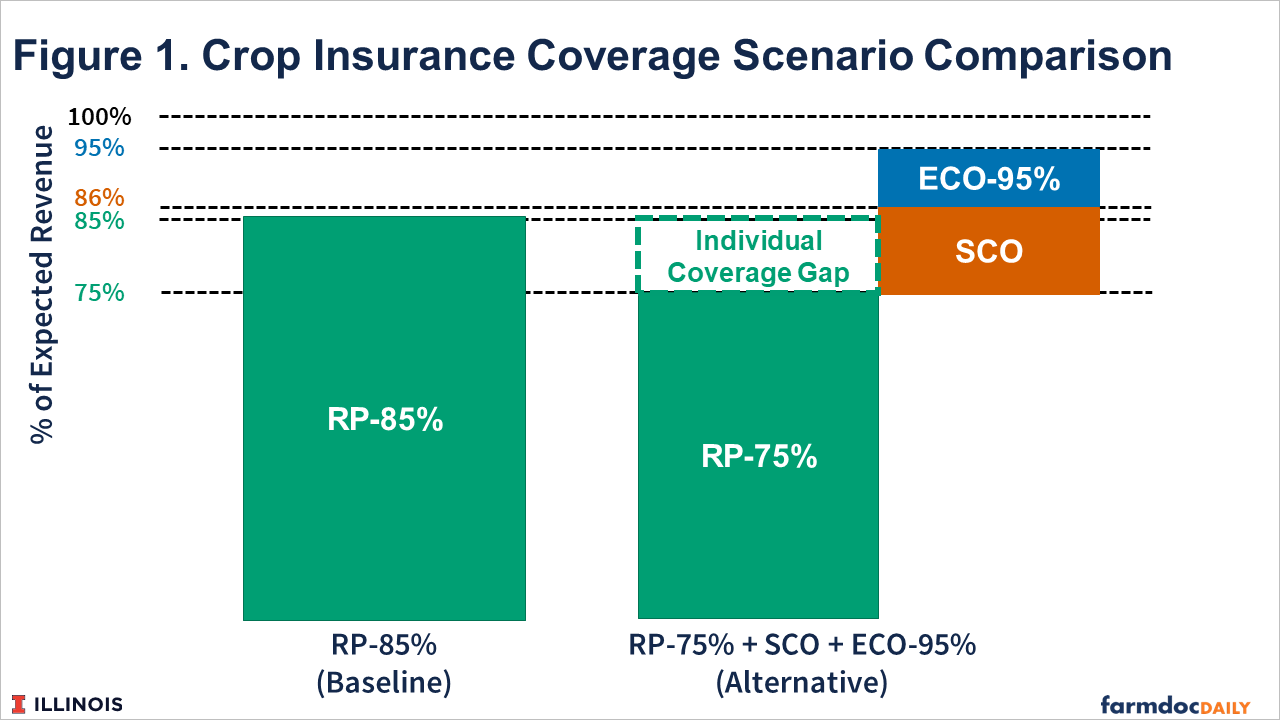
The coverage provided by two crop insurance scenarios is illustrated in Figure 1. The RP-85% baseline covers losses for situations where actual farm revenue falls below 85% of the expected farm revenue guarantee. This is the maximum coverage level available for farm-level protection in the federal crop insurance program and basis risk is minimal. The RP-75%+SCO+ECO-95% alternative covers losses for situations where actual farm revenue falls below 75% of the expected farm revenue guarantee while SCO and ECO supplement the underlying coverage by protecting against losses where actual county revenues fall below 95% of the county’s expected revenue. The SCO and ECO coverage is capped, covering county-based losses up to 20% for this scenario (from 95% down to 75%), with the county loss percentage being applied to the farm’s liability to determine the payment.
While RP-75%+SCO+ECO-95% may appear to provide 95% coverage, county losses do not always match farm losses. Specifically, individual farm losses that RP-85% covers in the 85% to 75% range are not guaranteed to be covered by SCO – this is labeled as the “Individual Coverage Gap” in Figure 1.
Previous farmdoc daily articles have shown that RP-75%+SCO+ECO-95% typically has these benefits when compared to RP-85%:
- Similar to slightly lower farmer premiums;
- Significant increases in expected net benefits (expected indemnities net of farmer premium);
- Improved downside risk protection (higher revenues in the 5% worst outcomes).
This strategy also has some drawbacks. For example, lowering RP coverage will reduce prevent plant payments if prevent plant occurs. Producers with insurance units in areas at high risk of prevent plant will likely have less interest in trading lower farm-level coverage for supplemental area coverage. The timing of payments is also an issue that is commonly raised. Loss payments for farm-level coverage can often be received relatively soon after harvest while indemnities from the supplemental area plans will not be available until June of the next crop year.
In addition, basis risk is introduced when trading some farm-level coverage for area-based coverage. There are outcomes where RP-85% would provide greater loss coverage (i.e. larger indemnity payments) than the RP-75%+SCO+ECO-95% alternative. In these situations, the county-based coverage does not fully offset the value of the farm-level loss experienced within the “Individual Coverage Gap” band and the producer may feel “regret” for choosing lower RP coverage and supplementing with SCO and ECO.
Estimating the Probability of Regret
Using the same model that the farmdoc Crop Insurance Evaluator tools is based on, we estimated this probability of regret across all counties in Illinois for both corn and soybeans. The estimates are based on representative farms in each county using Enterprise Units. The probability of regret represents the percentage of simulated scenarios where RP-85% would result in greater support than RP-75%+SCO+ECO-95%. Table 1 summarizes average probabilities of regret across the counties in each of the three regions in Illinois as well as for the entire state. The average farmer premium and expected net benefit differences are also included in Table 1.

For corn in Northern and Central Illinois, RP-75%+SCO+ECO-95% has a nearly $2 per acre lower farmer premium, on average, than the RP-85% baseline. In Southern Illinois the premium difference is even larger with RP-75%+SCO+ECO-95% having a farmer premium that is more than $8 per acre cheaper, on average. The average increase in net benefits (expected indemnities less farmer premium) exceeds $33 per acre in Northern Illinois, $35 per acre in Central Illinois, and $38 in Southern Illinois. These results are driven by the increase in overall subsidy rate for the alternative coverage scenario compared with the RP-85% baseline, and the higher likelihood of payments being triggered given the higher overall coverage level for the RP-75%+SCO+ECO-95% alternative.
The average probability of regret across counties in Northern Illinois for corn is 4.4% and increases to 5.4% in Central Illinois. These likelihoods equate to a roughly 1-in-20 chance of RP-85% triggering a larger indemnity payment than RP-75%+SCO+ECO-95%, since premiums are similar. The average probability of regret increases to 8.9% in Southern Illinois, or about a 1-in-10 chance of RP-85% triggering a larger indemnity payment.
For soybeans, the premium savings for RP-75%+SCO+ECO-95% averages $2.58 per acre in Northern Illinois, $0.82 per acre in Central Illinois, and $5.58 per acre in Southern Illinois. Expected net benefits for RP-75%+SCO+ECO-95% are $17.49 higher in Northern Illinois, $15.51 higher in Central Illinois, and $18.84 higher in Southern Illinois. The average probability of regret ranges from 4.4% in central Illinois to 8% in Southern Illinois, with Northern Illinois falling between these two values at 6.6%.
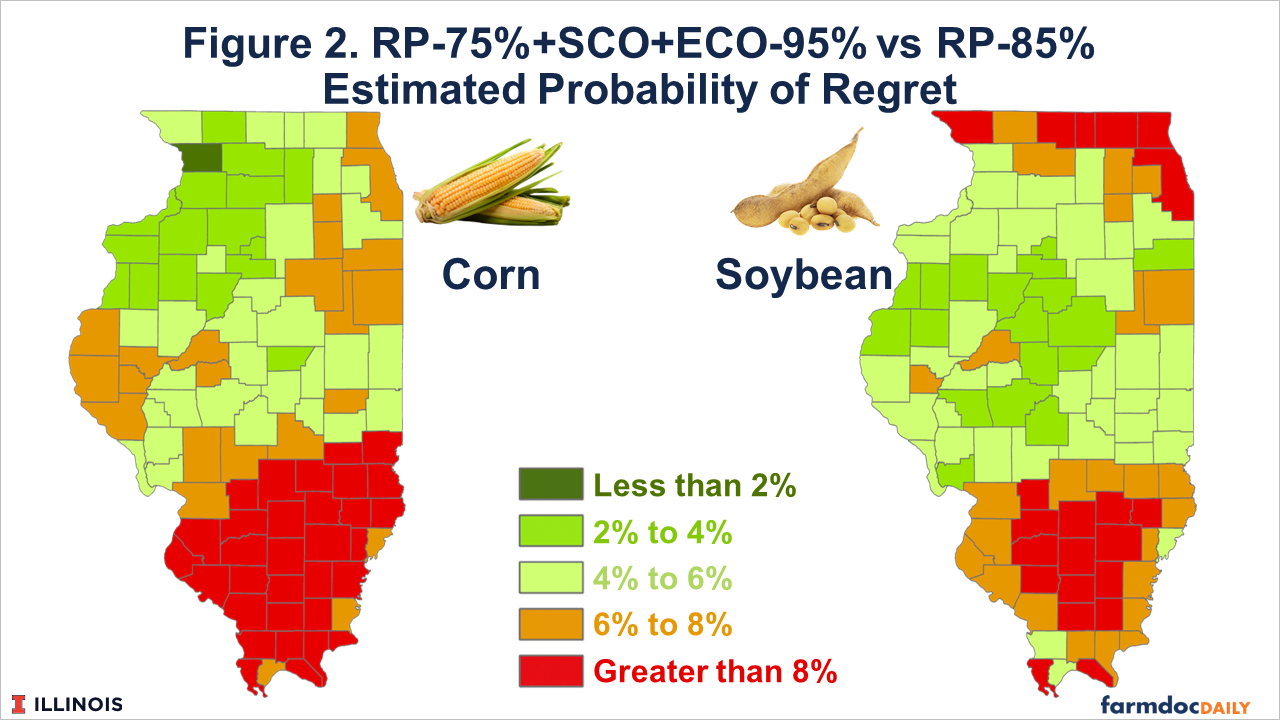
The maps in Figure 2 illustrate how the estimated probability of regret varies across Illinois counties, with higher probabilities of regret, generally exceeding 8%, occurring in counties in the Southern third of Illinois. The upper two thirds of Illinois are generally associated with estimated probabilities of regret that do not exceed 8% with many counties having values below 4%, particularly for corn in Northern Illinois and soybeans in Central Illinois.
Regret outcomes only occur 5-10% of the time but can result in fairly large differences in indemnity payments between the RP-85% baseline and the RP-75%+SCO+ECO-95% alternative. For regret outcomes, or outcomes where RP-85% results in a larger payment, the average difference between RP-85% and RP-75%+SCO+ECO-95% indemnities is $38 per acre for corn and $26 per acre for soybeans.
The extreme case would be a situation where farm-level losses occur but no losses are triggered at the county level. While highly unlikely, the indemnity payment differences between RP-85% and RP-75% in these extremes could be as large as 10% of the farm’s revenue guarantee. For corn, this could exceed $100 per acre in many parts of Illinois based on the 2026 projected price of $4.62 and typical APH yields (0.10 x $4.62 x 225 bu/acre = $104 per acre). For soybeans, this could exceed $75 per acre (0.10 x $11.09 x 70 bu/acre = $78 per acre).
Whether these probabilities and potential payment differences cause great enough concern to outweigh the benefits provided by the alternative coverage compared with RP-85% is something that individual producers will need to weigh in their crop insurance decisions for 2026. Basis risk can be reduced by using higher coverage levels for the underlying product (i.e. RP-80% or RP-85%) but the producer will pay higher total premium costs if either or both SCO and ECO are added.
Summary
Increases in subsidy rates have generated additional interest in the potential use of the SCO and ECO insurance programs in 2026. One alternative of particular interest has been combining lower underlying farm-level coverage with the use of SCO and ECO. A common application of this strategy would be to lower RP coverage from 85% to 75% and then add SCO and ECO-95%. For most counties in Illinois this will result in a lower overall premium cost for the farmer (compared with RP-85%), a significant increase in expected net benefits (expected indemnities less farmer premium) and improved downside risk protection. In other words, in the majority of outcomes the farmer will be better off with RP-75%+SCO+ECO-95% than with RP-85%.
However, there will be possible outcomes where this alternative will provide smaller indemnity payments to cover losses than the higher RP coverage baseline, resulting in the farmer regretting this decision. The likelihood of this occurring varies around 5% for corn and soybeans in Northern and Central Illinois and 8% in Southern Illinois. Whether the tradeoff between better expected performance and the risk of regret is worth it will vary across individual producers.
References
Schnitkey, G., N. Paulson, C. Zulauf, H. Monaco and B. Sherrick. "SCO and ECO Choices in 2026." farmdoc daily (16):16, Department of Agricultural and Consumer Economics, University of Illinois at Urbana-Champaign, February 3, 2026.
Monaco, H., G. Schnitkey, N. Paulson, J. Coppess, B. Sherrick, C. Zulauf, C. Navarro, P. Shan and L. Fu. "Release of Insurance Evaluator with the New SCO and ECO." farmdoc daily (16):21, Department of Agricultural and Consumer Economics, University of Illinois at Urbana-Champaign, February 10, 2026.
Paulson, N., G. Schnitkey, H. Monaco and C. Zulauf. "Comparing Crop Insurance Scenarios with SCO and ECO for 2026." farmdoc daily (16):25, Department of Agricultural and Consumer Economics, University of Illinois at Urbana-Champaign, February 17, 2026.
Monaco, H., G. Schnitkey, N. Paulson, B. Sherrick and C. Zulauf. "Revisiting the Basis Risk when evaluating SCO and ECO." farmdoc daily (16):27, Department of Agricultural and Consumer Economics, University of Illinois at Urbana-Champaign, February 19, 2026.
Schnitkey, G., N. Paulson, C. Zulauf and H. Monaco. "Common Questions on SCO and ECO." farmdoc daily (16):30, Department of Agricultural and Consumer Economics, University of Illinois at Urbana-Champaign, February 24, 2026.
Disclaimer: We request all readers, electronic media and others follow our citation guidelines when re-posting articles from farmdoc daily. Guidelines are available here. The farmdoc daily website falls under University of Illinois copyright and intellectual property rights. For a detailed statement, please see the University of Illinois Copyright Information and Policies here.