








Rewriting the RFS Playbook: Final 2026-2027 RVOs for Biomass-Based Diesel
On March 27th the U.S. Environmental Protection Agency (EPA) released the long-awaited final rule establishing Renewable Volume Obligations (RVOs) under the Renewable Fuel Standard (RFS) for 2026 and 2027. This rule—commonly referred to as the “Set 2” rule—represents the culmination of a series of pivotal EPA decisions about the implementation of the RVOs over the last year. Collectively, these decisions will set the trajectory of the U.S. biomass-based diesel industry for the next several years, and perhaps longer. In recent months, we analyzed proposed and anticipated RVO levels in a series of farmdoc daily articles (October 29, 2025; November 5, 2025; November 12, 2025; November 24, 2025; February 25, 2026). The final rule delivers biomass-based diesel volume requirements close to but somewhat above our most recent projections, confirms the delay—rather than elimination—of the half-RIN import penalty until 2028 or later, and adopts 70 percent reallocation of 2023–2025 small refinery exemptions (SREs). The purpose of this article is to review the final RVOs and compare them to our most recent projections.
Analysis
We begin with an overview of the final RVOs presented in Table 1. Panel A shows the final applicable volumes in billions of RIN gallons and Panel B expresses these as percentage standards. Notably, this is the first time that the EPA issued a final RVO rulemaking with all categories expressed in RIN gallons. Previously, the biomass-based diesel RVO was stated in physical gallons. To place biofuels on a comparable footing when implementing compliance standards, the EPA assigns to each biofuel an energy-equivalence value relative to a gallon of ethanol (farmdoc daily, May 17, 2023). For example, a physical gallon of FAME biodiesel has about 150 percent of the energy content of a gallon of ethanol, so the equivalence value for biodiesel is 1.5, and one physical gallon of biodiesel generates 1.5 RIN gallons. In the past, the other major type of biomass-based diesel, renewable diesel, had an equivalence value of 1.6 or 1.7. In the Set 2 rulemaking the equivalence value for renewable diesel was lowered to 1.5, the same as biodiesel, starting in 2027. Renewable diesel producers may petition the EPA to increase their equivalence value to 1.6. As a rule-of-thumb, the biomass-based diesel RVOs shown in Table 1 can be converted to physical gallons by dividing through by 1.6.
Table 1 shows that the total volume requirement stands at 25.82 and 25.98 billion RIN gallons for 2026 and 2027, respectively. The volume added to the RVOs by SRE reallocation for 2023-2025 is also presented in Table 1. This reflects SREs awarded for 2023 and projected for 2024 and 2025. In the EPA’s September 2025 reallocation policy framework, the EPA indicated it was considering 50 or 100 percent reallocation of 2023-2025 SREs in the final RVO rulemaking. The EPA settled on 70 percent reallocation for the final Set 2 rule. This added about one billion gallons of volume to the total RVOs for 2026 and 2027. Projected SREs for 2026 and 2027 are fully reallocated within each compliance year. The final applicable volumes for 2026 and 2027 are 26.81 and 27.02 billion gallons, respectively. Compared to the 2025 total RVO of 22.61 billion gallons, the 2026 and 2027 totals increase slightly less than 20 percent.
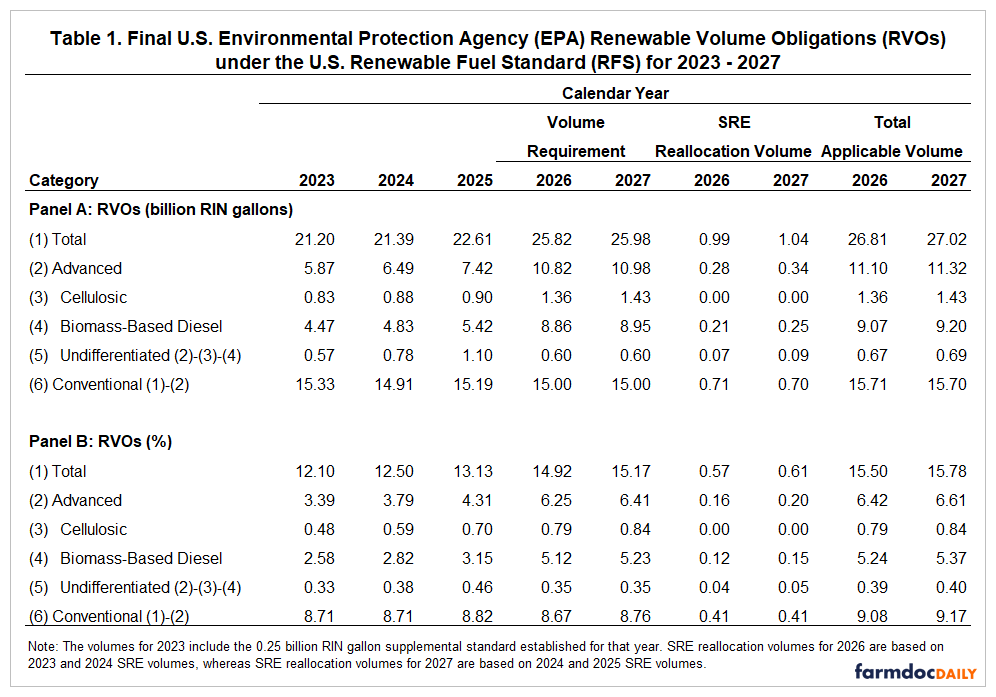
The biomass-based diesel volume requirement of 8.86 billion RIN gallons for 2026 and 8.95 billion RIN gallons for 2027, when combined with SRE reallocation, yields total applicable biomass-based diesel volumes of 9.07 billion and 9.20 billion RIN gallons. The conventional renewable fuel (D6) volume requirement is set at 15.00 billion RIN gallons in both 2026 and 2027, though the total applicable D6 obligation rises to 15.71 and 15.70 billion RIN gallons after SRE reallocation, a point with significant implications for biomass-based diesel that we will explore in a future article.
In our February 25th farmdoc daily article, we projected biomass-based diesel volumes of 5.25 and 5.61 billion physical gallons for 2026 and 2027, respectively. Taking an average of the 100 and 50 percent reallocation scenarios we considered, this converts to 8.63 and 9.24 billion RIN gallons. The final rule came in modestly above the average projection for 2026 and nearly the same for 2027. Hence, the final RVOs largely confirmed our projections, with a modest overshoot relative to our February estimate for 2026. This possibly reflects a slightly more aggressive volume stance by the EPA to compensate for the decision to delay the controversial half-RIN provision included in the June 2025 preliminary Set 2 rulemaking. Market participants should take note that the EPA indicated in the press release announcing the final rulemaking that it intends to implement the half-RIN import penalty starting in 2028.
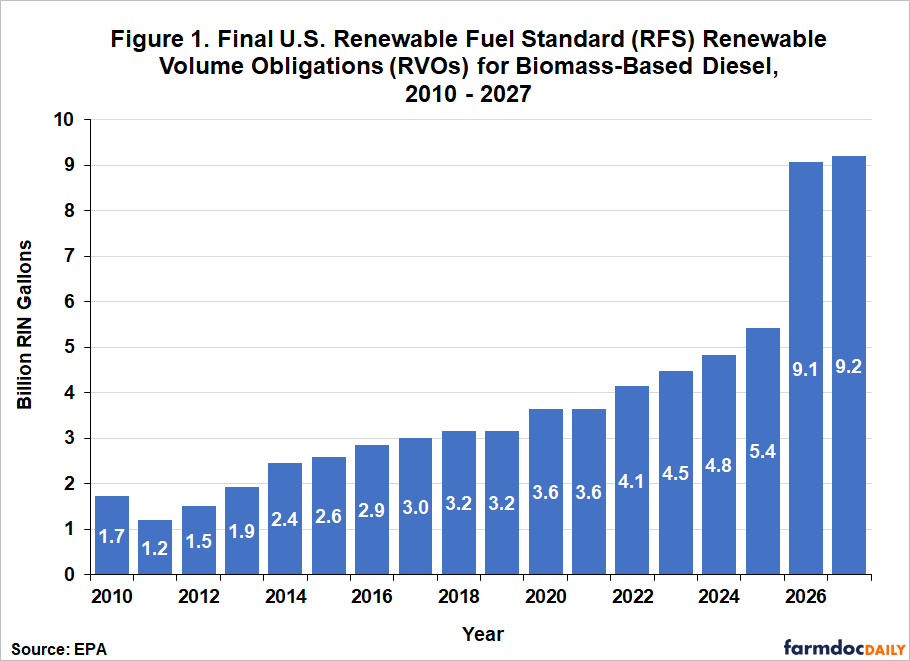
A long-term perspective on the increases in biomass-based diesel under Set 2 is provided by Figure 1, which shows the final RVOs in RIN gallons over 2010 through 2027. It is obvious based on Figure 1 that the increase in biomass-based diesel RVOs for 2026 and 2027 is unprecedented in the history of the RFS. The RVOs for these last two years jump by 67 and 70 percent, respectively, compared to the 2025 total of 5.42 billion gallons. Previously, the largest year-over-year increase in the biomass-based diesel RVO was in 2013, when the RVO increased by 28 percent. The largest previous year-over-year increase in the RVO in absolute terms was 600 million gallons in 2025. In all other years the growth was less than 500 million gallons. By comparison, the 2026 and 2027 biomass-based diesel RVOs are set to grow by 3.65 and 3.78 billion RIN gallons compared to 2025.
While the RVOs presented in Table 1 for 2026 and 2027 are final in a regulatory sense, actual compliance volumes of obligated parties may vary from the volumes in Table 1 for two important reasons. First, the volume of SREs awarded by the EPA may differ from those projected in the final rulemaking for 2026 and 2027 (and 2024 and 2025 as well). If the volume of SREs turns out to be higher than the EPA projection of 7.55 billion gallons this will reduce the RVOs in volume terms because the percentage standards shown in Table 1 are fixed from this point forward. Second, the actual volume of obligated petroleum and diesel for 2026 and 2027 may differ from that projected by the EPA. However, if the volume of obligated gasoline and diesel is higher than the EPA projection this will increase the RVOs in volume terms. The volume uncertainty introduced by these two factors is not expected to be large, but it is something that should be monitored when tracking the market impacts of the 2026 and 2027 RVOs.
Implications
The EPA’s final Set 2 rule delivers total applicable biomass-based diesel volumes of 9.07 billion RIN gallons in 2026 and 9.20 billion in 2027—the largest in the history of the RFS and nearly 70 percent above the 2025 applicable volume of 5.42 billion RIN gallons. To put those numbers in historical perspective, the biomass-based diesel category has never been asked to grow by more than a few hundred million gallons in a single year. Now the industry faces a ramp-up of over three billion RIN gallons in each of the next two years. The sheer magnitude of this obligation makes the implementation of the final rule unlike anything the biomass-based diesel sector has previously confronted. Taken together, the final Set 2 rule has set in motion forces that will reshape biomass-based diesel markets, feedstock supply chains, and biofuel trade patterns for at least the next several years. These production, trade, and feedstock dynamics are the subjects we will turn to in our next several farmdoc daily articles in this series.
References
Gerveni, M., T. Hubbs and S. Irwin. "Overview of the U.S. Renewable Fuel Standard." farmdoc daily (13):90, Department of Agricultural and Consumer Economics, University of Illinois at Urbana-Champaign, May 17, 2023.
Hubbs, T. and S. Irwin. “Rewriting the RFS Playbook: Final RVOs for 2026–2027.” farmdoc daily (16):30, Department of Agricultural and Consumer Economics, University of Illinois at Urbana-Champaign, February 25, 2026.
Hubbs, T. and S. Irwin. “Rewriting the RFS Playbook: Revised RVOs Backload Projected Biomass-Based Diesel Production and Feedstock Use into 2027.” farmdoc daily (15):217, Department of Agricultural and Consumer Economics, University of Illinois at Urbana-Champaign, November 24, 2025.
Hubbs, T. and S. Irwin. “Rewriting the RFS Playbook: The Impact of Revised RVOs on Projected Biomass-Based Diesel Production and Feedstock Use for 2026–2027.” farmdoc daily (15):209, Department of Agricultural and Consumer Economics, University of Illinois at Urbana-Champaign, November 12, 2025.
Hubbs, T. and S. Irwin. “Rewriting the RFS Playbook: The Impact of Revised RVOs on Projected D4 Biomass-Based Diesel RIN Generation for 2026–2027.” farmdoc daily (15):204, Department of Agricultural and Consumer Economics, University of Illinois at Urbana-Champaign, November 5, 2025.
Hubbs, T. and S. Irwin. “Rewriting the RFS Playbook: The Impact of Recent EPA Decisions on 2023–2027 RVOs for Biomass-Based Diesel.” farmdoc daily (15):199, Department of Agricultural and Consumer Economics, University of Illinois at Urbana-Champaign, October 29, 2025.
Disclaimer: We request all readers, electronic media and others follow our citation guidelines when re-posting articles from farmdoc daily. Guidelines are available here. The farmdoc daily website falls under University of Illinois copyright and intellectual property rights. For a detailed statement, please see the University of Illinois Copyright Information and Policies here.