








Conservation & Risk, Part 2: Examining the Spring Planting Window in Illinois
Based on crop insurance, the spring planting window in Illinois for corn is 61 days for corn and soybeans, longer in the southern region and shorter in the northern third of the State (farmdoc daily, April 11, 2017; March 23, 2017; March 12, 2013). It is arguably the most critical window in the entire crop year, with the likelihood that delayed planting will result in lower yields (farmdoc daily, April 3, 2025). According to USDA, farmers in Illinois have had a total of 20.4 days (48.6%) suitable for field work in the six weeks (42 days) since the beginning of April (USDA-NASS, “Crop Progress”). To address questions of risk and conservation, we began by exploring this all-important spring planting window and this article examines the days suitable for fieldwork in that window (farmdoc daily, May 7, 2026).
Background
Based on University of Illinois research, “corn and soybean achieved 99% of the maximum yield when planted between April 10 and April 30” and that yield losses “remained relatively low through the first weeks of May 15 (94% of maximum) but increased rapidly thereafter” (farmdoc daily, April 3, 2025). Recall that a 6% yield loss would be well within the deductible range for crop insurance—losses that would not be indemnified and must be covered by the farmer. In general, wet springs create yield risk through saturated soils that can damage seedlings, increase disease pressure and reduce oxygen availability, but begins with reduced field workable days and extended planting delays due to soil moisture status, not only rainfall on a given day. Field conditions and soil moisture are the result of rainfall, temperature, and other weather conditions that combine with soil types and other field qualities (e.g., drainage, growing plants or crop residues, etc.). The functional spring window is the smaller set of days when field conditions allow equipment in the field without unacceptable agronomic risk or risks of damage to the soil (Huber et al., 2023; Urban et al., 2015).
Implementing cover crops necessarily navigates these springtime realities. Cereal rye before soybeans can provide soil cover, weed suppression, reduced erosion, reduced nutrient losses, and other conservation benefits, but many of those benefits depend on spring biomass, and biomass depends on termination timing. For all the potential benefits of the practice, cover crops add another timing-sensitive operation to an already constrained spring window. Cover crop biomass, delayed termination, stressful planting conditions, planter or equipment performance, soybean stand establishment, and planting date can interact in ways that can increase yield risk. Any risks are also conditional because cover crops can be managed without yield losses, especially when planting and establishment conditions are favorable. Cover crops may also reduce some longer-term weather-related risks and reduce prevented-planting-related crop insurance losses, including excess moisture (Kannberg et al., 2024; Silva et al., 2024; Won et al., 2024; Aglasan et al., 2024).
Discussion
Applying research to this question of risk in the spring planting window for implementing cover crops, we take a deeper dive into the days suitable for fieldwork framework. We divided the spring window into three sub-windows based on the research into impacts for soybean yields: the early window (April 1 to April 21), in which yield losses from delayed planting are likely to be minimal (0% to 2%); the middle window (April 22 to May 21), in which yield losses are more concerning (2% to 10%); and the late window (May 22 to June 20), in which yield losses (10% to 25%) move out of the deductible range for crop insurance (farmdoc daily, April 14, 2022; April 7, 2020; April 3, 2025).
To illustrate this approach, Figure 1 uses McLean County, Illinois, as an example; we examined the spring planting window not just by calendar dates, but by the days when fields are likely to be suitable for work. We used historical and simulated data to establish a preliminary benchmark for days suitable for spring fieldwork from April 1 through June 20, providing a way to compare the crop insurance window with the days when fieldwork was likely to be possible. First, the shaded bands divide the season into early, mid, and late planting sub-windows as discussed above. Second, the black line projects the probability that each day is suitable for field work in the county. This probability estimate is based on historic data and modeled simulations for the weather and soil conditions of diverse sites in the years 2008 to 2022. The simulations were developed using the ecosys model, which is a process-based model that simulates underlying biophysical and soil-water dynamics at given weather, soil, and management conditions. We applied the model simulations to estimate suitable conditions (Qin et al., 2023). Third, the dashed horizontal line marks a 60% suitability probability threshold, which we selected as a conservative marker or indicator that field conditions could reliably be considered suitable for field operations—the simulated results indicated that at least 60% of the fields in the county would be suitable for fieldwork on that day based on the weather and soil conditions. Therefore, any part of the solid line that falls below this 60% threshold suggests a historical average probability of unsuitable days as a consequence of rain, temperature or soil conditions.
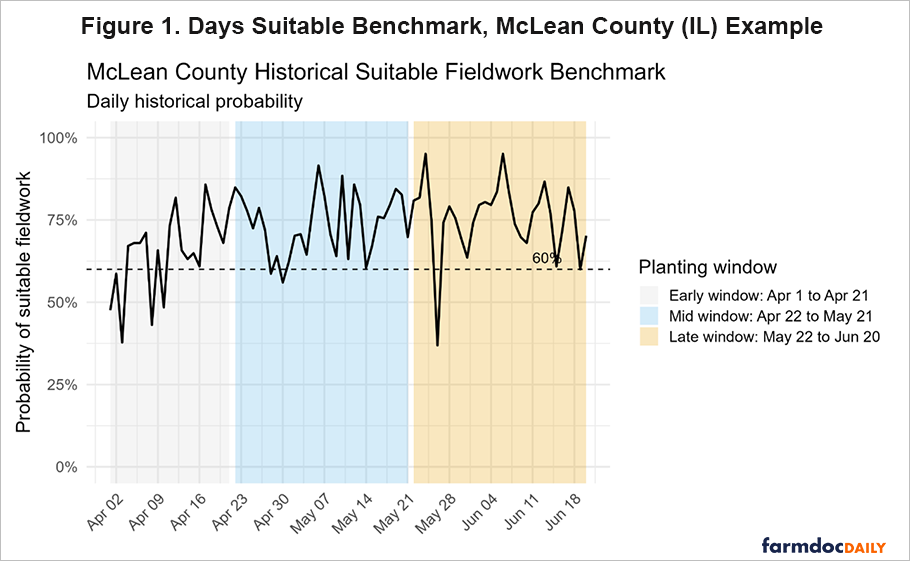
Importantly, this initial benchmark (solid line) concept demonstrates that suitable fieldwork opportunities can fluctuate from day to day within the critical planting season. Based on it, McLean County farmers could expect 16 out of 21 days to be suitable in the early window (76%), 28 out of 30 days to be suitable in the middle window (93%), and 29 out of 30 days to be suitable in the late window (97%). In general, these results suggest that McLean County farmers should expect many suitable days available across the spring window. To better understand the relative risk, however, we will need to compare benchmarks across counties or regions in future efforts. At least from this initial examination of the spring window, farmers using cover crops in McLean County have some degree of confidence that termination and planting should usually fit within the spring window. Of course, nothing is guaranteed in the spring.
To help show how different the spring window can look from year to year, Figure 2 compares daily fieldwork suitability in McLean County for 2012 and 2019, from April 1 to June 20. The dashed line is the benchmark from Figure 1, the days in the dataset (2008 to 2022) in which the model simulations estimate that at least 60% of the fields in the county would be suitable for fieldwork (marked with dotted line). Using that benchmark, the green bars illustrate our estimates of the probability that each day in the window was suitable for fieldwork in the county. The grey bars represent those days in which we estimate that fewer than 60% of the fields in the county were suitable for fieldwork. The days without any bars are those in which we estimate none of the fields in the county were suitable—days very unlikely to have been suitable for fieldwork.
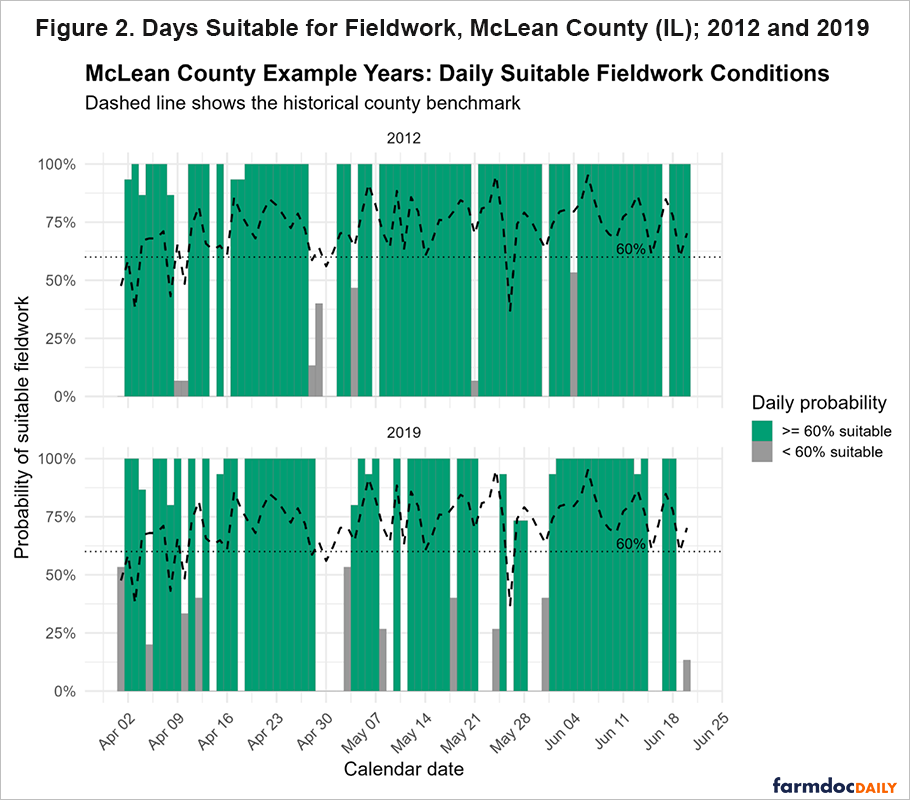
The key comparison between 2012 and 2019 may be the stretches of days suitable for fieldwork and the unsuitable periods that break up those suitable days. In 2012, suitable days were more frequent and more continuous through the middle window and into the beginning of June—farmers had multiple unbroken days to complete fieldwork. In 2019, suitable days were more limited and often separated by stretches of unsuitable conditions, especially around the transition from the middle window into the late window (May 21st). This timing matters because planting delays become more costly (likely to reduce yields within the insurance deductible range) as the season moves later. A farmer who misses a suitable day in this period may not simply lose one day of work but could lose several additional days if wet or unsuitable conditions persist—delays that could result in lower yields and losses that are not compensated by policy. This is where the risk potential for cover crops becomes clearer: when a timing-sensitive spring operation, such as termination or planting, is pushed into a year like 2019, the loss of workable days can compound quickly and increase the chance of reduced yields.
Concluding Thoughts
Standing in a field at the start of spring, a farmer cannot know how many days will be available to get all the work done, including that which results from conservation practices like cover crops. To evaluate conservation and risk, we developed an initial concept of an historical benchmark for completing spring planting and related work. We also compared two example years in one county to help put spring risk into practical terms. Farmers do not manage a fixed calendar window; they manage the workable days that weather and field conditions allow, and there are only so many days and so much work that can be completed in them. Consider that a conventional 24-row planter has the potential to allow a farmer to plant maybe 300 acres in a day—of course that would be a full day without any breaks or equipment problems. Those days are rare, while smaller planters, no-till planters, and drills plant fewer acres per hour and day (see, farmdoc, “Field Operations 2025”; June 4, 2010; March 31, 2004).
To these constraints and challenges, or risks, the figures illustrate how variable the spring window can be from year to year, as well as how much it can change throughout the season. The spring window in 2012 was favorable, most days were above the benchmark with high probabilities that the days were suitable for fieldwork. Of course, that year featured an historic drought in the summer months throughout the Midwest and caused widespread losses. The impacts of conservation practices like cover crops for resiliency in a drought remains a big research question, but one not addressed in this discussion.
An opposing perspective is clear in 2019, which was a unusually wet spring (Lee and Abatzoglou, 2023; Lawal et al., 2021). The likelihood that farmers are unable to work in the fields could stretch across multiple days; the risk isn’t just missing a day here or there but that missing one day quickly adds up to multiple missed days. Depending on the amount of rain, and the condition of the soil prior to the rain, it could take days to dry out before a field is suitable for equipment and fieldwork. This situation is arguably the key risk for a practice like cover crops. If the growing cover crop delays work, pushing planting into stretches of unsuitable days, a single missed day could result in significantly delayed planting if the weather does not cooperate. It is in this situation, we would argue, that policy should better help with losses that result.
Cover crops as a conservation practice includes weather-dependent risks; the practice may be protective over time, but costly in specific years when limited suitable fieldwork days and delayed soybean planting collide. These snapshots show why additional work is needed to better estimate when spring fieldwork risk becomes costly, how often that risk occurs, and how policy could better support conservation in dynamic weather planting years—starting points for further research and additional analytical work informative for policy design and innovation. Future articles in this series will explore additional questions, beginning with analyzing the potential costs that result from these risks and the gaps in financial support from existing policy designs.
References
Aglasan, Serkan, Roderick M. Rejesus, Stephen Hagen, and William Salas. "Cover crops, crop insurance losses, and resilience to extreme weather events." American Journal of Agricultural Economics 106, no. 4 (2024): 1410-1434. https://doi.org/10.1111/ajae.12431.
Coppess, J., K. Guan and E. J. Diaz-Vallejo. "Conservation & Risk, Part 1: Introduction and Hypothesis." farmdoc daily (16):80, Department of Agricultural and Consumer Economics, University of Illinois at Urbana-Champaign, May 7, 2026.
Fontes, G.. "Have we missed the best planting window for 2025?" Department of Crop Sciences, University of Illinois at Urbana-Champaign, April 3, 2025.
Huber I, Wang L, Hatfield JL, Hanna HM, Archontoulis SV. Modeling days suitable for fieldwork using machine learning, process-based, and rule-based models. Agricultural Systems. 2023 Mar 1;206:103603. https://doi.org/10.1016/j.agsy.2023.103603.
Irwin, S. "What Do We Know About Planting Dates and Corn and Soybean Yield from Agronomic Field Trials?" farmdoc daily (12):51, Department of Agricultural and Consumer Economics, University of Illinois at Urbana-Champaign, April 14, 2022.
Lattz, D. and G. Schnitkey. “Machinery Costs: Field Operations.” farmdoc. Department of Agricultural and Consumer Economics, University of Illinois at Urbana-Champaign, August 2025.https://farmdoc.illinois.edu/assets/management/machinery-costs/field_operations_2025.pdf.
Lawal, Afolarin, Hannah Kerner, Inbal Becker-Reshef, and Seth Meyer. "Mapping the location and extent of 2019 prevent planting acres in South Dakota using remote sensing techniques." Remote Sensing 13, no. 13 (2021): 2430. https://doi.org/10.3390/rs13132430.
Lee, Seunghyun, and John T. Abatzoglou. "Effects of water surplus on prevented planting in the US Corn Belt for corn and soybeans." Environmental Research Communications 5, no. 9 (2023): 095014. https://iopscience.iop.org/article/10.1088/2515-7620/acf919/meta.
Kannberg S, Lindsey AJ, Chiavegato MB, Lindsey LE. Effect of ultra‐early, early, and normal soybean planting dates and rye cover crop on soybean grain yield. Agronomy Journal. 2024 May;116(3):1321-30. https://doi.org/10.1002/agj2.21550.
Nafziger, E.. "Planting date for corn and soybeans in Illinois." Department of Crop Sciences, University of Illinois at Urbana-Champaign, March 23, 2017.
Nafziger, E.. "Planting corn and soybeans in 2020." Department of Crop Sciences, University of Illinois at Urbana-Champaign, April 7, 2020.
Schnitkey, G. "Early Planting and Final Planting Dates for Crop Insurance." farmdoc daily (3):47, Department of Agricultural and Consumer Economics, University of Illinois at Urbana-Champaign, March 12, 2013.
Schnitkey, G. "Earliest Planting, Final Planting Dates, and Prevented Planting Factors for Crop Insurance." farmdoc daily (7):66, Department of Agricultural and Consumer Economics, University of Illinois at Urbana-Champaign, April 11, 2017.
Schnitkey, G. “Working Field Days in Illinois.” farmdoc. Department of Agricultural and Consumer Economics, University of Illinois at Urbana-Champaign, June 4, 2010. https://farmdoc.illinois.edu/publications/working-field-days-in-illinois.
Schnitkey, G. “Planter Costs for Alternative Farm Sizes.” farmdoc. Department of Agricultural and Consumer Economics, University of Illinois at Urbana-Champaign, March 31, 2004. https://farmdoc.illinois.edu/assets/management/fefo/fefo_04_05.pdf.
Silva, Tatiane Severo, Spyridon Mourtzinis, Anthony Justin McMechan, Gabriela Inveninato Carmona, Bruce D. Potter, Kelley J. Tilmon, Louis S. Hesler et al. "Cereal rye cover crop termination at or before soybean planting has minimal effect on soybean yield across the midwestern US." Field Crops Research 312 (2024): 109393. https://doi.org/10.1016/j.fcr.2024.109393
Urban, Daniel W., Michael J. Roberts, Wolfram Schlenker, and David B. Lobell. "The effects of extremely wet planting conditions on maize and soybean yields." Climatic Change 130, no. 2 (2015): 247-260. https://link.springer.com/article/10.1007/s10584-015-1362-x.
Won, Sunjae, Roderick M. Rejesus, Barry K. Goodwin, and Serkan Aglasan. "Understanding the effect of cover crop use on prevented planting losses." American Journal of Agricultural Economics 106, no. 2 (2024): 659-683. https://doi.org/10.1111/ajae.12396
Disclaimer: We request all readers, electronic media and others follow our citation guidelines when re-posting articles from farmdoc daily. Guidelines are available here. The farmdoc daily website falls under University of Illinois copyright and intellectual property rights. For a detailed statement, please see the University of Illinois Copyright Information and Policies here.