








Farmer Support for Crop Farmers from Federal Programs: 2015 – 2024
We document Federal support provided to crop farmers from U.S. Department of Agriculture programs. From 2015 to 2024, $15.8 billion per year was provided to U.S. farmers, with substantial year-to-year variability. Slightly over one-half of this support came from standing programs offered through the Commodity Title of the Farm Bill and crop insurance. Slightly less than one-half came through ad hoc programs. Changes made to commodity title and crop insurance programs in the One Big Beautiful Bill Act will increase potential support from those programs starting with the 2025 crop year. Whether those changes will reduce the need for future ad hoc payments, shifting the balance of total support back to standing programs, is an open question.
Farm Service Agency (FSA) Providing Farm Support
We provide a breakdown of payments provided to farmers for crop farming from 2015 to 2024, sourced from the U.S. Department of Agriculture. Payments are attributed to the crop year in which they were associated which can differ from the year in which payments are actually received. For example, payments from the Emergency Commodity Assistance Program (ECAP) were associated with 2024 but not received by farmers until 2025. Similarly, payments associated with ARC or PLC for a crop year are typically received in the following crop year.
This farmer support came either through the Farm Service Agency (FSA) in the form of commodity title and ad hoc disaster assistance, or through the Risk Management Agency (RMA) in the form of net insurance benefits. Data on FSA programs were obtained through publicly available payment files made available on FSA’s website (FSA Payment Files). Net benefits (indemnity payments less farmer-paid premiums) from crop insurance were calculated through data from RMA’s Summary of Business.
Only payments flowing to farmers are reported in this article. Not included are the administrative costs of running Federal Agencies, and the Federal funds provided to crop insurance companies for administering and operating (A&O) the crop insurance program. Also not included are programs that provided support to farmers outside the USDA, such as the Paycheck Protection Program (PPP) and the Economic Injury Disaster Loan (EIDL) program.
From 2015 to 2024, farmer support for crop farming from USDA averaged $15.8 billion per year and came through programs we placed in four categories (see Table 1):
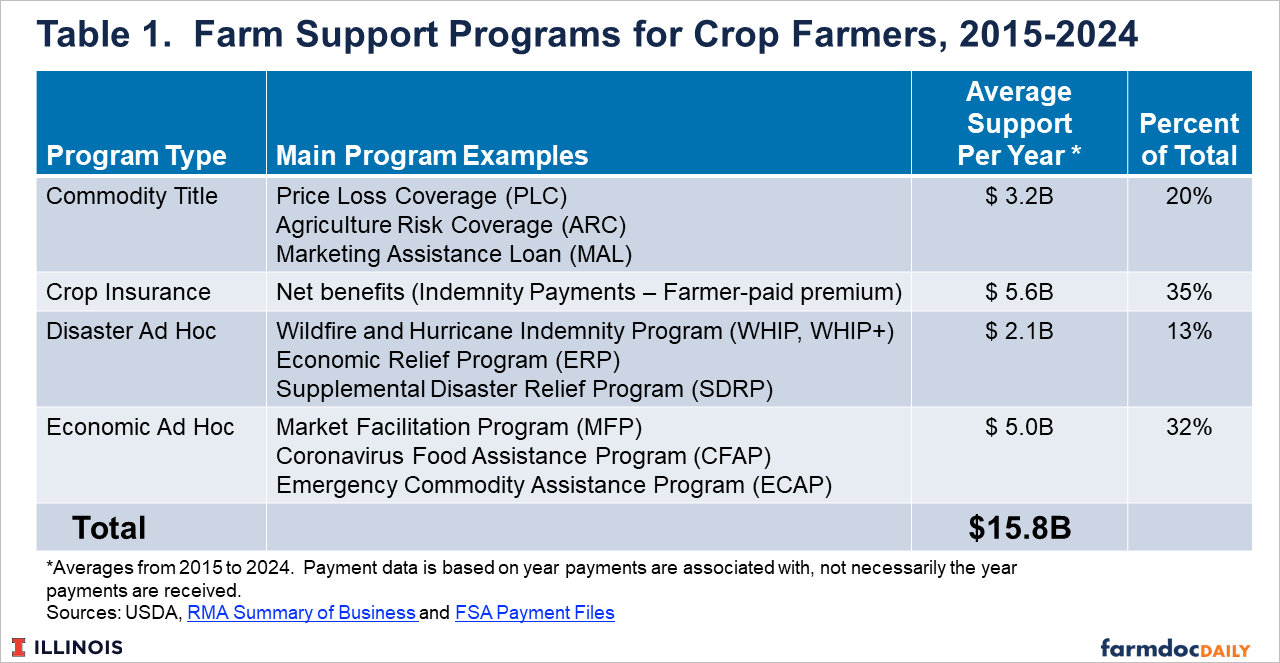
Commodity Title programs include support to all program crops offered through the Price Loss Coverage (PLC), Agriculture Risk Coverage (ARC), and Marketing Assistance Loans (MAL) programs. Over the 2014-2025 period, farmer support averaged $3.2 billion, or 19% of total program support.
Crop Insurance Programs are ongoing programs administered by the Risk Management Agency (RMA). Farmer support equals insurance payments from crop insurance minus the farmer-paid premium. Therefore, farmer support represents the amount of funding flowing to farmers above their farmer-paid premium. Over the 2015-2024 period, farmer support averaged $5.6 billion per year, or 35% of the total farmer support. Net crop insurance payments have been 75% larger than those from the farm bill’s commodity title programs.
Disaster Ad Hoc Programs are not standing programs but are instituted to provide relief in the event of losses caused by natural disasters (i.e. hurricanes, wildfires, derechos, etc.). Some level of natural disaster assistance has been authorized for each year since 2017. Programs used to distribute disaster ad hoc payments include: the Wildfire and Hurricane Indemnity Program (WHIP), WHIP+, the Economic Relief Program (ERP), and the Supplemental Disaster Relief Program (SDRP). These programs have provided funding for a range of natural disasters, with many designed to incorporate regional disaster declarations and farmers’ crop insurance decisions in calculating payments received.
Disaster ad hoc program payments have averaged $2.1. billion per year, or 13% of total support. The consistent authorization of disaster programs since 2017 raises questions and concerns over whether farmers now expect these types of payments to persist into the future (see farmdoc daily articles from June 7, 2022 and June 14, 2022).
Economic Ad Hoc programs are not standing programs but are instituted to provide relief from identified economic issues. Examples of Ad Hoc economic assistance programs have included:
- Market Facilitation Program (MFPs). MFP payments were made for the 2018 and 2019 crop years and were intended to provide financial assistance to those who suffered economic damage from lost export sales due to international trade disputes.
- Coronavirus Food Assistance Program (CFAP). CFAP payments were intended to compensate for market disruptions associated with the COVID-19 pandemic. CFAP payments were associated with 2020.
- Emergency Commodity Assistance Program (ECAP). ECAP was authorized in the American Relief Act to mitigate losses from high input costs and falling commodity prices. ECAP payments were associated with the 2024.
Overall, economic ad hoc programs were associated with only four years: 2018, 2019, 2020, and 2024. However, over the entire ten-year period from 2015 to 2024, economic ad hoc payments averaged $5.0 billion, or 32% of farmer support. Overall, ad hoc economic programs provided a large amount of support, and their payments magnitude could continue into the future. In 2025, for example, the Farmer Bridge Assistance (FBA) program made another round of economic ad hoc disaster assistance (see farmdoc daily article from January 6, 2026).
Yearly Farmer Support
While annual support across the four categories of programs discussed in this article have averaged $15.8 billion, farmer support has varied by year (see Figure 1). The highest level of program support across these four categories was associated with 2019 and 2020, when $29 billion was provided. In 2019, much of this was economic ad hoc assistance in the form of MFPs. In 2020, much of it was ad hoc economic disaster assistance in the form of pandemic-related (CFAP) payments. The lowest years in terms of total support were in 2017 ($6 billion across commodity title, crop insurance, and disaster assistance) and 2016 ($7.4 billion mainly from commodity title payments).
Several items to note in Figure 1:
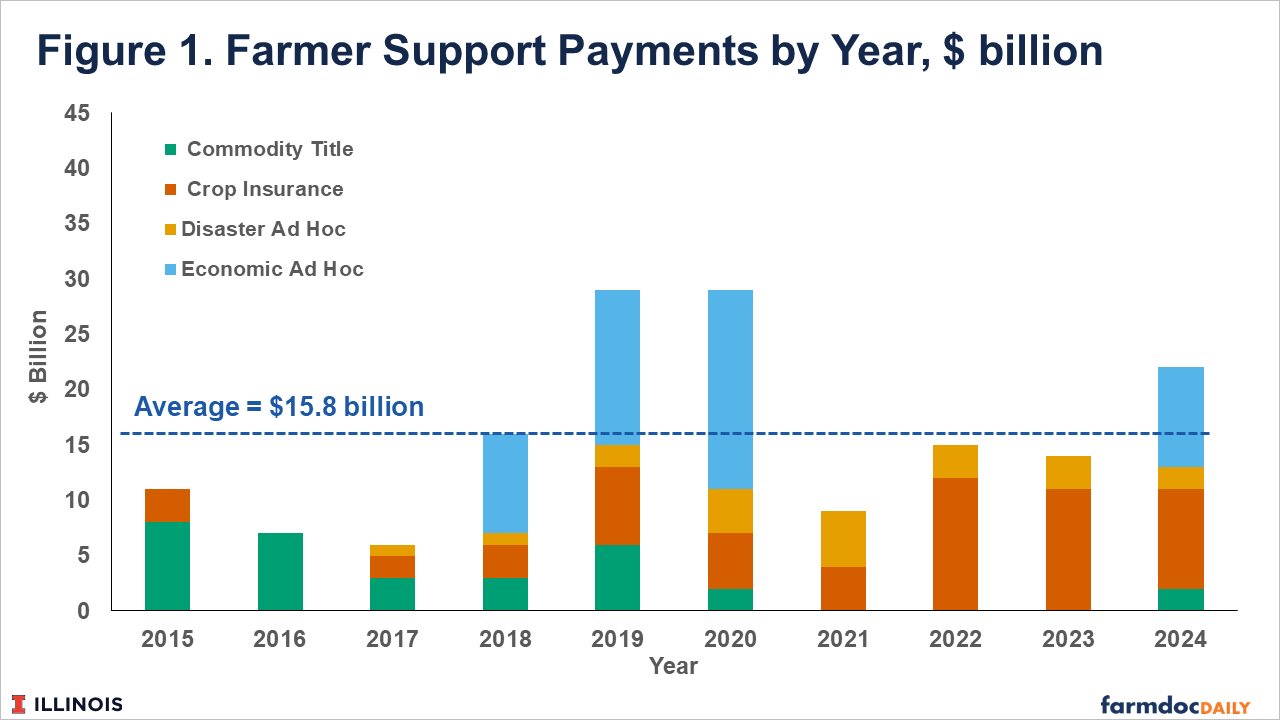
- Commodity Title payments triggered the largest levels of support in 2015 and 2016 and then began to decline. Commodity Title payments were very low from 2021 through 2023 and then increased again in 2024. By design, the annual variation in commodity title payments tends to follow variation in commodity prices with larger payments occurring following multi-year price declines.
- Also by design, net crop insurance support will vary through time based on yield and price experience. In general, net crop insurance support increased over the 10-year period covered in this article. Average net crop insurance payments averaged $2 billion per year from 2015 to 2018, $5 billion from 2019 to 2021, and $11 billion from 2022 to 2024. Of the four program categories, crop insurance has provided the most support to crop farmers.
- Disaster ad hoc programs have provided the smallest share of the four categories of payments considered here. Disaster assistance has been triggered consistently each year since 2017, averaging $2.7 billon per year from 2017 through 2024.
- Economic ad hoc programs have been a relatively new mode of support and have provided the largest share of total payments over the 10 years from 2015 to 2024. Payments from economic ad hoc programs have also been the most variable with large amounts of support associated with 2018 through 2020 (MFP and CFAP) and again in 2024 (ECAP). While not included here, another large round of economic ad hoc assistance was provided for the 2025 year through the Farmer Bridge Assistance (FBA) program (see farmdoc daily article from January 6, 2026).
Commentary
Farmer support has been substantial over the ten-year period from 2015 to 2024. About half of this support has come from ad hoc programs, either focused on losses associated with natural disasters and especially with broader economic issues. The large amounts of ad hoc assistance in recent years led to discussion over the effectiveness of standing programs in the farm safety net (commodity title programs and crop insurance), which were introduced to reduce the need for ad hoc programs.
The recently passed One Big Beautiful Bill Act will increase farmer support from the Commodity Title (see farmdoc daily articles from May 21, 2024 and July 15, 2025) and from crop insurance (see farmdoc daily article from February 3, 2026). Hence, support will likely grow from the two standing programs associated with titles in the farm bill. Whether the increase from the standing programs reduces future ad hoc spending remains to be seen.
Crop insurance has continued to grow in importance for farmers as a share of the federal safety net. In many respects, recent additions and modifications to crop insurance has moved it from being primarily a risk management program to also providing strong modes of income support. Again, changes in the OBBB Act will enhance the income support aspects of crop insurance, potentially altering the scale of distortionary impacts associated with crop insurance.
References
Paulson, N., G. Schnitkey, J. Coppess and C. Zulauf. "Farmer Bridge Assistance Program Payment Rates." farmdoc daily (16):3, Department of Agricultural and Consumer Economics, University of Illinois at Urbana-Champaign, January 6, 2026.
Schnitkey, G., N. Paulson, C. Zulauf and J. Coppess. "Impacts of the Commodity Title Changes Under the One Big Beautiful Bill Act (OBBBA) for Midwestern Farms in 2025." farmdoc daily (15):128, Department of Agricultural and Consumer Economics, University of Illinois at Urbana-Champaign, July 15, 2025.Schnitkey, G., J. Coppess, N.
Paulson, B. Sherrick and C. Zulauf. "Spending Impacts of House Proposal for Commodity Title Changes." farmdoc daily (14):96, Department of Agricultural and Consumer Economics, University of Illinois at Urbana-Champaign, May 21, 2024.
Schnitkey, G., N. Paulson, C. Zulauf, H. Monaco and B. Sherrick. "SCO and ECO Choices in 2026." farmdoc daily (16):16, Department of Agricultural and Consumer Economics, University of Illinois at Urbana-Champaign, February 3, 2026.
Swanson, K., G. Schnitkey, C. Zulauf, J. Coppess and N. Paulson. "Continued Discussion of Disaster Programs in U.S. Agriculture: Interactions with Crop Insurance." farmdoc daily (12):84, Department of Agricultural and Consumer Economics, University of Illinois at Urbana-Champaign, June 7, 2022.
Swanson, K., G. Schnitkey, C. Zulauf, J. Coppess and N. Paulson. "Continuous Disaster Aid Programs in U.S. Agriculture: A Policy Discussion." farmdoc daily (12):89, Department of Agricultural and Consumer Economics, University of Illinois at Urbana-Champaign, June 14, 2022.
Disclaimer: We request all readers, electronic media and others follow our citation guidelines when re-posting articles from farmdoc daily. Guidelines are available here. The farmdoc daily website falls under University of Illinois copyright and intellectual property rights. For a detailed statement, please see the University of Illinois Copyright Information and Policies here.